Key takeaways
- Shop air conditioning is often a split system: ceiling cassettes or concealed ceiling units where there is a ceiling void, or wall units where there is not. Our commercial air conditioning guide covers the other system types.
- An air curtain is a fan over the door. Daikin says its Biddle air curtains reduce heat loss and suit open door trading, but its percentage claims state no test method, so treat them as claims.
- On DESNZ’s small-business average of 28.59p per kWh (April to June 2026, excluding VAT), two Daikin 5 kW cassettes’ label consumption of 504 kWh a year costs £144.09. At the very small average of 38.36p it is £193.34.
- Regulation 7 says the temperature in indoor workplaces “shall be reasonable”; on a maximum, HSE says “There’s no law for maximum working temperature, or when it’s too hot to work, because every workplace is different.” HSE lists air conditioning among several steps.
- If you lease the shop, check the lease and ask your landlord before an outdoor unit goes up. In England, ask the council about planning too.
What type of air conditioning works in a shop?
It depends on the ceiling and the layout. Daikin UK’s retail page says “Concealed ceiling units blend in seamlessly with your interior and free up wall space for shelves and displays.” Its Sky Air range is “The energy efficient solution for small to medium-sized commercial locations”, with shops and boutiques among the uses it lists. Where there is no ceiling void, a wall-mounted split is the usual alternative: see split air conditioning.
Our cassette air conditioner page covers what a cassette is and what to compare. Larger shops with many zones may be offered VRF; Daikin’s retail page also lists its VRV range. See VRF air conditioning.
Can you trade with the door open?
An open door lets the cooled air out. An air curtain is a fan over the door: Daikin says the airflow of its Biddle air curtains “acts as a curtain that reduces heat loss and eliminates turbulence”, and its retail page lists “Open door trading” as a use.
Daikin makes percentage claims: “72% more efficient than standard electric models”, a reduction in heat loss of “80-85%” and air separation levels of “80-85%”. Its page gives no test conditions, method or baseline for them, so they are the maker’s claims, not savings you will get. Daikin’s payback claim is conditional on the curtain being “connected to your Daikin air conditioner”.
How big a system does a shop need?
A heat load calculation by the installer comes first; we give no rule of thumb of our own. Broughton, a maker of portable units, lists approximate heat loads for a few items: a PC about 150 W, a laser printer about 500 W, a coffee machine about 800 W and a TV or video screen about 50 W. It says an accurate cooling calculation usually needs a site visit. Shops also have lighting, shop-front glass and customers, so give the installer all of it.
Leased shops: landlord, planning and building regulations
- Lease: a lease is a private contract. Check it and ask the landlord before you order.
- Planning (England): Planning Portal says air source heat pumps on non-domestic land “are likely to require an application for planning permission”. Ask the council before you order. See air conditioning planning permission. Noise from outdoor units: see air conditioning noise rules.
- Building regulations (England): GOV.UK lists “put in a fixed air-conditioning system” among projects that may need approval, and says “You do not need to get approval yourself if you use someone registered with a competent person scheme.” The scheme list for air conditioning in buildings other than homes names BESCA, Blue Flame Certification, Certsure and NAPIT (updated 17 September 2026).
Rules in Wales, Scotland and Northern Ireland were not checked. This is general information, not legal advice.
Staff and customers in the heat
Regulation 7 of the Workplace (Health, Safety and Welfare) Regulations 1992 (England, Wales and Scotland) says “During working hours, the temperature in all workplaces inside buildings shall be reasonable.” HSE says employers must stick to health and safety law, including “keeping the temperature at a comfortable level”, and that “There’s no law for maximum working temperature, or when it’s too hot to work, because every workplace is different.” HSE’s list of ways to help includes fans, “air-cooling or air-conditioning and adequate ventilation”, shading, windows that open and cold water. See workplace temperature law.
What does shop air conditioning cost to run?
The domestic price cap does not apply to businesses, so use the unit rate on your own bill. As a guide this page uses DESNZ’s averages for April to June 2026, including Climate Change Levy and excluding VAT: 28.59p per kWh for small businesses (20 to 499 MWh a year) and 38.36p for very small ones (0 to 20 MWh). The running costs section of our commercial air conditioning guide explains the figures.
Two 5 kW cassettes. Two Daikin Round Flow FCAG60B cassettes use 504 kWh a year on the label’s 350 hours: £144.09 a year at 28.59p, or £193.34 at 38.36p. The full working, and the cost of longer hours, is on our cassette air conditioner page.
Real shops use longer hours, and a door that is often open costs more. We have not computed an air curtain’s running cost. We found no published installed price for a shop system on 25 November 2026; see commercial air conditioning installation for what drives the price.
Servicing and inspection
In Great Britain, leak checks are required from 5 tonnes CO2 equivalent (about 7.4 kg of R32): at least every 12 months, or 24 with a leak detection system. Whatever the size, GOV.UK says you must have qualifications to install, service, check for leaks, recover gases and decommission, and a company servicing equipment for others “must be certified by an approved body”. See F-gas rules.
TM44 (England and Wales): GOV.UK’s guide covers systems with an effective rated output of more than 12 kW, and units under one person’s control in one building count as one system. Two 5 kW cassettes are 10 kW nominal but 6 kW maximum cooling each on Daikin’s table, so they are close to the line: check the rating plates and ask an accredited energy assessor. See TM44 inspections.
A portable or hired unit for a short spell
For a breakdown or a short season, see commercial portable air conditioners and air conditioning hire.
How to brief an installer
- Floor plan, ceiling height and whether there is a ceiling void.
- Opening hours, customers at peak times, lighting and equipment, and how often the door is open.
- Whether you need heating as well as cooling.
- Where an outdoor unit could go, and whether your landlord and council allow it.
- Your electrical supply details.
- Ask in writing for a heat load calculation, the make, model and SEER of every unit, the F-gas company certificate number, the competent person scheme, what the price excludes, warranty and servicing terms, and the refrigerant charge.
Frequently asked questions
What type of air conditioning is best for a shop?
It depends on your ceiling and layout. Daikin’s retail page suggests concealed ceiling units to free wall space for displays; a wall split suits a shop without a ceiling void. Ask installers to justify their choice with a heat load calculation.
Can I keep the shop door open with air conditioning on?
An air curtain over the door is the usual answer; Daikin lists “Open door trading” as a use for its Biddle range. Its percentage claims come with no stated test method.
Do I need planning permission for a shop air conditioning unit?
In England, Planning Portal says air source heat pumps on non-domestic land “are likely to require an application for planning permission”, so ask the council before you order. Other nations were not checked. Check your lease and ask your landlord too.
How much does shop air conditioning cost to run?
Two 5 kW Daikin cassettes’ label consumption of 504 kWh a year costs about £144.09 at 28.59p per kWh, excluding VAT. Use your own tariff and hours.
Is there a maximum temperature for shop staff?
Regulation 7 says the temperature in indoor workplaces “shall be reasonable”; on a maximum, HSE says “There’s no law for maximum working temperature, or when it’s too hot to work, because every workplace is different.”
Does my shop need a TM44 inspection?
In England and Wales, only if the system’s effective rated output is more than 12 kW; units under one person’s control in one building are added together. Ask an accredited energy assessor if you are near the line.
Sources
- Daikin UK: Retail (checked 25 November 2026)
- Daikin UK: Biddle air curtains (checked 25 November 2026)
- Daikin UK: Sky Air (checked 25 November 2026)
- Daikin UK: FCAG-B / RZAG-B technical details (checked 25 November 2026)
- Broughton: MCe9.0 and range details (checked 25 November 2026; on 28 November 2026 the address opened Broughton’s category page, not the product page)
- HSE: Temperature in the workplace (updated 3 November 2026) (checked 27 November 2026)
- HSE: Managing workplace temperature (checked 25 November 2026)
- legislation.gov.uk: Workplace (Health, Safety and Welfare) Regulations 1992, regulation 7 (checked 25 November 2026)
- Planning Portal: Heat pumps, non-domestic (England) (checked 25 November 2026)
- GOV.UK: Building regulations approval, when you need approval (checked 25 November 2026)
- GOV.UK: Competent person schemes, current schemes (updated 17 September 2026) (checked 25 November 2026)
- GOV.UK: Air conditioning inspections for buildings, a guide (updated 5 November 2026) (checked 25 November 2026)
- GOV.UK: Checking F gas equipment for leaks (checked 25 November 2026)
- DESNZ: Gas and electricity prices in the non-domestic sector (updated 29 September 2026); table file, sheet 3.4.2 (incl CCL), 2026 quarter 2 (figures as read from the file on 25 November 2026 for this cluster’s pillar; the page itself could not show them when we re-opened it)
- GOV.UK: Qualifications to work with F gas (updated 3 March 2026) (checked 25 November 2026)
- GOV.UK: Certification for companies working on equipment containing F gas (checked 25 November 2026)
Products on this page
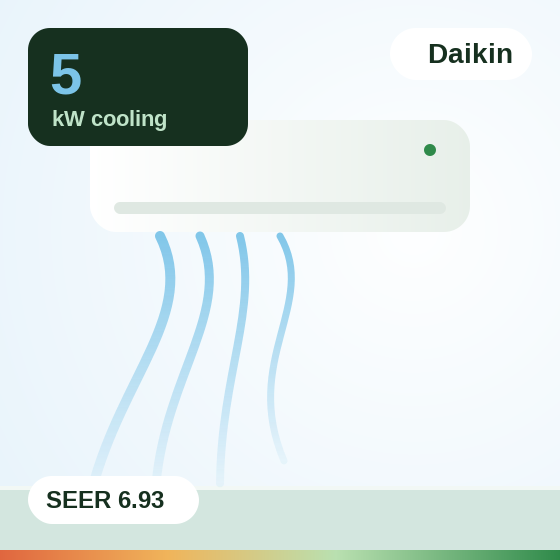
Daikin
Round Flow cassette FCAG60BVEB with Sky Air RZAG50B5V1B outdoor unit
5 kW cooling · SEER 6.93
No current UK price found
Figures from the maker or retailer listing. Cost an hour is our own, at the price cap of 26.32p a kWh.