Key takeaways
- Commercial air conditioning installation starts with a heat load survey and permissions, not with a price. We searched for a published installed price for a commercial split, cassette or VRF system on 25 November 2026 and found none; our commercial air conditioning guide covers the system types.
- Installing, servicing and leak checking must be done by qualified technicians working for an F-gas certified company in Great Britain. Ask for the certificate number.
- In England, GOV.UK says you do not need to apply for building regulations approval yourself if you use someone registered with a competent person scheme. Planning Portal says air source heat pumps on non-domestic land “are likely to require an application for planning permission”.
- The domestic price cap does not apply to businesses. The same 252 kWh label figure for a Daikin 5 kW cassette costs £66.33 at the domestic cap, £72.04 at DESNZ’s small-business average and £96.67 at its very small average, all excluding VAT.
What should happen before the quote?
- A heat load survey. Broughton, a maker of portable units, says an accurate cooling calculation usually requires a site visit. Ask each installer for a calculation for each area, not a rule of thumb.
- Landlord consent. A lease is a private contract: check it and ask your landlord before you order, especially for an outdoor unit.
- Planning (England). Planning Portal says “installations of air source heat pumps on non-domestic land are likely to require an application for planning permission”, and says its guidance “relates to the planning regime for England”. Ask the council before you order. See air conditioning planning permission.
- Building regulations (England). GOV.UK lists “put in a fixed air-conditioning system” among projects that may need approval. For mechanical ventilation and air-conditioning systems in buildings other than homes, the schemes named (updated 17 September 2026) are BESCA, Blue Flame Certification, Certsure and NAPIT. See air conditioning and building regulations.
Rules in Wales, Scotland and Northern Ireland were not confirmed. This is general information, not legal advice.
What does the installer do?
The sequence differs by job, but a commercial split or cassette installation covers these stages. This is our summary of the work, not a standard:
- Siting the outdoor unit and getting equipment to it.
- Routing refrigerant pipes and cables through ceiling voids and risers.
- Fitting indoor units and a drain for the condensate (Daikin’s FCAG-B cassette has a “Standard drain pump with 675mm lift”).
- Making the electrical connection and fitting controls.
- Leak testing, commissioning and handover.
What about working in an occupied building?
We found no published figures on how long an installation takes or what out-of-hours working costs. Ask each installer about: working out of hours, protecting furniture and stock from dust, making good ceilings, and removing old equipment. Old equipment’s refrigerant must be recovered by someone with F-gas qualifications; GOV.UK lists recovering gases and decommissioning among the activities needing qualifications.
What does it cost?
No published commercial installed prices
We searched on 25 November 2026 and found none from an installer’s own page. We will not give a typical figure, because we could not trace one to a provider’s published price. Be wary of figures quoted without a source.
What drives the price
System type and capacity; the number and type of indoor units; pipe and cable lengths and routes; the outdoor unit’s location and access (roof work, a crane); the electrical supply; condensate drainage; controls and any link to a building management system; fresh air ventilation; planning and building regulations paperwork; out-of-hours working; making good; removing old plant; commissioning and handover documents; and VAT.
Equipment prices exist, but only for certified buyers
Hawco lists a Haier 5 kW cassette indoor unit at £765 “excl. tax” (checked 27 November 2026; the listing showed no reduced price or “was” price, and said “2 available online”). Its page says “Sales of all air conditioning units will require a valid FGAS certificate”, and that certificates must be issued by Refcom, Quidos or Veritas. That is equipment only, an indoor unit without the outdoor unit; it is not an installed price.
Home figures are not a guide
Our air conditioning installation cost page covers homes. Those figures do not carry over to business premises: scale, access, ceilings and paperwork differ. See also how to get and compare quotes.
VAT, and tax relief
HMRC’s Notice 708/6 says “The relief for energy-saving materials applies to installations in residential accommodation”, and extends to buildings intended for use solely for a relevant charitable purpose. An office or shop is neither, so our reading is that a business installation pays 20% VAT. Ask your accountant how VAT applies to you.
For tax, HMRC’s Capital Allowances Manual lists “a powered system of ventilation, air cooling or air purification” among integral features, and GOV.UK says “The AIA amount is £1 million” and “You can claim AIA on most plant and machinery up to the AIA amount.” Ask your accountant how your system is treated; we compute no tax figure. See VAT on air conditioning.
Running costs: why the domestic cap does not apply
The domestic price cap does not apply to businesses, so use the unit rate on your own bill. As a guide this page uses DESNZ’s averages for April to June 2026, including Climate Change Levy and excluding VAT: 28.59p per kWh for small businesses (20 to 499 MWh a year) and 38.36p for very small ones (0 to 20 MWh). The running costs section of our commercial air conditioning guide explains the figures.
Our arithmetic for one 5 kW cassette. Daikin’s table gives the Round Flow FCAG60B with the RZAG50B outdoor unit an annual cooling consumption of 252 kWh, worked out on 350 hours of cooling a year.
| Rate | Price per kWh | 252 kWh a year |
|---|---|---|
| Domestic price cap, for comparison only (Great Britain, 1 October to 31 December 2026) | 26.32p | £66.33 |
| DESNZ small business average | 28.59p | £72.04 |
| DESNZ very small business average | 38.36p | £96.67 |
A business does not pay the domestic cap rate. If VAT at 20% applies to your supply and you cannot recover it, add it: £86.45 and £116.00 for the two business rates (our arithmetic; ask your accountant how VAT applies to you).
What paperwork should you get?
- F-gas records. Article 6 of the F-gas Regulation as it applies in Great Britain says operators keep records “for at least five years”, including the quantity and type of F gas installed, quantities added or recovered, the identity of the undertaking that installed or serviced the equipment, and the dates and results of leak checks. Ask the installer for the refrigerant type and charge.
- Commissioning sheets, warranty and service terms.
- Building regulations evidence from the competent person scheme, in England.
- The system’s rating plate details for any TM44 inspection.
What happens after installation?
In England and Wales, a system with an effective rated output of more than 12 kW needs a first TM44 inspection within five years of going into service. GOV.UK’s guide says units under one person’s control in one building are treated as one system. See TM44 inspections. In Great Britain, leak checks start at 5 tonnes CO2 equivalent (about 7.4 kg of R32): at least every 12 months, or 24 with a leak detection system. See F-gas rules, HVAC maintenance and choosing an HVAC company.
See also HVAC installation, which covers whole projects with ductwork and ventilation, cassette air conditioning units and office air conditioning. For homes, see air conditioning installation.
How to brief an installer
- Floor plans, ceiling heights and ceiling voids.
- People, equipment and hours of use in each room, and which rooms need heating too.
- Where an outdoor unit could go, and whether your landlord and the council allow it.
- Your electrical supply details, and any existing system’s make, model, refrigerant and age.
- Ask in writing for a heat load calculation, the make, model and SEER of every unit, the F-gas company certificate number, the competent person scheme, the refrigerant charge, what the price excludes (builder’s work, electrics, access, making good, removal of old plant, VAT), working hours, warranty and servicing terms.
Frequently asked questions
How much does commercial air conditioning installation cost?
We found no published installed price on 25 November 2026. The price depends on the system, the number of units, the building and access. Give each installer the same brief and ask for itemised quotes.
How long does commercial installation take?
We found no published duration. Ask each installer for a programme, including any out-of-hours work.
Do I need permission from my landlord?
Check your lease and ask your landlord. A lease is a private contract; we do not say what yours contains.
Do I need planning permission?
In England, Planning Portal says air source heat pumps on non-domestic land “are likely to require an application for planning permission”. Ask the council. Other nations were not checked.
Can the work be done out of hours?
Ask the installers; it may affect the price and the programme, and we found no published figures.
Is commercial air conditioning installation VAT free?
No. HMRC’s 0% relief is for residential accommodation and certain charity buildings, and runs to 31 March 2027. A business installation pays 20% by our reading of the notice.
Sources
- GOV.UK: Building regulations approval, when you need approval (checked 25 November 2026)
- GOV.UK: Competent person schemes, current schemes (updated 17 September 2026) (checked 25 November 2026)
- Planning Portal: Heat pumps, non-domestic (England) (checked 25 November 2026)
- Broughton: MCe9.0 and range details (checked 25 November 2026; on 28 November 2026 the address opened Broughton’s category page, not the product page)
- Daikin UK: Round Flow FCAG-B (checked 25 November 2026)
- Daikin UK: FCAG-B / RZAG-B technical details (checked 25 November 2026)
- Hawco: Haier 5 kW cassette indoor unit AB50S2SC2FA-H (checked 27 November 2026)
- HMRC: VAT on energy-saving materials and heating equipment (Notice 708/6) (checked 25 November 2026)
- HMRC: Capital Allowances Manual CA22330, integral features (checked 25 November 2026)
- GOV.UK: Annual Investment Allowance (checked 25 November 2026)
- legislation.gov.uk: F-gas Regulation (EU) No 517/2014 as it applies in Great Britain, Article 6 (checked 27 November 2026)
- GOV.UK: Qualifications to work with F gas (updated 3 March 2026) (checked 25 November 2026)
- GOV.UK: Air conditioning inspections for buildings, a guide (updated 5 November 2026) (checked 25 November 2026)
- GOV.UK: Checking F gas equipment for leaks (checked 25 November 2026)
- DESNZ: Gas and electricity prices in the non-domestic sector (updated 29 September 2026); table file, sheet 3.4.2 (incl CCL), 2026 quarter 2 (figures as read from the file on 25 November 2026 for this cluster’s pillar; the page itself could not show them when we re-opened it)
- Ofgem: Changes to the energy price cap between 1 October and 31 December 2026 (rate as recorded in our energy file)
Products on this page
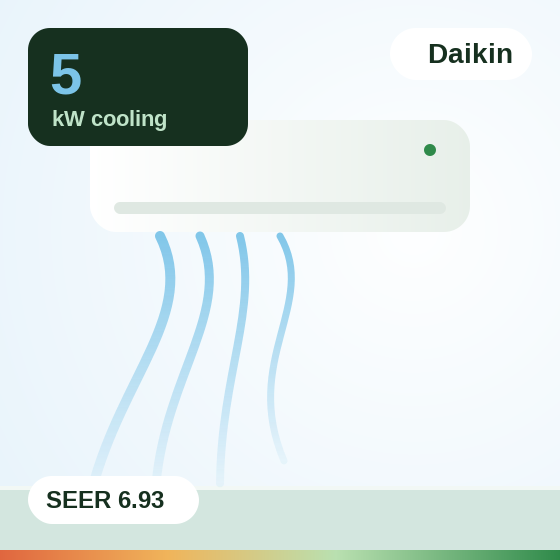
Daikin
Round Flow cassette FCAG60BVEB with Sky Air RZAG50B5V1B outdoor unit
5 kW cooling · SEER 6.93
No current UK price found
Figures from the maker or retailer listing. Cost an hour is our own, at the price cap of 26.32p a kWh.