Key takeaways
- HVAC stands for heating, ventilation and air conditioning. Designing Buildings says it can be used in buildings “to maintain internal air quality, regulate internal temperatures, and regulate internal humidity”.
- Air conditioning is one part of HVAC. A split unit that only cools and recirculates room air is not a whole HVAC system.
- This page explains the term for a UK building, where heating, ventilation and cooling can be separate systems or one.
- In a UK business, different laws attach to different parts: inspections above 12 kW (England and Wales), F-gas rules for refrigerant, workplace temperature and ventilation rules, and legionella duties for evaporative cooling.
What HVAC stands for
HVAC means heating, ventilation and air conditioning. It is the whole set of equipment that keeps the air in a building at a workable temperature, humidity and freshness. In a UK commercial building the three jobs can be done by different equipment, installed by different trades, under different rules. This guide is part of our commercial air conditioning section.
Designing Buildings (page last edited 8 September 2026) says the term is sometimes extended “to include other services, such as refrigeration”, which gives HVACR. When this page says HVAC it means the three core jobs.
What each part does in a UK building
Heating
In a commercial building, heating can come from boilers or from heat pumps feeding radiators, fan coil units or air handling units. A heat pump runs the refrigeration cycle in reverse, which is why one machine can heat and cool. Our section on air-to-air heat pumps covers the type that heats rooms directly with air.
Ventilation
Ventilation brings fresh air in and takes stale air out, through windows, extract fans or a mechanical system. It is a separate duty from temperature. Regulation 6 of the Workplace (Health, Safety and Welfare) Regulations 1992 (England, Wales and Scotland) says “Effective and suitable provision shall be made to ensure that every enclosed workplace is ventilated” “by a sufficient quantity of fresh or purified air”. Northern Ireland’s equivalent was not checked.
Air conditioning
Our guide to what air conditioning means gives the definition and how air conditioning works explains the refrigeration cycle. A split or cassette unit cools and recirculates the air in a room; on our reading, it does not bring fresh air in.
How HVAC is arranged
Designing Buildings describes several arrangements:
| Arrangement | What it means (Designing Buildings) |
|---|---|
| Centralised | Plant serves the whole building |
| Local | Equipment serves the space it sits in |
| Combined | For example, local air handling units supplied by central cooling |
| Network-connected | Linked to a wider district heating or cooling network |
| Integrated | One system provides heating, ventilation and air conditioning, for example air handling units connected to ductwork |
| Separate | Distinct systems, for example mechanical ventilation, radiators for heating and local comfort cooling units |
| Passive | “Natural” systems such as natural ventilation |
| Mixed-mode | Ventilation that combines natural and mechanical methods |
How the parts fit together is covered in how an HVAC system works, and the individual components in HVAC system meaning and components.
HVAC at home and at work: why US pages talk about furnaces
Some US pages about HVAC describe a home with a furnace, a central air conditioner and ducts to every room. We have not found a UK source that says how many UK homes have ducted systems. If you want a ducted system at home, see ducted air conditioning. Terms such as tonnage and SEER2 on US pages belong to the US market: UK units are rated in kilowatts and carry a UK energy label.
Which rules apply to an HVAC system
This is general information, not legal advice. Each line names the nation where we confirmed it.
- Inspection (England and Wales). GOV.UK’s guide (updated 5 November 2026) says inspections cover “All air conditioning systems with an effective rated output of greater than 12kW” and must be “no more than 5 years apart”. See air conditioning inspections (TM44). Scotland and Northern Ireland have their own rules from 12 kW.
- F-gas (Great Britain). GOV.UK says that for stationary refrigeration, air conditioning and heat pump systems you must have qualifications to “install new systems”, “service and maintain systems”, “check for leaks”, “recover gases” and “decommission and dispose of old systems”, and that a company servicing equipment operated by others “must be certified by an approved body”. See F-gas regulations.
- Workplace temperature (England, Wales, Scotland). Regulation 7(1) says “During working hours, the temperature in all workplaces inside buildings shall be reasonable.” HSE says “There’s no law for maximum working temperature, or when it’s too hot to work, because every workplace is different.” See workplace temperature law.
- Legionella (HSE guidance; nations not confirmed). HSE lists “cooling tower and evaporative condensers” among the most common sources and does not name air conditioning. HSE says “If you have a cooling tower or evaporative condenser, you should put in place appropriate measures to prevent or control the” risk of legionella.
- Building regulations (England). GOV.UK lists “put in a fixed air-conditioning system” among projects that may need approval, and says “You do not need to get approval yourself if you use someone registered with a competent person scheme.” For mechanical ventilation and air conditioning in buildings other than dwellings, GOV.UK’s list (updated 17 September 2026) names BESCA, Blue Flame Certification, Certsure and NAPIT. Other nations were not checked.
Worked example: when do small units add up to an inspection?
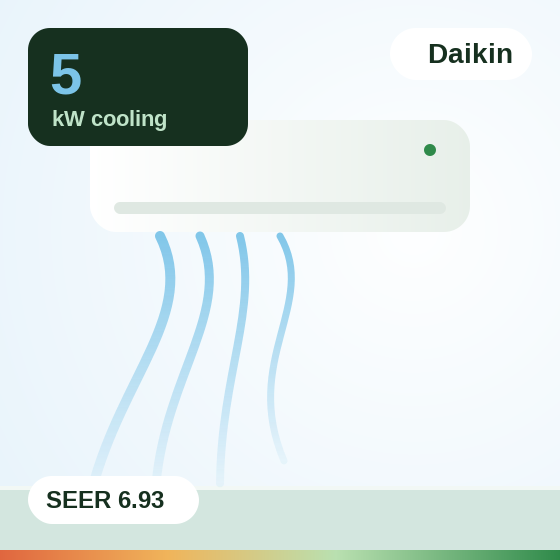
GOV.UK says “One or more air conditioning units within a single building controlled by a single person” count as one system. Daikin’s table for the Round Flow FCAG60B cassette with the RZAG50B outdoor unit gives 5 kW nominal cooling and a range of 1.7 to 6 kW.
- Three of these cassettes in one building under one person’s control add up to 15 kW nominal, more than 12 kW.
- Two add up to 10 kW nominal, but GOV.UK says “The effective rated output is the maximum calorific output in kW stated by the manufacturer”. If the 6 kW maximum were the figure that counted, two units would total exactly 12 kW, which is not “greater than 12kW”. We have not confirmed which figure an assessor would use for this model: check the rating plate and ask an accredited energy assessor.
Who designs, installs and maintains HVAC
A building services engineer or designer sets the system out; a mechanical contractor installs it; an F-gas certified company handles any refrigerant; an electrician does the supply. In England, a competent person scheme member can self-certify the building regulations side. How to pick one is in choosing an HVAC company. For the engineer’s role at home scale, see the air conditioning engineer glossary entry. Ducted systems are covered in HVAC ductwork.
How to brief an installer
- Give floor plans, ceiling heights and the number of people and machines in each room.
- Say which rooms need heating as well as cooling, and what fresh air the building already gets.
- Ask for a heat load calculation, the make and model of every unit, the F-gas company certificate number and the competent person scheme.
- Ask what the price excludes, and for the refrigerant type and charge for your F-gas records.
Frequently asked questions
What does HVAC stand for?
Heating, ventilation and air conditioning. Designing Buildings says it is sometimes extended to HVACR to include refrigeration.
Is HVAC the same as air conditioning?
No. Air conditioning is one of the three parts. See what air conditioning means.
Does a home have an HVAC system?
Every home has heating and some ventilation, but we found no UK source saying how many have central cooling or ducted systems.
What is HVACR?
HVAC plus refrigeration, according to Designing Buildings.
What does an HVAC engineer do?
They fit, commission, service and repair the equipment. Anyone working on refrigerant needs F-gas qualifications. See the engineer glossary entry and choosing an HVAC company. We give no pay figures.
Does an HVAC system need an inspection?
In England and Wales, air conditioning with an effective rated output of more than 12 kW does, at least every five years. See TM44 inspections.
Sources
- Designing Buildings: HVAC (last edited 8 September 2026) (checked 25 November 2026)
- GOV.UK: Air conditioning inspections for buildings, a guide (updated 5 November 2026) (checked 25 November 2026)
- legislation.gov.uk: Workplace (Health, Safety and Welfare) Regulations 1992, regulation 6 (checked 25 November 2026)
- legislation.gov.uk: Workplace Regulations 1992, regulation 7 (checked 25 November 2026)
- HSE: Temperature in the workplace (updated 3 November 2026) (checked 25 November 2026)
- HSE: Legionella, workplace risks (checked 25 November 2026)
- HSE: Evaporative cooling systems (updated 14 January 2026) (checked 25 November 2026)
- GOV.UK: Qualifications to work with F gas (updated 3 March 2026) (checked 25 November 2026)
- GOV.UK: Company certification to work with F gas (checked 25 November 2026)
- GOV.UK: Building regulations approval, when you need approval (checked 25 November 2026)
- GOV.UK: Competent person schemes, current schemes (updated 17 September 2026) (checked 25 November 2026)
- Daikin UK: FCAG-B / RZAG-B technical details (checked 25 November 2026)
Products on this page
Daikin
Round Flow cassette FCAG60BVEB with Sky Air RZAG50B5V1B outdoor unit
5 kW cooling · SEER 6.93
No current UK price found
Figures from the maker or retailer listing. Cost an hour is our own, at the price cap of 26.32p a kWh.