Key takeaways
- Our BTU calculator uses one rule for cooling: 100 watts per square metre of floor at a 2.4 m ceiling, scaled by room volume (Daikin UK), then adjusted for sun, loft, kitchen, conservatory, poor insulation and extra people.
- A 4 x 3.5 m bedroom with a 2.4 m ceiling and two people needs about 1,400 W of cooling, which is 4,777 BTU per hour, so a 5,000 BTU unit.
- A single-hose portable cools less than its rated BTU suggests, because the test does not count warm outside air drawn into the room. Check the maker’s own room size too, and go up a size if it does not cover your room.
- Radiator mode is a separate rule (Viessmann UK’s factors per cubic metre). Never use the cooling figure to size a radiator.
- The answer is always rounded up to the next size you can buy, never down.
This BTU calculator tells you how much cooling your room needs in BTU per hour, kW and watts, and which size of air conditioner to buy. Enter the room’s length, width and ceiling height, tick what applies, and it rounds the answer up to the next size sold in the UK. It also has a radiator mode for heating, which uses a different rule.
BTU calculator
The rule in one line: cooling needed in watts = room volume in cubic metres x 100 / 2.4, adjusted for the room, then x 3.412141 for BTU per hour.
What you enter:
| Input | What to enter | Default |
|---|---|---|
| Mode | Cooling (air conditioner) or heating (radiator) | Cooling |
| Units | Metres or feet | Metres |
| Length and width | The floor measurements of the room | None |
| Ceiling height | The average height; for a sloping loft ceiling, the average across the room | 2.4 m (7 ft 10 in) |
| Room type | Standard, kitchen or conservatory | Standard |
| Tick boxes | Sun-facing (large south or west windows), loft or top floor, poorly insulated | Unticked |
| People | How many people usually use the room at once | 2 |
| Heating only | Bedroom, bedroom single glazed, or living room double glazed | Bedroom |
What you get back:
- the cooling (or heat) needed, to the nearest 100 BTU per hour, in kW to two decimal places and in watts;
- the recommended size: the smallest size sold that is equal to or above your figure;
- the largest room the sizes either side of it cover, so you can see how close you are to the next size;
- the running cost of a named unit at the recommended size, per hour, per eight-hour night and per 350-hour summer, at the Great Britain price cap.
The tool works the same way as the method set out below, so you can do the sum by hand with the worked examples if you prefer.
id: btu-calculator
page: /tools/btu-calculator/
data: data/energy.json (sizing, assumptions, priceCap)
modes: [cooling, heating]   # default cooling

inputs:
  units:         { type: choice, options: [metres, feet], default: metres }
  length:        { type: number, min: 0.5, max: 50, unit: m or ft, required: true }
  width:         { type: number, min: 0.5, max: 50, unit: m or ft, required: true }
  ceilingHeight: { type: number, min: 1.5, max: 6, unit: m or ft, default: 2.4 m or 7.87 ft }
  # cooling mode only
  roomType:      { type: choice, options: [standard, kitchen, conservatory], default: standard }
  sunFacing:     { type: checkbox, default: false, disabledWhen: roomType == conservatory }
  loftOrTopFloor:{ type: checkbox, default: false }
  poorlyInsulated: { type: checkbox, default: false }
  people:        { type: integer, min: 1, max: 20, default: 2 }
  # heating mode only
  heatingRoom:   { type: choice, options: [bedroomDoubleGlazed, bedroomSingleGlazed, livingRoomDoubleGlazed], default: bedroomDoubleGlazed }   # key name from energy.json: Viessmann's standard bedroom figure (108), not stated as double glazed

conversion of feet:
  metres = feet x 0.3048 (exact); convert each dimension before multiplying.

cooling formula:
  volumeM3 = length x width x ceilingHeight
  baseW    = volumeM3 x 100 / 2.4            # sizing.base (use 41.6667 unrounded, not 41.667)
  pct      = sum of sizing.adjustments[x].percent for each that applies:
               kitchen 20 | conservatory 30 (room types: at most one)
               sunFacing 15 (never with conservatory)
               loftOrTopFloor 20
               poorlyInsulated 10
  needW    = baseW x (1 + pct / 100) + 180 x max(0, people - 2)
  needBtu  = needW x 3.412141                # sizing.conversions.btuPerHourPerWatt
  needKw   = needW / 1000

rounding (sizing.rounding):
  sizes = [5000, 7000, 8000, 9000, 10000, 12000, 14000, 15000, 16000, 18000, 20000, 24000]
  recommended = smallest size >= needBtu (compare unrounded needBtu)
  if needBtu < 5000: recommended = 5000
  if needBtu > 24000: no recommendation; show "No single home unit covers this room: consider two units or ask an installer for a heat-load survey."
  display needBtu to nearest 100, needKw to 2 decimals, needW to nearest 10

either side:
  for the size below and above the recommendation, show the largest floor area it covers
  under the same ticks and ceiling height:
  sizeW      = size / 3.412141 - 180 x max(0, people - 2)
  maxFloorM2 = sizeW / (1 + pct / 100) / (100 / 2.4 x ceilingHeight), rounded down to 1 decimal
  With the default 2.4 m ceiling and no ticks this equals sizing.roomSizeBySize.

heating formula (sizing.heating):
  needBtu = volumeM3 x factor  # 108 bedroom (Viessmann's standard figure), 132 bedroom single glazed, 135 living room double glazed
  needW   = needBtu x 0.2930711
  no rounding to an air conditioner size; show "Choose a radiator (or radiators) with a combined output at or above this figure."
  other rooms: "Viessmann gives no factor for this room. Ask a heating engineer."

running cost line (cooling only):
  pick the named unit for the recommended size from the product library (launch: 5000 -> pro-breeze-5000-btu-3-in-1-pb-ac-08; 12000 -> meaco-cirro-12000-ch; others from the size page for that size)
  perHourPence   = powerW / 1000 x priceCap.pence, 1 decimal
  perNightPounds = perHourPence x assumptions.hoursPerNight / 100, 2 decimals
  perSummer      = powerW / 1000 x assumptions.hoursPerSummer kWh (1 decimal) x priceCap.pence / 100, 2 decimals
  always show: the cap period (priceCap.from to priceCap.to), "Great Britain average", and
  "These figures use the Great Britain price cap. In Northern Ireland, use the unit rate on your own bill."

output wording (cooling):
  "Your room needs about {needBtu} BTU per hour ({needKw} kW, {needW} W) of cooling.
   Recommended size: {recommended} BTU. A {below} BTU unit covers up to {belowM2} m2 and a
   {above} BTU unit up to {aboveM2} m2 for a room like yours.
   If it is a single-hose portable, check the maker's own room size as well, and go up a size if it does not cover your room."

no JavaScript: the page text, the worked examples and the room-size table give the same answers.
How the calculator works
The base rule: 100 W per square metre at a 2.4 m ceiling, scaled by volume
The starting point is Daikin UK’s sizing guidance, which says typical UK homes need “around 0.1 kW per square metre for average ceiling heights and insulation”. Daikin adds that most sizing rules assume a 2.4 m ceiling, and that a 3 m ceiling increases the room’s volume by 25%, “and so should your cooling capacity”.
So the calculator works by volume, not floor area. One hundred watts per square metre at 2.4 m is 100 / 2.4 = 41.6667 watts per cubic metre. In BTU that is 142.2 BTU per hour per cubic metre, or 341.2 BTU per hour per square metre of floor at a 2.4 m ceiling. In feet, it is about 31.7 BTU per hour per square foot at the same ceiling height.
We chose this rule because it comes from a maker’s UK guidance, it is metric, it grows with ceiling height and it gives a figure per extra person. CIBSE publishes no domestic rule of thumb that we could find; its approach is a full cooling-load calculation, which a web tool cannot reproduce. The US ENERGY STAR chart (12,000 BTU for 450 to 550 sq ft at an 8-foot ceiling) gives larger rooms per BTU than UK makers claim for their portables, so we do not use it.
Adjustments and where each figure comes from
Add up the percentages that apply, multiply the base watts by one plus that total, then add 180 W for each person beyond two.
| Adjustment | Figure | Where it comes from |
|---|---|---|
| Sun-facing (large south or west windows) | +15% | Daikin UK says 10 to 20%; Electric Point says 10 to 15%. 15% is the highest figure inside both ranges. |
| Loft or top floor | +20% | Electric Point says add 10 to 20% for top-floor rooms and loft conversions. No maker figure found, so we take the top of the range. |
| Kitchen | +20% | Daikin UK says kitchens often need 10 to 20% more. ENERGY STAR (US) adds a flat 4,000 BTU for a kitchen, so we take the top of Daikin’s range. |
| Conservatory or glazed garden room | +30% | Electric Point says add at least 25 to 30%. No maker figure found. Do not also tick sun-facing. |
| Poorly insulated (single glazing, little wall insulation) | +10% | Electric Point says 5 to 10%. It fits Daikin’s example of a 20 m2 bedroom needing about 2 kW when well insulated and 2.5 kW when poorly insulated and sun-facing. |
| Each person beyond two | +180 W (614 BTU) | Daikin UK says around 0.18 kW per person beyond two. ENERGY STAR says 600 BTU and Electric Point 500 BTU, so the sources agree closely. |
Kitchen and conservatory are room types, so use one at most. The loft, conservatory and poor-insulation figures are a common rule of thumb from one UK retailer’s buying guide rather than a maker or engineering body. A glass roof in full sun or a very hot loft can need more than the calculator says.
In words, the whole sum is: volume x 41.6667, times (1 + the percentages), plus 180 W for each person beyond two, times 3.412141 for BTU per hour.
Rounding up to a size you can buy
Air conditioners come in set sizes. The calculator picks the smallest of these that is equal to or above your figure: 5,000, 7,000, 8,000, 9,000, 10,000, 12,000, 14,000, 15,000, 16,000, 18,000, 20,000 and 24,000 BTU. Electric Point’s guide puts it plainly: “Always round up, never down.”
Below 5,000 BTU, the calculator still recommends 5,000 BTU, the smallest size commonly sold. Above 24,000 BTU, it says that no single home unit covers the room, and suggests two units or an installer’s heat-load survey. For example, a 10 x 8 m room with a 2.4 m ceiling needs 8,000 W, about 27,300 BTU, which is past the largest size.
Fitted split systems are sold in kW (2.5, 3.5, 5.0 and so on) rather than BTU, so the calculator always shows kW next to BTU. See our guide to split air conditioners for how those sizes work.
Worked examples
Each example follows the same steps: volume, base watts, adjustments, extra people, BTU, then round up. The feet figures are the same rooms converted at 0.3048 m to the foot.
1. Bedroom, 4 x 3.5 m (13 ft 1 in x 11 ft 6 in), 2.4 m ceiling, two people. Volume 4 x 3.5 x 2.4 = 33.6 m3. 33.6 x 41.6667 = 1,400 W. No adjustments. 1,400 x 3.412141 = 4,777 BTU per hour (1.40 kW). Recommended: 5,000 BTU.
2. Living room, 5 x 4 m (16 ft 5 in x 13 ft 1 in), 2.4 m ceiling, sun-facing, four people. Volume 48 m3, so 2,000 W. Sun: 2,000 x 1.15 = 2,300 W. Two extra people: 2,300 + 360 = 2,660 W. 2,660 x 3.412141 = 9,076 BTU per hour (2.66 kW). Recommended: 10,000 BTU.
3. Loft bedroom, 4 x 4 m (13 ft 1 in square), average ceiling 2.4 m, sun-facing. Volume 38.4 m3, so 1,600 W. Loft 20% plus sun 15%: 1,600 x 1.35 = 2,160 W. 2,160 x 3.412141 = 7,370 BTU per hour (2.16 kW). Recommended: 8,000 BTU.
4. Kitchen, 4 x 3 m (13 ft 1 in x 9 ft 10 in), 2.4 m ceiling. Volume 28.8 m3, so 1,200 W. Kitchen: 1,200 x 1.2 = 1,440 W. 1,440 x 3.412141 = 4,913 BTU per hour (1.44 kW). Recommended: 5,000 BTU.
5. Conservatory, 4 x 3.5 m (13 ft 1 in x 11 ft 6 in), average height 2.5 m. Volume 35 m3, so 1,458 W. Conservatory: 1,458 x 1.3 = 1,896 W. 1,896 x 3.412141 = 6,469 BTU per hour (1.90 kW). Recommended: 7,000 BTU. Our best air conditioners for a conservatory page lists units at this size and above.
6. Open-plan room, 6 x 5 m (19 ft 8 in x 16 ft 5 in), 2.4 m ceiling, poorly insulated, three people. Volume 72 m3, so 3,000 W. Poor insulation: 3,000 x 1.1 = 3,300 W. One extra person: 3,300 + 180 = 3,480 W. 3,480 x 3.412141 = 11,874 BTU per hour (3.48 kW). Recommended: 12,000 BTU.
7. Measured in feet: a 14 x 12 ft bedroom with an 8 ft ceiling, two people. Convert first: 14 ft = 4.267 m, 12 ft = 3.658 m, 8 ft = 2.438 m. Volume 38.06 m3 (1,344 cubic feet). 38.06 x 41.6667 = 1,586 W. 1,586 x 3.412141 = 5,411 BTU per hour (1.59 kW). Recommended: 7,000 BTU, because 5,411 is just over 5,000 and there is no common size in between. This is the case where the sizes either side matter: a 5,000 BTU unit covers up to 14.6 m2 at a 2.4 m ceiling, and this room is 15.6 m2 with a slightly higher ceiling.
8. Ceiling height on its own: the bedroom from example 1 with a 3 m ceiling. Volume 4 x 3.5 x 3 = 42 m3, so 1,750 W, which is 5,971 BTU per hour (1.75 kW). Recommended: 7,000 BTU. The same floor at 2.4 m needed only 5,000 BTU: the 25% extra height Daikin describes moves the room up a size.
What those sizes cost to run
For the bedroom in example 1, the Pro Breeze 5000 BTU (PB-AC-08) is a 5,000 BTU portable rated at 563 W in its UK manual. 563 W is 0.563 kW. At 26.32p per kWh, the Ofgem price cap’s Great Britain average for 1 October to 31 December 2026, that is 14.8p an hour, £1.19 for an eight-hour night and £51.86 for our standard 350-hour summer (197.1 kWh). Pro Breeze gives its room size as up to 12 m2, smaller than the 14.6 m2 our rule gives for 5,000 BTU, so for a room of 14 m2 or so its own figure is the one to check. Pro Breeze’s manual for the 5000 says “Never leave the appliance unattended while in use”, and that it “is intended for indoor household use and similar applications”; cooling the room before bed and switching off is the cautious way to follow that. It was from £224.99 at Pro Breeze , checked 13 November 2026, when it was not in stock to buy; check stock before ordering.
For the open-plan room in example 6, the Meaco Cirro 12000 draws 1,350 W, which is 1.35 kW. At 26.32p per kWh that is 35.5p an hour, £2.84 for an eight-hour night and £124.36 for a 350-hour summer (472.5 kWh). Meaco gives its room size as 20 to 30 m2. Our rule gives 35.1 m2 for 12,000 BTU in a plain room, and this example room is 30 m2 with extra load, which sits at the top of Meaco’s own range. It was from £539.99 at Meaco , checked 13 November 2026, in stock that day. Our Meaco Cirro 12000 page has the full specification.
These figures use the Great Britain price cap. In Northern Ireland, use the unit rate on your own bill. They leave out the standing charge, which you pay anyway, and rated power is a full-power figure: an inverter unit draws less once the room is cool. The air conditioning running cost calculator works out any unit, and air conditioning running costs explains the method.
Room size each BTU size covers
This table runs the rule backwards: the largest room each size covers at a 2.4 m ceiling, with two people and no adjustments. Floor areas and volumes are rounded down. The sun-facing and loft columns divide the unrounded floor area by 1.15 and 1.2.
| Size | kW | Watts | Largest floor | Largest volume | Sun-facing | Loft or top floor |
|---|---|---|---|---|---|---|
| 5,000 BTU | 1.47 | 1,465 | 14.6 m2 (157 sq ft) | 35.1 m3 | 12.7 m2 | 12.2 m2 |
| 7,000 BTU | 2.05 | 2,051 | 20.5 m2 (220 sq ft) | 49.2 m3 | 17.8 m2 | 17.0 m2 |
| 8,000 BTU | 2.34 | 2,345 | 23.4 m2 (252 sq ft) | 56.2 m3 | 20.3 m2 | 19.5 m2 |
| 9,000 BTU | 2.64 | 2,638 | 26.3 m2 (283 sq ft) | 63.3 m3 | 22.9 m2 | 21.9 m2 |
| 10,000 BTU | 2.93 | 2,931 | 29.3 m2 (315 sq ft) | 70.3 m3 | 25.4 m2 | 24.4 m2 |
| 12,000 BTU | 3.52 | 3,517 | 35.1 m2 (378 sq ft) | 84.4 m3 | 30.5 m2 | 29.3 m2 |
| 14,000 BTU | 4.10 | 4,103 | 41.0 m2 (441 sq ft) | 98.4 m3 | 35.6 m2 | 34.1 m2 |
| 15,000 BTU | 4.40 | 4,396 | 43.9 m2 (473 sq ft) | 105.5 m3 | 38.2 m2 | 36.6 m2 |
| 16,000 BTU | 4.69 | 4,689 | 46.8 m2 (504 sq ft) | 112.5 m3 | 40.7 m2 | 39.0 m2 |
| 18,000 BTU | 5.28 | 5,275 | 52.7 m2 (567 sq ft) | 126.6 m3 | 45.8 m2 | 43.9 m2 |
| 20,000 BTU | 5.86 | 5,861 | 58.6 m2 (630 sq ft) | 140.6 m3 | 50.9 m2 | 48.8 m2 |
| 24,000 BTU | 7.03 | 7,034 | 70.3 m2 (757 sq ft) | 168.8 m3 | 61.1 m2 | 58.6 m2 |
Portable buyers have two more pages for the commonest sizes: 9,000 BTU portable air conditioners, 12,000 BTU portable air conditioners and 14,000 BTU portable air conditioners. If you would rather start from the question than the sum, read what size air conditioner do I need? or how many BTU do I need?. For a quick answer by room with presets for typical UK rooms, try the air conditioner size calculator for a room.
Portable air conditioners: why the label BTU overstates real cooling
Under the energy label rules that apply in Great Britain, a single-duct (single-hose) portable is rated at 35C both indoors and outdoors, and its condenser is cooled with indoor air rather than outdoor air. In a real room, every litre of air the hose blows outside has to be replaced, and it is replaced by warm air leaking in from outside or the rest of the house. The rating does not count that.
The US Department of Energy looked at this in 2016. It found that the net cooling of portable air conditioners is “generally significantly lower” than the older rating, mainly because of this air infiltration, and that the effect is most pronounced for single-duct units. US listings now show a second, seasonally adjusted figure (SACC) alongside the older one. UK listings show one figure. If you import a US unit, use its SACC figure in the calculator.
No UK or EU document gives a percentage to knock off, so we do not apply one and we do not quote one. What we do instead:
- show the maker’s own room size next to our rule’s figure on every size page;
- if the maker’s figure does not cover your room, go up a size;
- if you want the rated figure to hold, look at a split, which avoids most of the problem (when we checked on 14 November 2026 we found no dual hose portable confirmed by its maker on UK sale).
Our portable air conditioner guide covers the types, how to vent a portable air conditioner shows how to keep the hose short and the window seal tight, and best dual hose portable air conditioners explains what we found: when we checked on 14 November 2026 we found no dual hose portable confirmed by its maker on UK sale. For a bedroom, best air conditioners for a bedroom adds noise figures to the sizing.
BTU, kW and watts
BTU stands for British thermal unit, a unit of energy; an air conditioner labelled “12,000 BTU” gives 12,000 BTU per hour of cooling, which is power. One watt is 3.412141 BTU per hour and one BTU per hour is 0.2930711 W (NIST), so 12,000 BTU per hour is 3.52 kW. Cooling output is not the electricity a unit uses: the Meaco Cirro 12000 gives 3.5 kW of cooling for 1,350 W of electricity, because a heat pump moves more heat than it uses. Our converters show the sums: BTU to kW, BTU to watts and BTU to kWh, where a kWh is 3,412.14 BTU of energy. For the definitions, see what does BTU mean? and what does BTU stand for?.
Radiator mode: BTU for heating a room
Heating needs a different rule, so the calculator switches to Viessmann UK’s factors when you choose radiator mode. Viessmann says to multiply a bedroom’s volume in cubic metres by 108, or by 132 if it is single glazed, and a double-glazed living room’s volume by 135. It gives no factor for kitchens, bathrooms, halls or other rooms; for those, the calculator says so and suggests a heating engineer.
Worked example (Viessmann’s own room). A bedroom 4.8 x 4 m with a 2.4 m ceiling is 46.08 m3. Using Viessmann’s standard bedroom figure: 46.08 x 108 = 4,977 BTU per hour. In watts: 4,977 x 0.2930711 = 1,459 W. Choose a radiator, or radiators, with a combined output at or above that figure. Single glazed, the same room is 46.08 x 132 = 6,083 BTU per hour (1,783 W).
The cooling rule must not be used for heating, and the heating factors are for radiators, not for an air conditioner in heat mode. If you are heating with an air-to-air heat pump or an air conditioner, the installer needs to do a heat-loss calculation for the room.
What the calculator cannot know
A rule of thumb works from the room’s size and a few ticks. It cannot see:
- how much glass the room has, and whether blinds or shading cut the sun;
- the real insulation in the walls and roof;
- heat from a computer, a television, an oven or lighting;
- doors left open to the rest of the house, which make the room bigger than you measured;
- where a portable’s hose goes and how well the window is sealed.
If the room is large, mostly glass, under a hot roof, or the answer lands near the 24,000 BTU limit, ask an installer for a heat-load (cooling load) calculation before buying a fitted system. A proper survey is part of most quotes; air conditioning installation cost covers what to expect.
Frequently asked questions
How do I calculate BTU for a room?
Multiply length x width x ceiling height in metres to get the volume, then multiply by 41.6667 for watts and by 3.412141 for BTU per hour. Add 15% for sun, 20% for a loft or kitchen, 30% for a conservatory and 10% for poor insulation as they apply, plus 180 W for each person beyond two. Round up to the next size sold.
How many BTU do I need per square metre?
About 341 BTU per hour per square metre of floor at a 2.4 m ceiling, which is Daikin UK’s 100 W per square metre. A higher ceiling needs proportionally more, and sun, a loft, a kitchen or poor insulation add to it.
Does ceiling height change the BTU I need?
Yes. The calculator works by volume, so a 3 m ceiling needs 25% more cooling than a 2.4 m ceiling over the same floor. A 4 x 3.5 m bedroom moves from 5,000 BTU to 7,000 BTU when the ceiling goes from 2.4 m to 3 m.
How many BTU for a conservatory or loft?
Add 30% for a conservatory and 20% for a loft or top-floor room. A 4 x 3.5 m conservatory with an average height of 2.5 m needs about 6,469 BTU, so 7,000 BTU. A sun-facing 4 x 4 m loft bedroom needs about 7,370 BTU, so 8,000 BTU. Glass roofs in full sun can need more.
Is it better to buy a bigger air conditioner?
Round up to the next size, but going further up mainly costs more to buy and run. Bigger units draw more power: the 12,000 BTU Meaco Cirro uses 1,350 W against 563 W for the 5,000 BTU Pro Breeze. The exception is a single-hose portable whose maker’s room size does not cover your room: then go up a size.
Why does my portable not cool the room its label says?
A single-hose portable is rated without counting the warm air that leaks in to replace the air its hose blows outside. The US Department of Energy found real cooling is generally significantly lower than the old rating for this reason. Use the maker’s room size, keep the hose short and sealed, or choose a split.
How many BTU do I need for a radiator?
Use radiator mode, not the cooling rule. Viessmann UK multiplies the room volume in cubic metres by 108 for a bedroom, or 132 if single glazed, and 135 for a double-glazed living room. A 4.8 x 4 x 2.4 m bedroom needs 4,977 BTU per hour (1,459 W).
How do I convert BTU to kW?
Divide BTU per hour by 3,412.141, or multiply by 0.0002930711. 9,000 BTU per hour is 2.64 kW and 12,000 BTU per hour is 3.52 kW. That is cooling output, not electricity used.
Sources
- Daikin UK: air conditioner size guide (checked 14 November 2026)
- Electric Point: portable air conditioning units UK buying guide (checked 14 November 2026)
- ENERGY STAR: room air conditioners (checked 14 November 2026)
- legislation.gov.uk: Regulation (EU) No 626/2011, Annex VII (checked 14 November 2026)
- Federal Register: Energy conservation program, test procedures for portable air conditioners, 1 June 2016 (checked 14 November 2026)
- NIST: Guide for the use of the SI, Appendix B.9, factors for units listed by kind of quantity (checked 14 November 2026)
- Viessmann UK: how many BTU to heat a room (checked 14 November 2026)
- Ofgem: changes to the energy price cap between 1 October and 31 December 2026 (checked 14 November 2026)
- Pro Breeze: PB-AC08 5000 BTU smart portable air conditioner instruction manual (UK) (checked 15 November 2026)
- Pro Breeze: 5000 BTU smart portable air conditioner (checked 13 November 2026)
- Meaco: Cirro 12000 BTU super quiet smart portable air conditioner and heater (checked 13 November 2026)
- EPREL: product fiche 2756020, Meaco Cirro 12000 BTU (checked 14 November 2026)
Products on this page
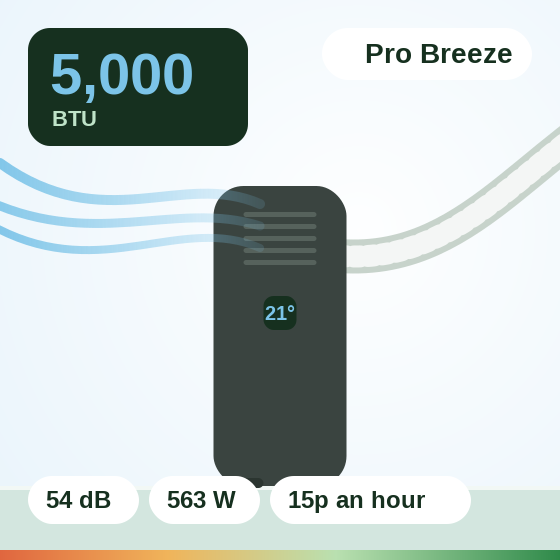
Pro Breeze
5000 BTU 3-in-1 Portable Air Conditioner with Dehumidification Function, Smart Wifi App (PB-AC-08)
5,000 BTU · 54 dB · 563 W · 15p an hour
£224.99 at Pro Breeze (maker shop), checked 13 Nov 2026
See it at Pro Breeze (maker shop)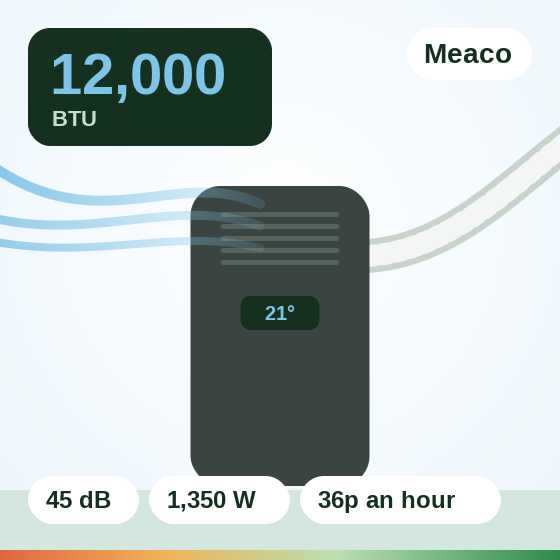
Meaco
Cirro 12000 BTU Super Quiet Smart Portable Air Conditioner & Heater (A-Cirro-12K-CH)
12,000 BTU · 45 dB · 1,350 W · 36p an hour
£539.99 at Meaco (maker shop), checked 13 Nov 2026
See it at Meaco (maker shop)
Figures from the maker or retailer listing. Cost an hour is our own, at the price cap of 26.32p a kWh.