Key takeaways
- This TM44 inspection guide covers England and Wales. In England and Wales, the Energy Performance of Buildings Regulations 2012 apply to air-conditioning systems with “an effective rated output of more than 12kW”: an energy assessor must inspect them “at regular intervals not exceeding five years”.
- Several units in one building under one person’s control count as one system, so small units can add up to more than 12 kW. The person who controls the system is responsible, and it is usually the owner. See our commercial air conditioning guide for the wider picture.
- The penalty for having no report is £300, and £200 for not producing a report to an enforcement officer within 7 days. A new operator who takes over a system without a report has 3 months to have it inspected.
- We found no published price for an inspection. GOV.UK says the fee “can vary depending on the energy assessor you choose”, so ask for quotes.
What is a TM44 inspection?
“TM44” is a document, not the law. CIBSE’s TM44 is titled “Inspection of Air Conditioning Systems”, a 2012 revision that replaced the 2007 edition, and CIBSE’s page says it “provides guidance on conducting an air conditioning inspection”. GOV.UK’s guide says it includes extracts from TM44 (2012), reproduced with CIBSE’s permission. The regulations themselves do not use the name; they require an “inspection” by an “energy assessor”. In practice, people say “TM44 inspection” for the legal inspection. This is general information, not legal advice.
The short answer
In England and Wales, whoever controls an air conditioning system with an effective rated output of more than 12 kW must have it inspected by an accredited energy assessor at least every five years. GOV.UK’s guide (updated 5 November 2026) says it applies to England and Wales.
Does your system count?
Regulation 17(1) says Part 4 of the 2012 Regulations “applies to air-conditioning systems with an effective rated output of more than 12kW”. Regulation 17(3) says that “effective rated output” “means the maximum calorific output specified and guaranteed by the manufacturer of the system as being deliverable during continuous operation while complying with the useful efficiency indicated by the manufacturer.”
Several units: where a relevant person can control the temperature of more than one unit in a building, regulation 17(2) says each unit “shall be considered to be a component of a single air-conditioning system”. GOV.UK’s guide says “it may be necessary to aggregate the ratings shown on the rating plate of each unit”. On separate buildings it says “Individual systems in separate buildings cannot be grouped together to create a combined rated output greater than 12kW and included in a single report”, and “Only when buildings share plant can they be combined under a single report”. Confirm with an assessor if you have more than one building.
Where to find the figure: GOV.UK’s guide points to the rating plate of each unit.
Worked example (our arithmetic). Three Daikin 5 kW cassettes in one office, under one person’s control, make 15 kW nominal, which is over 12 kW. Two 5 kW cassettes make 10 kW nominal, but Daikin’s table gives each a maximum cooling figure of 6 kW (and a maximum heating figure of 6 kW): 2 x 6 = 12 kW, which is not “more than 12kW”. Whether an assessor would read your units’ effective rated output that way depends on the figures the maker has specified and guaranteed. What counts towards the 12 kW is the “effective rated output”, which regulation 17(3) defines as the output “specified and guaranteed by the manufacturer of the system as being deliverable during continuous operation”; a maker’s table maximum may not be that figure, so ask an accredited assessor which figure applies. In Northern Ireland, nidirect uses two wordings (below), “12kW or more” and “over 12kW”, so ask there too.
Who is responsible?
GOV.UK’s guide uses the term “relevant person” for the person who controls the operation of an air conditioning system. It says the owner usually controls the system, even if day-to-day operation is contracted out. Where an occupier installed equipment locally, “the responsibility will lie with the occupier as they own the system”. Where the occupier takes full responsibility for the building services, the occupier controls it. If you rent, read the tenancy or lease and ask your landlord who holds the report; a lease is a private contract and we do not say what one usually contains. See landlords, tenants and air conditioning.
Regulation 20 requires the relevant person to keep the most recent inspection report, and the previous relevant person to give any report to the new one.
When is it due?
- First inspection: within five years of the system first going into service. Regulation 18(3)(a) says the relevant date is “the last day of the period of five years beginning with the date on which the system is first put into service” for systems first in service on or after 1 January 2008. For example, a system first in service on 1 March 2027 must be inspected by 29 February 2032 (our reading of the regulation).
- After that: at “regular intervals not exceeding five years” (regulation 18(1)).
- New operator: regulation 21 says “the new relevant person must ensure that the system is inspected within three months” where they are not given an inspection report. GOV.UK’s guide says the same.
What does the inspection involve?
GOV.UK’s guide says the inspection looks at the refrigeration equipment and heat exchangers (for damage or poor maintenance), air-moving systems such as filters, fans and air intakes, and controls, including set temperatures, operating times, zoning and sensor placement. It does not include physical adjustments or cleaning. The report must give the building address, the assessor’s name and employer, the inspection date and the accreditation scheme, and cover matters such as efficiency, faults, maintenance, controls and system sizing, with “a summary of the findings and the key recommendations”. Regulation 19 sets this out.
Finding an accredited energy assessor
GOV.UK says “Only an accredited energy assessor can inspect your air conditioning system” and the guide says “All energy assessors must be a member of an accreditation scheme”. Only reports produced and lodged on the register are valid, and the guide says “a search facility is available on the register website”. Start from GOV.UK’s find an energy assessor page.
What are the penalties?
- No inspection report: £300 (regulation 38(1)(d), for breaches of regulations 18(1), 20(1), 20(2) or 21). GOV.UK says “If you do not get your air-conditioning inspected every 5 years, you will be fined £300.”
- Not producing the report within 7 days: £200 (regulation 38(1)(e), for breach of regulation 35(5)), where an authorised officer asks for it. GOV.UK’s guide describes this as a request from a Trading Standards officer.
- Who enforces: regulation 34(1) says “Every local weights and measures authority is an enforcement authority for the purpose of this Part.”
Scotland and Northern Ireland
This page is about England and Wales. We opened the sources for the other two nations only for the wording below.
- Scotland: regulation 17 of the Building (Scotland) Regulations 2004 says “the owners of buildings shall ensure” that “accessible parts of every air-conditioning system within a building are inspected” “at regular intervals not exceeding five years”. It does not apply to systems “with a total effective output rating of less than 12 kW” or “solely for processes within a building”.
- Northern Ireland: nidirect says “systems with a rated output of 12kW or more installed after 30 December 2008 must be inspected within five years” and, in the same list, “all systems over 12kW should be inspected regularly - not exceeding five years”, with enforcement by district councils, which can include “a penalty charge notice”.
The thresholds are worded differently in each nation: “more than 12kW” in England and Wales, systems of less than 12 kW excluded in Scotland, and both “12kW or more” and “over 12kW” in nidirect’s wording for Northern Ireland.
What does a TM44 inspection cost?
We found no published price on 25 November 2026. GOV.UK says “You will be charged for this inspection, and this fee can vary depending on the energy assessor you choose.” The assessor pages we opened ask for a quote instead of giving a price. The CIBSE price you may see (£75.00 plus VAT for the PDF, free to members) is for the TM44 guidance document, not for an inspection.
Things worth giving an assessor so the quote is firm: how many indoor and outdoor units, their makes and models, where they are, whether you can show maker documents and past service records, and access to plant areas.
TM44 is not servicing or an F-gas leak check
An inspection is an assessment; GOV.UK’s guide says it “does not include physical adjustments or cleaning”. It is separate from servicing and from F-gas leak checks, which are required from 5 tonnes CO2 equivalent in Great Britain and carried out by qualified technicians. See HVAC maintenance, commercial air conditioning servicing and F-gas rules. Other pages affected: office air conditioning and hotel room air conditioning units. For building regulations, see air conditioning and building regulations.
How to brief an assessor
- List every air conditioning unit in each building: make, model, rating plate and where it is.
- Say who controls the system, and whether you rent.
- Gather maker documents, service records and any previous report.
- Ask whether the assessor is a member of an accreditation scheme, which scheme, and when you will get the report.
- Ask what the quote covers and whether the report will be lodged on the register.
Frequently asked questions
What is a TM44 inspection?
It is the legal inspection of air conditioning systems over 12 kW in England and Wales by an accredited energy assessor. TM44 is CIBSE’s guidance document on the method; the regulations do not use the name.
Do I need a TM44 inspection?
In England and Wales, if your system has an effective rated output of more than 12 kW. Units in one building under one person’s control are treated as one system.
How often is a TM44 inspection needed?
At regular intervals not exceeding five years, with the first within five years of the system first going into service.
What is the penalty for not having a TM44 report?
£300 for not having an inspection report, and £200 for not producing it within 7 days when an authorised officer asks.
Do domestic air conditioning systems need TM44?
We did not confirm this. Part 4 of the 2012 Regulations does not mention homes, and GOV.UK’s guide refers to “buildings” and does not mention dwellings. Ask an accredited energy assessor about any home system over 12 kW.
Who can carry out a TM44 inspection?
An accredited energy assessor, who must be a member of an accreditation scheme. GOV.UK says “Only an accredited energy assessor can inspect your air conditioning system.”
Is a TM44 inspection the same as an EPC?
Regulation 19 makes the air conditioning inspection report its own document. We did not research EPC rules for this page, so ask your assessor whether you also need an EPC.
Sources
- GOV.UK: Air conditioning inspections for buildings, a guide (updated 5 November 2026) (checked 27 November 2026)
- GOV.UK: Get your air conditioning system inspected (checked 25 November 2026)
- legislation.gov.uk: Energy Performance of Buildings (England and Wales) Regulations 2012, Part 4 (checked 25 November 2026)
- legislation.gov.uk: EPB Regulations 2012, regulation 17 (checked 27 November 2026)
- legislation.gov.uk: EPB Regulations 2012, regulation 18 (checked 25 November 2026)
- legislation.gov.uk: EPB Regulations 2012, Part 7 (checked 25 November 2026)
- legislation.gov.uk: Building (Scotland) Regulations 2004, regulation 17 (checked 25 November 2026)
- nidirect: Air-conditioning energy inspections (checked 27 November 2026)
- CIBSE: TM44 Inspection of Air Conditioning Systems (checked 25 November 2026)
- Daikin UK: FCAG-B / RZAG-B technical details (checked 25 November 2026)
- TEAM Energy: TM44 inspection requirements and regulations guide (checked 25 November 2026; opened only to see whether an assessor’s page states an inspection price: it did not)
Products on this page
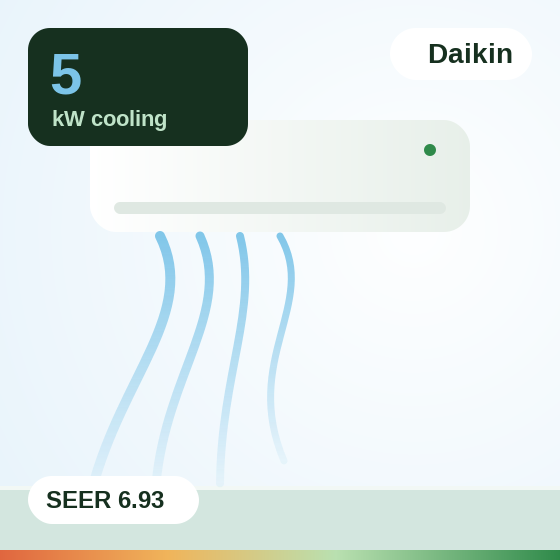
Daikin
Round Flow cassette FCAG60BVEB with Sky Air RZAG50B5V1B outdoor unit
5 kW cooling · SEER 6.93
No current UK price found
Figures from the maker or retailer listing. Cost an hour is our own, at the price cap of 26.32p a kWh.