Key takeaways
- A cassette air conditioner is a ceiling-mounted indoor unit, joined by refrigerant pipes to an outdoor unit. It is part of the same family of systems as the ones in our commercial air conditioning guide, and it is used in shops, offices and restaurants.
- Our worked example is Daikin’s Round Flow cassette. Daikin’s table gives the 5 kW model an annual cooling consumption of 252 kWh, which costs £72.04 a year at the DESNZ small-business average of 28.59p per kWh (excluding VAT), or £96.67 at the very small average of 38.36p.
- Three 5 kW cassettes under one person’s control come to 15 kW nominal, which is more than the 12 kW line for a TM44 inspection in England and Wales.
- We found no published installed price for a commercial cassette on 25 November 2026. One retailer, Hawco, sells its Haier cassette only to F-gas certified buyers, so ask installers for itemised quotes.
What is a cassette air conditioner?
A cassette is the indoor half of a split or multi split system, built to sit in the ceiling with only its panel showing. The outdoor unit does the same job as on a home split: it releases the heat the refrigerant has collected from the room. Our guides to split air conditioning and multi split air conditioning explain that cycle at home scale.
Daikin UK describes its Round Flow FCAG-B cassette as having “360° air discharge for optimum efficiency and comfort”, so air leaves on all four sides of the panel instead of from one wall unit. That is where the name “4 way cassette” comes from, though other makers use other air patterns.
Where do cassettes suit?
A cassette needs somewhere to go. Daikin’s FCAG-B page does not mention suspended ceilings, so ask an installer what void your ceiling has. The page does say the unit has the “Lowest installation height in the market: 214mm for class 20-63”, which is Daikin’s own claim.
Daikin UK’s retail page says “Concealed ceiling units blend in seamlessly with your interior and free up wall space for shelves and displays”. See how this plays out in shops and offices. Daikin calls its Sky Air range “The energy efficient solution for small to medium-sized commercial locations”.
Which features should you compare?
From Daikin’s FCAG-B page (checked 25 November 2026):
- Air pattern: “360° air discharge”.
- Filter: “Optional automatic filter cleaning panel results in higher efficiency & comfort and lower maintenance costs.” That is Daikin’s claim, with no figure.
- Sensors: “Two optional intelligent sensors improve energy efficiency and comfort.”
- Condensate: “Standard drain pump with 675mm lift increases flexibility and installation speed”. Cooling makes water, so every indoor unit needs a way to drain it.
- Fresh air: “Optional fresh air intake”. On our reading, a cassette does not supply fresh air unless that kit is fitted and the building is designed for it.
When you compare makes, ask for each model’s sound pressure figure and its SEER (seasonal energy efficiency ratio). Daikin’s table view gives no sound figure for these models, so for them it is “Not stated by the maker” on that page.
Example: Daikin Round Flow with a Sky Air outdoor unit
Daikin’s technical table gives these figures. We use them as one worked model, not as a recommendation; this is a feature summary from the maker’s documents, and we have tested nothing. These are commercial units, sold through installers.
| FCAG35B with RZAG35B | FCAG60B with RZAG50B | |
|---|---|---|
| Cooling, minimum / nominal / maximum | 1.6 / 3.5 / 4.5 kW | 1.7 / 5 / 6 kW |
| Heating, minimum / nominal / maximum | 1.4 / 4 / 5 kW | 1.5 / 5.8 / 6 kW |
| SEER (space cooling) | 7.3 | 6.93 |
| SCOP (space heating) | 4.3 | 4.35 |
| Energy class, space cooling | A++ | A++ |
| Annual cooling consumption | 168 kWh | 252 kWh |
The table also has a row headed “Energy Labelling Directive” with class A and annual figures of 398 and 628 kWh. Those come from a different method, so we use the space cooling figures, which are the ones from Daikin’s “Space cooling” rows. Our product files record R32 for both (Daikin UK, checked 14 November 2026). Sky Air is a heat pump, so these units can heat as well as cool: Daikin says it provides “heating in the winter and cooling in the summer”.
What does a cassette cost to run?
The domestic price cap does not apply to businesses, so use the unit rate on your own bill. As a guide this page uses DESNZ’s averages for April to June 2026, including Climate Change Levy and excluding VAT: 28.59p per kWh for small businesses (20 to 499 MWh a year) and 38.36p for very small ones (0 to 20 MWh). The running costs section of our commercial air conditioning guide explains the figures.
The label figure is worked out on 350 hours of cooling a year, so these are costs for that much use:
- 5 kW cassette: 252 kWh x 28.59p = £72.04 a year; at 38.36p, £96.67.
- 3.5 kW cassette: 168 kWh x 28.59p = £48.03 a year.
- Two 5 kW cassettes: 2 x 252 = 504 kWh; 504 kWh x 28.59p = £144.09 a year; at 38.36p, £193.34. Each further 100 hours for both is 144 kWh, or £41.17 at 28.59p and £55.24 at 38.36p.
- Per 100 hours (5 kW model): 252 / 350 = 0.72 kWh an hour on average, so 72 kWh, or £20.58 at 28.59p and £27.62 at 38.36p. A business that cools for more hours pays in proportion.
Real use depends on the weather, the building and the hours you trade. For comparison only, the domestic price cap for Great Britain (26.32p per kWh, 1 October to 31 December 2026) would make 252 kWh cost £66.33. A business does not pay that rate.
What does a cassette cost to buy and fit?
We searched for a published installed price for a commercial cassette on 25 November 2026 and found none. We will not give a typical figure, because we could not trace one to an installer’s own published price.
One equipment price does exist. Hawco lists a Haier 5 kW cassette indoor unit at £765.00 “excl. tax” (checked 25 November 2026). Its page says the outdoor unit is a separate item, and that “Refrigeration components sold must be installed by an FGAS certified engineer”. Treat that as one retailer’s condition of sale, not as an installed price.
What drives the price: capacity and number of indoor units, pipe and cable runs through the ceiling void, where the outdoor unit goes and how it is reached, the electrical supply, the drain route, controls, working out of hours, making good the ceiling, removing old equipment and commissioning. VAT on a business installation is at 20% by our reading of HMRC’s notice: its relief is for homes and certain charity buildings. See commercial air conditioning installation and Daikin’s commercial ranges. For home prices see air conditioning installation cost; they do not carry over to business premises.
What rules apply to a cassette?
This is general information, not legal advice.
- F-gas (Great Britain): GOV.UK says that for refrigeration, air conditioning and heat pump systems “you must have qualifications to” install, service and maintain, check for leaks, recover gases and decommission. A company that services this equipment for others “must be certified by an approved body”. See F-gas rules.
- TM44 inspection (England and Wales): GOV.UK’s guide covers systems with an effective rated output of more than 12 kW, and says units under one person’s control in one building are treated as one system. Three 5 kW cassettes make 15 kW nominal. Two make 10 kW nominal, but Daikin’s maximum cooling figure is 6 kW each, so ask an accredited energy assessor how the total is read. See TM44 inspections.
- Building regulations (England): GOV.UK lists “put in a fixed air-conditioning system” among projects that may need approval, and says “You do not need to get approval yourself if you use someone registered with a competent person scheme.”
- Planning (England): Planning Portal says air source heat pumps on non-domestic land “are likely to require an application for planning permission”. Ask the council before you order. See air conditioning planning permission.
- Fresh air: Regulation 6 of the Workplace (Health, Safety and Welfare) Regulations 1992 (England, Wales and Scotland) requires ventilation “by a sufficient quantity of fresh or purified air”. On our reading, cooling a room is not the same as ventilating it.
Leases are private contracts: check your lease and ask your landlord before an outdoor unit goes up.
How to brief an installer
- Floor plan, ceiling height and the depth of the ceiling void above each cassette position.
- People, equipment and opening hours in each area, and whether you need heating too.
- Where the outdoor unit could go, and whether your landlord and the council allow it.
- Your electrical supply details.
- Ask in writing for a heat load calculation, the make and model of every unit with its SEER and sound pressure figure, the F-gas company certificate number, the competent person scheme, the refrigerant type and charge for your records, what the price excludes, and warranty and servicing terms.
Frequently asked questions
What is a cassette air conditioner?
It is an indoor air conditioning unit fitted into the ceiling, connected by pipework to an outdoor unit. Daikin’s Round Flow version discharges air in “360°” around the panel.
Do cassettes need a suspended ceiling?
They sit in the ceiling, so you need a void deep enough. Daikin gives a minimum installation height of 214 mm for its class 20 to 63 units, and its page does not mention suspended ceilings, so ask the installer what your ceiling allows.
Can a cassette heat as well as cool?
Daikin’s Sky Air is a heat pump, and its table gives heating capacities of 4 kW and 5.8 kW nominal for the two models above.
How much does a cassette air conditioner cost to run?
On Daikin’s label figure of 252 kWh a year, the 5 kW model costs about £72.04 a year at 28.59p per kWh and £96.67 at 38.36p, excluding VAT. Use your own tariff rate, and scale for your hours.
Do cassettes bring in fresh air?
Not on their own, on our reading. Daikin lists an “Optional fresh air intake”. The workplace ventilation duty is separate from cooling.
Where does the condensate go?
Daikin’s FCAG-B has a “Standard drain pump with 675mm lift”. Ask the installer where the drain runs.
Do I need an F-gas engineer?
Yes. GOV.UK says you must have qualifications to install, service and check for leaks, and Hawco will only sell its cassette to buyers who can show a certified engineer will fit it.
Sources
- Daikin UK: Round Flow FCAG-B (checked 25 November 2026)
- Daikin UK: FCAG-B / RZAG-B technical details (checked 25 November 2026)
- Daikin UK: Retail (checked 25 November 2026)
- Daikin UK: Sky Air (checked 25 November 2026)
- Hawco: Haier 5 kW cassette indoor unit AB50S2SC2FA-H (checked 25 November 2026)
- GOV.UK: Air conditioning inspections for buildings, a guide (updated 5 November 2026) (checked 25 November 2026)
- GOV.UK: Qualifications to work with F gas (updated 3 March 2026) (checked 25 November 2026)
- GOV.UK: Certification for companies working on equipment containing F gas (checked 25 November 2026)
- GOV.UK: Building regulations approval, when you need approval (checked 25 November 2026)
- Planning Portal: Heat pumps, non-domestic (England) (checked 25 November 2026)
- legislation.gov.uk: Workplace (Health, Safety and Welfare) Regulations 1992, regulation 6 (checked 25 November 2026)
- HMRC: VAT on energy-saving materials and heating equipment (Notice 708/6) (checked 25 November 2026)
- DESNZ: Gas and electricity prices in the non-domestic sector (updated 29 September 2026); table file, sheet 3.4.2 (incl CCL), 2026 quarter 2 (figures as read from the file on 25 November 2026 for this cluster’s pillar; the page itself could not show them when we re-opened it)
- Ofgem: Changes to the energy price cap between 1 October and 31 December 2026 (rate as recorded in our energy file, checked 25 November 2026)
Products on this page
Daikin
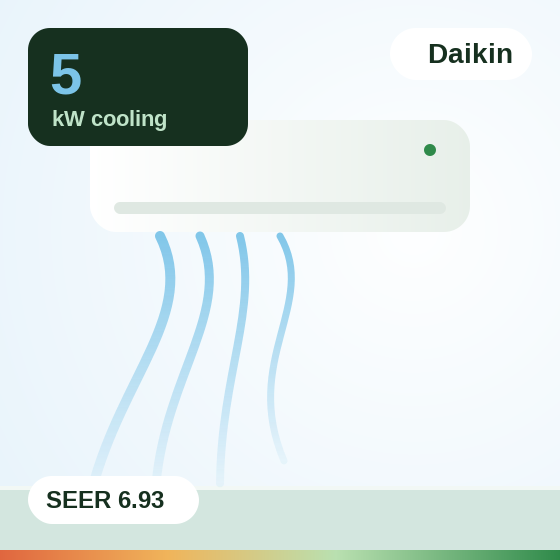
Round Flow cassette FCAG60BVEB with Sky Air RZAG50B5V1B outdoor unit
5 kW cooling · SEER 6.93
No current UK price found
Daikin
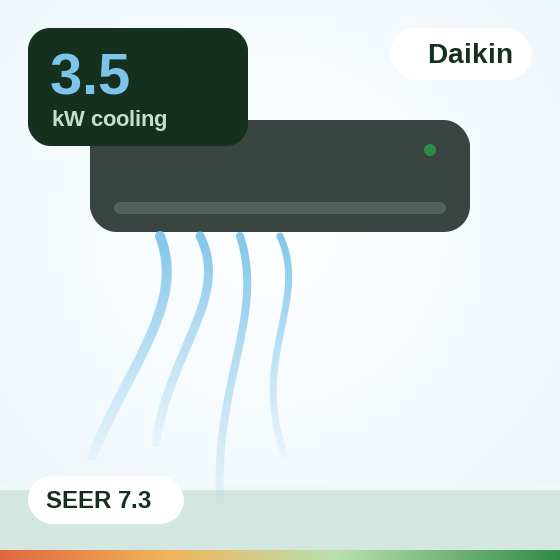
Round Flow cassette FCAG35BVEB with Sky Air RZAG35B5V1B outdoor unit
3.5 kW cooling · SEER 7.3
No current UK price found
Figures from the maker or retailer listing. Cost an hour is our own, at the price cap of 26.32p a kWh.