
Key takeaways
- An air conditioning engineer installs, services and repairs air conditioning. My World of Work calls the job refrigeration and air conditioning engineer.
- GOV.UK says F-gas qualifications are needed to install new systems, service and maintain them, check for leaks, recover gases and decommission old systems.
- A company working on equipment operated by others must also be certified by an approved body: Refcom, F-Gas Register (Quidos) or Bureau Veritas, as GOV.UK lists them.
- To check an engineer, ask for their F-gas qualification and their company’s certification, and get both in writing.
- This page gives no cost or pay figures. For prices, see our cost pages.
What is an air conditioning engineer?
An air conditioning engineer is the person who fits, maintains and repairs cooling systems. My World of Work describes the job as keeping buildings comfortable “by fitting, maintaining and fixing cooling systems”, under the title refrigeration and air conditioning engineer. The machine they work on is the one in our guide to how air conditioning works: a sealed refrigerant circuit, a compressor and two coils.
What does an air conditioning engineer do?
My World of Work lists duties that include:
- installing and commissioning refrigeration or air conditioning units;
- diagnosing faults and repairing broken systems;
- routine maintenance and safety checks;
- advising customers on upgrades or energy-saving options;
- handling refrigerant gases safely and legally;
- keeping detailed work records and compliance certificates.
What qualifications must they have?
The F-gas qualification
GOV.UK says you must have qualifications to install new systems, service and maintain systems, check for leaks, recover gases, and decommission and dispose of old systems. For refrigeration, air conditioning and heat pump work the categories are:
- Category 1: all activities.
- Category 2: installing, maintaining, servicing and recovering refrigerant on systems with less than 3 kg of F gas (less than 6 kg if hermetically sealed).
- Category 3: recovering refrigerant from those systems.
- Category 4: checking for leaks, if you do not break into the refrigeration circuit.
GOV.UK names the accredited bodies as City and Guilds, the Building Engineering Services Association (BESA) and LCL Awards, and says CITB no longer issues new F-gas qualifications. City and Guilds’ own page describes its 2079 F-Gas and ODS Regulations qualification as for “refrigeration, air-conditioning and heat pump system engineers working with fluorinated gas”.
Company certification
GOV.UK says a company, including a sole trader, “must be certified by an approved body to service stationary equipment containing F gas operated by others”. It names Refcom Certification Ltd, F-Gas Register (Quidos) and Bureau Veritas UK Ltd, and says certification must be renewed every 3 years. Refcom’s home page describes it as a UK F-gas certification scheme and register.
Building regulations competence
In England, GOV.UK lists putting in a fixed air-conditioning system among projects that may need building regulations approval, and says “you do not need to get approval yourself if you use someone registered with a competent person scheme”. GOV.UK’s competent person scheme list shows four schemes for mechanical ventilation and air-conditioning systems in dwellings and other buildings: BESCA, Blue Flame Certification, Certsure and NAPIT. It describes joining a scheme as optional for the installer; it does not say registration is compulsory for every job. We did not confirm the rules in Wales, Scotland or Northern Ireland.
R290 and flammable refrigerants
BESA’s guidance on R290 (propane), reported by the International Institute of Refrigeration, says the UK has no R290-specific rules beyond the F-Gas Regulations and stresses proper training for engineers who handle it. F-Gas Register’s bulletin says engineers working with flammable refrigerants “should have training in the specific handling requirements of them”. See R32 refrigerant and R290 air conditioners.
Do you need an air conditioning engineer?
| Your situation | What the sources say |
|---|---|
| Portable air conditioner | The qualification rules are for work on a refrigerant circuit. Follow the maker’s manual. |
| Split system already fitted | Servicing, leak checks and recovering refrigerant need F-gas qualifications. See servicing and maintenance. |
| Installing a new split | An F-gas qualified engineer from a certified company; in England, a competent person scheme means you do not apply for building regulations approval yourself. See installation. |
| A suspected leak or a fault | Do not break into the refrigerant circuit yourself. See repair. |
| Topping up refrigerant | A householder cannot lawfully buy F gas to top up: Article 11(4) of the F-gas Regulation says that for “installation, servicing, maintenance or repair”, F gases “shall only be sold to and purchased by undertakings that hold the relevant certificates” (or that employ certified people). See the F-gas guide. |
How to check an engineer
- Ask for their F-gas qualification and which body issued it.
- Ask which certified company they work for, and for the company’s certification in writing.
- Ask whether they are registered with a competent person scheme for air conditioning.
- Ask for the refrigerant and its charge in kilograms, and who is responsible for leak checks.
We do not describe any register’s search tool, because we did not confirm how one works.
Our worked example: where a home split sits against the lines
The Daikin Perfera 2.5 kW holds 0.95 kg of R32, according to Daikin’s table. That is 0.95 / 3 = 31.7% of the 3 kg line GOV.UK uses for category 2. In carbon terms, 0.95 x 675 / 1,000 = 0.64 tonnes CO2 equivalent, which is 12.8% of the 5 tonne step where regular leak checks begin. A different model holds a different amount; ask for the charge in your own system’s paperwork.
How to become one
My World of Work says entry routes include a Modern Apprenticeship (it suggests Electrical Installation) or qualifications at college, such as an HNC or HND, and that you must hold current F Gas Certification once in a job. It states no pay figure, and neither do we. No source we opened gives a length of training.
Frequently asked questions
What does an air conditioning engineer do?
They install and commission units, diagnose and repair faults, carry out maintenance and safety checks, advise on upgrades and handle refrigerant legally, keeping records (My World of Work).
Do air conditioning engineers need to be F-gas qualified?
Yes, for work on the refrigerant circuit. GOV.UK says you must have qualifications to install, service, leak check, recover gases from and decommission systems containing F gas.
Is an air conditioning engineer the same as an HVAC engineer?
My World of Work lists “Also known as: HVAC engineer” for the refrigeration and air conditioning engineer job, so it treats the two titles as one job. See what HVAC is and choosing an HVAC company.
How do I check an air conditioning engineer is qualified?
Ask for their F-gas qualification and their company’s certification (Refcom, F-Gas Register (Quidos) or Bureau Veritas, as GOV.UK lists them), and ask about a competent person scheme. Get the answers in writing.
Can an electrician install air conditioning?
The refrigerant work needs F-gas qualifications. The electrical supply is a separate job. No source we opened covers who may fit a split system from end to end, so check both.
How much does an air conditioning engineer cost?
We give no figure here. See air conditioning installation cost and service cost.
How long does it take to become one?
No source we opened gives a duration. The route is an apprenticeship or a college course, then F-gas certification (My World of Work).
Sources
- My World of Work: Refrigeration and air conditioning engineer (checked 15 November 2026)
- GOV.UK: Qualifications to work with F gas (updated 3 March 2026) (checked 15 November 2026)
- GOV.UK: Company certification to work with F gas (updated 21 August 2019) (checked 15 November 2026)
- City and Guilds: F GAS and ODS Regulations (2079) (checked 15 November 2026)
- Refcom: home page (checked 15 November 2026)
- GOV.UK: Building regulations approval, when you need approval (checked 15 November 2026)
- GOV.UK: Competent person scheme, current schemes and how schemes are authorised (updated 17 September 2026) (checked 15 November 2026)
- IIF-IIR: BESA releases new guidelines for safe use of R290 (propane) in heating and cooling systems (1 August 2024) (checked 15 November 2026)
- ACR Journal (F-Gas Register bulletin): Flammable refrigerants in air conditioning and heat pump systems, 9 March 2026 (checked 15 November 2026)
- Daikin Europe: specifications table RXM-A9 (RXM25A5V1B9) (checked 15 November 2026)
- legislation.gov.uk: Regulation (EU) No 517/2014 as it applies in GB, Annex I (GWP of F gases) (checked 15 November 2026)
- GOV.UK: Checking F gas equipment for leaks (checked 15 November 2026)
- legislation.gov.uk: Regulation (EU) No 517/2014 as it applies in GB, Article 11 (restrictions on placing on the market) (checked 15 November 2026)
Products on this page
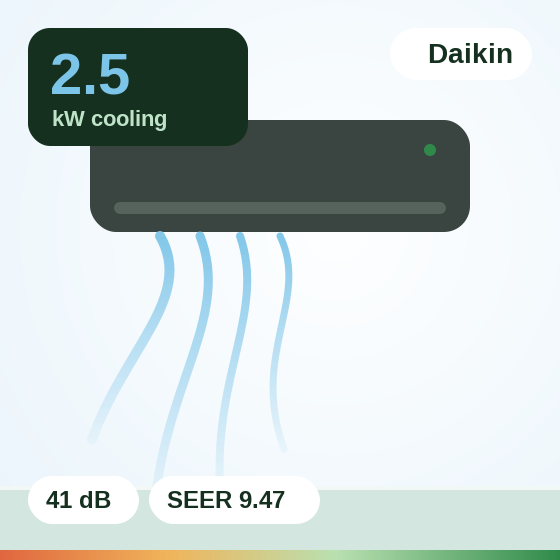
Daikin
Perfera FTXM25A (indoor) with RXM25A5V1B9 (outdoor), 2.5 kW
2.5 kW cooling · 41 dB · SEER 9.47
No current UK price found
Figures from the maker or retailer listing. Cost an hour is our own, at the price cap of 26.32p a kWh.