Key takeaways
- Office air conditioning is often wall splits or ceiling cassettes for a small office, VRF where there are many rooms, or fan coil units fed by a chiller in larger buildings. Our commercial air conditioning guide compares them.
- A heat load survey by the installer sets the size. One maker’s rule of thumb, Broughton’s 46 W per cubic metre for modern offices, gives about 9.9 kW for a 10 m x 8 m x 2.7 m office; that is one maker’s figure for portable cooling, not a standard.
- On DESNZ’s small-business average of 28.59p per kWh (April to June 2026, excluding VAT), two Daikin 5 kW cassettes’ label consumption of 504 kWh a year costs £144.09.
- Regulation 7 says the temperature in indoor workplaces “shall be reasonable”; on a maximum, HSE says “There’s no law for maximum working temperature, or when it’s too hot to work, because every workplace is different.” An enclosed workplace also needs fresh air, and on our reading cooling that only recirculates air does not supply it.
What are the options for an office?
- Wall-mounted splits: one indoor unit per room, each linked to an outdoor unit. See split air conditioning and multi split air conditioning.
- Ceiling cassettes: indoor units in the ceiling, with air discharged on several sides. See cassette air conditioning units.
- Ducted: see ducted air conditioning.
- VRF: one outdoor unit serving many indoor units. Designing Buildings cites hotels, “where some rooms may be unoccupied whilst others have a very high thermal demand”, as a good fit, and says VRF “may be less suited to large uniform spaces”. See VRF air conditioning.
- Fan coil units: Designing Buildings says a fan coil unit is “mounted in the ceiling void or floor mounted often at the perimeter of a building”, with hot and chilled water supplied by central plant. See fan coil units.
- Portable units: a stopgap; see commercial portable air conditioners. A server room has different needs: see server room air conditioning.
How big a system does an office need?
A heat load survey first
The installer or a building services engineer should calculate the heat load. Broughton says an accurate cooling calculation usually requires a site visit. We do not give a sizing rule of our own for offices.
One maker’s rule of thumb
Broughton, which makes portable air conditioners, lists “Normal, Modern Offices ± 46 W per m³”. Treat it as a first guide for portable cooling, not a design figure.
Worked example (our arithmetic). An office 10 m x 8 m x 2.7 m is 216 m³. 216 x 46 = 9,936 W, about 9.9 kW.
Heat from equipment
Broughton also lists approximate heat loads: a PC about 150 W, a laser printer about 500 W, a photocopier about 200 W on standby and 1,000 W in use, a coffee machine about 800 W. For 10 PCs, a laser printer, a photocopier in use and a coffee machine, that is 1,500 + 500 + 1,000 + 800 = 3,800 W. Broughton’s page does not say whether the 46 W per m³ already includes such equipment, so a survey has to settle it.
Two Daikin 5 kW cassettes would be 10 kW nominal cooling, which is near that rule’s figure; that is a comparison of two numbers, not a sizing. See the example cassette in our Daikin page. For a home room use the BTU calculator.
Fresh air and temperature: what the law says
This is general information, not legal advice. Regulations 6 and 7 of the Workplace (Health, Safety and Welfare) Regulations 1992 cover England, Wales and Scotland.
- Ventilation: regulation 6(1) says “Effective and suitable provision shall be made to ensure that every enclosed workplace is ventilated by a sufficient quantity of fresh or purified air.” HSE’s page on assessing the risk of poor ventilation says that HSE’s Approved Code of Practice and guidance states “The fresh-air supply rate should not normally fall below 5 to 8 litres per second, per occupant.” HSE says recirculating systems, “including air-conditioning systems”, should be designed with fresh air inlets that are kept open. On our reading, a split or cassette that only recirculates room air cools the room but does not supply fresh air.
- Temperature: regulation 7(1) says “During working hours, the temperature in all workplaces inside buildings shall be reasonable.” HSE says employers must stick to health and safety law, including “keeping the temperature at a comfortable level”, that the minimum temperature in an indoor workplace “should normally be at least” 16C (13C if much of the work involves rigorous physical effort), and “There’s no law for maximum working temperature, or when it’s too hot to work, because every workplace is different.” Regulation 7(3) says “A sufficient number of thermometers shall be provided”.
See workplace temperature law. Northern Ireland’s ventilation rule was not checked.
What does office air conditioning cost to run?
The domestic price cap does not apply to businesses, so use the unit rate on your own bill. As a guide this page uses DESNZ’s averages for April to June 2026, including Climate Change Levy and excluding VAT: 28.59p per kWh for small businesses (20 to 499 MWh a year) and 38.36p for very small ones (0 to 20 MWh). The running costs section of our commercial air conditioning guide explains the figures.
Two 5 kW cassettes. Two Daikin Round Flow FCAG60B cassettes use 504 kWh a year on the label’s 350 hours: £144.09 a year at 28.59p, or £193.34 at 38.36p. The full working, and the cost of longer hours, is on our cassette air conditioning page.
We found no published installed price for office air conditioning on 25 November 2026. See commercial air conditioning installation for the cost drivers.
Leased offices
Your lease is a private contract: check it and ask your landlord before an outdoor unit goes up or work starts. For TM44 inspections in England and Wales, GOV.UK’s guide says the owner usually controls a central system, and that for equipment the occupier installed locally, “the responsibility will lie with the occupier as they own the system”. The inspection rules apply above 12 kW; see TM44 inspections. In England, Planning Portal says air source heat pumps on non-domestic land “are likely to require an application for planning permission”; ask the council. See landlords and air conditioning.
Quick fixes in a heatwave
HSE’s steps for keeping people comfortable when it is too hot include “Provide fans, such as desk, pedestal or ceiling-mounted ones”, “Provide air-cooling or air-conditioning and adequate ventilation”, “Ensure windows can be opened to keep air circulating”, shading windows, positioning workstations away from direct sunlight or heat, and cold water dispensers. A portable unit is an option for a few weeks; see commercial portable air conditioners.
How to brief an installer
- Floor plans and ceiling heights, including any ceiling void.
- People and equipment in each room, and hours of use.
- Which rooms need heating as well as cooling.
- Where an outdoor unit could go, and whether your landlord and the council allow it.
- Your electrical supply details, and any existing system’s make, model and refrigerant.
- Ask in writing for a heat load calculation, the make, model and SEER of every unit, the F-gas company certificate number, the competent person scheme, how fresh air will be provided, what the price excludes, warranty and servicing terms, and the refrigerant charge.
Frequently asked questions
What size air conditioning does an office need?
A heat load survey decides. As a first guide, Broughton gives about 46 W per cubic metre for modern offices for its portable units, which makes about 9.9 kW for a 216 m³ office; Broughton does not say whether that includes equipment.
What is the best air conditioning for an office?
It depends on the layout and building. Splits or cassettes suit small offices, Designing Buildings says VRF suits buildings with many spaces and varying demand, and fan coil units suit buildings with central plant. We do not rank them.
What temperature should an office be?
Regulation 7 says the temperature in indoor workplaces “shall be reasonable”; on a maximum, HSE says “There’s no law for maximum working temperature, or when it’s too hot to work, because every workplace is different.” HSE says the minimum “should normally be at least” 16C (13C if much of the work involves rigorous physical effort).
Can my employer refuse to put air conditioning in?
Regulation 7 sets the standard as a reasonable temperature, and HSE’s list of steps for hot workplaces includes air conditioning alongside fans, shading and cold water. Raise it with your employer, and see workplace temperature law.
Does office air conditioning need a TM44 inspection?
In England and Wales, if the effective rated output of the system, adding units under one person’s control in one building, is more than 12 kW.
Do portable air conditioners work in offices?
They can serve as a stopgap; see commercial portable air conditioners.
Does air conditioning provide fresh air?
Not on its own, on our reading. HSE says recirculating systems should have fresh air inlets, and regulation 6 asks for “a sufficient quantity of fresh or purified air”.
Sources
- Broughton: MCe9.0 and range details (checked 25 November 2026; on 28 November 2026 the address opened Broughton’s category page, not the product page)
- HSE: Temperature in the workplace (updated 3 November 2026) (checked 27 November 2026)
- HSE: Managing workplace temperature (checked 25 November 2026)
- legislation.gov.uk: Workplace (Health, Safety and Welfare) Regulations 1992, regulation 6 (checked 25 November 2026)
- legislation.gov.uk: Workplace (Health, Safety and Welfare) Regulations 1992, regulation 7 (checked 25 November 2026)
- HSE: Assessing the risk of poor ventilation (updated 18 July 2025) (checked 25 November 2026)
- HSE: How to improve ventilation (checked 25 November 2026)
- Designing Buildings: Variable refrigerant flow VRF (last edited 3 August 2021) (checked 25 November 2026)
- Designing Buildings: Fan coil unit (last edited 4 August 2022) (checked 25 November 2026)
- Daikin UK: FCAG-B / RZAG-B technical details (checked 25 November 2026)
- GOV.UK: Air conditioning inspections for buildings, a guide (updated 5 November 2026) (checked 25 November 2026)
- Planning Portal: Heat pumps, non-domestic (England) (checked 25 November 2026)
- DESNZ: Gas and electricity prices in the non-domestic sector (updated 29 September 2026); table file, sheet 3.4.2 (incl CCL), 2026 quarter 2 (figures as read from the file on 25 November 2026 for this cluster’s pillar; the page itself could not show them when we re-opened it)
Products on this page
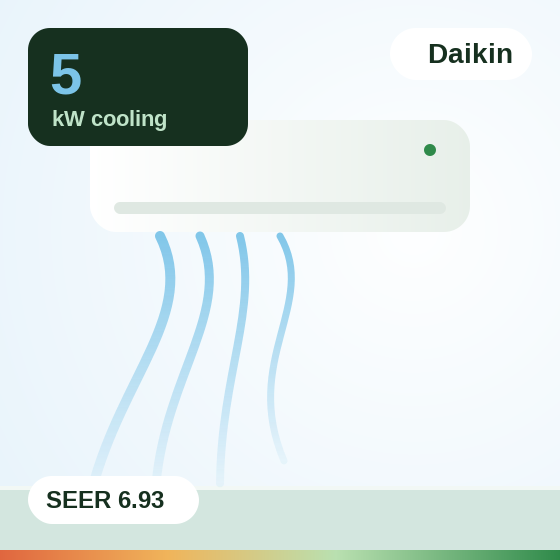
Daikin
Round Flow cassette FCAG60BVEB with Sky Air RZAG50B5V1B outdoor unit
5 kW cooling · SEER 6.93
No current UK price found
Figures from the maker or retailer listing. Cost an hour is our own, at the price cap of 26.32p a kWh.