Key takeaways
- Server room air conditioning (part of our commercial air conditioning guide) has to run all year, not just in summer. Every kilowatt of cooling electricity running for 8,760 hours costs £2,504.38 at DESNZ’s April to June 2026 small business average (28.59p per kWh, excluding VAT), and £3,360.37 at the very small business average (38.36p).
- Daikin, a maker of both comfort and server room cooling, says a server room is a different job from comfort cooling: it needs round-the-clock operation and a backup that takes over instantly. That is a maker’s view.
- A temperature range is not given here. Use the inlet temperature range your server maker states.
- For a small business, the options run from a wall split or cassette specified for continuous use to dedicated close control units, with a second unit for backup. A portable is a stopgap.
- The domestic price cap does not apply to businesses.
Why are server rooms different?
Our working, not a source’s: almost all the electricity an IT device draws ends up as heat in the room, so a 1.5 kW comms cupboard produces about 1.5 kW of heat, continuously. The cooling has to remove it every hour of the year. A domestic energy label is worked out on 350 hours of cooling a year; a server room runs 8,760 hours, about 25 times as long (8,760 / 350 = 25.0).
For the other parts of the picture, see our pillar guide to commercial air conditioning and office air conditioning.
How does comfort cooling differ from close control?
Close control (or precision) cooling means units built for equipment rather than people. Daikin’s “Infrastructure cooling solution” brochure (it carries the code ECPEN17-140 and we could not date it) says infrastructure cooling “removes the heat that is constantly generated by IT equipment, servers and business supporting equipment”. It sets out its own view:
- Rooms like these “require round-the-clock cooling”.
- “Indoor systems for infrastructure cooling environments need enhanced capabilities for continuous heat transfer because they work harder to extract energy by cooling dry air.”
- “When a failure occurs (error or shutdown by the temperature protection function), a dependable backup system should take over instantly.”
- Its own answer is a split system with “duty rotation control, automatic backup activation and remote alarms”.
Daikin sells all of these, so treat the brochure as a maker’s view with no stated test method. The brochure also lists “closed control systems” as a more sophisticated and more expensive option, and we did not read the detail.
What are the options for a small server room?
- A wall split or cassette. Possible if the unit is sized and specified for continuous running and you accept the maker’s limits. Ask the maker or installer in writing whether the model is intended for 24-hour use. See split air conditioners.
- A close control or infrastructure unit. Built for the duty; costs more. Ask for a quote against the same IT load.
- Two units for backup. Daikin describes a backup that takes over; how much backup you need is a risk decision, which your IT provider should help you make.
- A portable as a stopgap. If the cooling fails, a hired or owned portable can keep a room going. Broughton’s MCSe6.7, a water-cooled split portable, has a 35 m umbilical line to a heat exchanger box, so the hot air need not be ducted out of the room (April 2025 sheet, read 25 November 2026). See commercial portable air conditioners and the best industrial portable air conditioners.
How do you size it?
A heat load survey by an installer or building services engineer sets the size. As a start, add up the electrical input of every item in the room in watts, including uninterruptible power supplies (UPS) and lighting. Server Room Environments says dense racks can reach “15kW or more within a server rack”, and that heat from UPS units, PDUs, lighting and the building fabric must be considered. Broughton’s page gives office heat loads of about 150 W for a PC, 500 W for a laser printer and 1,000 W for a photocopier in use. Tell the installer both the load now and the load you plan to add.
What does it cost to run all year?
The domestic price cap does not apply to businesses, so use the unit rate on your own bill. As a guide this page uses DESNZ’s averages for April to June 2026, including Climate Change Levy and excluding VAT: 28.59p per kWh for small businesses (20 to 499 MWh a year) and 38.36p for very small ones (0 to 20 MWh). The running costs section of our commercial air conditioning guide explains the figures.
- 1 kW of electrical input running all year is 8,760 kWh.
- At 28.59p that is £2,504.38; at 38.36p it is £3,360.37.
- The 1.5 kW of IT equipment in our example is itself 13,140 kWh a year, £3,756.57 at 28.59p. The cooling unit’s own electricity is on top.
For the stopgap: Broughton gives a running current, not a wattage. The MCSe6.7’s 12.4 A at 35C and 40% relative humidity gives 230 V x 12.4 A = 2.852 kVA, our upper estimate of input. At 28.59p that is up to 81.5p an hour, or £6.52 for 8 hours; at 38.36p, up to £8.75. Real power is lower if the power factor is below 1.
What about monitoring and alarms?
Regulation 6(2) of the Workplace (Health, Safety and Welfare) Regulations 1992 (England, Wales and Scotland) says plant used for ventilation “shall include an effective device” “to give visible or audible warning of any failure of the plant where necessary for reasons of health or safety.” That is about ventilation plant for people, and we do not say it applies to cooling an IT room. A temperature alarm for the equipment is a sensible idea, but we found no source that says what is needed, so ask your IT provider. This is general information, not legal advice.
How often should it be serviced?
F-gas leak checks follow the refrigerant’s CO2 equivalent: see commercial air conditioning servicing. One installer, Server Room Environments, says most makers recommend servicing twice a year and that harsh environments may need three or more visits, so a unit that never rests may need more. That is the installer’s statement.
How to brief an installer
- The IT load in kW now and planned, from the equipment’s rated inputs.
- Room size, ceiling height and any heat from UPS units and lighting.
- How much backup you want: one unit, or two.
- Out-of-hours response: who is called, and how fast the contract promises to attend.
- Where an outdoor unit could go, and whether the landlord and council allow it.
- Ask for: the unit’s duty rating for 24-hour running, the F-gas company certificate number, what the price excludes, and the refrigerant charge for your records.
Frequently asked questions
What temperature should a server room be?
Use the inlet temperature range your server maker states. We do not quote an industry range because we could not read one from the standard body or a server maker’s own page.
Can I use a normal air conditioner in a server room?
It may be possible for a small room if the unit is sized and specified for continuous running. Daikin says infrastructure cooling needs round-the-clock operation and a backup; ask the maker in writing whether your model is intended for it.
What is close control air conditioning?
Cooling designed for equipment: it runs all year and is built around the heat of IT kit rather than people. Daikin’s brochure describes infrastructure cooling as removing heat “constantly generated by IT equipment, servers and business supporting equipment”.
Do server rooms need backup cooling?
That is a risk decision. Daikin says “a dependable backup system should take over instantly” when a failure occurs. Ask your IT provider what a failed cooling system would cost you.
How much does server room cooling cost to run?
Each kW of electrical input running all year is 8,760 kWh: £2,504.38 at 28.59p and £3,360.37 at 38.36p per kWh, DESNZ April to June 2026, excluding VAT. Use your own rate.
Can a portable air conditioner cool a server room?
As a stopgap, yes in principle if the heat can leave the room. Broughton’s MCSe6.7 uses a heat exchanger box on a line of up to 35 m instead of an exhaust duct. We have not tested any unit, and Broughton gives no rating for continuous use in the sheet we read.
Sources
- Daikin: Infrastructure cooling solution brochure (ECPEN17-140, undated) (checked 25 November 2026)
- Server Room Environments: Server room cooling systems (checked 25 November 2026)
- Server Room Environments: Air conditioner maintenance contracts (checked 25 November 2026)
- Broughton: MCSe6.7 specification sheet, April 2025 (checked 25 November 2026)
- Broughton: MCe9.0 range details and heat loads (checked 25 November 2026; on 28 November 2026 the address opened Broughton’s category page, not the product page)
- legislation.gov.uk: Workplace (Health, Safety and Welfare) Regulations 1992, regulation 6 (checked 25 November 2026)
- DESNZ: Gas and electricity prices in the non-domestic sector, table 3.4.2 (checked 25 November 2026)
Products on this page
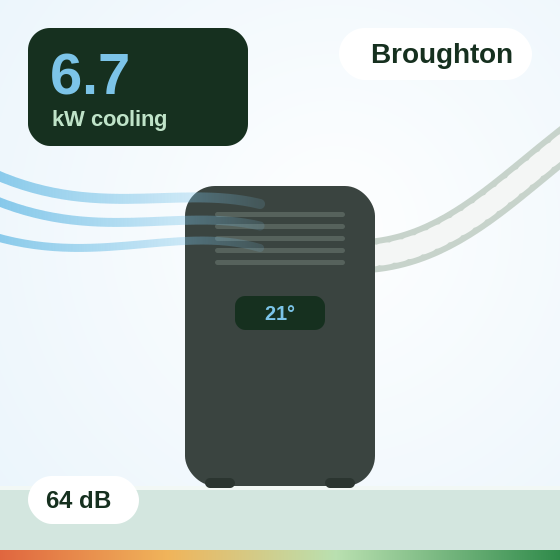
Broughton
Mighty Cool MCSe6.7 Low GWP Portable Water Cooled Split Air Conditioner (230V)
6.7 kW cooling · 64 dB
£3828.00 at National Heater Shops, checked 25 Nov 2026
See it at National Heater Shops
Figures from the maker or retailer listing. Cost an hour is our own, at the price cap of 26.32p a kWh.