Key takeaways
- Industrial air conditioning (part of our commercial air conditioning guide) means one of two jobs: cooling people, or cooling a process. Chillers can do both, according to Designing Buildings, while portables and evaporative coolers are mostly spot or people cooling.
- Regulation 7 says the temperature in indoor workplaces “shall be reasonable”; on a maximum, HSE says “There’s no law for maximum working temperature, or when it’s too hot to work, because every workplace is different.” HSE’s steps for hot workplaces include air cooling or air conditioning with adequate ventilation, fans and “Place insulating materials around hot plant and pipes”.
- Cooling towers and evaporative condensers bring legionella duties and a notification duty; ordinary air-cooled units are not on HSE’s list of sources.
- On DESNZ’s small-business average of 28.59p per kWh (April to June 2026, excluding VAT), our upper estimate for one 8-hour shift is £5.42 for a Broughton MCe9.0 portable and 52.6p for a 230 W evaporative cooler. They do different jobs, so the sum is not a like for like comparison.
People cooling or process cooling?
First decide what you are cooling. Designing Buildings says chillers “mainly provide comfort cooling for HVAC systems” and “can also be used to provide cooling for industrial processes”. A process may need a set temperature all year; a workshop for people needs comfort in summer. Our commercial air conditioning guide covers the building types, and warehouse air conditioning covers large open storage.
Inspection rules are one place where this matters, in Scotland: regulation 17 of the Building (Scotland) Regulations 2004 does not apply to systems “with a total effective output rating of less than 12 kW” or, according to our rules data (checked 14 November 2026), to systems solely for processes. England and Wales: GOV.UK’s guide says inspections cover “All air conditioning systems with an effective rated output of greater than 12kW”; we did not confirm any process exemption, so do not assume one. See TM44 inspections. This is general information, not legal advice.
The options
Chillers and air handling units
Designing Buildings says “Chillers remove heat from a liquid through a refrigeration cycle”. Air-cooled chillers reject heat to outside air; water-cooled chillers are generally suited to large systems and need a connection to cooling towers. An air handling unit is an insulated box that may hold filters, a fan, heating and cooling elements, dehumidification, sound attenuators and dampers. Daikin Applied UK makes air handling units, chillers and heat pumps for “large-scale bespoke projects, from data centres and hospitals to large offices and universities”; see Daikin commercial ranges.
VRF and large splits
Variable refrigerant flow joins one outdoor unit to several indoor units. Designing Buildings says it is “best suited to buildings with multiple spaces, varying heating and cooling demand” such as hotels, and less suited to large uniform spaces such as gymnasiums or theatres. See VRF air conditioning.
Industrial portable air conditioners
Broughton’s range page lists the MCSe6.7 water-cooled split (6.7 kW cooling duty, “Standard 13A supply”), the MCe7.3 monobloc (nominal 7.3 kW, “Standard 13A supply”), the MCe6.0, MCe9.0 and MCSe14.6. Broughton’s sheets, as recorded in our product files (checked 14 November 2026), give the MCe9.0 an operating range of 15 to 35C and the MCe7.3 21 to 35C, both with an IP2X rating. See the best industrial portable air conditioners and commercial portable air conditioners.
Evaporative coolers
The Energy Technology List (DESNZ, 4 October 2024) says “Direct evaporative coolers can achieve energy and carbon savings of up to 80% compared to air conditioning” and “This can lead to high humidity levels in the cooled air produced.” That is a government list’s “up to” claim, with a humidity caveat. Broughton’s range page describes its Comcool52 as “ideal for large open spaces such as warehouses and outdoors where traditional air conditioning is not an option”. See evaporative cooler explained and evaporative cooler versus air conditioner.
Fans
Air movement is not cooling, but HSE lists fans among its steps. See industrial cooling fans.
Heat in workplaces: the law
Regulation 7(1) of the Workplace (Health, Safety and Welfare) Regulations 1992 (England, Wales and Scotland) says “During working hours, the temperature in all workplaces inside buildings shall be reasonable.” HSE says “There’s no law for maximum working temperature, or when it’s too hot to work, because every workplace is different.” Its steps include “Provide air-cooling or air-conditioning and adequate ventilation”, “Provide fans”, shading, breaks, cold water and “Place insulating materials around hot plant and pipes”. See workplace temperature law.
Legionella if you use cooling towers or evaporative condensers
HSE names “cooling tower and evaporative condensers” among the most common sources of legionella; air conditioning is not named. HSE says “If you have a cooling tower or evaporative condenser, you should put in place appropriate measures to prevent or control the” risk of legionella. Regulation 3 of the Notification of Cooling Towers and Evaporative Condensers Regulations 1992 requires a person in control of premises to ensure no notifiable device is on them unless notified in writing to the local authority on HSE’s approved form. We did not open a source on portable evaporative coolers beyond the maker’s cleaning instructions.
F-gas at industrial scale
In Great Britain leak checks are required from 5 tonnes CO2 equivalent (about 7.4 kg of R32): at least every 12 months, or 24 with a leak detection system; every 6 months from 50 tonnes, or 12 with one. Equipment of 500 tonnes or more must have a leak detection system and is then checked at least every 6 months. For R32, the steps start at 7.41 kg, 74.07 kg and 740.74 kg; for R410A (about 2,088 GWP, US EPA) at 2.39, 23.95 and 239.46 kg. The R410A figure is the US EPA’s, used here for illustration only; we did not check the figure the GB F-gas Regulation uses for this blend, so ask your engineer for the system’s CO2 equivalent. Find the charge on the rating plate. See F-gas regulations.
Running costs
The domestic price cap does not apply to businesses, so use the unit rate on your own bill. As a guide this page uses DESNZ’s averages for April to June 2026, including Climate Change Levy and excluding VAT: 28.59p per kWh for small businesses (20 to 499 MWh a year) and 38.36p for very small ones (0 to 20 MWh). The running costs section of our commercial air conditioning guide explains the figures.
Broughton publishes a running current, not a wattage. 230 V x current = our upper estimate of input; real power is lower if the power factor is below 1. Cost for one 8-hour shift at 28.59p:
| Unit | Running current | Upper estimate of input | Per hour | 8-hour shift |
|---|---|---|---|---|
| Broughton MCe9.0 (9 kW cooling) | 10.3 A | 2.369 kVA | up to 67.7p | up to £5.42 |
| Broughton MCe7.3 (nominal 7.3 kW) | 11.5 A | 2.645 kVA | up to 75.6p | up to £6.05 |
| Maha Kool 70 L evaporative cooler | 230 W stated | 0.23 kW | 6.6p | 52.6p (1.84 kWh) |
At 38.36p the shifts are £7.27, £8.12 and 70.6p. The evaporative cooler gives no rated cooling output and adds humidity, so these figures are not a like for like comparison. The Maha Kool was listed at £419.99 at B&Q’s online marketplace on 14 November 2026 (our product file); we did not re-check it. The MCe7.3 was listed at £1,950.00 excluding VAT (£2,340.00 including VAT) at National Heater Shops, shown as out of stock, on 14 November 2026. We found no price for the MCe9.0.
How to brief an installer
- Give the process heat loads in kW, the hours of use and the target temperature.
- Describe dust, oil mist, washdown and the IP rating you need (Broughton’s units are rated IP2X).
- Say whether you need people cooling, process cooling or both.
- Ask for the F-gas certificate number, the refrigerant and charge, and any cooling tower or evaporative condenser the design uses, with the legionella arrangements.
Frequently asked questions
What is the best way to cool a factory?
It depends on where the heat comes from, the size of the space and how much humidity you can accept. Options are chillers with air handling units, VRF, portables for spot cooling, evaporative coolers and fans, and a survey should decide.
Is there a maximum temperature for factory workers?
Regulation 7 says the temperature in indoor workplaces “shall be reasonable”; on a maximum, HSE says “There’s no law for maximum working temperature, or when it’s too hot to work, because every workplace is different.”
Are evaporative coolers suitable for industrial buildings?
The Energy Technology List says direct coolers can save up to 80% against air conditioning but can lead to high humidity in the cooled air. Check whether your process tolerates humidity.
Do industrial chillers need a cooling tower?
Water-cooled chillers need a connection to cooling towers, according to Designing Buildings; air-cooled chillers do not. Cooling towers bring legionella and notification duties.
Do industrial systems need TM44 inspections?
In England and Wales, GOV.UK says inspections cover air conditioning systems with an effective rated output of greater than 12 kW. Scotland’s rule, as recorded in our rules data, excludes systems solely for processes.
Can I use a portable air conditioner in a workshop?
For spot cooling, Broughton sells industrial portables; check the operating range (15 or 21 to 35C on the sheets we recorded) and the IP2X rating against your conditions.
Sources
- Designing Buildings: Chiller (last edited 16 December 2025) (checked 25 November 2026)
- Designing Buildings: HVAC (last edited 8 September 2026) (checked 25 November 2026)
- Designing Buildings: Variable refrigerant flow VRF (last edited 3 August 2021) (checked 25 November 2026)
- Daikin Applied UK: About us (checked 25 November 2026)
- Broughton: Industrial portable air conditioning range (checked 25 November 2026)
- Broughton: MCe9.0 specification sheet (May 2023) and MCe7.3 specification sheet (June 2025) (checked 14 November 2026, as recorded in our product files; the PDFs could not be re-read on 25 November 2026)
- DESNZ Energy Technology List: Energy-efficient evaporative air coolers (4 October 2024) (checked 25 November 2026)
- HSE: Temperature in the workplace (updated 3 November 2026) (checked 27 November 2026)
- HSE: Managing workplace temperature (checked 25 November 2026)
- legislation.gov.uk: Workplace Regulations 1992, regulation 7 (checked 25 November 2026)
- HSE: Legionella, workplace risks (checked 25 November 2026)
- HSE: Evaporative cooling systems (updated 14 January 2026) (checked 25 November 2026)
- legislation.gov.uk: Notification of Cooling Towers and Evaporative Condensers Regulations 1992, regulation 3 (checked 25 November 2026)
- legislation.gov.uk: F-gas Regulation (EU) No 517/2014 as it applies in Great Britain, Article 4 and Article 5 (checked 25 November 2026)
- US EPA: Technology Transitions GWP reference table (updated 2 April 2026) (checked 25 November 2026)
- GOV.UK: Air conditioning inspections for buildings, a guide (updated 5 November 2026) (checked 25 November 2026)
- legislation.gov.uk: Building (Scotland) Regulations 2004, regulation 17 (checked 14 November 2026, as recorded in our rules data)
- B&Q: Maha Kool 70L industrial evaporative cooler (checked 14 November 2026, as recorded in our product file)
- National Heater Shops: Broughton MCe7.3 (checked 14 November 2026, as recorded in our product file)
- DESNZ: Gas and electricity prices in the non-domestic sector (updated 29 September 2026), Table 3.4.2 including CCL, 2026 quarter 2 (page opened 25 November 2026; figures from table_341.xlsx)
Products on this page
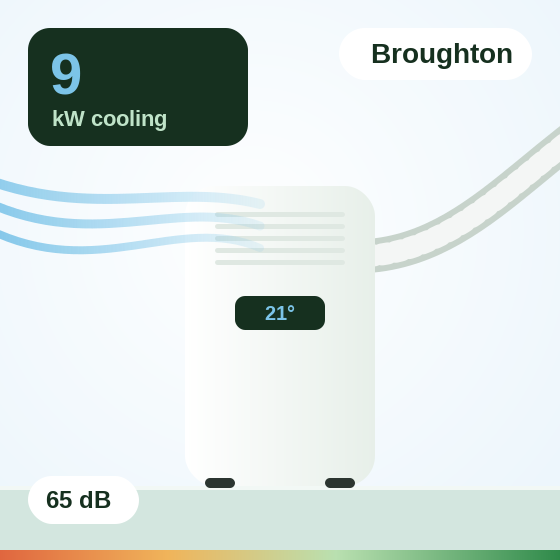
Broughton
Mighty Cool MCe9.0 Low GWP Portable Monoblock Air Conditioner (230V)
9 kW cooling · 65 dB
No current UK price found
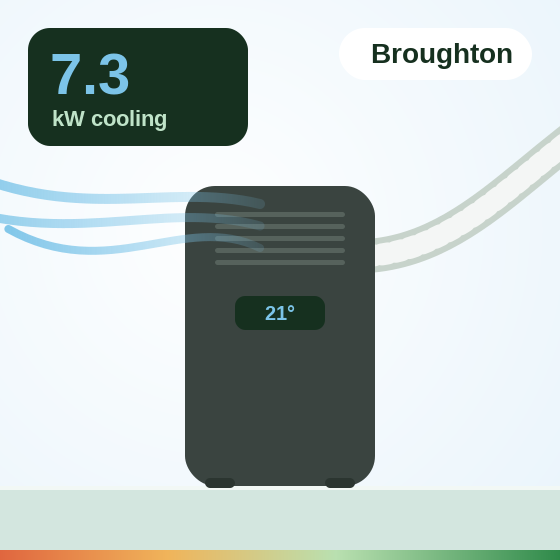
Broughton
Mighty Cool MCe7.3 Low GWP Portable Monoblock Air Conditioner (230V)
7.3 kW cooling
£2340.00 at National Heater Shops, checked 14 Nov 2026
See it at National Heater Shops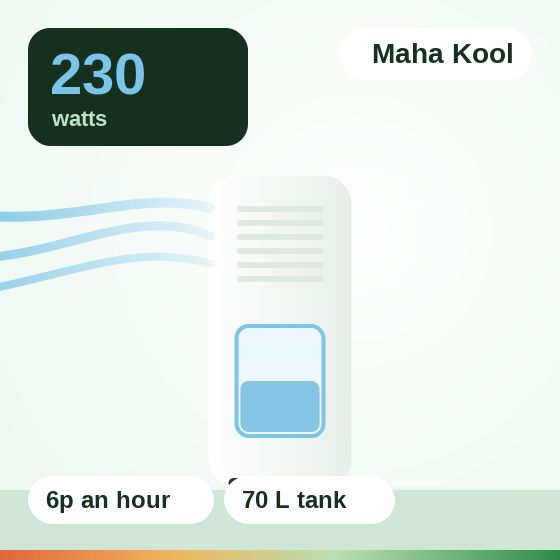
Maha Kool
70L Industrial Evaporative Cooler (metal fan blades, 3 speeds)
230 watts · 6p an hour · 70 L tank
£419.99 at B&Q (marketplace, online only), checked 14 Nov 2026
See it at B&Q (marketplace, online only)
Figures from the maker or retailer listing. Cost an hour is our own, at the price cap of 26.32p a kWh.