Key takeaways
- An industrial cooling fan moves air. It does not lower the air temperature, so it cools people by air movement and does nothing for heat from machines or stock. HSE lists fans among the practical steps for a hot workplace, beside air conditioning and ventilation (see our commercial air conditioning guide).
- Three kinds suit business premises: high velocity floor fans, commercial ceiling fans and evaporative coolers. An evaporative cooler does cool the air, but a government service says direct models can leave the cooled air very humid.
- At DESNZ’s April to June 2026 average for small businesses (28.59p per kWh, excluding VAT), the fans and cooler below cost 1.9p to 6.6p an hour to run. A Broughton MCe7.3 portable air conditioner is up to 75.6p an hour on our upper estimate, about 25 times the floor fan’s input.
- Regulation 7 says the temperature in indoor workplaces “shall be reasonable”; on a maximum, HSE says “There’s no law for maximum working temperature, or when it’s too hot to work, because every workplace is different.” Whether a fan is enough for your premises depends on the work, the heat sources and the people.
What does a fan do, and what does it not do?
A fan pushes air past people. It does not remove heat from a building, which is the job of commercial air conditioning. HSE’s page on thermal comfort says “The speed of air moving across a worker may help cool them if the air is cooler than the environment”, and that “Air temperature alone is not a valid or accurate indicator of a comfortable workplace temperature or heat stress.” Our reading is that moving air helps the people in it, and does not make the room cooler.
HSE’s page on managing workplace temperature (updated 20 January 2026) lists, among steps for hot workplaces, “Provide fans, such as desk, pedestal or ceiling-mounted ones” and “Provide air-cooling or air-conditioning and adequate ventilation”. HSE’s page on thermal comfort says fans “may cause draught or noise problems”. HSE says large-diameter ceiling fans can provide air movement over a wide area. For fans against air conditioning in general, see fan vs air conditioner.
What kinds of industrial fan are there?
The three examples below come from our product files. They are not a ranking, and we have not tested any of them.
High velocity floor fans
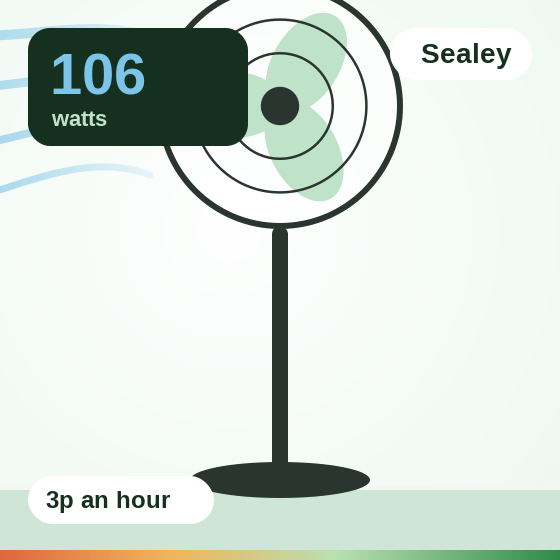
The Sealey HVF20 is a 20 inch industrial floor fan. Rapid Online’s listing, which we opened on 25 November 2026, gives a fan power input of 105.5 W (listed as 105 to 115 W), a maximum airflow of 110 m³ a minute (6,600 m³ an hour), three speeds and a sound power of 78.26 dB(A). A reply to a customer question on the listing gives about 50, 65 and 70 dB at 2 metres by speed and calls the fan “not silent”; that is the retailer’s answer, not a maker figure. The listing describes the blades as fully guarded, and a reply on it says the fan is not IP rated. The price showed “Price on Application”, so we give none. See our best large floor fans.
Commercial ceiling fans
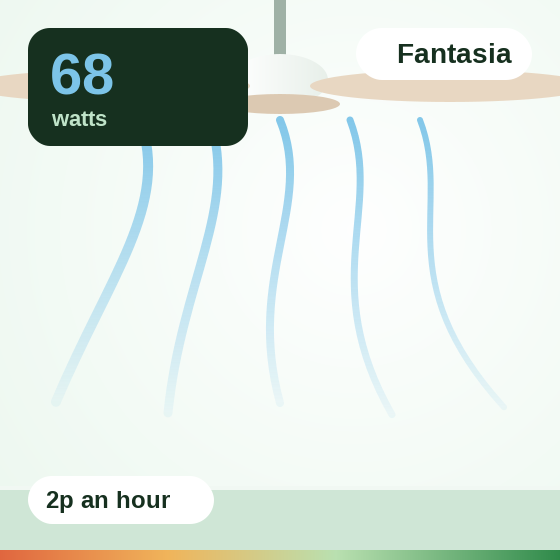
Fantasia’s commercial range is hard-wired and needs a commercial fan controller, sold separately. On Fantasia’s own shop, the 56 inch fan (blade diameter 1,440 mm) has a 68 W motor rating, 6,800 cubic feet a minute on high and a two-year motor warranty. It was listed at £138.00 on 25 November 2026, with a higher “was” price of £176.40 and the note “In Stock for Next Working Day Delivery”; a controller was extra from £21.41. Our product files also record a 48 inch (65 W, £110, shown out of stock) and a 36 inch (45 W, £90) at the file’s date of 14 November 2026. Fantasia recommends at least 10 ft from blade to floor, and at least 7.5 ft as a minimum. See best industrial ceiling fans.
Evaporative coolers
An evaporative cooler passes air over a wet pad, so water evaporating cools the air. The Maha-Kool 70 L industrial cooler is listed at £419.99 on B&Q’s online marketplace (checked 25 November 2026; sold and shipped by George’s Industrial Services Limited, not stocked in B&Q stores) with a 230 W power rating, 6,000 m³ an hour airflow, a 70 litre tank and an air throw “up to 50 ft”. We could not find a noise figure or a test result for the cooling it gives; “fast and effective cooling in large areas” is the seller’s wording with no figure. Check the maker’s cleaning instructions for the pad and tank before you buy.
The Energy Technology List (a DESNZ service) said on 4 October 2024 that evaporative air coolers suit “especially in high-demand sectors like data centres, production facilities, distribution centres and office buildings”. It says direct evaporative coolers “can achieve energy and carbon savings of up to 80% compared to air conditioning”, and that direct cooling “can lead to high humidity levels in the cooled air produced”. HSE says “High-humidity environments have a lot of vapour in the air, which prevents sweat evaporating.” Treat the 80% as a claim about direct coolers in general, not about the Maha-Kool. See evaporative coolers explained.
What do they cost to run?
The domestic price cap does not apply to businesses, so use the unit rate on your own bill. As a guide this page uses DESNZ’s averages for April to June 2026, including Climate Change Levy and excluding VAT: 28.59p per kWh for small businesses (20 to 499 MWh a year) and 38.36p for very small ones (0 to 20 MWh). The running costs section of our commercial air conditioning guide explains the figures.
Each figure is the rated power in kW times the rate. For the Sealey, 0.1055 kW x 28.59p = 3.0p an hour. The list is ordered by power drawn, lowest first.
| Unit | Power | Per hour at 28.59p | Per hour at 38.36p |
|---|---|---|---|
| Fantasia 56 inch ceiling fan | 68 W | 1.9p | 2.6p |
| Sealey HVF20 floor fan | 105.5 W | 3.0p | 4.0p |
| Maha-Kool 70 L evaporative cooler | 230 W | 6.6p | 8.8p |
| Broughton MCe7.3 portable air conditioner | up to 2.645 kVA | up to 75.6p | up to 101.5p |
The Broughton figure is our upper estimate: Broughton publishes a running current of 11.5 A, not a wattage, and 230 V x 11.5 A = 2.645 kVA. Real power is lower if the power factor is below 1. 2.645 / 0.1055 = about 25, so the portable uses up to 25 times the floor fan’s input. A fan and an air conditioner do different jobs, so the table compares electricity, not cooling: the air conditioner cools the air and the fan does not. See portable commercial air conditioners for the cooling side.
Safety and siting
- Choose a guarded fan where people or hands can reach it. The Sealey listing describes fully guarded blades, and a reply on it says the fan is not IP rated, so we would keep it away from water.
- Keep cables out of walkways and away from forklift routes. That is our advice, not a rule we have a source for.
- A ceiling fan is wired into the building’s electrics. Fantasia’s page says “If you are in any doubt then consult a qualified electrician”. For business premises we suggest asking an electrician to fit it and to say what paperwork they will give you. See ceiling fan installation.
- The fixing point matters. Fantasia says it must support four times the fan’s stationary weight.
When do you need air conditioning instead?
A fan is the wrong tool where the heat comes from the air itself or from equipment: ovens, machines, a server room, or a humid process. Air conditioning removes heat from the air; fans do not. In a large warehouse, see warehouse air conditioning; for process heat, industrial air conditioning; for a spot-cooled stopgap, the best industrial portable air conditioners.
How to brief a supplier or installer
- The floor area, ceiling height and what is stored or made in the space.
- How many people work there and where they stand or sit.
- Heat sources: machines, ovens, sunlight through roof lights.
- Whether the air is humid, dusty or greasy.
- Power available at each position, and whether a ceiling can carry a fan.
- Ask for: the power in watts as the maker states it, noise in dB with the distance, guard and IP details, the warranty, and who fits and certifies a hard-wired fan.
Frequently asked questions
Do industrial fans actually cool a building?
No. They cool people by moving air across them, which HSE says may help “if the air is cooler than the environment”. They do not remove heat from the building.
What is the difference between an industrial fan and an evaporative cooler?
A fan only moves air. An evaporative cooler passes air over a wet pad so the water cools it. The Energy Technology List says direct coolers can leave the cooled air very humid.
How much does an industrial fan cost to run?
On DESNZ’s April to June 2026 small business average of 28.59p per kWh, the Sealey HVF20 costs about 3.0p an hour and Fantasia’s 56 inch ceiling fan about 1.9p. At 38.36p (very small businesses) they cost 4.0p and 2.6p. Use your own bill’s rate.
Are evaporative coolers good in the UK?
We found no UK test of the Maha-Kool. The Energy Technology List says direct coolers raise humidity, and HSE says high humidity stops sweat evaporating, so they suit dry, hot spaces better than humid ones. Our guide covers whether evaporative coolers work in the UK.
Do I need an electrician to fit a commercial ceiling fan?
It is hard-wired, so we suggest a qualified electrician. Fantasia says “If you are in any doubt then consult a qualified electrician”. We did not find a source on who may do the work in a workplace.
Is a fan enough to meet the workplace temperature rules?
That is not something we can say. Regulation 7 of the Workplace (Health, Safety and Welfare) Regulations 1992 (England, Wales and Scotland) says the temperature in indoor workplaces “shall be reasonable”. On a maximum, HSE says “There’s no law for maximum working temperature, or when it’s too hot to work, because every workplace is different.” HSE lists fans as one step. This is general information, not legal advice. See workplace temperature law.
Sources
- HSE: Managing workplace temperature (checked 25 November 2026)
- HSE: Thermal comfort (checked 25 November 2026)
- HSE: Temperature in the workplace (updated 3 November 2026) (checked 27 November 2026)
- legislation.gov.uk: Workplace (Health, Safety and Welfare) Regulations 1992, regulation 7 (checked 25 November 2026)
- Energy Technology List: ETL and Eurovent certification, evaporative air coolers (4 October 2024) (checked 25 November 2026)
- DESNZ: Gas and electricity prices in the non-domestic sector, table 3.4.2 (checked 25 November 2026)
- Rapid Online: Sealey HVF20 industrial high velocity floor fan (checked 25 November 2026)
- Fantasia Ceiling Fans: 56 inch commercial fan (checked 25 November 2026)
- Fantasia Ceiling Fans: 48 inch commercial fan (not re-opened on 25 November 2026; as recorded in our product file, checked 14 November 2026)
- Fantasia Ceiling Fans: 36 inch commercial fan (not re-opened on 25 November 2026; as recorded in our product file, checked 14 November 2026)
- B&Q: Maha Kool 70L industrial evaporative cooler (checked 25 November 2026)
- Broughton: MCe7.3 specification sheet, June 2025 (checked 25 November 2026)
Products on this page
Sealey
HVF20 Industrial High Velocity Floor Fan 20" 230V
106 watts · 3p an hour
No current UK price found
Fantasia
Commercial Fan 56"
68 watts · 2p an hour
£138.00 at Fantasia Ceiling Fans (maker shop), checked 14 Nov 2026
See it at Fantasia Ceiling Fans (maker shop)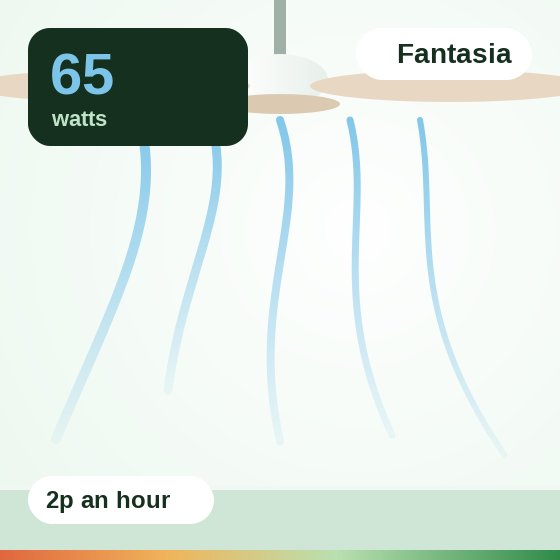
Fantasia
Commercial Fan 48"
65 watts · 2p an hour
£110.00 at Fantasia Ceiling Fans (maker shop), checked 14 Nov 2026
See it at Fantasia Ceiling Fans (maker shop)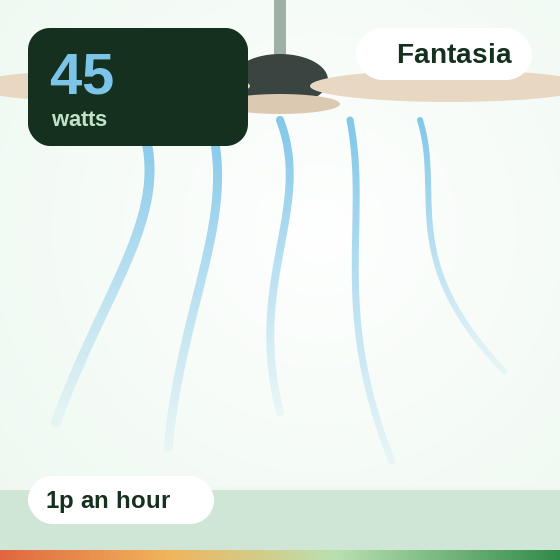
Fantasia
Commercial Fan 36"
45 watts · 1p an hour
£90.00 at Fantasia Ceiling Fans (maker shop), checked 14 Nov 2026
See it at Fantasia Ceiling Fans (maker shop)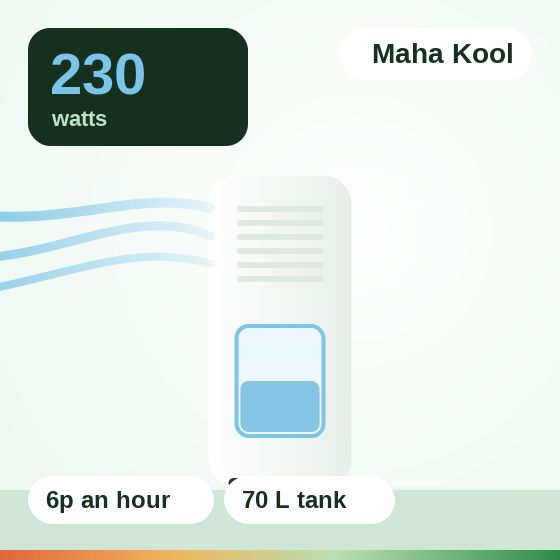
Maha Kool
70L Industrial Evaporative Cooler (metal fan blades, 3 speeds)
230 watts · 6p an hour · 70 L tank
£419.99 at B&Q (marketplace, online only), checked 14 Nov 2026
See it at B&Q (marketplace, online only)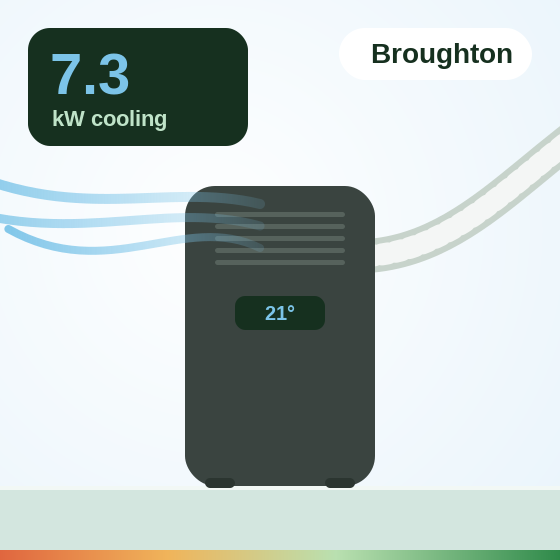
Broughton
Mighty Cool MCe7.3 Low GWP Portable Monoblock Air Conditioner (230V)
7.3 kW cooling
£2340.00 at National Heater Shops, checked 14 Nov 2026
See it at National Heater Shops
Figures from the maker or retailer listing. Cost an hour is our own, at the price cap of 26.32p a kWh.