Key takeaways
- For a hotel room air conditioning unit, Daikin’s hotel page lists wall-mounted units and concealed ceiling units for guest rooms. Larger hotels may use VRF or fan coil units, both described in our commercial air conditioning guide.
- Heat recovery VRF can heat some rooms while cooling others. Designing Buildings says VRF suits hotels, where some rooms are empty while others have a high thermal demand.
- Key card controls can switch heating and cooling off when a guest leaves or opens a window. Daikin’s “up to 70%” energy figure is a maker’s claim with no stated method.
- HMRC says the standard rate of VAT applies to installing energy-saving materials in hotels, which are outside its 0% relief for residential accommodation.
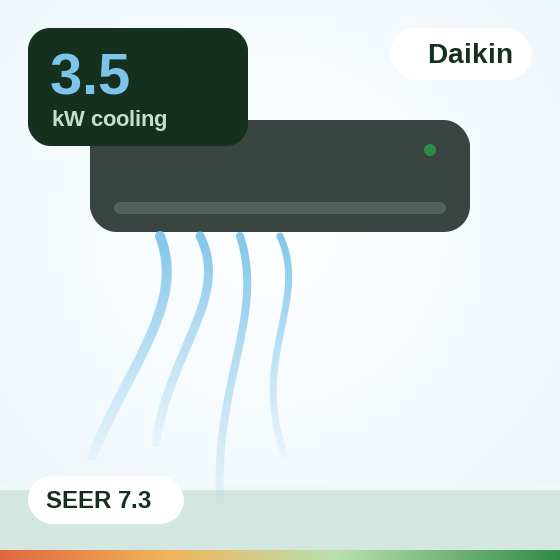
- Daikin’s 3.5 kW cassette uses 168 kWh a year on its label: £48.03 a room at the DESNZ small-business average of 28.59p per kWh (excluding VAT), or £960.58 for 20 rooms on the label’s 350 hours.
What do hotels fit?
Daikin UK’s hotel page says “Stylish wall mounted units and concealed ceiling units go unnoticed with their minimal design and quiet operation.” That is the maker’s description of guest-room options. It also lists round flow cassettes and concealed ceiling units with optional auto-cleaning filters; see cassette air conditioning units.
In larger hotels, chilled water may feed fan coil units. Designing Buildings, quoting BSRIA, describes a fan coil unit as a device “mounted in the ceiling void or floor mounted often at the perimeter of a building” with a fan, coils and a filter, and says “they can be noisy and can create vibrations because the fan is in the occupied space”. See fan coil units.
For a building with many rooms, VRF is the other common route. Designing Buildings says it suits buildings “such as hotels, where some rooms may be unoccupied whilst others have a very high thermal demand”, and may be “less suited to large uniform spaces such as gymnasiums or theatres”. See VRF air conditioning.
Can one system heat one room and cool another?
Yes, with heat recovery VRF. Designing Buildings says three-pipe systems use “heat recovery enabling heat from zones requiring cooling to be used to heat zones that require heating”, at a greater capital cost than two-pipe systems, which provide either cooling or heating to all zones. Daikin’s VRV 5 Heat Recovery has a “3-pipe heat recovery design”. Mitsubishi Electric’s City Multi R2 is a heat recovery system it describes as “the only 2-pipe heat recovery solution on the market”, which is its own claim. Daikin describes VRV as “invented by us”; it is Daikin’s name for the same idea that other makers call VRF.
What do key cards and room controls do?
Daikin says its “smart key cards automatically communicate with your Daikin units to turn off the air conditioning or heating”. Its page also lists “Energy saving through key card, window contact integration and set point limitation” for its Madoka controller. Daikin claims you can “Control up to 70% of your entire hotel’s energy use”. That is a claim about control, with no method or baseline, so do not read it as a saving.
How noisy is a hotel room unit?
Daikin’s hotel page says only “quiet operation” and gives no decibel figure. Ask for the indoor unit’s sound pressure figure from the maker’s data sheet, and check how noise from outdoor units is treated; see air conditioning noise rules.
What about fresh air?
Cooling is not ventilating. Regulation 6 of the Workplace (Health, Safety and Welfare) Regulations 1992 (England, Wales and Scotland) says “every enclosed workplace” must be ventilated by “a sufficient quantity of fresh or purified air”, which applies to the places where staff work, such as reception, kitchens and offices. We have not checked what applies to guest rooms. HSE says systems that recirculate air “including air-conditioning systems” should “have been designed with fresh air inlets and that they are kept open”. Ask your designer how each room gets fresh air.
VAT, inspection and leak checks
This is general information, not legal advice.
- VAT: HMRC’s Notice 708/6 says “The relief for energy-saving materials applies to installations in residential accommodation” and that the standard rate applies to installations in “hospitals, prisons or similar institutions, hotels or inns or similar establishments”. That is HMRC’s wording on the standard rate for hotels (20%). See VAT on air conditioning.
- TM44 inspection (England and Wales): GOV.UK’s guide covers systems with an effective rated output of more than 12 kW, and says units under one person’s control in one building are treated as one system. Twenty rooms of 3.5 kW is 70 kW nominal, far over the line if one person controls them. Check the rating plates and ask an accredited energy assessor how your rooms add up. See TM44 inspections.
- F-gas leak checks (Great Britain): required from 5 tonnes CO2 equivalent: at least every 12 months, or 24 with a leak detection system; every 6 months from 50 tonnes, or 12 with one. Equipment of 500 tonnes or more must have a leak detection system and is then checked at least every 6 months. Tonnes = kg x GWP / 1,000, and a VRF system’s charge is on the rating plate. See F-gas rules.
- Water systems: HSE says “If you have a cooling tower or evaporative condenser, you should put in place appropriate measures” to prevent or control legionella. That sentence is about cooling towers and evaporative condensers; ask your engineer whether your hotel has any water-based cooling plant.
What does a hotel room unit cost to run?
The domestic price cap does not apply to businesses, so use the unit rate on your own bill. As a guide this page uses DESNZ’s averages for April to June 2026, including Climate Change Levy and excluding VAT: 28.59p per kWh for small businesses (20 to 499 MWh a year) and 38.36p for very small ones (0 to 20 MWh). The running costs section of our commercial air conditioning guide explains the figures.
Worked figure: a 3.5 kW cassette per room. Daikin’s table gives the FCAG35B with the RZAG35B outdoor unit an annual cooling consumption of 168 kWh, worked out on 350 hours of cooling a year.
- Per room: 168 kWh x 28.59p = £48.03 a year.
- Twenty rooms: 20 x 168 = 3,360 kWh, £960.58 a year.
That is our arithmetic on the label’s hours; real hotel use differs, and rooms that are used more cost proportionally more. We found no published installed price for hotel air conditioning on 25 November 2026.
For guests: how does a hotel room unit work?
A hotel room may have one of the kinds of unit described above. If the unit stops when you leave the room, a key card or window contact may be switching it off; Daikin says its key card system turns off “the air conditioning or heating” automatically. Some hotels also limit the set point. If the room is too warm or cold, ask reception.
How to brief an installer
- Number and size of rooms, ceiling heights and whether each has a ceiling void.
- Occupancy pattern, and which rooms or floors need heating while others need cooling.
- Public areas, kitchens and staff areas, which have different needs.
- Whether you want key card or window contact control, and a link to a building management system.
- Where outdoor units or plant could go, and whether your landlord (if any) and the council allow it.
- Ask in writing for a heat load calculation, the make and model of every unit with its SEER and sound pressure, the F-gas company certificate number, the competent person scheme, the refrigerant charge, what the price excludes, and warranty and servicing terms.
Frequently asked questions
What air conditioning do hotels use?
Daikin’s hotel page lists wall-mounted and concealed ceiling units for guest rooms; larger hotels may use fan coil units or VRF, which Designing Buildings says suits buildings with many spaces.
Why does the hotel air conditioning stop when I leave the room?
It may be a key card system. Daikin says its smart key cards communicate with its units “to turn off the air conditioning or heating”.
Can hotel air conditioning heat and cool at the same time?
Heat recovery VRF can. Designing Buildings says it moves heat from zones needing cooling to zones needing heating.
Do hotels pay 0% VAT on air conditioning installs?
No. HMRC says the standard rate applies to installations in “hotels or inns or similar establishments”; the 0% relief is for residential accommodation and certain charity buildings.
Does a hotel need a TM44 inspection?
In England and Wales, if the effective rated output under one person’s control is more than 12 kW. Twenty 3.5 kW rooms are 70 kW nominal.
How quiet is a hotel room air conditioner?
Daikin’s hotel page says “quiet operation” but gives no figure. Ask the maker for the sound pressure of the indoor unit you are offered.
Sources
- Daikin UK: Hotels (checked 25 November 2026)
- Daikin UK: VRV (checked 25 November 2026)
- Daikin UK: FCAG-B / RZAG-B technical details (checked 25 November 2026)
- Designing Buildings: Variable refrigerant flow VRF (last edited 3 August 2021) (checked 25 November 2026)
- Designing Buildings: Fan coil unit (last edited 4 August 2022) (checked 25 November 2026)
- Mitsubishi Electric UK: City Multi YXM R2 series (checked 25 November 2026)
- legislation.gov.uk: Workplace (Health, Safety and Welfare) Regulations 1992, regulation 6 (checked 25 November 2026)
- HSE: How to improve ventilation (checked 25 November 2026)
- HSE: Evaporative cooling systems (updated 14 January 2026) (checked 25 November 2026)
- HMRC: VAT on energy-saving materials and heating equipment (Notice 708/6) (checked 25 November 2026)
- GOV.UK: Air conditioning inspections for buildings, a guide (updated 5 November 2026) (checked 25 November 2026)
- GOV.UK: Checking F gas equipment for leaks (checked 25 November 2026)
- DESNZ: Gas and electricity prices in the non-domestic sector (updated 29 September 2026); table file, sheet 3.4.2 (incl CCL), 2026 quarter 2 (figures as read from the file on 25 November 2026 for this cluster’s pillar; the page itself could not show them when we re-opened it)
Products on this page
Daikin
Round Flow cassette FCAG35BVEB with Sky Air RZAG35B5V1B outdoor unit
3.5 kW cooling · SEER 7.3
No current UK price found
Figures from the maker or retailer listing. Cost an hour is our own, at the price cap of 26.32p a kWh.