Key takeaways
- R32 refrigerant (HFC-32) is a gas used to move heat in air conditioners (see how air conditioning works). The two split systems we use as examples, a Daikin Perfera and a Mitsubishi Electric MSZ-LN, both use it.
- Its GWP (global warming potential) is 675, from Annex I of the Great Britain F-gas Regulation. R410A, a mixture of R32 and R125, is about 2,088, so R32 is about a third of it.
- R32 is in safety class A2L: non-toxic but of lower flammability, according to a trade bulletin from F-Gas Register.
- Work on the refrigerant circuit of a split system needs F-gas qualifications. A householder cannot lawfully buy F gas to top up a system.
- A 2.5 kW split holds under 1 kg: the Daikin example holds 0.95 kg, which is 0.64 tonnes of CO2 equivalent.
What is R32?
R32 is the name of the hydrofluorocarbon HFC-32 when it is used as a refrigerant: the fluid that moves heat round a split air conditioner. It is the refrigerant listed for the Daikin Perfera 2.5 kW (0.95 kg) and the Mitsubishi Electric MSZ-LN 2.5 kW (0.8 kg) in our product files. To see where the refrigerant sits in the machine, read how air conditioning works; for all the gases side by side, see air conditioning refrigerants.
R32 is an F gas. The GB F-gas rules define fluorinated greenhouse gases as the hydrofluorocarbons, perfluorocarbons, sulphur hexafluoride and other fluorine-containing gases listed in Annex I, and HFC-32 is on that list.
What is R32’s GWP?
GWP means global warming potential: the warming effect of a gas relative to carbon dioxide, over 100 years (Article 2(6) of the GB F-gas Regulation). Annex I of that Regulation lists HFC-32 at 675, so one kilogram of R32 that escaped would warm the climate as much as 675 kg of carbon dioxide over 100 years.
R410A is a mixture of R32 and R125: Daikin Chemicals’ safety data sheet for R-410A (revision 23 March 2023) lists difluoromethane and pentafluoroethane, roughly half each, and Annex I names those gases HFC-32 and HFC-125. The US EPA’s reference table lists it at 2,088, and Mitsubishi Electric’s product information sheet gives the same figure, so we say “about 2,088”. Our arithmetic: 675 / 2,088 = 32.3%. Mitsubishi Electric UK, in a page dated 5 March 2018, says R32 is “32% of the GWP of R410A”. We did not find R410A listed as a gas in Annex I.
Is R32 flammable?
R32 is classed as A2L. F-Gas Register’s bulletin in ACR Journal (9 March 2026) says “R32 is classified as an A2L refrigerant as it is non-toxic but of lower flammability”. In that scheme the letter A means non-toxic or of lower toxicity and a higher number means more flammable. Mitsubishi Electric UK’s 2018 page says R32, “although flammable, is very difficult to ignite”. Those are the sources’ words; a manual for a specific unit says what to do with that unit, so read it.
What are the UK rules for R32?
These are the rules for Great Britain. Northern Ireland follows the EU F-gas system instead.
Who may work on it
GOV.UK says you must have F-gas qualifications to install new systems, service and maintain systems, check for leaks, recover gases, and decommission and dispose of old systems. Companies, including sole traders, working on equipment operated by others must be certified by an approved body: GOV.UK names Refcom, F-Gas Register (Quidos) and Bureau Veritas, with renewal every 3 years. Article 11(4) of the Regulation says that for “installation, servicing, maintenance or repair”, F gases “shall only be sold to and purchased by undertakings that hold the relevant certificates” (or that employ certified people), so a householder cannot lawfully buy refrigerant to top up a system. See who can legally install air conditioning and what an air conditioning engineer is.
New single splits under 3 kg
In Great Britain, new single split air conditioners holding under 3 kg of refrigerant cannot use an F-gas with a GWP of 750 or more (from 1 January 2025), so R32 (GWP 675) is allowed. GOV.UK’s guidance table words the limit as “Above 750”. The bans are on placing new products on the market, and nothing in them requires a system already fitted to be removed.
Leak checks
Regular leak checks start at 5 tonnes of CO2 equivalent: at least every 12 months, or every 24 with a leak detection system. Tonnes CO2e = charge in kg x GWP / 1,000, so 5 tonnes of R32 is 5,000 / 675 = 7.41 kg. A 2.5 kW home split holds far less (see the worked example below). The checks, and the records an operator must keep, are in the F-gas guide.
Northern Ireland
Northern Ireland is part of the EU F-gas system, so do not apply Great Britain’s dates or thresholds there. GOV.UK points Northern Ireland businesses to the Northern Ireland Environment Agency.
R32 compared with R410A
| R32 | R410A | |
|---|---|---|
| What it is | HFC-32, one gas | A mixture of R32 and R125, roughly half each (Daikin Chemicals safety data sheet) |
| GWP (100 year) | 675 (Annex I, GB F-gas Regulation) | About 2,088 (US EPA table; Mitsubishi Electric product sheet) |
| Safety class | A2L, lower flammability | Not stated by the sources we opened |
Because 2,088 is above 750, a new single split holding under 3 kg of R410A would fall inside the limit that bans gases of GWP 750 or more. GOV.UK’s table does not name R410A, so that link is our comparison of its limit with the EPA figure.
Mitsubishi Electric UK’s 2018 page also says R32 systems “use up to 20% less refrigerant than R410A equivalents”. It states no test or conditions and it is a maker claim from that date, so we do not rely on it.
Our worked example: how much R32 is in a home split
Each product file records the charge from the maker’s own table. We multiply by the GWP.
- Daikin Perfera 2.5 kW (outdoor unit RXM25A5V1B9, 0.95 kg of R32 in Daikin’s table): 0.95 kg x 675 / 1,000 = 0.64 tonnes CO2e. That is 12.8% of the 5 tonne leak-check step (0.64 / 5). Daikin’s table prints 0.65, which is a rounding difference.
- Mitsubishi Electric MSZ-LN25VG3: 0.8 kg x 675 / 1,000 = 0.54 tonnes CO2e, which is 10.8% of the step. Mitsubishi’s sheet gives the same 0.54.
So a 2.5 kW home split is well below the 5 tonne leak-check threshold. A different model holds a different amount, and a longer pipe run can need extra refrigerant, so check the charge in the installer’s paperwork.
What to ask your installer
- Which F-gas qualification do you hold, and which certified company do you work for?
- What is the refrigerant, and how many kilograms does the system hold?
- Who deals with a leak, and are records kept?
Our split air conditioner page covers the systems themselves, and air conditioning gas and regassing cover top-ups.
Frequently asked questions
What is R32 refrigerant?
R32 is HFC-32, the hydrofluorocarbon refrigerant used in many current split air conditioners. It moves heat round the sealed refrigerant circuit.
What is the GWP of R32?
It is 675 over 100 years, from Annex I of the Great Britain F-gas Regulation. R410A is about 2,088.
Is R32 flammable?
It has a lower flammability: class A2L in F-Gas Register’s bulletin of 9 March 2026. Mitsubishi Electric UK’s 2018 page says it is flammable but very difficult to ignite.
Is R32 better than R410A?
It has a lower GWP: 675 against about 2,088. We make no claim about efficiency, because the “up to 20% less refrigerant” figure from Mitsubishi in 2018 has no stated conditions.
Can I top up R32 myself?
No. A householder cannot lawfully buy F gas to top up a system: Article 11(4) of the F-gas Regulation limits sales for servicing to certified businesses. Ask a qualified engineer from a certified company.
Can an R410A system be converted to R32?
Ask the system’s maker and a qualified engineer. We give no instructions.
Is R32 being phased out?
The hydrofluorocarbon phase-down in Great Britain continues on the existing schedule in Annex 5 of the Regulation. Defra said on 15 May 2026 it would not legislate in 2026 to change the steps from 1 January 2027, and that it remains committed to reform. R32 at 675 is below the 750 limit for new single splits.
What do the F-gas rules say about R32 in portables?
New movable room air conditioners, which the law defines as hermetically sealed units the user can move between rooms, cannot use an HFC with a GWP of 150 or more, and R32 is 675. For the Midea PortaSplit, we could not confirm whether the GB F-gas rules treat it as a movable unit or as a split system. Portables such as the Pro Breeze PB-AC04 use R290 (130 g in its manual); see R290 air conditioners.
Sources
- legislation.gov.uk: Regulation (EU) No 517/2014 as it applies in GB, Annex I (GWP of F gases) (checked 15 November 2026)
- legislation.gov.uk: Regulation (EU) No 517/2014 as it applies in GB, Article 2 (definitions) (checked 15 November 2026)
- legislation.gov.uk: Regulation (EU) No 517/2014 as it applies in GB, Annex III (product bans) (checked 15 November 2026)
- GOV.UK: Bans on F gas in new products and equipment, current and future (updated 27 August 2026) (checked 15 November 2026)
- US EPA: Technology Transitions GWP reference table (updated 2 April 2026) (checked 15 November 2026)
- ACR Journal (F-Gas Register bulletin): Flammable refrigerants in air conditioning and heat pump systems, 9 March 2026 (checked 15 November 2026)
- Mitsubishi Electric UK: R32 need to know (5 March 2018) (checked 15 November 2026)
- Mitsubishi Electric UK: MSZ-LN R32 product information sheet, effective February 2026 (PDF) (checked 15 November 2026)
- GOV.UK: Qualifications to work with F gas (updated 3 March 2026) (checked 15 November 2026)
- GOV.UK: Company certification to work with F gas (updated 21 August 2019) (checked 15 November 2026)
- GOV.UK: Checking F gas equipment for leaks (checked 15 November 2026)
- GOV.UK: Fluorinated gas (F gas), guidance for users, producers and traders, updated 12 May 2025 (checked 15 November 2026; this address was the page “F gas in refrigeration, air conditioning and fire protection systems” and opened this collection when we looked again on 28 November 2026; the collection says F gases include HFCs, PFCs and sulphur hexafluoride and that Northern Ireland is part of the EU system)
- Daikin Europe: specifications table RXM-A9 (RXM25A5V1B9) (checked 15 November 2026)
- GOV.UK (Defra): Amending the hydrofluorocarbon phasedown schedule (checked 15 November 2026)
- GOV.UK: Fluorinated gas (F gas), guidance for users, producers and traders (updated 12 May 2025) (checked 15 November 2026)
- Pro Breeze: PB-AC04 7000 BTU Portable Air Conditioner instruction manual (UK/EU) (checked 15 November 2026)
- legislation.gov.uk: Regulation (EU) No 517/2014 as it applies in GB, Article 11 (restrictions on placing on the market) (checked 15 November 2026)
- Daikin Chemicals: R-410A safety data sheet, revision 23 March 2023 (PDF) (checked 15 November 2026)
Products on this page
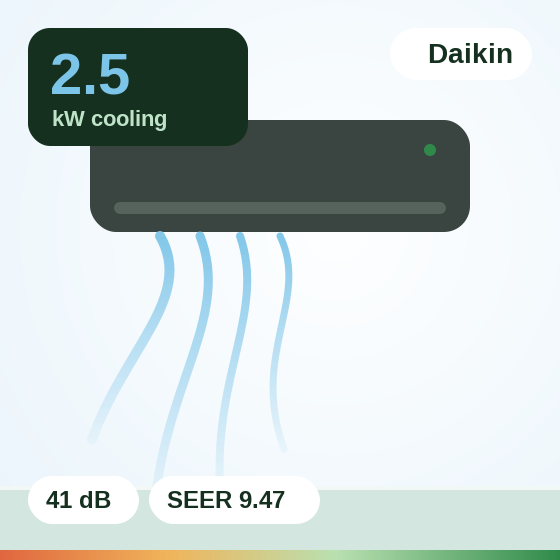
Daikin
Perfera FTXM25A (indoor) with RXM25A5V1B9 (outdoor), 2.5 kW
2.5 kW cooling · 41 dB · SEER 9.47
No current UK price found
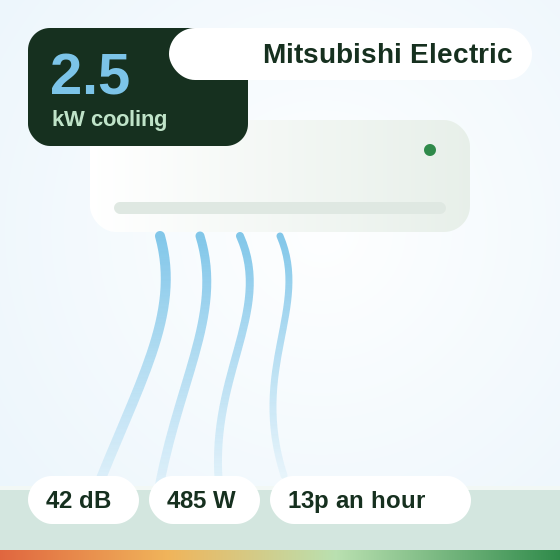
Mitsubishi Electric
MSZ-LN25VG3 (indoor) with MUZ-LN25VG3 (outdoor), 2.5 kW
2.5 kW cooling · 42 dB · 485 W · 13p an hour
No current UK price found
Figures from the maker or retailer listing. Cost an hour is our own, at the price cap of 26.32p a kWh.