Key takeaways
- An air conditioning refrigerant is the fluid sealed inside the pipes that carries heat out of the room by changing between liquid and gas (see how air conditioning works).
- The refrigerants in our product files are R32 (split systems such as the Daikin and Mitsubishi Electric examples) and R290, which is propane (37 of the 47 current portables in our files, counted on 15 November 2026). Other gases, such as R410A, are not in our product files; the rating plate shows what a unit holds.
- GWP (global warming potential) compares a gas’s warming effect with carbon dioxide over 100 years: R32 is 675, R290 is 3 and R410A is about 2,088. GWP measures climate impact, not safety.
- R32 is class A2L (“lower flammability”); R290 is class A3 (“highly flammable”). A householder cannot lawfully buy F gas to top up a system, and work on the refrigerant circuit is for qualified people.
What is an air conditioning refrigerant?
An air conditioning refrigerant is the fluid that flows round the sealed loop inside an air conditioner. Daikin UK describes it as refrigerant that “flows through in a cycle through the system and changes state to provide its cooling output”. It absorbs heat from the room air at the indoor coil and gives that heat up at the outdoor coil. The guide to how air conditioning works explains the four steps; this page compares the gases themselves.
Which refrigerants are used in UK air conditioners?
| Refrigerant | GWP (100 years) | Safety class | F gas? | Where it appears |
|---|---|---|---|---|
| R32 | 675 | A2L, lower flammability | Yes (an HFC) | Split systems such as the Daikin Perfera and Mitsubishi Electric MSZ-LN in our product files |
| R290 (propane) | 3 | A3, highly flammable | No | Portables such as the Pro Breeze and Meaco models in our product files |
| R410A (a mixture of R32 and R125) | about 2,088 | Not stated by the sources we opened | Contains HFCs | Not in our product files |
GWP figures: R32 and R290 from Annexes I and IV of the F-gas Regulation as it applies in Great Britain; R410A from the US EPA’s table, which lists R-32 at 675 and R-410A at 2,088 on the same 100-year basis (IPCC 2007). R410A is not listed in Annex I, so say “about 2,088”. The safety classes are from F-Gas Register’s bulletin in ACR Journal (9 March 2026).
R32
R32 is an HFC with a GWP of 675 (Annex I). ACR Journal says “R32 is classified as an A2L refrigerant as it is non-toxic but of lower flammability”. Daikin’s FTXF-F operation manual states “Refrigerant type: R32” and “Global warming potential (GWP) value: 675”, and calls it “mildly flammable”.
R290
R290 is propane. Annex IV of the F-gas Regulation lists it with a GWP of 3 (the US EPA table gives 3.3 on an older assessment). ACR Journal: “R290 (propane) is classified as an A3 refrigerant as it is non-toxic but highly flammable”. Room-size limits and handling warnings come from each maker’s manual.
R410A
R410A is a mixture of two HFCs. Daikin Chemicals’ safety data sheet for R-410A (revision 23 March 2023) lists its ingredients as pentafluoroethane and difluoromethane, roughly half each (ranges between 48.5% and 51.5%); Annex I of the F-gas Regulation names those gases HFC-125 and HFC-32, that is R125 and R32. The US EPA lists R410A at 2,088. The bans described below apply to new products; nothing in them requires an R410A system already fitted to be removed. Our comparison, not GOV.UK’s: a new single split under 3 kg using a gas with a GWP of 2,088 would be above the 750 limit.
Older ozone-depleting gases (HCFCs)
NetRegs says that if you own or operate stationary refrigeration or air conditioning equipment, “CFCs, Halons and HCFCs can no longer be used for servicing equipment”, and that “The use of recovered or reclaimed HCFCs to top up or service equipment has been banned since 1 January 2015”. GOV.UK says “Reclaimed or recycled ODS cannot be used to service RACHP equipment in Great Britain”. GOV.UK’s list of ozone-depleting substances includes HCFC-22 (chlorodifluoromethane). Neither NetRegs nor GOV.UK says which air conditioners hold an HCFC, so ask a qualified engineer what a particular old system holds and what can be done. Our guide to air conditioning gas covers topping up.
What does GWP mean?
The GB F-gas Regulation defines global warming potential as the warming effect of a gas “relative to that of carbon dioxide” over 100 years. Carbon dioxide is 1, so a refrigerant with a GWP of 675 traps 675 times as much heat as the same mass of carbon dioxide. Published GWP values differ slightly between assessments, which is why R290 appears as 3 in the Regulation and 3.3 in the EPA’s table.
What do the UK rules say?
These are Great Britain’s rules; Northern Ireland follows the EU F-gas system instead. Our F-gas regulations guide has the detail.
- New movable room units. New hermetically sealed units the user can move between rooms cannot contain HFCs with a GWP of 150 or more (Annex III, from 1 January 2020). R290 is not an HFC.
- New single splits. New single split systems holding under 3 kg of F gas cannot use a gas with a GWP of 750 or more from 1 January 2025 (Annex III). GOV.UK’s table words both limits as “above”. R32 at 675 is under the limit.
- Existing systems. The bans are on placing new products on the market, and nothing in them requires a system already fitted to be removed.
- People. GOV.UK says you must have qualifications to “install new systems”, “service and maintain systems”, “check for leaks”, “recover gases” and “decommission and dispose of old systems”. Article 11(4) of the F-gas Regulation says that for “installation, servicing, maintenance or repair”, F gases “shall only be sold to and purchased by undertakings that hold the relevant certificates” (or that employ certified people), so a householder cannot lawfully buy it to top up. See air conditioning refill.
- R290. The F-gas rules cover fluorinated gases only, and propane is not one. BESA’s guidance, reported by the IIF-IIR, says “the UK lacks specific regulations for the use of R290, beyond the F-Gas Regulations” and stresses training for engineers.
- Phase-down. The HFC phase-down continues on the existing schedule; we quote no percentage.
What do the flammability classes mean?
In ACR Journal’s words, R32 (A2L) is “non-toxic but of lower flammability” and R290 (A3) is “non-toxic but highly flammable”. The article adds that “refrigerants such as R290 are heavier than air” and “will readily displace air in a room where leaking refrigerant is present”, and that engineers working with them “should have training in the specific handling requirements”. If you suspect a leak, contact a qualified engineer and follow your manual.
How do I find which refrigerant my unit uses?
Look on the unit’s rating plate and in the manual. Daikin’s FTXF-F manual prints the refrigerant type and GWP in a section called “About the refrigerant”. Meaco’s manual for its 12,000 BTU portables states “about 200 grams” of R290, and Pro Breeze’s PB-AC08 manual says its unit “contains 95g of R290 refrigerant gas”.
Our worked example: the refrigerant charge in tonnes of CO2e
Tonnes of CO2 equivalent (CO2e) is the charge in kilograms times the GWP, divided by 1,000 (our working).
- Daikin Perfera 2.5 kW: 0.95 kg of R32 x 675 / 1,000 = 0.64 tonnes CO2e. The first step for leak checks is 5 tonnes, so this is 12.8% of it. 5 tonnes of R32 is 7.41 kg.
- Meaco 12,000 BTU portable: about 0.2 kg of R290 x 3 = 0.6 kg CO2e.
- The same 0.2 kg of R32 would be 0.2 x 675 = 135 kg CO2e, which is 225 times as much (675 / 3).
This compares climate impact only. It says nothing about safety, where R290’s flammability is the issue.
Frequently asked questions
What refrigerant is used in air conditioners?
It varies by model. The split systems in our product files use R32 and 37 of the 47 current portables use R290; other models may use other gases, such as R410A. Check the rating plate and manual.
Which refrigerant is best?
There is no single best. R290 has a far lower GWP (3 against 675 for R32) but is highly flammable, and its manuals limit room size. R32 has a higher GWP and is of lower flammability. Which is fitted depends on the type of unit.
What is the GWP of R32, R290 and R410A?
R32 is 675 and R290 is 3 (Annexes I and IV of the GB F-gas Regulation); R410A is about 2,088 (US EPA table). All are 100-year figures.
Is air conditioning refrigerant harmful?
We make no health claims beyond the safety classes above and the makers’ warnings. Both R32 and R290 are classed “non-toxic”, and both are flammable to different degrees. Report a suspected leak to a qualified engineer.
How do I know which refrigerant my air conditioner uses?
Read the rating plate and manual. Daikin’s manual states the type and GWP; Meaco’s and Pro Breeze’s manuals state R290 and the weight.
Can I buy refrigerant to top up my air conditioner?
Not for F gases: Article 11(4) of the F-gas Regulation says F gas for installation, servicing, maintenance or repair may only be sold to certified businesses (or those employing certified people). See air conditioning gas and air conditioning refill.
Can an old system with an ozone-depleting gas be topped up?
No, not with recovered or reclaimed gas. GOV.UK says reclaimed or recycled ozone-depleting substances cannot be used to service refrigeration, air conditioning and heat pump equipment in Great Britain, and NetRegs says the same for reclaimed HCFCs since 1 January 2015. Neither says which systems hold such a gas, so ask an engineer about your system.
Sources
- Daikin UK: The refrigerant cycle, what is it? (checked 15 November 2026)
- legislation.gov.uk: Regulation (EU) No 517/2014 as it applies in GB, Annex I (checked 15 November 2026)
- legislation.gov.uk: Regulation (EU) No 517/2014, Annex III (checked 15 November 2026)
- legislation.gov.uk: Regulation (EU) No 517/2014, Annex IV (checked 15 November 2026)
- US EPA: Technology Transitions GWP reference table, updated 2 April 2026 (checked 15 November 2026)
- ACR Journal: Flammable refrigerants in air conditioning and heat pump systems, 9 March 2026 (checked 15 November 2026)
- IIF-IIR: BESA releases new guidelines for safe use of R290, 1 August 2024 (checked 15 November 2026)
- GOV.UK: Qualifications to work with F gas, updated 3 March 2026 (checked 15 November 2026)
- GOV.UK: Recovering ozone-depleting substances from equipment, published 18 April 2023 (checked 15 November 2026)
- NetRegs: Stationary refrigeration, air conditioning and heat pumps, ODS controls (checked 15 November 2026)
- GOV.UK: Fluorinated gas (F gas), guidance for users, producers and traders, updated 12 May 2025 (checked 15 November 2026; this address was the page “F gas in refrigeration, air conditioning and fire protection systems” and opened this collection when we looked again on 28 November 2026; the collection says F gases include HFCs, PFCs and sulphur hexafluoride and that Northern Ireland is part of the EU system)
- Daikin: FTXF-F operation manual 3P511999-9S, 2024.09 (checked 15 November 2026)
- Meaco: MeacoCool Pro 12,000 BTU and 12,000CH instruction manual (copy at Air Conditioning Centre) (checked 15 November 2026)
- Pro Breeze: PB-AC08 instruction manual (checked 15 November 2026)
- Daikin UK: FTXM-A / RXM-A9 specifications table, for the 0.95 kg R32 charge recorded in our product file (checked 14 November 2026; not re-opened on 15 November 2026)
- legislation.gov.uk: Regulation (EU) No 517/2014 as it applies in GB, Article 11 (restrictions on placing on the market) (checked 15 November 2026)
- Daikin Chemicals: R-410A safety data sheet, revision 23 March 2023 (PDF) (checked 15 November 2026)
- GOV.UK: Ozone-depleting substances (ODS), updated 6 February 2024 (checked 15 November 2026)
Products on this page
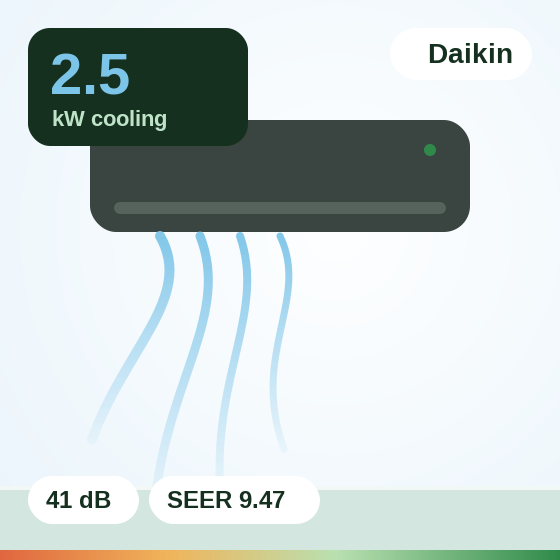
Daikin
Perfera FTXM25A (indoor) with RXM25A5V1B9 (outdoor), 2.5 kW
2.5 kW cooling · 41 dB · SEER 9.47
No current UK price found
Figures from the maker or retailer listing. Cost an hour is our own, at the price cap of 26.32p a kWh.