
Key takeaways
- An R290 air conditioner uses propane as its refrigerant. Its GWP (global warming potential) is 3, against 675 for R32, but ACR Journal classes it A3: “non-toxic but highly flammable”.
- Limits come from each maker’s manual. Meaco’s 12,000 BTU manual says about 200 g and not in a room smaller than 5.2 m2; Pro Breeze’s PB-AC08 manual says 95 g and a floor area larger than 4 m2.
- R290 is not an F gas, so the F-gas qualification rules do not cover a unit charged only with it, but BESA says engineers handling it need training.
- GWP measures climate impact, not safety. Read your own manual and use a trained engineer for anything on the refrigerant circuit.
What is R290?
R290 is propane, a hydrocarbon refrigerant. In an air conditioner it does the same job as any refrigerant: carrying heat out of the room as it changes between liquid and gas. The guide to how air conditioning works explains the cycle, and air conditioning refrigerants compares the gases.
Why do portable air conditioners use R290?
Of the 47 current portable air conditioners in our product files, 37 list R290, including the Pro Breeze PB-AC08 cited here (counted on 15 November 2026; 4 list R454C, 1 R32 and 5 give no refrigerant). We have not checked every portable on sale. The GB F-gas rules ban new movable room air conditioners, which the law defines as hermetically sealed units the user can move between rooms, from containing HFCs with a GWP of 150 or more (Annex III, from 1 January 2020). R290 is not an HFC and its GWP is 3. We do not state makers’ motives. Meaco’s manual says its units use R290 “to comply with European Environmental Directives”.
Is R290 safe?
ACR Journal (F-Gas Register’s bulletin, 9 March 2026) classes R290 as A3: “non-toxic but highly flammable”. It says “refrigerants such as R290 are heavier than air” and “will readily displace air in a room where leaking refrigerant is present”. BESA’s guidance, reported by the IIF-IIR on 1 August 2024, stresses training for engineers “due to its high flammability” and recommends risk assessments. We cannot call any unit “safe” or “unsafe” without the maker’s conditions, which are in the manual.
What do two makers’ manuals say?
We quote only what the manuals say.
- Meaco, MeacoCool Pro 12,000 BTU and 12,000CH. We quote this manual for what it says about R290; the model was not on Meaco’s own site when our product file was checked on 14 November 2026, so we do not present it as one to buy. The unit “uses about 200 grams … of R290 refrigerant which is flammable. Therefore, it is part of a sealed system and must only be serviced by a trained Meaco engineer.” It says “Do not use or store this air conditioner in a room smaller than 5.2m2 to prevent a fire or explosion hazard”, “Do not use in a room with any continuous sources of ignition, for example open flames, gas fires or hobs”, that R290 “is odourless”, and “If there is any damage to the air conditioner then do not use it and contact Meaco or your retailer”. It also says “Do not leave the air conditioner running unattended.”
- Pro Breeze, PB-AC08. The manual says “The appliance must be installed, operated and stored in a room with a floor area larger than 4m2” and “This appliance contains 95g of R290 refrigerant gas”. It says “Do not puncture any part of refrigerant circuit”, that the appliance “must be placed in an area without any continuous sources of ignition such as open flames, gas, or electrical appliances in operation”, and “This appliance is intended for indoor household use and similar applications. Do not use outdoors.” It also says “Never leave the appliance unattended while in use.”
Limits differ by model, so read the manual for yours. We give no handling advice of our own.
Is R290 an F gas?
No. The F-gas rules cover fluorinated gases listed in Annex I of the Regulation; propane appears only in Annex IV, with a GWP of 3. So the F-gas qualification, company certification and sales rules do not apply to a unit charged only with R290. GOV.UK defines F gases as HFCs, PFCs and sulphur hexafluoride. BESA, via the IIF-IIR, says “the UK lacks specific regulations for the use of R290, beyond the F-Gas Regulations” and stresses proper training. See F-gas regulations and air conditioning servicing.
How does R290 compare with R32?
| R290 | R32 | |
|---|---|---|
| What it is | Propane, a hydrocarbon | An HFC |
| GWP (100 years) | 3 (Annex IV) | 675 (Annex I) |
| Safety class (ACR Journal) | A3, “highly flammable” | A2L, “lower flammability” |
| F gas? | No | Yes |
| Charge in our examples | About 200 g (Meaco 12,000 BTU); 95 g (Pro Breeze PB-AC08) | 0.95 kg (Daikin Perfera 2.5 kW split) |
See R32 refrigerant.
Our worked example: 200 g of R290 against 200 g of R32
CO2 equivalent is the charge in kilograms times the GWP (our working). The US EPA’s table gives R290 as 3.3 on an older assessment, so we say “about 3”.
- 0.2 kg of R290 x 3 = 0.6 kg CO2e.
- 0.2 kg of R32 x 675 = 135 kg CO2e.
- 675 / 3 = 225, so the R32 charge would be 225 times as much.
This measures climate impact only, not safety.
What about R290 split air conditioners?
The electriQ Easy-Fit 9000 BTU split in our product files uses R290, and its Appliances Direct listing says it “does not require installation by an F-Gas registered engineer or specialist equipment for typical installation”. That is one seller’s listing. The F-gas rules cover fluorinated gases only, and propane (R290) is not one, but we found no GOV.UK or HSE guidance on who may fit a propane system. Follow the maker’s instructions. In England, regulation 12(6A) of the Building Regulations 2010 says a person intending electrical work covered by Part P must give a building notice or apply for building control approval with full plans where the work “consists of” “the installation of a new circuit” (among other things). We do not say fitting one yourself is legal, illegal or safe. See split air conditioners.
Frequently asked questions
What is R290 refrigerant?
Propane, a hydrocarbon refrigerant with a GWP of 3 in Annex IV of the GB F-gas Regulation.
Is R290 flammable?
Yes. ACR Journal classes it A3, “non-toxic but highly flammable”.
Is an R290 portable air conditioner safe to use at home?
Manuals set conditions. Meaco’s 12,000 BTU manual says not to use or store the unit in a room smaller than 5.2 m2, not to use it with continuous ignition sources such as open flames, gas fires or hobs, and “Do not leave the air conditioner running unattended”. Pro Breeze’s PB-AC08 manual says “Never leave the appliance unattended while in use.” We do not call any unit completely safe. See portable air conditioners and how to store one.
What is the smallest room I can use an R290 air conditioner in?
It depends on the model: 5.2 m2 for Meaco’s 12,000 BTU units and 4 m2 for the Pro Breeze PB-AC08, per their manuals. Read yours.
Can R290 be used in a split air conditioner?
Yes; the electriQ Easy-Fit in our files uses it. See the section above.
Who can repair an R290 air conditioner?
Meaco’s manual says its units “must only be serviced by a trained Meaco engineer”, and BESA calls for training. See air conditioning servicing.
Is R290 better for the environment than R32?
Its GWP is about 3 against 675, so its climate impact per kilogram is far lower. That is climate impact only; it is highly flammable where R32 has lower flammability.
Is R290 banned or being phased out?
We found no source that says so. The HFC phase-down applies to HFCs, and R290 is not one.
Sources
- ACR Journal: Flammable refrigerants in air conditioning and heat pump systems, 9 March 2026 (checked 15 November 2026)
- IIF-IIR: BESA releases new guidelines for safe use of R290, 1 August 2024 (checked 15 November 2026)
- Meaco: MeacoCool Pro 12,000 BTU and 12,000CH instruction manual (copy at Air Conditioning Centre) (checked 15 November 2026)
- Pro Breeze: PB-AC08 instruction manual (checked 15 November 2026)
- legislation.gov.uk: Regulation (EU) No 517/2014, Annex I (checked 15 November 2026)
- legislation.gov.uk: Regulation (EU) No 517/2014, Annex III (checked 15 November 2026)
- legislation.gov.uk: Regulation (EU) No 517/2014, Annex IV (checked 15 November 2026)
- US EPA: Technology Transitions GWP reference table, updated 2 April 2026 (checked 15 November 2026)
- GOV.UK: Fluorinated gas (F gas), guidance for users, producers and traders, updated 12 May 2025 (checked 15 November 2026; this address was the page “F gas in refrigeration, air conditioning and fire protection systems” and opened this collection when we looked again on 28 November 2026; the collection says F gases include HFCs, PFCs and sulphur hexafluoride and that Northern Ireland is part of the EU system)
- Appliances Direct: electriQ eIQ-9WMINV listing, as recorded in our product file (checked 14 November 2026; not re-opened on 15 November 2026)
- legislation.gov.uk: The Building Regulations 2010, regulation 12 (England version) (checked 15 November 2026)
Products on this page
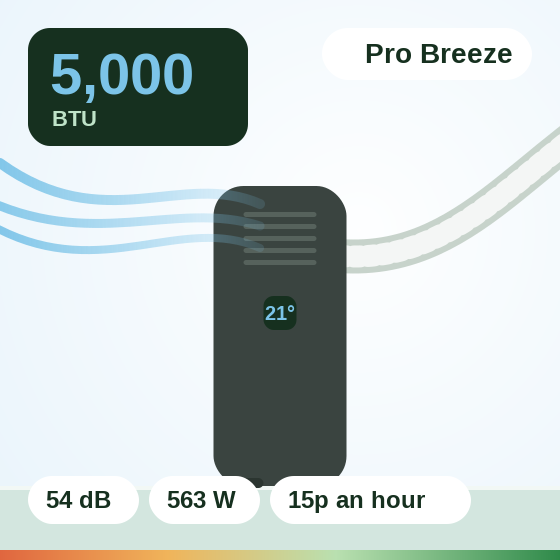
Pro Breeze
5000 BTU 3-in-1 Portable Air Conditioner with Dehumidification Function, Smart Wifi App (PB-AC-08)
5,000 BTU · 54 dB · 563 W · 15p an hour
£224.99 at Pro Breeze (maker shop), checked 13 Nov 2026
See it at Pro Breeze (maker shop)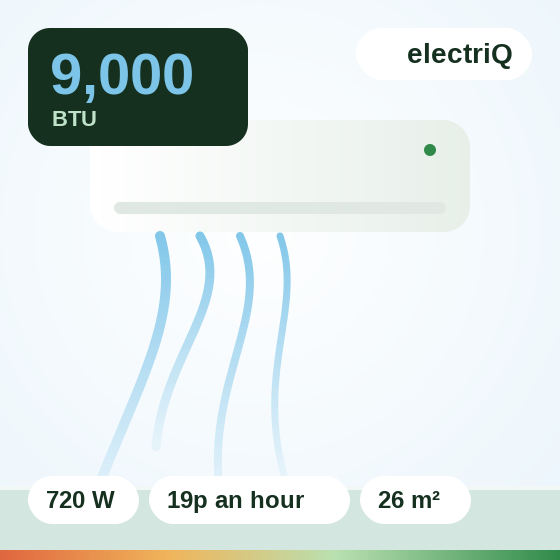
electriQ
Easy-Fit 9000 BTU A+++ WiFi Smart Wall Mounted Split Air Conditioner with Heat Pump (eIQ-9WMINV)
9,000 BTU · 720 W · 19p an hour · 26 m²
£754.97 at Appliances Direct, checked 14 Nov 2026
See it at Appliances Direct
Figures from the maker or retailer listing. Cost an hour is our own, at the price cap of 26.32p a kWh.