
Key takeaways
- A condensing unit is the outdoor unit of a split air conditioner (see how air conditioning works). It holds the compressor and the condenser coil, where the heat taken from the room is released to the outdoor air.
- On a 2.5 kW Mitsubishi Electric split, our working puts about 3.0 kW of heat out of the outdoor unit at its rated cooling: 2.5 kW from the room plus 0.485 kW of electricity.
- That outdoor unit measures 800 x 285 x 550 mm, weighs 32 kg and is rated 46 dB(A) in cooling.
- It needs clearance for airflow. Planning and noise rules depend on the nation: see the short section below and our guides.
- A condensing unit is not a condensing boiler, and a portable air conditioner has no separate one.
What is a condensing unit?
A condensing unit is the outdoor unit of a split air conditioner. Penn State’s course notes list the “Compressor (Outdoor Unit)” and the “Condenser Coil (Outdoor Unit)”, with the evaporator coil in the indoor unit. A fan moves outdoor air across the coil (our description; the sources we opened name the parts but not the fan). The guide to how air conditioning works explains the whole loop. People also say “outdoor unit” or “condenser”, and for a home system they mean the same box.
What does a condensing unit do?
It gets rid of heat. Daikin UK says that at the condenser the refrigerant “condenses, and changes state to become a sub-cooled high-pressure liquid”, releasing its heat into the surrounding air. The compressor, which Daikin says “pumps the refrigerant around the system”, is what drives the loop, and Penn State notes it needs energy to do so.
What is inside a condensing unit?
The sources above name the compressor and the condenser coil. Refrigerant pipes link it to the indoor unit. Beyond that, what a particular unit contains is for its maker’s documents; we have not opened one.
Our worked example: what one outdoor unit releases
The heat taken from the room and the electricity the compressor uses both leave through the condenser. Neither source states that as a sum, so this is our working from the rule that energy is not lost, using the Mitsubishi Electric MSZ-LN25VG3 with its MUZ-LN25VG3 outdoor unit. Its product information sheet rates it at 2.5 kW of cooling for a nominal 485 W of input.
- Heat from the room: 2.5 kW.
- Electricity used: 0.485 kW.
- Heat released outdoors: 2.5 + 0.485 = 2.985 kW, about 3.0 kW (our working).
- Cost of the input at full nominal power: 0.485 kWh x 26.32p = 12.8p an hour.
The 26.32p is Ofgem’s Great Britain average unit rate under the price cap for 1 October to 31 December 2026, with no VAT (0%) for this period; in Northern Ireland use the unit rate on your own bill. The 485 W is a nominal rated figure, and an inverter such as this one often draws less once the room is cool. We rework the figure when the cap changes.
The same file lists the outdoor unit at 800 x 285 x 550 mm (W x D x H), 32 kg, 46 dB(A) sound pressure in cooling and a maximum pipe length of 20 m.
Where does it go and what should I know first?
Daikin UK says “The outdoor unit needs proper clearance for air flow”, half a metre on the sides where air enters and exits as a minimum it gives, and that it needs to be accessible for maintenance and “not positioned where it might annoy neighbours with noise”. It adds that using qualified installers “ensures proper installation and maintains warranty coverage”. The installer decides the position. Fitting the refrigerant circuit needs F-gas qualifications: see F-gas regulations and installation costs.
Planning in England. Planning Portal says the permitted development rights “only apply if the system provides a heating function (including if it can provide both heating and cooling)”, and that for a system that “only offers a cooling function” an application for planning permission will be required. A unit installed under those rights must also pass the MCS 020 a) sound calculation, which checks a limit of 37 dB LAeq,5mins at the assessment positions. Other nations’ rules differ: see planning permission and noise rules.
Flats and rented homes. If you own a flat on a lease, GOV.UK says the lease sets out “if you need permission to make alterations”; the lease and its plan show which parts of the building are yours and whether you need the freeholder’s consent. A tenant checks the tenancy agreement and asks the landlord.
Condensing unit or condensing boiler?
They are different machines. A condensing boiler is a heating appliance; a condensing unit here is the outdoor half of a refrigerant system. The word “condensing” in both refers to a gas turning into a liquid, but nothing else is shared.
Condensing units in commercial refrigeration
Search results for “condensing unit” also include commercial refrigeration. We have not opened a source for that use, so this page describes the home split system only; see commercial air conditioning for the commercial pages we cover.
Frequently asked questions
What is a condensing unit in an air conditioner?
It is the outdoor unit of a split system, holding the compressor and the condenser coil, where the heat from the room is released outdoors.
Is a condensing unit the same as a condenser?
Often the words are used interchangeably. The condenser is the coil; the condensing unit is the outdoor box that holds the condenser coil and the compressor.
Where does the condensing unit go?
Outside, in a position the installer chooses. Daikin UK says it needs clearance for airflow, to be accessible for maintenance and not to annoy neighbours with noise.
Does the condensing unit contain the refrigerant?
Refrigerant circulates through both the outdoor and indoor units. Daikin’s specification table for its outdoor model gives a charge; see R32 refrigerant and refrigerants.
Is a condensing unit noisy?
The Mitsubishi Electric unit above is rated 46 dB(A) in cooling; other models differ. See noise rules.
Do I need planning permission for a condensing unit?
In England, a cooling-only system is not covered by the permitted development right, so planning permission is required; a system that can heat and cool may be covered if it meets all the limits. Check with your council.
Does a portable air conditioner have a condensing unit?
Not as a separate outdoor part. Meaco’s manual calls its portables “self-contained systems”, so the compressor and condenser are in the same box. See portable air conditioners.
Sources
- Daikin UK: The refrigerant cycle, what is it? (checked 15 November 2026)
- Penn State EGEE 102: How air conditioners work (checked 15 November 2026)
- Daikin UK: Air conditioner types (checked 15 November 2026)
- Planning Portal: Do I need planning permission to add air conditioning to my home? (checked 15 November 2026)
- MCS: MCS 020 a) Issue 1.1, sound calculation for permitted development air source heat pumps (checked 15 November 2026)
- GOV.UK: Leasehold property, leaseholder rights and responsibilities (checked 15 November 2026)
- Mitsubishi Electric UK: MSZ-LN R32 product information sheet, February 2026, for the figures in our product file (checked 14 November 2026; not re-opened as text on 15 November 2026)
- Meaco: MeacoCool Pro 12,000 BTU instruction manual (copy at Air Conditioning Centre) (checked 15 November 2026)
- Ofgem: Energy price cap, 1 October to 31 December 2026 (checked 13 November 2026 in our energy data file; not re-opened)
Products on this page
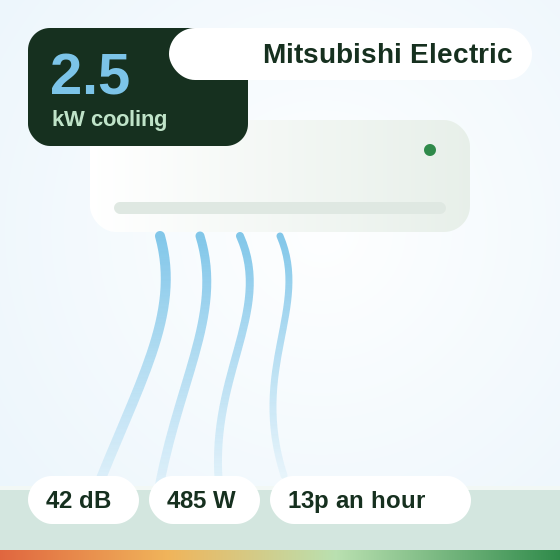
Mitsubishi Electric
MSZ-LN25VG3 (indoor) with MUZ-LN25VG3 (outdoor), 2.5 kW
2.5 kW cooling · 42 dB · 485 W · 13p an hour
No current UK price found
Figures from the maker or retailer listing. Cost an hour is our own, at the price cap of 26.32p a kWh.