Key takeaways
- A working split system is sealed. Daikin’s manual says its refrigerant “is mildly flammable, but normally does NOT leak”, and iHeat says refrigerant “should not be treated as a consumable that needs topping up every year”. A low charge therefore points to a leak that needs finding, not to a routine air conditioning refill. Our air conditioning repair guide covers the rest of repair and servicing.
- In Great Britain, only an F-gas qualified technician working for a certified company may work on the refrigerant circuit, and F-gas for servicing may be sold only to certified businesses. You cannot lawfully buy a regas kit.
- We found no published price for a regas or refrigerant leak repair. A service price of £79 to £179 does not include refrigerant. Ask for a written quote.
- Poor cooling has simpler causes first: check settings, filters and blocked air inlets or outlets before you suspect the gas.
- This is general information, not legal advice. Northern Ireland follows the EU F-gas rules.
Does home air conditioning need regassing?
No, not as routine upkeep. A home split system keeps its refrigerant in a sealed circuit, and the refrigerant is not used up like fuel. “Air conditioning refill” and “regas” mean putting refrigerant back after some has escaped. This page explains what a low charge means and who may deal with it. The gas itself is covered on air conditioning gas, and recognising a leak on air conditioning leaks. Both sit within our guide to air conditioning repair.
Why a low charge means a leak
Daikin’s FTXF-F operation manual, which names the 60 and 71 sizes, says: “The refrigerant inside the unit is mildly flammable, but normally does NOT leak.” iHeat’s maintenance guide says “Refrigerant should not be treated as a consumable that needs topping up every year” and “If an engineer identifies a low charge, the reason needs investigating rather than simply adding more refrigerant repeatedly.” Mitsubishi’s MSZ-LN manual (New Zealand edition) says that when the air conditioner does not cool or heat “there is a possibility of refrigerant leakage”, and that if a repair involves recharging, you should ask the service technician for details.
Signs of a low charge
The manuals we read do not give a list of symptoms that prove a low charge, and we do not give one. What they say:
- Poor cooling with the basics ruled out. Daikin’s FTXF-E guide lists the checks first: airflow rate and temperature settings, blocked air inlets or outlets, clogged filters, open doors and windows, Econo mode and furniture beside the unit. Mitsubishi’s list adds the fan setting, a dirty fan or heat exchanger and a high outside temperature. See air conditioner not cooling.
- An error code. Daikin’s FTXF-E guide explains how to read a code on the wireless remote and says to consult your dealer. Its list of error descriptions includes “Refrigerant shortage”. The letter and number codes are images in the guide’s PDF, so we print none. The guide says reading and resetting a code “should be done by a licensed installer or your local dealer”.
- A flashing operation lamp. Daikin’s FTXF-F manual says to notify your installer and report the error code.
Daikin’s E-series list also includes freeze-up protection, but the manual does not say what causes it. If you see any code, report it.
What an engineer does
The engineer finds where the refrigerant is escaping and repairs it, then puts the refrigerant back; iHeat says a low charge should be investigated rather than simply topped up. Where leak checks apply, GOV.UK says that if you find a leak you “must repair it as soon as possible” and retest within a month. Article 3 of the F-gas Regulation as it applies in Great Britain says operators of equipment containing F-gases “shall take precautions” against leaks and, where one is detected, “the operators shall ensure that the equipment is repaired without undue delay.” Ask for a written record of what was found and done. For equipment that must be leak checked, Article 6 says the operator keeps records for at least five years.
Our figure: why a home system is below the leak-check table
Tonnes CO2 equivalent = charge in kg x GWP / 1,000. A Daikin Sensira 2.5 kW holds 0.42 kg of R32 (Daikin UK’s outdoor unit table, GWP 675): 0.42 x 675 / 1,000 = 0.28 tonnes. GOV.UK’s leak check frequencies start at 5 tonnes, which is 5,000 / 675 = 7.41 kg of R32, so the Sensira holds 5.7% of it. It is below the table, but the duty to prevent leaks and repair them without undue delay still applies. We give no figure for how much refrigerant a unit can lose, because none of the sources we read does.
What does a regas cost?
We found no published price for a regas, a refrigerant leak repair or a recharge when we checked on 25 November 2026. The service prices we found are for the visit only: Molesey Air’s from £79 and Appliances Direct’s from £179 including VAT, and Appliances Direct says repairs are not included and offers “repair/regas options” without a price. iHeat’s maintenance guide gives no regas prices either.
A quote has to cover finding the leak, repairing it, recovering any refrigerant and recharging, plus parts and access. Ask the engineer to itemise those, to state whether VAT is included and to give you a written quote before work starts. Costs for a failed compressor are on compressor replacement cost, and service prices are on air conditioning service cost.
Can I buy a regas kit?
No. GOV.UK says you must have qualifications to “service and maintain systems”, “check for leaks” and “recover gases”. Article 11(4) of the GB F-gas Regulation says that for installation, servicing, maintenance or repair, F-gases “shall only be sold to and purchased by undertakings that hold the relevant certificates”. That covers the gas you would put in. For a portable, De’Longhi’s PAC AP manual says refrigerant “filling, cleaning, recovery and disposal” should be done only by a technical service centre appointed by the manufacturer. Read F-gas rules for the detail.
Older systems with HCFC gas
An old system built for an HCFC refrigerant cannot be topped up with reclaimed or recycled gas in Great Britain (GOV.UK and NetRegs). What that means for repair or replacement is on when to replace an air conditioning unit. For a service visit, see air conditioning service.
Frequently asked questions
Does home air conditioning need regassing?
Not as routine upkeep. Daikin says its refrigerant “normally does NOT leak”, and iHeat says refrigerant should not be treated as a consumable that needs topping up every year. A low charge means the reason needs investigating.
How often should an air conditioner be regassed?
No maker’s manual we read gives a regas interval. Where a low charge is found, the cause needs investigating rather than repeatedly adding refrigerant.
How much does it cost to regas an air conditioner?
We found no published price for a regas or leak repair on 25 November 2026. A service from £79 (Molesey Air) or from £179 including VAT (Appliances Direct) does not include refrigerant. Ask for a written, itemised quote.
Why is my air conditioner low on gas?
A leak is the reason to investigate. Mitsubishi’s manual says that when a unit does not cool or heat, there is a possibility of refrigerant leakage. Rule out settings, filters and blocked airflow first, then call an F-gas certified engineer.
Can I top up my air conditioner myself?
No, and a top-up would not fix the cause: a low charge means a leak that has to be found and repaired first. The rules on who may buy refrigerant and work on the circuit are on air conditioning gas. This is general information, not legal advice.
Is regassing the same as a service?
No. A service is a planned visit that includes a check of the refrigerant circuit. Regassing is a repair that follows when refrigerant has been lost, and it is charged on top.
Can a leak be fixed without regassing?
That is for the engineer to judge. None of the sources we read says whether a repaired system needs recharging, so ask your engineer what they found and what they did, in writing.
Sources
- Daikin: FTXF60F2V1B and FTXF71F2V1B operation manual 3P511999-9S, 2024.09 (PDF) (checked 25 November 2026)
- Daikin: FTXF20 to 42E5V1B user reference guide 4D526466-14K, 2022.09 (PDF) (checked 25 November 2026)
- Mitsubishi Electric: MSZ-LN25VG2 to MSZ-LN60VG3 operating instructions VG79Y699H01, New Zealand edition (PDF) (checked 25 November 2026)
- De’Longhi: PAC AP series instructions for use 5715117836 (PDF) (checked 25 November 2026)
- iHeat: Air Conditioning Maintenance: Filter Cleaning, Servicing and Costs (updated 2 October 2026) (checked 25 November 2026; the address names a regassing article but opens this maintenance guide, which held the lines quoted when we looked again on 28 November 2026)
- GOV.UK: Qualifications required to work on equipment containing F gas (updated 3 March 2026) (checked 25 November 2026)
- GOV.UK: Checking F gas equipment for leaks (published 21 August 2019) (checked 25 November 2026)
- legislation.gov.uk: Regulation (EU) No 517/2014 as it applies in GB, Article 3 (checked 25 November 2026)
- legislation.gov.uk: Regulation (EU) No 517/2014 as it applies in GB, Article 6 (records) (checked 25 November 2026)
- legislation.gov.uk: Regulation (EU) No 517/2014 as it applies in GB, Article 11 (checked 25 November 2026)
- GOV.UK: Recovering ozone-depleting substances from equipment (published 18 April 2023) (checked 25 November 2026)
- NetRegs: Stationary refrigeration, air conditioning and heat pumps, ODS controls (checked 25 November 2026)
- Molesey Air: air conditioning maintenance, Surrey (checked 25 November 2026)
- Appliances Direct: split air conditioning service (checked 25 November 2026)
- Daikin UK: specifications table RXF-F (outdoor units) (checked 25 November 2026)
Products on this page
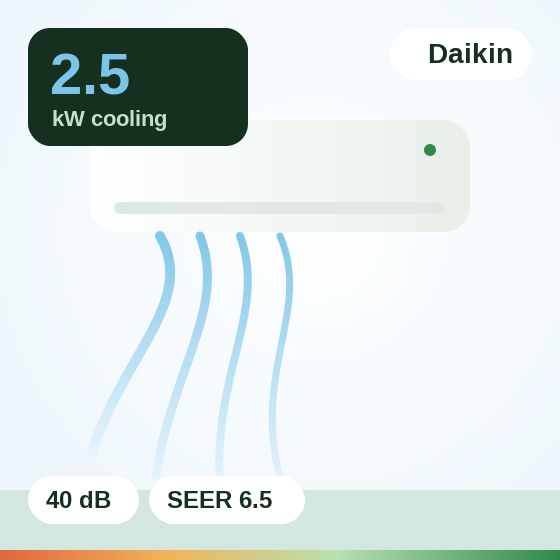
Daikin
Sensira FTXF25F5V1B (indoor) with RXF25F5V1B (outdoor), 2.5 kW
2.5 kW cooling · 40 dB · SEER 6.5
No current UK price found
Figures from the maker or retailer listing. Cost an hour is our own, at the price cap of 26.32p a kWh.