Key takeaways
- An inverter air conditioner has a compressor whose speed can change, so the unit can vary how much it cools instead of only running flat out or switching off. Our guide to how air conditioning works explains the cycle it drives.
- The word “inverter” is not a rating. Two 2.5 kW Daikin inverter splits have different energy labels: 92 kWh a year for the Perfera and 135 kWh for the Sensira.
- To compare running costs, read the label’s SEER and annual kWh, not the word “inverter”.
- Daikin UK says inverters use “up to 30% less electricity than non-inverter systems”, but names no model, test standard or conditions, so we do not quote it as a saving.
- Inverter portables exist. A portable’s rated input is a full-power figure, so a cost worked out from it is an upper estimate.
What is an inverter air conditioner?
An inverter air conditioner is one whose compressor can run at different speeds. Daikin UK says an inverter “is a device which controls the electric voltage, current and frequency of a device”, and in an air conditioner it works by altering the speed of the compressor, so the compressor can be modulated rather than simply switched on or off.
That changes how hard the compressor works, not how the cooling cycle works. The refrigerant still moves heat from the room to the outdoors; our guide to how air conditioning works explains the four parts. The inverter only decides how fast the compressor turns.
How an inverter works compared with a fixed-speed unit
A fixed-speed unit: on, off, on
Daikin UK describes a traditional non-inverter unit as having “a fixed-speed compressor that runs at full power”. It reaches the set temperature, switches off, and switches on again when the room warms. Daikin says this cycle causes “energy spikes during each restart”.
An inverter: it changes speed to hold the temperature
Daikin UK says inverter units “continuously regulate compressor speed and refrigerant flow to maintain a stable indoor temperature”. The range is stated on the maker’s specification table. For the Daikin Perfera 2.5 kW, Daikin gives 0.90 kW of cooling at the minimum, 2.50 kW nominal and 3.80 kW at the maximum.
What it changes for you
Steadier temperature and fewer restarts
This is Daikin’s description of its own technology: a unit that adjusts its speed holds the room closer to the set temperature than one that cycles fully on and off. We have not tested any unit, and no independent measurement of this is cited here.
Noise
Daikin UK says an inverter “operates quietly, especially in silent mode”, and that a non-inverter is louder because of compressor cycling. That is a maker statement, not a promise about any model. Noise is stated per unit: Daikin lists the Perfera’s indoor unit at 19 dB(A) in silent operation, 25 on low, 33 on medium and 41 on high.
Running cost: why the label, not the word “inverter”, shows efficiency
The energy label’s yearly cooling figure comes from a method set in law. Annex VII of the energy labelling regulation says the calculation must take into account “the degradation of the energy efficiency caused by on/off cycling (if applicable) depending on the type of control”. So the label’s SEER and annual kWh already reflect how a unit’s control behaves.
Our worked example: the same size, two different labels
Both of these are 2.5 kW Daikin inverter splits. We use the label method, at 26.32p per kWh: Ofgem’s Great Britain average unit rate under the price cap for 1 October to 31 December 2026, which carries no VAT (0%) for this period. The standing charge is left out. In Northern Ireland, use the unit rate on your own bill.
| Daikin Perfera 2.5 kW | Daikin Sensira 2.5 kW | |
|---|---|---|
| Cooling, minimum / nominal / maximum | 0.90 / 2.50 / 3.80 kW | 1.30 / 2.50 / 2.80 kW |
| SEER | 9.47 | 6.50 |
| Label cooling energy | 92 kWh a year | 135 kWh a year |
| Cost at 26.32p | £24.21 a year | £35.53 a year |
The working, once:
- Perfera: 92 kWh x 26.32p = £24.21 a year. The energy label applies 350 hours of cooling a year to air conditioners other than single-duct and double-duct units (Annex VII, Table 4), which covers these splits, so 92 / 350 = 0.263 kWh an hour on average, which is 6.9p an hour.
- Sensira: 135 kWh x 26.32p = £35.53 a year.
- The difference: 135 - 92 = 43 kWh, which is £11.32 a year.
- Modulation: the Perfera’s lowest setting is 0.9 / 2.5 = 36% of its nominal output and its highest is 3.8 / 2.5 = 152%. The Sensira’s range is 1.3 / 2.5 = 52% to 2.8 / 2.5 = 112%.
Both are inverters, yet the labels differ by 43 kWh a year. We have no figure for how much an inverter saves against a fixed-speed unit of the same size, because no source we opened gives one with its conditions. These figures are label figures at the label’s assumed use; your use will differ.
What to check on a specification sheet
- SEER and annual kWh. The seasonal figure on the label; a higher SEER and a lower annual kWh mean less electricity over the label’s cooling season.
- Capacity range in kW. A minimum, nominal and maximum, as Daikin prints them. A low minimum means the unit can run gently in a cool room.
- Noise. The indoor sound pressure in dB(A) at each fan speed, for the model you are buying.
- Whether the figure is for a pair. Indoor and outdoor units are listed together; check the pair you are quoted.
For lists ranked on running cost, see our energy efficient air conditioner page, and for how a yearly cost is worked out, air conditioning running costs.
Inverter portable air conditioners
Portables described as inverter models are on sale. The De’Longhi Pinguino GentleJet Inverter (PACAP130IGENTLEJET) page says it uses “Inverter technology” and lists a rated input of 1035 W; it was out of stock at De’Longhi UK when we checked on 15 November 2026.
For a portable, the listing gives a rated input power, which is what the unit draws at full output under test conditions. An inverter often draws less once the room is cool, so a cost worked out from that wattage is an upper estimate. Single-duct portables are also rated under different conditions from splits (35C on both sides, against 35C outside and 27C inside), so do not compare a portable’s wattage cost with a split’s label cost without saying the methods differ. See best inverter portable air conditioners.
What Daikin’s “up to 30%” claim does and does not tell you
Daikin UK’s inverter pages give a 30% figure in more than one place: “30% less power consumption” on one page, and on another “In many cases, inverter ACs use up to 30% less electricity than non-inverter systems.” The comparison is with non-inverter systems in general: neither page names a model, the weather, the conditions or a test standard. For that reason we do not quote it as a saving, and you should not budget from it. Daikin’s page also cites a 20% to 35% higher upfront cost for inverters from an external market report; we leave that figure out too. Compare actual prices and the annual kWh on each label instead.
Frequently asked questions
What is an inverter air conditioner?
It is an air conditioner whose compressor speed can change. Daikin UK describes the inverter as controlling “electric voltage, current and frequency”, which lets the compressor be modulated rather than only switched on or off.
Is an inverter air conditioner cheaper to run?
The word alone does not tell you. Compare SEER and annual kWh: the Perfera’s label is 92 kWh a year and the Sensira’s is 135 kWh, and both are inverters.
Is an inverter quieter?
Makers say operation is quieter at lower compressor speeds. Daikin UK says inverter units operate quietly, especially in silent mode. Use the model’s own dB(A) range: 19 to 41 dB(A) for the Daikin Perfera’s indoor unit, for example.
Do inverter air conditioners last longer?
Daikin UK says inverters have “reduced wear due to stable operation” and a life that is “often longer”. That is a maker claim with no figure, so treat it as such.
Can a portable air conditioner be an inverter?
Yes. The De’Longhi Pinguino GentleJet Inverter is one example. A portable’s rated input is a full-power figure, so a running cost from it is an upper estimate.
What does inverter mean on a heat pump?
The same technology: a variable-speed compressor. See our guide to air-to-air heat pumps, which can both cool and heat.
Is an inverter worth the extra cost?
Compare the prices of the models you are choosing and their annual kWh, then work out the difference with the 26.32p rate. We leave out Daikin’s third-party figure for higher upfront cost. Our dry mode and refrigerant pages cover two other things on the specification sheet.
Sources
- Daikin UK: What is inverter technology? (checked 15 November 2026)
- Daikin UK: Inverter air conditioners (checked 15 November 2026)
- legislation.gov.uk: Regulation (EU) No 626/2011 as it applies in GB, Annex VII (checked 15 November 2026)
- Daikin UK: specifications table FTXM-A / RXM-A9 (checked 15 November 2026)
- Daikin UK: specifications table FTXM-A (indoor) (checked 15 November 2026)
- Daikin UK: specifications table FTXF-F / RXF-F (checked 15 November 2026)
- De’Longhi UK: Pinguino GentleJet Inverter PACAP130IGENTLEJET (checked 15 November 2026)
- Ofgem: Changes to energy price cap between 1 October and 31 December 2026 (checked 15 November 2026)
Products on this page
Daikin
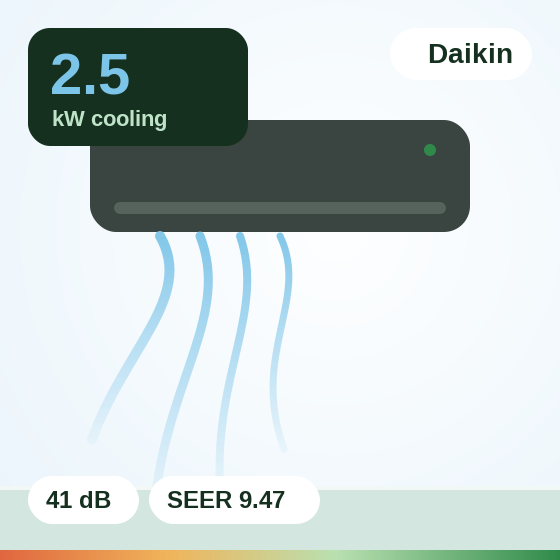
Perfera FTXM25A (indoor) with RXM25A5V1B9 (outdoor), 2.5 kW
2.5 kW cooling · 41 dB · SEER 9.47
No current UK price found
Daikin
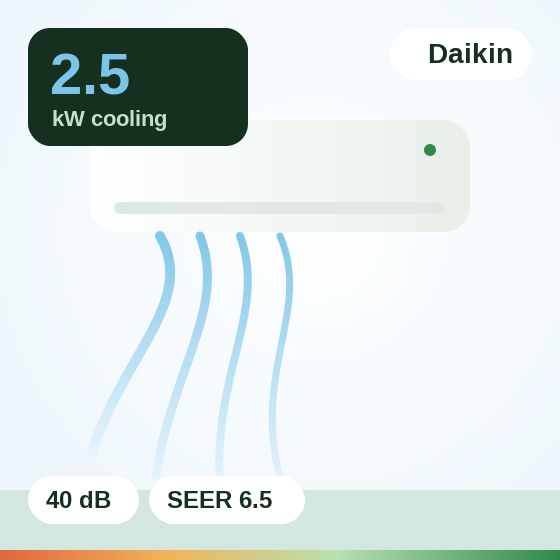
Sensira FTXF25F5V1B (indoor) with RXF25F5V1B (outdoor), 2.5 kW
2.5 kW cooling · 40 dB · SEER 6.5
No current UK price found
De'Longhi
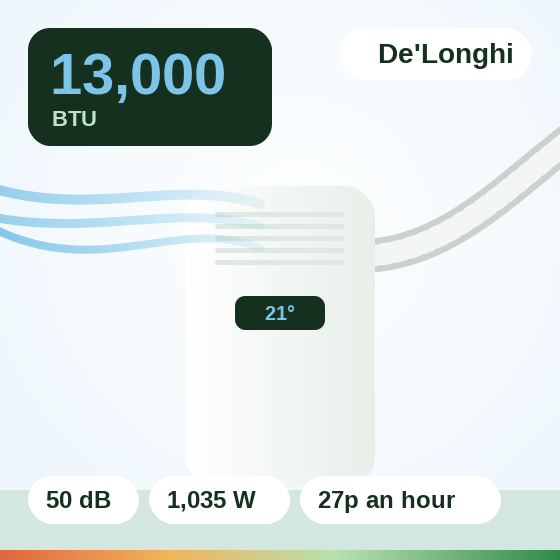
Pinguino GentleJet Inverter PACAP130IGENTLEJET
13,000 BTU · 50 dB · 1,035 W · 27p an hour
£999.99 at De'Longhi UK (maker shop), checked 14 Nov 2026
See it at De'Longhi UK (maker shop)
Figures from the maker or retailer listing. Cost an hour is our own, at the price cap of 26.32p a kWh.