Key takeaways
- Air conditioning gas is the refrigerant sealed inside the unit. Your unit’s data plate and manual name it: a Daikin Sensira 2.5 kW uses R32, 0.42 kg, with a global warming potential (GWP) of 675. Our air conditioning repair guide covers the rest of repair and servicing.
- R410A is a mixture of R32 and R125 and has a GWP of about 2,088 on the US EPA’s table, around three times R32’s 675.
- In Great Britain, only an F-gas qualified technician working for a certified company may work on the refrigerant circuit of a split system, and F-gas for servicing may be sold only to certified businesses. You cannot lawfully buy refrigerant to top up a system.
- Home systems hold far less than the 5 tonnes CO2 equivalent (about 7.4 kg of R32) at which GB leak check intervals start: 4.6% to 15.5% of it for the systems in our product files.
- This is general information, not legal advice. Northern Ireland follows the EU F-gas rules, not the Great Britain ones.
What is the gas in an air conditioner?
It is the refrigerant: the fluid sealed inside the unit that carries heat from indoors to outdoors. People say “air conditioning gas” and “regas” for it. This page covers which refrigerants home units use and who may handle them. It does not explain the refrigeration cycle; see our glossary pages on R32 refrigerant and air conditioning refrigerants. Whether your unit needs topping up is answered on does home air conditioning need regassing?. Both sit within our guide to air conditioning repair.
Which refrigerant does mine use?
Read the data plate and your manual: the label on your unit is the authority. Examples from makers’ own documents:
- Daikin FTXF-F (Sensira range). Daikin UK’s table lists R-32, a charge of 0.420 kg and a GWP of 675 for the RXF25F outdoor unit. Daikin’s FTXF-F manual (which names the 60 and 71 sizes) calls the refrigerant “mildly flammable” and says it “is odourless”.
- Mitsubishi Electric MSZ-LN. Mitsubishi’s UK instruction book DG79A05RL01, for the VG2 models, carries the warning “This unit uses a flammable refrigerant.” The MSZ-LN25VG3’s product file lists R32 at 0.8 kg.
- Portables. Many portables use R290 (propane). Pro Breeze’s PB-AC08 manual says the unit “contains 95g of R290 refrigerant gas”, and our product file for the Pro Breeze PB-AC04 lists R290. 37 of the 47 current portable air conditioners in our product files state R290 (counted on 15 November 2026).
R32 against R410A
R32
The GB version of the F-gas Regulation gives HFC-32 a GWP of 675 (Annex I). New single split systems holding under 3 kg may not use an F-gas with a GWP of 750 or more from 1 January 2025 (Annex III; GOV.UK words it “Above 750”), so R32 is allowed in new single splits. New movable room air conditioners may not contain HFCs with a GWP of 150 or more, so new portables are not charged with R32; many use R290.
R410A
The US EPA’s table lists R-410A at 2,088 (calculated) and R-32 at 675, so R32’s figure is about a third of R410A’s. R410A is a mixture of R32 and R125: Daikin Chemicals’ R-410A safety data sheet gives 48.5 to 50.5% difluoromethane (R32) and 49.5 to 51.5% pentafluoroethane (R125), roughly half each. R125 is listed in Annex I at 3,500, and half of 675 plus half of 3,500 is 2,087.5, which agrees with the EPA’s figure. At 2,088, R410A is above the 750 limit, so a new single split under 3 kg could not use it. That is our comparison: GOV.UK’s table does not name R410A. The bans are on placing new products on the market, and nothing in them requires a system already fitted to be removed.
Older gases
Some older systems were built to use an HCFC refrigerant. Current GOV.UK guidance (published 18 April 2023) says “Reclaimed or recycled ODS cannot be used to service RACHP equipment in Great Britain”, where RACHP means refrigeration, air conditioning and heat pump equipment. NetRegs says “The use of recovered or reclaimed HCFCs to top up or service equipment has been banned since 1 January 2015.” Neither current page names R22. An archived Defra information sheet headed “R22 Phase-out” (April 2012, archived by GOV.UK in January 2015, so not current guidance) names R22 as an HCFC refrigerant and says new equipment using it was banned in 2001, or 2004 for small air conditioning systems. We found no source that says an old system can be converted to another gas, so we make no claim about that. See when to replace an air conditioning unit.
Can I buy gas and top up my own air conditioner?
No. In Great Britain, fitting, servicing, leak checking, recovering refrigerant from or decommissioning a split or other fixed system containing F-gas must be done by an F-gas qualified technician working for an F-gas certified company. GOV.UK says you must have qualifications to “service and maintain systems”, “check for leaks” and “recover gases” (updated 3 March 2026).
Article 11(4) of the F-gas Regulation as it applies in Great Britain says that for installation, servicing, maintenance or repair, F-gases “shall only be sold to and purchased by undertakings that hold the relevant certificates”. A householder cannot lawfully buy refrigerant to top up a system, and a “regas kit” is not an owner’s job. For a portable, De’Longhi’s PAC AP manual says “Transport, filling, cleaning, recovery and disposal of refrigerant should be performed by a technical service centre appointed by the manufacturer only.” The qualification rules are for work on the refrigerant circuit; emptying a portable’s tank or cleaning its filter is the owner’s. Read F-gas rules for who can legally install and service.
What does the law say about the gas in a home system?
GOV.UK sets leak check intervals by CO2 equivalent: at least every 12 months from 5 tonnes (24 with a leak detection system) and every 6 months from 50 tonnes (12 with one). Equipment of 500 tonnes or more must have a leak detection system and is then checked at least every 6 months. For equipment that must be leak checked, Article 6 says the operator keeps records for at least five years.
Our figure: how far below the threshold?
Tonnes CO2 equivalent = charge in kg x GWP / 1,000, the formula Daikin prints in its manual. For a Sensira with 0.42 kg of R32 (re-read on Daikin UK’s table on 25 November 2026): 0.42 x 675 / 1,000 = 0.28 tonnes, and the 5 tonne threshold is 5,000 / 675 = 7.41 kg of R32, so the Sensira holds 5.7% of it. The seven home systems in our product files hold 0.34 to 1.15 kg, or 4.6% to 15.5% of the threshold; the table with each system is on air conditioning leaks.
None of them reaches the threshold at which the leak check frequency table starts, but that does not mean no rules apply. Article 3 says operators “shall take precautions” to prevent leaks, and where one is detected “the operators shall ensure that the equipment is repaired without undue delay.” For equipment that does need checks, GOV.UK says that if you find a leak you “must repair it as soon as possible” and retest within a month.
If you smell or suspect a gas leak
Refrigerant is odourless, so you may not smell it. Daikin’s manual says to turn off any combustible heating devices, ventilate the room and contact the dealer, and not to use the unit until a service person confirms the part has been repaired. Mitsubishi’s MSZ-LN manual (New Zealand edition) says: “If any refrigerant leakage is found, stop operations and ventilate the room well and consult your dealer immediately.” We add no handling advice of our own. See air conditioning leaks.
Frequently asked questions
What gas is used in air conditioners?
The home split systems in our product files use R32, and many portables use R290. R410A, a mixture of R32 and R125, is compared with R32 above. Check your data plate and manual, because the label on your unit is the authority.
Is R32 better than R410A?
R32’s GWP is 675 against about 2,088 for R410A on the US EPA’s table, so it is about a third. Makers also describe R32 as flammable (Daikin: “mildly flammable”), and in Great Britain only certified engineers may work on the circuit.
How do I know which gas my air conditioner has?
Look for the data plate on the outdoor unit and the refrigerant line in your manual. If you cannot find it, give your installer the model name and installation date.
Can I top up my air conditioner gas myself?
No. In Great Britain refrigerant for servicing may be sold only to certified undertakings (Article 11(4)), and the work needs an F-gas qualified technician from a certified company. This is general information, not legal advice.
Is air conditioning gas harmful or flammable?
Daikin calls its refrigerant “mildly flammable”, and Mitsubishi’s UK instruction book warns that the unit “uses a flammable refrigerant”. Both say a leak that meets fire from a heater or cooker can give off harmful gas. Follow your manual if you suspect a leak.
Can old air conditioners with HCFC gas still be regassed?
Current GOV.UK guidance says reclaimed or recycled ODS cannot be used to service RACHP equipment in Great Britain, and NetRegs says recovered or reclaimed HCFCs have been banned for topping up or servicing since 1 January 2015. Ask an F-gas engineer about the options for a leaking old system.
Do home air conditioners need F-gas leak checks?
Under the Great Britain rules, leak check intervals start at 5 tonnes CO2 equivalent, far above any home system in our files. Operators still have a duty to prevent leaks and repair them without undue delay. Northern Ireland follows EU rules.
Sources
- Daikin: FTXF60F2V1B and FTXF71F2V1B operation manual 3P511999-9S, 2024.09 (PDF) (checked 25 November 2026)
- Mitsubishi Electric UK: MSZ-LN18-60VG2 Instruction Book DG79A05RL01 (PDF) (checked 25 November 2026)
- Mitsubishi Electric: MSZ-LN25VG2 to MSZ-LN60VG3 operating instructions VG79Y699H01, New Zealand edition (PDF) (checked 25 November 2026)
- De’Longhi: PAC AP series instructions for use 5715117836 (PDF) (checked 25 November 2026)
- Pro Breeze: PB-AC08 portable air conditioner instruction manual (PDF) (checked 25 November 2026)
- Daikin UK: specifications table RXF-F (outdoor units) (checked 25 November 2026)
- legislation.gov.uk: Regulation (EU) No 517/2014 as it applies in GB, Annex I (GWPs) (checked 25 November 2026)
- legislation.gov.uk: Regulation (EU) No 517/2014 as it applies in GB, Article 3 (checked 25 November 2026)
- legislation.gov.uk: Regulation (EU) No 517/2014 as it applies in GB, Article 6 (records) (checked 25 November 2026)
- legislation.gov.uk: Regulation (EU) No 517/2014 as it applies in GB, Article 11 (checked 25 November 2026)
- US EPA: Technology Transitions GWP Reference Table (updated 2 April 2026) (checked 25 November 2026)
- Daikin Chemicals: R-410A safety data sheet, revision 23 March 2023 (PDF) (checked 25 November 2026)
- GOV.UK: Qualifications required to work on equipment containing F gas (updated 3 March 2026) (checked 25 November 2026)
- GOV.UK: Checking F gas equipment for leaks (published 21 August 2019) (checked 25 November 2026)
- GOV.UK: Bans on F gas in new products and equipment (updated 27 August 2026) (checked 25 November 2026)
- GOV.UK: Recovering ozone-depleting substances from equipment (published 18 April 2023) (checked 25 November 2026)
- NetRegs: Stationary refrigeration, air conditioning and heat pumps, ODS controls (checked 25 November 2026)
- Defra: Information Sheet RAC 8, R22 Phase-out, April 2012 (archived January 2015) (PDF) (checked 25 November 2026)
Products on this page
Daikin
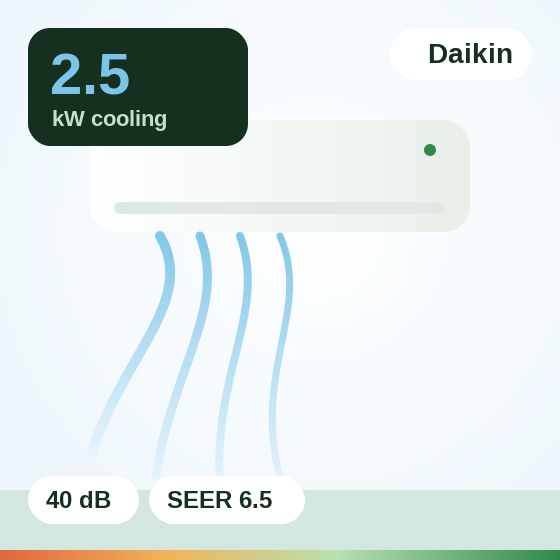
Sensira FTXF25F5V1B (indoor) with RXF25F5V1B (outdoor), 2.5 kW
2.5 kW cooling · 40 dB · SEER 6.5
No current UK price found
Daikin
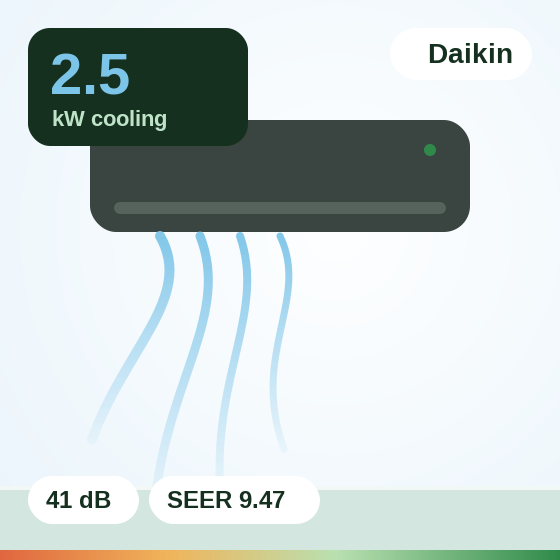
Perfera FTXM25A (indoor) with RXM25A5V1B9 (outdoor), 2.5 kW
2.5 kW cooling · 41 dB · SEER 9.47
No current UK price found
Daikin
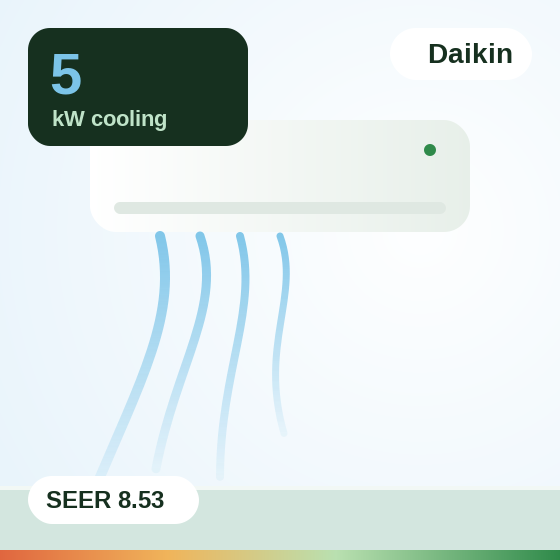
Multi split 2MXM50A2V1B8 (outdoor) with two Perfera FTXM25A indoor units, 5.0 kW
5 kW cooling · SEER 8.53
No current UK price found
Pro Breeze
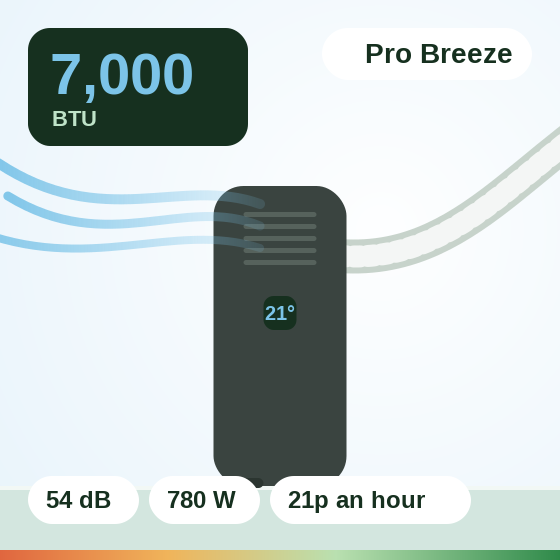
7000 BTU 3-in-1 Portable Air Conditioner with Dehumidification Function (PB-AC-04)
7,000 BTU · 54 dB · 780 W · 21p an hour
£279.99 at Pro Breeze (maker shop), checked 13 Nov 2026
See it at Pro Breeze (maker shop)
Figures from the maker or retailer listing. Cost an hour is our own, at the price cap of 26.32p a kWh.