Key takeaways
- Sometimes. Do evaporative air coolers work in the UK? On a hot, dry afternoon they can cool the air they blow by a few degrees; on a humid day they do very little, and they always add moisture.
- By our calculation a cooler does most on a hot, dry afternoon and little in muggy air; the worked figures are below.
- A cooler does not remove heat from the room, so it is not an air conditioner. Makers say to keep a window or door open.
- It costs little to run: about 1.7p an hour for a 65 W cooler, against 0.6p for a 24 W fan and 26.3p for a 1,000 W portable air conditioner.
The short answer
An air cooler cools the air it blows by evaporating water into it. In dry air that can be several degrees at the outlet. In humid air it is much less, and the room gets damper. It does not remove heat from the room, and no maker or retailer we read gives a temperature drop with stated conditions. For the machine itself, see the air cooler guide; for its mechanism, how air coolers work.
We have not tested any product. Everything below comes from official sources, makers’ and retailers’ listings and our own arithmetic, labelled as ours.
The limit: wet-bulb temperature
The Met Office defines it in three sentences [1]:
- “Wet bulb temperature is the lowest temperature that can be achieved through evaporative cooling.”
- “The greater the difference between the dry bulb and wet bulb temperatures, the drier the air.”
- “When both temperatures are equal, the air is fully saturated, and no further evaporation can occur.”
CIBSE says “the greatest potential for evaporative cooling is in hot/dry climates” [2]. PNNL, a US Department of Energy laboratory, gives a rule for whole-house coolers: “areas with wet-bulb temperatures of 70°F or lower are appropriate for evaporative cooling” (70°F is 21.1C), and coolers “can provide cooling in climates where coincidental wet-bulb temperatures are as high as 74°F” (23.3C), though high humidity reduces performance [3]. For a plainer definition, see evaporative cooler.
What does that mean in UK weather?
We could not find a Met Office page giving typical summer humidity for a UK station, so we do not claim one. What the Met Office does say:
- Of a spell in April 2026: afternoon relative humidity in some areas dropping to around 25 to 30%, which it called “exceptionally low by UK standards”, and “Overnight, humidity levels rise as temperatures fall, but daytime dryness quickly returns under sunny skies” [4].
- Of 30 June 2025: “A very warm and humid airmass continues to dominate southern parts of the UK”, with nights “not falling much below 20°C” and a forecast peak of 34°C [5].
- “Because it depends on temperature, the relative humidity can change during the day even if the actual amount of water vapour remains similar” (15 September 2026) [6].
So hot UK days can be dry or humid, and the same day’s afternoon is drier (in relative terms) than its early morning. A cooler does most in an afternoon in a dry spell, and least in the morning, in the evening, at night and in muggy spells.
The numbers
How we worked it out: the wet-bulb temperature comes from Roland Stull’s 2011 formula (Journal of Applied Meteorology and Climatology), as published in the ETHOS.RESKIT code [7], valid for 5% to 99% humidity and minus 20C to 50C, with wet-bulb errors from minus 1C to 0.65C [8]. The best-case outlet temperature is the air temperature minus the efficiency times the gap between air and wet-bulb temperature. PNNL says “Newer evaporative coolers have thick media with efficiencies (cooling effectiveness) of 75% to 93%” [3], and the EnergyPlus reference gives the same ratio [9]. We use 75% and 93%. The three conditions are ones we chose to span dry to muggy; they are not typical or average UK weather.
| Condition (our chosen inputs) | Wet-bulb | Best-case outlet at 75% | Best-case outlet at 93% | Air cooled by | Against PNNL’s rule of thumb |
|---|---|---|---|---|---|
| A. 30C, 40% humidity (a hot, dry-leaning afternoon) | 20.4C | 22.8C | 21.1C | 7.2C to 8.9C | under 21.1C: appropriate |
| B. 30C, 60% humidity (a hot, humid day) | 24.0C | 25.5C | 24.4C | 4.5C to 5.6C | above 23.3C: beyond the range PNNL says can still work |
| C. 25C, 75% humidity (a muggy summer day or evening) | 21.6C | 22.5C | 21.9C | 2.5C to 3.1C | between 21.1C and 23.3C: reduced performance |
On a hot, dry afternoon (30C, 40% humidity) the air leaving a cooler could at best be about 7 to 9C cooler. On a humid day (30C, 60%) at best 4.5 to 5.6C, and in muggy air (25C, 75%) about 2.5 to 3C. That is the air at the outlet, with all water in the air it adds to the room. Three cautions:
- These are upper limits for the air at the outlet, not the room temperature. PNNL’s 75% to 93% is for thick pads in whole-house coolers; no maker of a portable cooler we found states an efficiency, so a small unit may do worse.
- PNNL’s own example (95°F at 50% humidity, for which PNNL gives a wet-bulb of 79°F) has a supply temperature of 84°F, a drop of 11°F [3]. With PNNL’s own wet-bulb that is (95 - 84) / (95 - 79) = 11 / 16, about 69% effectiveness; with the wet-bulb from our method (26.6C, about 79.9°F) it is about 73%. Either way, PNNL’s example sits below its own 75% to 93% range.
- None of the figures says how cool a room will get. We do not convert them into a room temperature.
What it does to the room
A direct cooler adds moisture. PNNL: “Unlike standard air conditioning, direct evaporative coolers increase rather than decrease the humidity in the air” [3]. The Energy Technology List says this “can lead to high humidity levels in the cooled air produced” [10]. The Eco Wizard FAQ for the MasterKool iKOOL-50 Plus says “The air blown into the room is not dry” and that it is “noticeably more humid” [11].
Added moisture works against sweat. The Met Office: “In hot and humid conditions, sweat does not evaporate efficiently, making it harder for the body to cool down” [12]. A cooler that raises the humidity of a closed room works against the body’s own cooling.
When is an air cooler worth it?
- A dry spell, in the afternoon, with a window or door open so humid air can leave.
- A small space with a person near the unit, because the cooled air is at the outlet.
- A budget that rules out an air conditioner: about 1.7p an hour for a 65 W cooler.
Here is the cost working, once, in plain words. The Pro Breeze OmniAir 7L’s manual gives “Power: 65W” [13]: 0.065 kW. An hour uses 0.065 kWh, which costs 1.7p at 26.32p per kWh. Eight hours cost 13.7p. A 1,000 W portable air conditioner costs 26.3p for one hour, the same as about 15 hours of this cooler. A 24 W fan (the MeacoFan 1056, as Meaco’s product page was recorded on 14 November 2026 [19]) costs 0.6p an hour. The rate is Ofgem’s Great Britain price cap average for 1 October to 31 December 2026 [14]; it carries no VAT (0%) for this period. These figures use the Great Britain price cap. In Northern Ireland, use the unit rate on your own bill.
Cheap to run is not the same as good value: only an air conditioner removes heat, and a cooler cools least reliably of the three in humid weather.
When is it not?
- Muggy air, a closed room, or at night, when humidity is higher [6].
- When you need the room itself cooler: use an air conditioner. See portable air conditioners, air cooler vs air conditioner and evaporative cooler vs air conditioner. For no-hose claims, see ventless air conditioners.
- When a fan will do: see fan vs air cooler and cooling fans.
- In a bedroom: the OmniAir 7L’s manual says “Never leave the appliance unattended while in use” and “This appliance is intended for indoor household use and similar applications” [13]. See air coolers for a bedroom and how to keep cool at night.
Other ways to keep a home cool without air conditioning are in how to cool a room without air conditioning and the UK heatwave guide. If you are thinking of making your own, read DIY evaporative cooler first.
What do makers say?
No maker or listing we read gives a temperature drop with stated conditions:
- Mylek 8L (B&Q): “creates more cooling power than a fan”, with no figure [15].
- Symphony DiET 22i (Eco Wizard): “hours of uninterrupted cooling in hot, dry weather conditions” [16].
- Igenix IG9750 (Homebase): “Two ice boxes boost cooling power” [17].
- Honeywell 10L (B&Q): “this is not an air conditioner and will require a flow of air like an open window and/or door in the room to work effectively” [18].
Retailer advice pages quote temperature drops such as “2 to 5C” or “8 to 10C” with no stated conditions; we do not repeat them. We also do not repeat review-site claims.
Frequently asked questions
Do air coolers work in the UK?
On hot, dry afternoons they can cool the air they blow by several degrees; on humid or muggy days the effect is small [3, 1].
Do air coolers work in humid weather?
Much less. On a hot, dry afternoon (30C, 40% humidity) the air leaving a cooler could at best be about 7 to 9C cooler. On a humid day (30C, 60%) at best 4.5 to 5.6C, and in muggy air (25C, 75%) about 2.5 to 3C. That is the air at the outlet, with all water in the air it adds to the room. Those are our own figures, and the Met Office says that when the air is saturated “no further evaporation can occur” [1].
Do air coolers actually cool a room?
They cool the air they blow and add moisture. They do not remove heat from the room, which is why makers say to keep a window or door open.
Why is my air cooler not working?
It may be humid, rather than broken. If the pad, water level or window are the problem, see air cooler repair and maintenance.
How much cooler does an air cooler make a room?
We do not claim a room temperature. Our figures are for the outlet, in the three conditions above. On a hot, dry afternoon (30C, 40% humidity) the air leaving a cooler could at best be about 7 to 9C cooler. On a humid day (30C, 60%) at best 4.5 to 5.6C, and in muggy air (25C, 75%) about 2.5 to 3C. That is the air at the outlet, with all water in the air it adds to the room.
Are air coolers just fans with water?
Roughly: a fan, a tank and a wet pad. The water is what lets the air cool by evaporation, and it is also what adds moisture.
Do air coolers make you sweat more?
They can in humid air. The Met Office says that in hot and humid conditions sweat “does not evaporate efficiently” [12].
Sources
- Met Office: What are wet bulb temperatures and what they are used for? (7 August 2025) (checked 25 November 2026)
- CIBSE Journal: Module 135, Direct evaporative cooling for comfort applications (Tim Dwyer, November 2018) (checked 25 November 2026)
- PNNL Building America Solution Center: Evaporative cooling systems (checked 25 November 2026)
- Met Office: Deep Dive, high-pressure, dry air and meteor showers (22 April 2026) (checked 25 November 2026)
- Met Office: Daily weather for 30 June 2025 (checked 25 November 2026)
- Met Office: Why has it been so humid recently? (15 September 2026) (checked 25 November 2026)
- ETHOS.RESKIT: wet bulb temperature (code of Stull’s 2011 formula) (checked 25 November 2026)
- NCAR NCL documentation: wetbulb_stull (validity range and error) (checked 25 November 2026)
- EnergyPlus Engineering Reference: Evaporative coolers (checked 25 November 2026)
- Energy Technology List: ETL and Eurovent Certification collaboration, energy efficient evaporative air coolers (4 October 2024) (checked 25 November 2026)
- Eco Wizard: MasterKool iKOOL-50 Plus portable evaporative cooler, 26 litres (checked 25 November 2026)
- Met Office: What is humidity and how does it affect human health? (27 June 2025) (checked 25 November 2026)
- Pro Breeze: OmniAir 7L (PB-AC06) instruction manual, February 2023 (checked 25 November 2026)
- Ofgem: Changes to energy price cap between 1 October and 31 December 2026 (checked 25 November 2026)
- B&Q: Mylek 8L evaporative air cooler (checked 25 November 2026)
- Eco Wizard: Symphony DiET 22i portable evaporative air cooler (checked 25 November 2026)
- Homebase: Igenix white evaporative air cooler 50L (checked 25 November 2026)
- B&Q: Honeywell 10L evaporative air cooler 3 in 1 (checked 25 November 2026)
- Meaco: MeacoFan 1056 manual (power consumption 9.5 to 23.5 watts; the 24 W figure is from Meaco’s product page, which returned HTTP 429 on 25 November 2026 and is cited as recorded on 14 November 2026) (checked 25 November 2026)
Products on this page
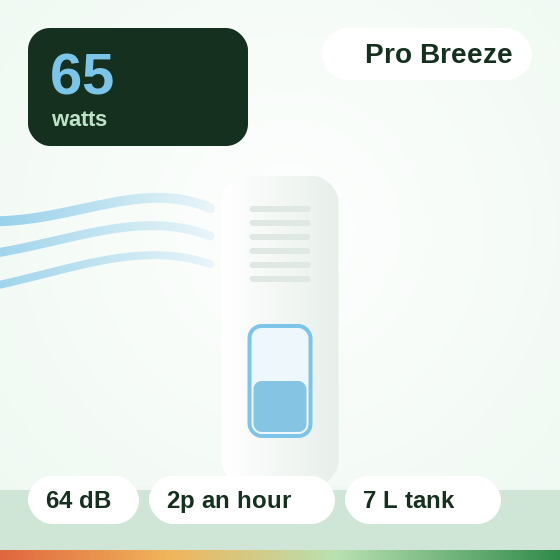
Pro Breeze
OmniAir 7L Evaporative Air Cooler (PB-AC06)
65 watts · 64 dB · 2p an hour · 7 L tank
£149.99 at Pro Breeze (maker shop), checked 14 Nov 2026
See it at Pro Breeze (maker shop)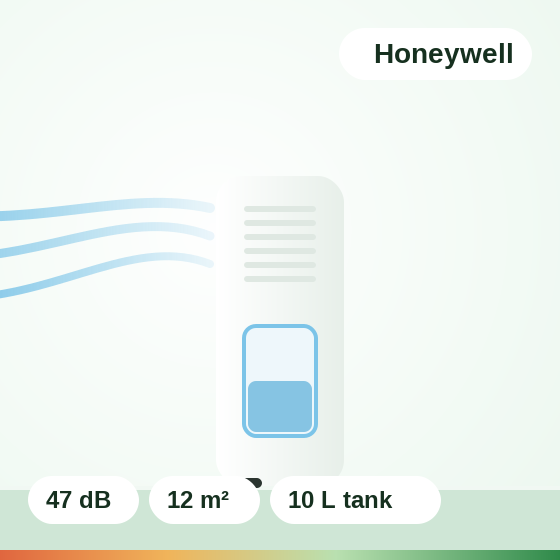
Honeywell
10L Evaporative Air Cooler 3 in 1 (rooms up to 12 m2)
47 dB · 12 m² · 10 L tank
No current UK price found
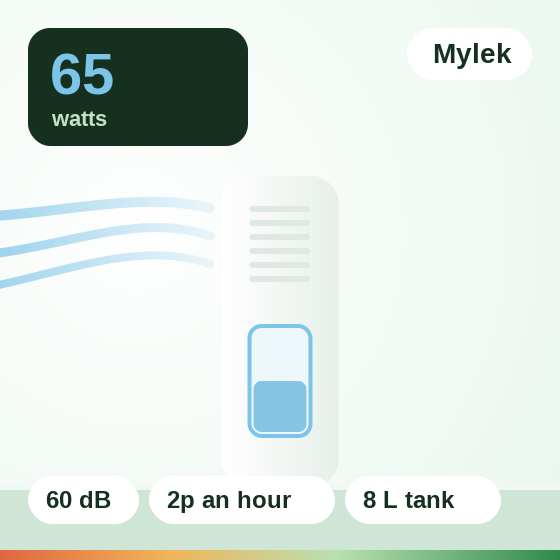
Mylek
Air Cooler Portable Evaporative 8L (65 W, oscillating louvres)
65 watts · 60 dB · 2p an hour · 8 L tank
No current UK price found
Figures from the maker or retailer listing. Cost an hour is our own, at the price cap of 26.32p a kWh.