Key takeaways
- A fan draws warm air over a wet pad. Water evaporating from the pad takes heat from the air, so the air that leaves is cooler and more humid. That is how an air cooler works (see the air cooler guide for the whole picture).
- The limit is the wet-bulb temperature. By our calculation a cooler does most in hot, dry air and little in muggy air; the worked figures are below.
- The heat the water absorbs goes into water vapour in the same air; it is not carried out of the room. That is why makers say to keep a window or door open.
- A 7 litre tank at the Pro Breeze OmniAir 7L’s rated 0.8 litres an hour lasts about 8.75 hours.
The short answer
A fan pulls warm air through a pad kept wet with water from a tank. As water evaporates from the pad it takes heat from the air passing through, so the air that comes out is cooler and carries more moisture. PNNL, a US Department of Energy laboratory, says that “Unlike standard air conditioning, direct evaporative coolers increase rather than decrease the humidity in the air” [1]. The Energy Technology List, the UK government’s list of energy-efficient products, says this “can lead to high humidity levels in the cooled air produced” [5].
We have not tested any product. This page uses makers’ documents, official sources and our own arithmetic, each labelled.
The parts
- Water tank. Holds the water. The Pro Breeze OmniAir 7L’s manual gives a 7 litre tank [6]; the Maha Kool 70L listing gives 70 litres [9].
- Pad or filter. The surface the water evaporates from. The OmniAir 7L’s manual lists a “Honeycomb evaporative filter” and a separate air filter [6]; the Maha Kool 70L listing says “3-sided honeycomb cooling pads” [9].
- Pump and water channels. Symphony’s maintenance page for its air coolers lists cleaning “the submersible pump impeller” and the “water distribution pipe/channels for even distribution of water on all sides” [8]. The OmniAir 7L manual’s parts list does not name a pump, so we cannot say how that model moves the water. Some manuals say how the tank connects to the filter; Pro Breeze’s says “there is a clip that connects the filter to the tank” [6].
- Fan and louvres. The fan moves the air through the pad; louvres direct it. The OmniAir 7L manual gives four speeds, a maximum airflow of 500 m3/h and a noise level from 40 to 64 dB [6].
- Ice packs or an ice box. Some coolers include them: see “What ice does” below.
- Remote and timer. Convenience features; the OmniAir 7L’s timer runs from half an hour up to 10 hours [6].
What happens, step by step
- Water reaches the pad. The tank feeds the pad; on the OmniAir 7L, “humidification mode” is the setting that evaporates water, and the display shows a water drop symbol when it is on [6].
- The fan draws warm room or outside air through the pad.
- Water evaporates into that air. Evaporation takes heat from the air; this is the cooling.
- Cooler, more humid air comes out. CIBSE: “the air leaving the evaporative cooler will have a high relative humidity” [2].
- The moist air has to go somewhere. In a closed room the air gets damper and the cooler does less and less, because the Met Office says “When both temperatures are equal, the air is fully saturated, and no further evaporation can occur” [3].
How much cooling is possible?
The Met Office: “Wet bulb temperature is the lowest temperature that can be achieved through evaporative cooling.” “The greater the difference between the dry bulb and wet bulb temperatures, the drier the air.” [3] CIBSE calls the gap the “wet-bulb depression” [2].
How we worked it out: the wet-bulb temperature comes from Roland Stull’s 2011 formula (Journal of Applied Meteorology and Climatology), as published in the ETHOS.RESKIT code [10], valid for 5% to 99% humidity and minus 20C to 50C, with wet-bulb errors from minus 1C to 0.65C [11]. The best-case outlet temperature is the air temperature minus the efficiency times the gap between air and wet-bulb temperature. PNNL says “Newer evaporative coolers have thick media with efficiencies (cooling effectiveness) of 75% to 93%” [1], and the EnergyPlus engineering reference defines the same ratio and says at 100% “the leaving dry-bulb temperature would equal the entering wet-bulb temperature” [4]. We use 75% and 93%.
| Condition (our chosen inputs) | Wet-bulb | Best-case outlet at 75% | Best-case outlet at 93% | Air cooled by |
|---|---|---|---|---|
| A. 30C, 40% humidity (a hot, dry-leaning afternoon) | 20.4C | 22.8C | 21.1C | 7.2C to 8.9C |
| B. 30C, 60% humidity (a hot, humid day) | 24.0C | 25.5C | 24.4C | 4.5C to 5.6C |
| C. 25C, 75% humidity (a muggy summer day or evening) | 21.6C | 22.5C | 21.9C | 2.5C to 3.1C |
On a hot, dry afternoon (30C, 40% humidity) the air leaving a cooler could at best be about 7 to 9C cooler. On a humid day (30C, 60%) at best 4.5 to 5.6C, and in muggy air (25C, 75%) about 2.5 to 3C. That is the air at the outlet, with all water in the air it adds to the room. Every figure is our calculation from stated inputs, not typical or average UK weather, and not a room temperature. PNNL’s 75% to 93% range is for thick pads in whole-house coolers; no maker of a portable cooler we found states an efficiency, so a small unit may do worse. The answer for UK weather is on do evaporative air coolers work in the UK?.
How much water and heat?
The OmniAir 7L’s manual gives a tank of 7 litres and an “Evaporative Rate: 0.8L/h” [6]. At that rate the tank lasts 7 / 0.8 = 8.75 hours. Other makers give other figures: Appliances Direct lists 0.58 L/h for the electriQ Arctic 25 [12], and Eco Wizard lists 2.4 to 4 L/h for the MasterKool iKOOL-50 Plus [13]. None gives the conditions.
Our working for the heat: the heat of vaporisation of water is 2,441.7 kJ per kg at 25C [7]. Taking 1 litre as about 1 kg, 0.8 litres an hour takes 0.8 x 2,441.7 = 1,953 kJ an hour. That is 0.54 kW, or about 1,850 BTU an hour (1 kWh is 3,412.14 BTU). BTU per hour is a rate; this is the heat turned into vapour, which stays in the room’s air. It is not heat removed from the room, so it is not a cooling capacity.
Cost, from the same figures. The cooler is rated at 65 W, which is 0.065 kW. An hour uses 0.065 kWh, which costs 1.7p at 26.32p per kWh. Eight hours costs 13.7p. A 1,000 W portable air conditioner costs 26.3p for one hour, the same as about 15 hours of this cooler. The rate is Ofgem’s Great Britain price cap average for 1 October to 31 December 2026 [14]; it carries no VAT (0%) for this period. These figures use the Great Britain price cap. In Northern Ireland, use the unit rate on your own bill. Water adds little: CIBSE puts mains water at about £2 per cubic metre [2], so 0.8 litres an hour is about 0.16p an hour (0.8 / 1,000 x 200p), our figure from CIBSE’s 2018 price.
What does ice do?
Some coolers include ice packs. Pro Breeze’s manual for the OmniAir 7L says “For an even cooler experience, add the ice packs (included) to the water tank”, to freeze them for at least four hours first, and warns that “Condensation may form on the outside of the water tank when using the ice packs, which can drip onto the floor” [6]. It also says “Do not puncture or attempt to open the ice packs” and “Only fill the water tank with fresh water and the provided ice packs” [6]. No maker we read gives a figure for what the ice packs add. For the physics of ice and fans, see ice cooling fans and water cooling fans.
Why must a window be open?
Honeywell’s B&Q listing says the cooler “will require a flow of air like an open window and/or door in the room to work effectively” [15]. The Symphony Duet Desk listing at Eco Wizard says “Keep door/window open for effective cooling & cross ventilation” [16]. Our reasoning, consistent with PNNL [1] and EnergyPlus [4]: the cooler turns heat in the air into water vapour in the same air; the heat leaves the room only when that humid air is swapped for outside air.
The OmniAir 7L’s manual also says “Never leave the appliance unattended while in use” and “This appliance is intended for indoor household use and similar applications” [6]; it is not a unit to run through the night.
Frequently asked questions
How does an air cooler work?
A fan pulls air through a wet pad. Water evaporates from the pad, takes heat from the air and leaves the air cooler and more humid.
Does an air cooler need water?
Yes. The OmniAir 7L manual says the water must be above the “min” mark for humidification mode to work, and that a flashing water drop means “insufficient water in the tank” [6].
Does an air cooler use a lot of water?
By the manual’s rating, 0.8 litres an hour for the OmniAir 7L, so a 7 litre tank lasts about 8.75 hours [6]. Larger units use more: Eco Wizard lists 2.4 to 4 litres an hour for the MasterKool iKOOL-50 Plus [13].
Do I need to add ice?
No. Ice is optional where the maker supplies ice packs. Use only the packs or ice compartment your maker names [6].
Why does my air cooler need a window open?
Because the cooler moves heat into water vapour in the same air. Honeywell’s listing says it needs “a flow of air like an open window and/or door” [15].
What is the pad in an air cooler?
The wet surface the air passes over. The OmniAir 7L’s manual calls it a “Honeycomb evaporative filter” and says its separate air filter “should be cleaned every two weeks using a damp cloth” [6]. For fixes and cleaning see air cooler repair and maintenance.
How is an air cooler different from a humidifier?
A humidifier adds moisture to the air and does not set out to cool it; a cooler uses evaporation to cool the air and adds moisture as a result. Several listings call their coolers “3 in 1” (cooler, fan and humidifier). For the definition, see evaporative cooler; for the comparison with a fan, fan vs air cooler. For air conditioners, which remove heat with a compressor, see air cooler vs air conditioner and what BTU means.
Sources
- PNNL Building America Solution Center: Evaporative cooling systems (checked 25 November 2026)
- CIBSE Journal: Module 135, Direct evaporative cooling for comfort applications (Tim Dwyer, November 2018) (checked 25 November 2026)
- Met Office: What are wet bulb temperatures and what they are used for? (7 August 2025) (checked 25 November 2026)
- EnergyPlus Engineering Reference: Evaporative coolers (checked 25 November 2026)
- Energy Technology List: ETL and Eurovent Certification collaboration, energy efficient evaporative air coolers (4 October 2024) (checked 25 November 2026)
- Pro Breeze: OmniAir 7L (PB-AC06) instruction manual, February 2023 (checked 25 November 2026)
- The Engineering ToolBox: Water properties (heat of vaporization) (checked 25 November 2026)
- Symphony: Preventive maintenance for air coolers (checked 25 November 2026)
- B&Q: Maha Kool 70L industrial evaporative cooler (checked 25 November 2026)
- ETHOS.RESKIT: wet bulb temperature (code of Stull’s 2011 formula) (checked 25 November 2026)
- NCAR NCL documentation: wetbulb_stull (validity range and error) (checked 25 November 2026)
- Appliances Direct: electriQ Arctic 25 air cooler (checked 25 November 2026)
- Eco Wizard: MasterKool iKOOL-50 Plus portable evaporative cooler, 26 litres (checked 25 November 2026)
- Ofgem: Changes to energy price cap between 1 October and 31 December 2026 (checked 25 November 2026)
- B&Q: Honeywell 10L evaporative air cooler 3 in 1 (checked 25 November 2026)
- Eco Wizard: Symphony Duet Desk evaporative air cooler (checked 25 November 2026)
Products on this page
Pro Breeze
OmniAir 7L Evaporative Air Cooler (PB-AC06)
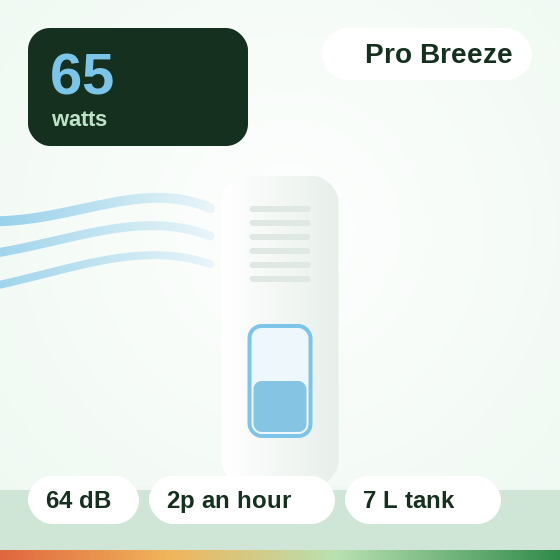
65 watts · 64 dB · 2p an hour · 7 L tank
£149.99 at Pro Breeze (maker shop), checked 14 Nov 2026
See it at Pro Breeze (maker shop)
Figures from the maker or retailer listing. Cost an hour is our own, at the price cap of 26.32p a kWh.