Key takeaways
- Air cooler vs air conditioner: in our reading, an air conditioner is the one to buy if a room has to get cooler. It takes heat out of the room and removes moisture (how air conditioning works). An air cooler does neither: it adds moisture.
- An air cooler is cheap to run. On the maker’s rated figures, a Pro Breeze OmniAir 7L (65 W) uses one twelfth of the power of a Pro Breeze 7000 BTU portable air conditioner (780 W).
- The cooler’s maker states no cooling output, so the sums below show cost, not value. They are not like for like.
- AHRI, a US industry body, says evaporative coolers “work best in very dry climates”. No source we opened says how much one cools a room.
- “Mini air conditioner” listings are often not air conditioners. Check for a compressor, a refrigerant and a rated cooling capacity.
The short answer: air conditioner, air cooler or fan?
In air cooler vs air conditioner, the question is whether you need the room cooler or just the air moving past you. In our reading, an air conditioner is the better answer to a room that is too hot, because it moves heat out of the room and dries the air. An air cooler evaporates water into the air instead, so the air gets cooler and damper. A fan only moves air. Our guide to how air conditioning works explains the refrigerant cycle behind the first of these.
What is the difference?
| Air conditioner (portable example) | Air cooler (evaporative) | |
|---|---|---|
| How it cools | A refrigerant cycle moves heat out of the room | Water evaporates into the air |
| Effect on humidity | Removes moisture from the room air | Adds moisture to the air |
| Hose or window | Yes: the Pro Breeze PB-AC04 has a heat exhaust hose to lead outside | No exhaust hose in the OmniAir manual; it has a water tank |
| Rated power | 780 W (Pro Breeze PB-AC04) | 65 W (Pro Breeze OmniAir 7L) |
| Cooling output stated by the maker | 2,051 W rated capacity for cooling | Not stated by the maker |
| Noise | 54 dBA in the PB-AC04’s manual | 40 to 64 dB in the OmniAir’s manual |
An air conditioner
A refrigerant air conditioner takes heat out of the room air and gets rid of it outside. Penn State’s engineering course says it “moves unwanted heat from where you don’t want it (inside) to where it doesn’t matter as much (outside)”, and that “moisture in the air condenses on the cold coil and drains away”. So the room gets cooler and drier. A refrigerant air conditioner has to reject its heat outside the room, which is why a portable has a hose and a split has an outdoor unit.
An air cooler
An evaporative air cooler passes air through a water-saturated medium. The government’s Energy Technology List says that for direct evaporative coolers this “can lead to high humidity levels in the cooled air produced”. AHRI, a US industry body, says evaporative coolers “work best in very dry climates” and “except for in very dry climates, they may increase humidity to a level that makes occupants uncomfortable”. Neither source gives a UK humidity figure, and neither do we.
Our worked example: what each costs to run
We compare two Pro Breeze products using the wattage method. The rate is 26.32p per kWh: Ofgem’s Great Britain average unit rate under the price cap for 1 October to 31 December 2026, with no VAT (0%) for this period and the standing charge left out. In Northern Ireland, use the unit rate on your own bill.
- Portable air conditioner, Pro Breeze 7000 BTU (PB-AC04): rated input 780 W, rated capacity for cooling 2,051 W, EER 2.6, R290 refrigerant (all from the maker’s manual). 0.78 kW x 26.32p = 20.5p an hour; x 8 hours = £1.64 a night; 0.78 kW x 350 hours = 273 kWh, which is £71.85 for our standard summer of 350 hours (an assumption).
- Air cooler, Pro Breeze OmniAir 7L: 65 W in the maker’s manual. 0.065 kW x 26.32p = 1.7p an hour; x 8 = 13.7p a night; 0.065 x 350 = 22.8 kWh (22.75 before rounding), which is £5.99 for the same 350-hour summer.
- The ratio: 780 / 65 = 12 times the power.
Three cautions. First, rated input is the full-power figure, so these are upper estimates. Second, the OmniAir’s manual gives no cooling output, so the two machines do not do the same job: the sums show what each costs to run, not what you get for it. Third, the OmniAir’s shop page prints 0.06 kWh where the manual says 65 W; we use the manual. Pro Breeze listed both products as sold out on 13 and 14 November 2026.
Both manuals carry warnings worth knowing. The PB-AC04 manual says its unit is for indoor household use; the OmniAir’s says “Never leave the appliance unattended while in use”. Our night figures are arithmetic for an eight-hour night, not advice to run either overnight.
Which one for which room
Bedroom or home office that gets too hot
If the room needs to be cooler and you can lead a hose to a window, a portable air conditioner is the product that does that job. A cooler adds water to the air of a room you may be sleeping in. For a fixed alternative, see split air conditioners.
Dry air
AHRI says evaporative coolers “work best in very dry climates”, so do not expect the same result in a damp room. No source we opened says how much a cooler lowers a room’s temperature.
Rented flat
Check your tenancy agreement and ask your landlord before drilling for a split. A portable needs no installation but needs a window or vent for its hose. See how to vent a portable air conditioner without a window.
Why humidity matters in the UK
The government’s Energy Technology List and AHRI both say a direct evaporative cooler can leave the air damp. An air conditioner does the opposite: water condenses on its cold coil and drains away. We state no UK humidity figure because we did not find a source we could open for one. For how a cooler works, see how air coolers work and do evaporative air coolers work in the UK?.
What about a fan?
A fan moves air and has no refrigerant or water. It makes you feel cooler by moving air past you; it does not lower the room’s temperature. See fan vs air conditioner and fan vs air cooler.
If the product has no hose and no outdoor part, but is sold as an air conditioner, our reading is that it is likely an evaporative air cooler; see portable air conditioners without a hose. For the mechanism alone, see evaporative cooler vs air conditioner. Dry mode on an air conditioner is a different thing again: see dry mode. For the types of air conditioner, see types of air conditioner.
Frequently asked questions
Is an air cooler as good as an air conditioner?
No. An air cooler evaporates water into the air, so it adds moisture, where an air conditioner removes heat and moisture. The OmniAir 7L’s maker states no cooling output, so we give no degree figure.
Which is cheaper to run, an air cooler or an air conditioner?
On rated power, the air cooler: 1.7p an hour for the 65 W OmniAir 7L against 20.5p for the 780 W PB-AC04, at 26.32p per kWh. These are full-power figures and the two do not do the same job.
Do air coolers work in humid weather?
They work less well, because the air already holds moisture. The Energy Technology List says direct coolers can produce high humidity in the cooled air, and AHRI says outside very dry climates they may raise humidity to an uncomfortable level.
Do air coolers need a window or hose?
An evaporative cooler such as the OmniAir has a water tank and no exhaust hose in its manual. A portable air conditioner does have one: the PB-AC04’s manual describes a heat exhaust hose led to an external area. Check each product’s listing.
Is an air cooler the same as a mini air conditioner?
Often not. Look in the listing for a compressor, a refrigerant and a rated cooling capacity. If there is none, our reading is that it is an evaporative air cooler.
Can an air cooler replace an air conditioner in a bedroom?
No source we opened says how much a cooler cools a room, and it will not remove heat and moisture the way a compressor unit does. The OmniAir 7L’s manual also says “Never leave the appliance unattended while in use”, so it is not a product to leave running while you sleep.
Does an air conditioner or an air cooler make the room damp?
An air cooler adds moisture. An air conditioner removes it: Penn State says moisture condenses on the cold coil and drains away.
Sources
- Penn State EMS, EGEE 102: 10.4 How Air Conditioners Work (checked 15 November 2026)
- Energy Technology List (DESNZ): ETL and Eurovent certification collaboration, energy efficient evaporative air coolers (4 October 2024) (checked 15 November 2026)
- AHRI: Swamp coolers (checked 15 November 2026)
- Pro Breeze: PB-AC04 7000 BTU Portable Air Conditioner instruction manual (UK/EU) (checked 15 November 2026)
- Pro Breeze: PB-AC06 (OmniAir 7L) instruction manual (UK/EU) (checked 15 November 2026)
- Pro Breeze: 7000 BTU 3 in 1 portable air conditioner, product page (checked 13 November 2026; sold out; could not be re-opened on 15 November 2026)
- Pro Breeze: OmniAir 7L air cooler, product page (checked 14 November 2026; sold out; could not be re-opened on 15 November 2026)
- Ofgem: Changes to energy price cap between 1 October and 31 December 2026 (checked 15 November 2026)
Products on this page
Pro Breeze
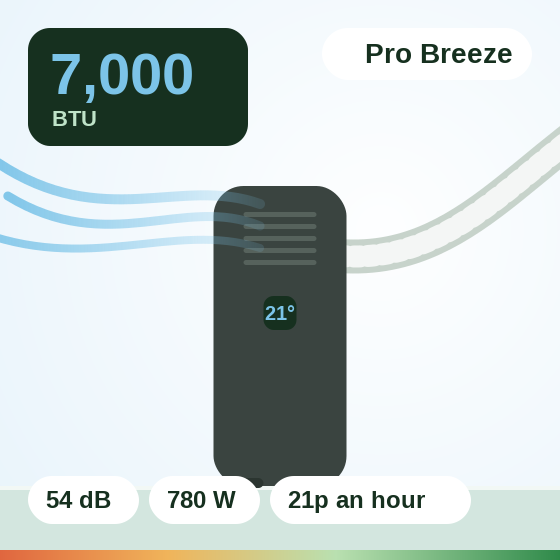
7000 BTU 3-in-1 Portable Air Conditioner with Dehumidification Function (PB-AC-04)
7,000 BTU · 54 dB · 780 W · 21p an hour
£279.99 at Pro Breeze (maker shop), checked 13 Nov 2026
See it at Pro Breeze (maker shop)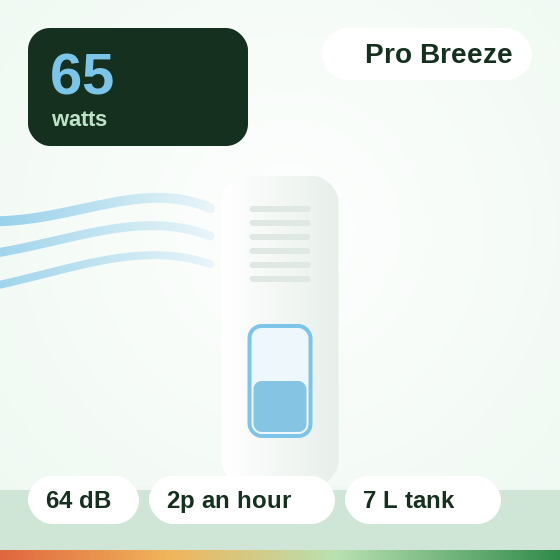
Pro Breeze
OmniAir 7L Evaporative Air Cooler (PB-AC06)
65 watts · 64 dB · 2p an hour · 7 L tank
£149.99 at Pro Breeze (maker shop), checked 14 Nov 2026
See it at Pro Breeze (maker shop)
Figures from the maker or retailer listing. Cost an hour is our own, at the price cap of 26.32p a kWh.