Key takeaways
- A water cooling fan is a fan that uses water to cool the air a little: either an evaporative air cooler, which blows air through a wet pad, or a misting fan, which sprays a fine mist in front of the blades. Our cooling fans guide explains every type.
- They work best in dry air. Our calculation from published physics: on a hot, dry afternoon (30C, 40% humidity) the air leaving a cooler could at best be about 7 to 9C cooler; in muggy air (25C, 75%) only about 2.5 to 3C. That is the air at the outlet, not the room.
- They add moisture to the room. PNNL, a US government laboratory, says direct evaporative coolers “increase rather than decrease the humidity in the air”.
- This list is every current evaporative cooler and misting fan for the home in our data with a confirmed wattage: four products, ordered by the cost of an eight-hour night.
- They cost a little more to run than a plain fan: 7.6p to 13.7p a night for the four, against 5.5p for a Meaco Sefte 10” pedestal fan, at the Great Britain price cap of 26.32p per kWh.
A water cooling fan is a fan that cools air by evaporating water, so the air it blows can be a few degrees cooler than the room, unlike a plain fan, which only moves air. This page covers the two kinds you can buy, evaporative air coolers and misting fans, with every model in our data whose maker or retailer publishes its power. For every type of fan, see our cooling fans guide; for the full list of air coolers, see the best evaporative air coolers. We have not tested these products; every figure comes from the maker’s manual or listing.
What is a water cooling fan?
- Evaporative air cooler (often sold as a “water cooling fan” or “air cooler fan”): a fan pulls room air through a pad or filter kept wet from a water tank. Water evaporating from the pad takes heat from the air, so the air that comes out is cooler and more humid. Most look like a tower fan with a tank in the base, and can also run as a plain fan.
- Misting fan: a fan with a small tank or a hose connection that sprays very fine droplets into the air stream. As the droplets evaporate they cool the air and your skin a little.
Neither is an air conditioner. An air conditioner removes heat and moisture from the room and sends the heat outside; a water cooling fan keeps the heat in the room and adds water to the air. See air coolers explained and fan vs air cooler.
Do they work in a UK home?
It depends on how dry the air is. The Met Office explains that “Wet bulb temperature is the lowest temperature that can be achieved through evaporative cooling”, and that if the air is fully saturated, evaporation stops. The drier the air, the bigger the gap between the air temperature and the wet-bulb temperature, and the more an evaporative cooler can do. PNNL, a US Department of Energy laboratory, says “Evaporative coolers work best in dry climates where the outdoor relative humidity during the cooling season is low”, and that newer coolers with thick pads reach an effectiveness of 75% to 93%.
We worked out what that means for three example conditions, using a published formula for wet-bulb temperature and PNNL’s 75% to 93% range as a best case (the full working is in do evaporative air coolers work?):
| Example condition (chosen by us, not “typical UK”) | Air leaving the cooler could at best be cooled by |
|---|---|
| 30C, 40% relative humidity (a hot, dry afternoon) | 7.2C to 8.9C |
| 30C, 60% relative humidity (a hot, humid day) | 4.5C to 5.6C |
| 25C, 75% relative humidity (a muggy day or evening) | 2.5C to 3.1C |
These are best cases for thick pads; no maker of a small portable cooler states its effectiveness, so real units may do less. They are the temperature drop of the air at the outlet, not the room, and every litre evaporated adds water to the room’s air. PNNL is clear that direct evaporative coolers “increase rather than decrease the humidity in the air”. Open a window or door to let the moist air out.
How we chose
- What is on the list: every evaporative air cooler or misting fan in our product data that is listed as a current model, is sized for a home, and has a power figure from its maker or a retailer. That gives four. Left out: one industrial 70-litre cooler (230 W), one personal cooler with no published power, and coolers whose status in our data is unknown.
- The order: running cost for an eight-hour night at full power, lowest first.
- For comparison only: a plain Meaco pedestal fan, shown in the last row, which is not on the list.
- Prices and stock are from listings checked on 14 November 2026.
Water cooling fans compared
| Product | Kind | Tank | Water use (maker) | Rated power | Per hour | Per 8-hour night | Price, checked 14 November 2026 | Stock on 14 November 2026 |
|---|---|---|---|---|---|---|---|---|
| Shark FlexBreeze HydroGo | cordless misting fan | 150 ml | not stated by the maker | 36 W | 0.9p | 7.6p | £104.99 at Shark | listed for sale (charcoal) |
| Pro Breeze OmniAir 5L | evaporative cooler | 5 L | not stated by the maker | 40 W | 1.1p | 8.4p | £119.99 at Pro Breeze | out of stock |
| Symphony Duet Desk 6L | evaporative cooler | 6 L | not stated by the retailer | 45 W | 1.2p | 9.5p | £79.99 at Eco Wizard | in stock |
| Pro Breeze OmniAir 7L | evaporative cooler | 7 L | 0.8 L an hour | 65 W | 1.7p | 13.7p | £149.99 at Pro Breeze | out of stock |
| For comparison, not on the list: Meaco MeacoFan Sefte 10” | pedestal fan | none | none | 26 W | 0.7p | 5.5p | £179.99 at Meaco | in stock |
How the costs are worked out. The OmniAir 7L is rated at 65 W in its manual, which is 0.065 kW. An hour uses 0.065 kWh, which costs 1.7p at 26.32p per kWh. Eight hours costs 13.7p. A 1,000 W portable air conditioner costs 26.3p for one hour, the same as about 15 hours of this cooler. The unit rate is Ofgem’s Great Britain average for 1 October to 31 December 2026. These figures use the Great Britain price cap. In Northern Ireland, use the unit rate on your own bill.
1. Shark FlexBreeze HydroGo (misting)
Who it suits: a garden table, picnic or desk: a cordless fan with a mist you can switch on when you want it.
Key specs: 36 W, a 150 ml tank, five speeds, 1.71 kg, a 3-hour charge, and a two-year guarantee on the fan and battery after registration. Shark describes the mist as ultra-fine, for use outdoors and indoors, leaving no wet surfaces. Battery: up to 12 hours on speed 1, 3.5 hours on speed 3 and 1 hour on speed 5, all without misting.
Running cost: 0.9p an hour at the rated 36 W, as an upper figure for recharging.
What to watch for: 150 ml is a small tank, and Shark gives no run time with the mist on. It is a personal fan, not a room cooler. Shark calls it “perfect for sleeping or working from home”, the maker’s claim; we have not read its manual, so check it before leaving the fan on overnight. See portable fans and Shark air coolers.
Where to buy: from £104.99 at Shark , checked 14 November 2026, when the charcoal version was listed for sale.
2. Pro Breeze OmniAir 5L
Who it suits: a small room in dry, hot weather, for someone who wants a tower-shaped fan that can also cool by evaporation.
Key specs: Pro Breeze gives energy consumption of 0.04 kWh (40 W), a 5 litre tank, three speeds, 75-degree oscillation, a remote and a 7-hour timer, 1,025 mm tall. Noise: 55 dB at most, minimum not stated. Warranty: not stated by the maker on the listing.
Running cost: 1.1p an hour, 8.4p a night.
What to watch for: Pro Breeze does not publish an evaporation rate for this model, so you cannot tell from the listing how long a tank lasts. We have not read its manual (the OmniAir 7L’s manual, from the same maker, says “Never leave the appliance unattended while in use”), so check it before leaving the cooler on overnight.
Where to buy: from £119.99 at Pro Breeze , checked 14 November 2026, listed as out of stock.
3. Symphony Duet Desk 6L
Who it suits: a small room or a desk, for the lowest price of the four.
Key specs: 45 W (“consumes only 45 watts”, in the retailer’s listing); 6 L tank; air throw 15 feet. The listing also mentions automatic vertical swing and a detachable pedestal. Noise, weight, remote, timer and warranty are not stated on the listing.
Running cost: 1.2p an hour, 9.5p for eight hours.
What to watch for: the listing advises: “Keep door/window open for effective cooling & cross ventilation.” We read only the retailer’s page, not Symphony’s own or its manual.
Where to buy: from £79.99 at Eco Wizard , checked 14 November 2026, listed in stock.
4. Pro Breeze OmniAir 7L
Who it suits: a larger living room in dry, hot weather, used while someone is in the room.
Key specs: the manual gives 65 W, a 7 litre tank, an evaporative rate of 0.8 litres an hour, a maximum airflow of 500 m3 an hour, noise of 40 to 64 dB and 10.5 kg. It comes with ice packs to add to the tank, and has Natural and Night modes among its settings; in Night mode the speed steps down after 30 minutes. The product page gives different figures (0.06 kWh, a 6 litre tank and 11.4 kg); we use the manual’s.
Running cost: 1.7p an hour, 13.7p for eight hours: the most of the four.
How long the water lasts: at 0.8 litres an hour, a full 7 litre tank lasts about 8.75 hours (7 / 0.8) of use.
What to watch for: its manual says it is for indoor household use and not to use it outdoors, to fill the tank only with fresh water and the supplied ice packs, and to empty the tank before moving or storing it. It also says “Never leave the appliance unattended while in use”, which rules out running it while you sleep.
Where to buy: from £149.99 at Pro Breeze , checked 14 November 2026, listed as out of stock. More on Pro Breeze air coolers.
Water cooling fan or ordinary fan?
On running cost, a plain fan wins. The Meaco MeacoFan Sefte 10” pedestal fan (26 W) costs 5.5p a night at full speed; the OmniAir 7L costs 13.7p, more than twice as much, and needs filling, emptying and cleaning.
On cooling, a water cooling fan can do a little more than a plain fan in dry heat, because the air it blows is cooler as well as moving. In humid weather the extra is small (our worked figures above), and it adds more moisture to air that is already damp.
So: in a dry heatwave with a window open, an evaporative cooler is worth considering. In a humid room, or overnight in a closed bedroom, a plain fan is simpler and cheaper; check the manual of any fan or cooler before leaving it running while you sleep. And in very hot weather neither may be enough: fans help while the air is below 35C. The NHS says ‘Electric fans can help if the temperature is below 35 degrees’; UKHSA says use them ‘if the air temperature is below 35°C’ and not to aim them directly at your body.
For ice in front of a fan, see ice cooling fans and does putting ice in front of a fan work?.
Frequently asked questions
Do water cooling fans actually work?
A little, and most in dry air. At best, on a hot, dry afternoon (30C, 40% humidity), the air leaving an evaporative cooler could be about 7 to 9C cooler, by our calculation; in muggy air (25C, 75%) about 2.5 to 3C. Those are outlet figures for the best pads, not the room temperature.
Do evaporative coolers make a room humid?
Yes. Every litre they evaporate goes into the room’s air. PNNL says direct evaporative coolers “increase rather than decrease the humidity in the air”. Keep a window or door open while one runs.
How long does the water last?
It depends on the evaporation rate. The Pro Breeze OmniAir 7L evaporates 0.8 litres an hour (its manual), so its 7 litre tank lasts about 8.75 hours. Pro Breeze gives no rate for the OmniAir 5L, and the Shark HydroGo’s 150 ml tank is for short bursts of mist.
Is a water cooling fan better than an air conditioner?
No. An air conditioner removes heat from the room and sends it outside; a water cooling fan only cools the air it blows, and adds moisture. It is far cheaper to run: 13.7p a night for the OmniAir 7L against £2.11 for a 1,000 W portable air conditioner. See fan vs air conditioner.
Can you put tap water in an air cooler?
Pro Breeze’s OmniAir 7L manual says to fill the tank only with fresh water and the supplied ice packs; it does not mention tap water specifically. Follow your own cooler’s manual, and empty and dry the tank before storing it.
Sources
- Ofgem: Changes to energy price cap between 1 October and 31 December 2026 (checked 14 November 2026)
- UKHSA: Beat the heat, staying safe in hot weather (updated 21 July 2026) (checked 14 November 2026)
- NHS: Heatwave, how to cope in hot weather (reviewed 12 June 2026) (checked 14 November 2026)
- PNNL Building America Solution Center: Evaporative cooling systems (checked 14 November 2026)
- Met Office: What wet bulb temperatures are and what they are used for (checked 14 November 2026)
- Pro Breeze: OmniAir 5L air cooler (checked 14 November 2026)
- Pro Breeze: OmniAir 7L air cooler (checked 14 November 2026)
- Pro Breeze: PB-AC06 (OmniAir 7L) instruction manual (February 2023) (checked 14 November 2026)
- Eco Wizard: Symphony Duet Desk evaporative air cooler (checked 14 November 2026)
- Shark: FlexBreeze HydroGo FA050UK (checked 14 November 2026)
- Meaco: MeacoFan Sefte 10” pedestal air circulator (checked 14 November 2026)
Other products mentioned
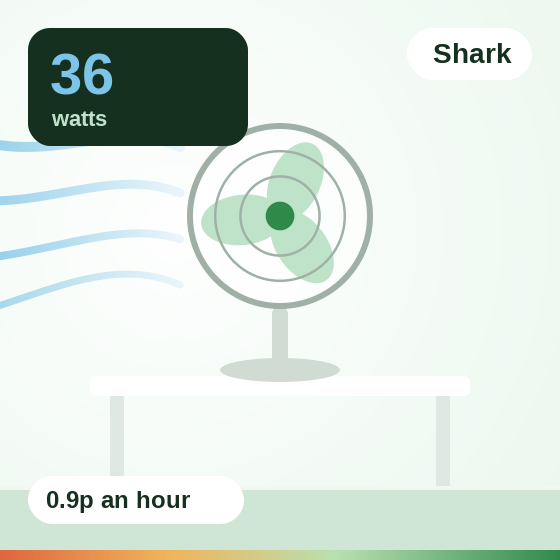
Shark
FlexBreeze HydroGo Misting Fan FA050UK
36 watts · 0.9p an hour
£104.99 at SharkNinja UK (maker shop), checked 14 Nov 2026
See it at SharkNinja UK (maker shop)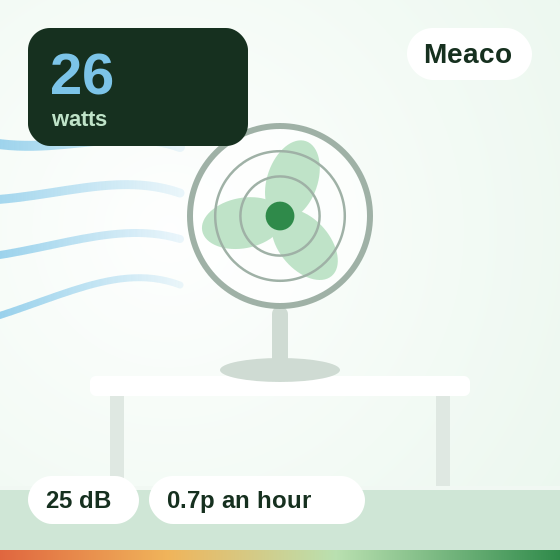
Meaco
MeacoFan Sefte 10" Pedestal Air Circulator
26 watts · 25 dB · 0.7p an hour
£179.99 at Meaco (maker shop), checked 14 Nov 2026
See it at Meaco (maker shop)
Figures from the maker or retailer listing. Cost an hour is our own, at the price cap of 26.32p a kWh.