Key takeaways
- An ice cooling fan is almost always an evaporative air cooler: a fan that blows air through a wet pad fed from a water tank, with ice packs you freeze and drop into the tank. See our cooling fans guide for every type of fan.
- Ice helps only a little. Melting 1 kg of ice soaks up about 317 BTU of heat. A 9,000 BTU per hour portable air conditioner removes as much heat every hour as melting about 28 kg of ice.
- They cost pennies to run: 7.6p to 13.7p for an eight-hour night at the Great Britain price cap of 26.32p per kWh. The ice itself costs freezer electricity, which no maker states.
- This list is every current evaporative cooler and misting fan for the home in our data with a confirmed wattage: four products, ordered by the cost of an eight-hour night. Only one maker, Pro Breeze for the OmniAir 7L, says in its manual that ice packs are included.
- They add moisture to the room and need cleaning. Fans help while the air is below 35C, in the NHS and UKHSA wording quoted below.
An ice cooling fan is a fan with a water tank that you can top up with ice, so the air it blows is a little cooler than the room for a while. In practice that means an evaporative air cooler with ice packs, or a misting fan. This page compares the ones whose makers publish their power, works out how much cooling a block of ice can give, and says when a plain fan or an air conditioner would serve you better. For every type of fan, start with our cooling fans guide. We have not tested these products; every figure comes from the maker’s manual or listing, or a retailer’s listing.
What is an ice cooling fan?
Shops use “ice fan”, “ice air cooler” and “fan with ice” for three kinds of product:
- Evaporative air cooler with ice packs. A fan pulls room air through a wet honeycomb pad fed from a tank. Water evaporating from the pad takes heat from the air. Ice packs sit in the tank and keep the water colder for a while. Pro Breeze’s OmniAir 7L manual says: “For an even cooler experience, add the ice packs (included) to the water tank.”
- Air cooler with no ice packs. The same idea without ice; you fill the tank with cold water.
- Misting fan. A fan that sprays a fine mist from a small tank into the air stream. The Shark FlexBreeze HydroGo is one; Shark mentions only water, not ice.
None of these is an air conditioner. An air conditioner moves heat out of the room through a hose or pipe. An ice fan keeps the heat in the room and adds water to the air. For how coolers work in detail, see how an air cooler works and air coolers explained. For evaporation and misting without the ice angle, see water cooling fans; for the do-it-yourself bowl of ice in front of a fan, see ice in front of a fan.
How much cooling does ice give?
Our own calculation, from a published physical constant. Melting ice absorbs about 334 kJ of heat per kilogram (Engineering ToolBox, a technical reference). In the units used for air conditioners:
- 334 kJ is 0.0928 kWh, which is about 317 BTU.
- A 9,000 BTU per hour portable air conditioner removes 9,000 BTU of heat from a room every hour. That is the same as melting 9,000 / 316.6 = about 28 kg of ice every hour.
- Put the other way, a 1 kg ice pack that melts over an hour soaks up heat at about 93 W. A small portable air conditioner removes heat at around 2,600 W (9,000 BTU per hour).
So a couple of frozen packs in a tank make the outlet air feel cooler for a while, but they cannot cool a room. Once the ice has melted, the cooler works as an ordinary evaporative cooler.
That evaporation does more than the ice, and it depends on how dry the air is. Our worked figures in do evaporative air coolers work? give a best case for thick pads of outlet air cooled by 7.2 to 8.9C at 30C and 40% relative humidity, 4.5 to 5.6C at 30C and 60%, and 2.5 to 3.1C at 25C and 75%. Those are example conditions we chose, not typical UK weather, and they are the air leaving the cooler, not the temperature of the room.
How we chose
- Which products: every evaporative air cooler or misting fan in our product library that is listed as a current model and has a power figure from its maker or a retailer. We left out one industrial 70-litre cooler, one personal cooler with no published power, and products whose status in our data is unknown.
- The order: by running cost for an eight-hour night at full power, lowest first.
- What we compare: tank size, whether the maker says ice packs are included (from the manual where we could read it), rated power, published noise and price.
- Prices and stock are from listings checked on 14 November 2026. Many coolers were out of stock that day, which is normal outside summer.
- Several other coolers sold with ice packs are in our library, but none was listed as a current model with a confirmed power figure, so they are not ranked here. See the best evaporative air coolers for the wider range.
Ice cooling fans compared
| Product | Kind | Tank | Ice packs | Rated power | Per hour | Per 8-hour night | Noise (as published) | Price, checked 14 November 2026 | Stock on 14 November 2026 |
|---|---|---|---|---|---|---|---|---|---|
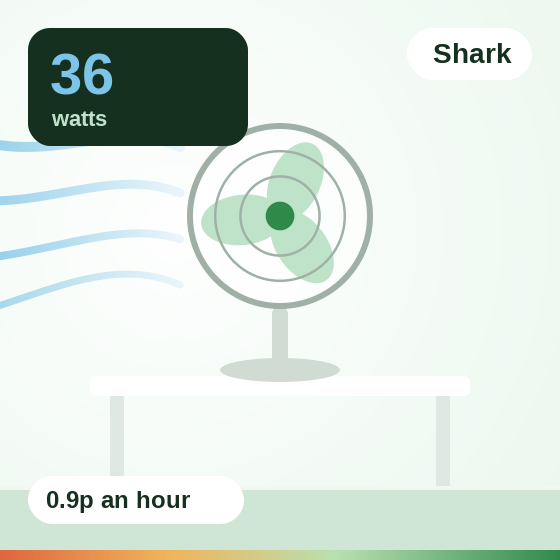
| Shark FlexBreeze HydroGo | cordless misting fan | 150 ml | not stated by the maker | 36 W | 0.9p | 7.6p | not stated by the maker | £104.99 at Shark | listed in stock (charcoal) |
| Pro Breeze OmniAir 5L | evaporative cooler | 5 L | not stated by the maker | 40 W | 1.1p | 8.4p | 55 dB (setting not stated) | £119.99 at Pro Breeze | out of stock |
| Symphony Duet Desk 6L | evaporative cooler | 6 L | not stated by the retailer | 45 W | 1.2p | 9.5p | not stated | £79.99 at Eco Wizard | in stock |
| Pro Breeze OmniAir 7L | evaporative cooler | 7 L | included (manual) | 65 W | 1.7p | 13.7p | 40 to 64 dB | £149.99 at Pro Breeze | out of stock |
How the costs are worked out. The OmniAir 7L is rated at 65 W in its manual, which is 0.065 kW. An hour uses 0.065 kWh, which costs 1.7p at 26.32p per kWh. Eight hours costs 13.7p. A 1,000 W portable air conditioner costs 26.3p for one hour, the same as about 15 hours of this cooler. The unit rate is Ofgem’s Great Britain average for 1 October to 31 December 2026; the standing charge is left out because you pay it anyway. These figures use the Great Britain price cap. In Northern Ireland, use the unit rate on your own bill. The figures are at full power; the freezer electricity for the ice is extra and no maker states it.
Shark FlexBreeze HydroGo
Who it suits: someone who wants a small cordless fan with a mist for a desk, a patio or a summer house. It is the only one here with a battery.
Key specs: 36 W; a 150 ml water tank for the mist; five speeds; up to 12 hours on speed one, 3.5 hours on speed three and 1 hour on speed five without misting; 3 hours to charge; 1.71 kg in Shark’s specification table (the same page also says 1.77 kg and “under 2.1Kg”); two-year guarantee on registration.
Running cost: 7.6p a night at the full 36 W; because it runs from a battery, the true cost is the electricity to recharge it, which is at most that.
What to watch for: it is a misting fan, not an ice fan: Shark’s page mentions only water. The tank is small. Shark’s page calls it “perfect for sleeping or working from home”, which is the maker’s claim; we have not read its manual, so check it before leaving the fan on overnight.
Where to buy: from £104.99 at Shark , checked 14 November 2026, charcoal listed in stock. More on Shark fans.
Pro Breeze OmniAir 5L
Who it suits: a small room in hot, dry weather, for someone who wants a tower-shaped cooler that also works as a plain fan.
Key specs: 40 W (the maker gives energy consumption of 0.04 kWh); 5 L tank; three speeds; 75-degree oscillation; remote; 7-hour timer; 1,025 mm tall; noise 55 dB, setting not stated.
Running cost: 8.4p a night.
What to watch for: the product listing recorded in our library does not say whether ice packs are included, and we could not open Pro Breeze’s page to check again on 14 November 2026, so we say “not stated by the maker”. Weight, airflow and warranty are not stated either. We have not read its manual (the OmniAir 7L’s says “Never leave the appliance unattended while in use”), so check it before leaving the cooler on overnight.
Where to buy: from £119.99 at Pro Breeze , checked 14 November 2026, out of stock. More on Pro Breeze air coolers.
Symphony Duet Desk 6L
Who it suits: a small room or a desk, for the lowest price of the four.
Key specs: 45 W (“consumes only 45 watts”, in the retailer’s listing); 6 L tank; air throw 15 feet. The listing also mentions automatic vertical swing and a detachable pedestal, so it can be used as a personal fan. Noise, weight, remote, timer and warranty are not stated on the listing.
Running cost: 9.5p a night.
What to watch for: the listing says nothing about ice. It also advises: “Keep door/window open for effective cooling & cross ventilation.” We read only the retailer’s page, not Symphony’s own.
Where to buy: from £79.99 at Eco Wizard , checked 14 November 2026, listed in stock.
Pro Breeze OmniAir 7L
Who it suits: the reader who wants a true ice cooler: it is the only one here whose manual says the ice packs come in the box.
Key specs (manual): 65 W; 7 L tank; evaporates 0.8 L of water an hour; airflow up to 500 m3 an hour; noise 40 to 64 dB; 10.5 kg; four speeds; 60-degree oscillation; remote; timer up to 10 hours. The manual says to freeze the ice packs “for at least four hours prior to use” and add them to the tank “for cooler air”.
Running cost: 13.7p a night, the most of the four.
What to watch for: at 0.8 L an hour, a full 7 L tank lasts about 9 hours at the maker’s rate, and all of that water goes into the room’s air. The manual warns that condensation can form on the tank when the ice packs are in, which can drip onto the floor, and says “Never leave the appliance unattended while in use”. The product page gives different figures (0.06 kWh, a 6 L tank, 11.4 kg); we use the manual’s.
Where to buy: from £149.99 at Pro Breeze , checked 14 November 2026, out of stock.
What to watch for with any ice fan
- Refilling: the ice lasts a short time and the tank needs fresh water before every use; the OmniAir 7L manual says so in those words.
- Humidity: every litre evaporated stays in the room unless a window is open. In a damp or muggy room, a cooler adds to the problem; a plain fan does not.
- Cleaning: standing water and a wet pad need regular care. The OmniAir 7L manual says to empty and clean the unit before storage and to clean it again before the next use. Follow your own model’s manual.
- Ice packs only: the OmniAir 7L manual says to fill the tank only with fresh water and the provided ice packs, and not to puncture or open the packs.
- Very hot days: Fans help while the air is below 35C. The NHS says ‘Electric fans can help if the temperature is below 35 degrees’; UKHSA says use them ‘if the air temperature is below 35°C’ and not to aim them directly at your body. See our heatwave guide.
When to buy an air conditioner instead
If the room itself is too hot, not just you, an ice fan will not fix it. A portable air conditioner removes heat from the room, but costs far more to run: 26.3p an hour at 1,000 W, against 1.7p an hour for the OmniAir 7L. Our fan vs air conditioner comparison sets out the trade-off, the best portable air conditioners lists the models, and the BTU calculator sizes one for your room. For a straight fan against cooler comparison, see fan vs air cooler.
Frequently asked questions
Do ice cooling fans work?
They make the air leaving the fan a little cooler for as long as the ice lasts, and an evaporative cooler keeps working after the ice melts, best in dry air. They do not cool a whole room: a 9,000 BTU per hour air conditioner removes as much heat each hour as melting about 28 kg of ice.
How long does ice last in an air cooler?
No maker in this list gives a figure. It depends on the size of the packs, the water temperature and the room. Pro Breeze says to freeze its packs for at least four hours before use, so having two sets lets you swap them.
Is a fan with ice better than an air conditioner?
It is far cheaper to buy and run (7.6p to 13.7p a night here, against 26.3p an hour for a 1,000 W portable air conditioner), but it cools much less and adds moisture. For a room that is too hot to sleep in, an air conditioner is the tool that works.
Can I use frozen water bottles instead of ice packs?
Pro Breeze’s OmniAir 7L manual says to fill the tank only with fresh water and the provided ice packs, so check your own manual before putting anything else in the tank. A frozen bottle in a bowl in front of a plain fan is a different trick, covered in ice in front of a fan.
Do ice fans make a room damp?
Evaporative coolers do add moisture: the OmniAir 7L’s manual gives an evaporation rate of 0.8 L an hour. Keep a window or door open, as the Symphony listing advises, and use a plain fan instead in a room that is already damp.
How much does an ice cooling fan cost to run?
At the Great Britain price cap of 26.32p per kWh, the four here cost 0.9p to 1.7p an hour and 7.6p to 13.7p for an eight-hour night at full power. Freezing the ice adds freezer electricity, which no maker states.
Sources
- Ofgem: Changes to energy price cap between 1 October and 31 December 2026 (checked 14 November 2026)
- Engineering ToolBox: Latent heat of melting for some common materials (checked 14 November 2026)
- Pro Breeze: PB-AC06 OmniAir 7L instruction manual (February 2023) (checked 14 November 2026)
- Pro Breeze: OmniAir 7L air cooler (checked 14 November 2026)
- Pro Breeze: OmniAir 5L air cooler (checked 14 November 2026)
- Shark: FlexBreeze HydroGo misting fan FA050UK (checked 14 November 2026)
- Eco Wizard: Symphony Duet Desk evaporative air cooler (checked 14 November 2026)
- NHS: Heatwave, how to cope in hot weather (reviewed 12 June 2026) (checked 14 November 2026)
- UKHSA: Beat the heat, staying safe in hot weather (updated 21 July 2026) (checked 14 November 2026)
Other products mentioned
Shark
FlexBreeze HydroGo Misting Fan FA050UK
36 watts · 0.9p an hour
£104.99 at SharkNinja UK (maker shop), checked 14 Nov 2026
See it at SharkNinja UK (maker shop)
Figures from the maker or retailer listing. Cost an hour is our own, at the price cap of 26.32p a kWh.