Key takeaways
- A DIY evaporative cooler obeys the same limit as a bought air cooler: the air cannot be cooled below the wet-bulb temperature, and it adds moisture. By our calculation that limit leaves little to gain in humid air (figures below).
- PNNL’s best-case efficiencies are for thick pads in whole-house coolers. No source we found gives a figure for a cloth or towel, so a homemade set-up may not reach them.
- Electrical Safety First’s advice is “Don’t mix electricity and water”. On our reading, a homemade cooler puts water beside a mains appliance that was not made for it.
- We give no build guide. A fan on its own, or a shop-bought cooler used as its maker says, is the safer choice; a fan costs 0.6p to 0.9p an hour to run.
The short answer
Does a homemade evaporative cooler work? A little, in dry air, in the way a bought cooler does: water evaporating into the air that passes a wet surface takes heat from that air. It does not beat the wet-bulb limit, it makes the air damper, and it does not remove heat from the room. We have not tested any product or any DIY set-up; this page uses official sources, makers’ manuals and our own arithmetic. For how a bought unit does the same job, see how air coolers work; for the answer for UK weather, do evaporative air coolers work in the UK?.
What can a homemade cooler do?
The physics is the same as for a bought cooler. The Met Office: “Wet bulb temperature is the lowest temperature that can be achieved through evaporative cooling”, and “When both temperatures are equal, the air is fully saturated, and no further evaporation can occur” [1]. PNNL, a US Department of Energy laboratory, says “Unlike standard air conditioning, direct evaporative coolers increase rather than decrease the humidity in the air” and “Newer evaporative coolers have thick media with efficiencies (cooling effectiveness) of 75% to 93%” [2].
How we worked the best case: the wet-bulb temperature comes from Roland Stull’s 2011 formula (as published in the ETHOS.RESKIT code [3], valid for 5% to 99% humidity and minus 20C to 50C [4]), and the outlet temperature is the air temperature minus efficiency times the gap to the wet-bulb temperature, at PNNL’s 75% to 93%. On a hot, dry afternoon (30C, 40% humidity) the air leaving a cooler could at best be about 7 to 9C cooler. On a humid day (30C, 60%) at best 4.5 to 5.6C, and in muggy air (25C, 75%) about 2.5 to 3C. That is the air at the outlet, with all water in the air it adds to the room. These are our chosen inputs, not typical UK weather, and the efficiencies are for thick pads; no source we found gives one for a cloth.
Evaporating water takes a lot of heat. The heat of vaporisation of water is 2,441.7 kJ per kg at 25C [5], so evaporating 1 litre (about 1 kg) takes 2,441.7 / 3,600 = 0.678 kWh (our working). That heat goes into the water vapour in the same air; it is not removed from the room. The room stays warm and gets damper unless a window is open.
What it cannot do
- It cannot cool the air below the wet-bulb temperature [1].
- It cannot take moisture out: it adds it [2].
- It cannot remove heat from the room. Even in dry air the room does not get cooler unless humid air leaves through an open window. A bought cooler’s maker says the same: Honeywell’s listing says its cooler “will require a flow of air like an open window and/or door in the room to work effectively” [14].
- It does little in muggy air, and sweat “does not evaporate efficiently” in hot, humid conditions, according to the Met Office [13].
Safety: water and electricity
Electrical Safety First’s advice is “Don’t mix electricity and water”, with examples such as “never take electrical appliances into the bathroom” and “don’t fill your steam iron while it’s switched on” [9]. That is the principle; we found no source we could open that sets out a safe way to put water beside a mains fan, so we give no set-up steps.
A bought cooler is made for water, and even so its maker sets limits: Pro Breeze’s manual for the OmniAir 7L says “Do not allow water or other liquids to run into the appliance, as this could create a fire and/or electrical hazard”, “Do not immerse the appliance in water” and “Never leave the appliance unattended while in use” [10]. Its 30 inch tower fan manual says “Never leave the appliance unattended while in use” and “Do not use the appliance while sleeping or place it near a person who is sleeping” [7]. On our reading, a fan that is not made for water has none of a cooler’s design for it. Where a shop-bought cooler or a plain fan is an option, it is the safer choice.
Standing water: the NHS says Legionnaires’ disease “is usually caught in places like hotels, hospitals or offices where the bacteria have got into the water supply”, and lists “air conditioning systems” and “humidifiers” among things you can catch it from; it is less common to catch it at home [11]. HSE’s workplace guidance says any water system is potentially a reasonably foreseeable legionella risk if the water temperature may be “between 20-45°C” or it stores or re-circulates water [12]. We found no HSE, UKHSA or NHS page about homemade coolers.
Does ice in front of a fan work?
This page is about evaporation, not ice; see putting ice in front of a fan for that.
Better options
- A fan on its own. NHS: “Electric fans can help if the temperature is below 35 degrees” [15]. UKHSA: “use electric fans if the air temperature is below 35°C” and “do not aim the fan directly at your body as this can lead to dehydration” [16]. Running cost, worked once: the MeacoFan 1056 air circulator is 24 W on Meaco’s product page as recorded on 14 November 2026 (its manual gives power consumption of 9.5 to 23.5 watts) [6]. 24 W is 0.024 kW; an hour uses 0.024 kWh, which costs 0.6p at 26.32p per kWh, and eight hours cost 5.1p. Pro Breeze’s 30 inch tower fan, “Power: 35W” in its manual [7], costs 0.9p an hour and 7.4p for eight hours. The rate is Ofgem’s Great Britain price cap average for 1 October to 31 December 2026 [8]; it carries no VAT (0%) for this period. These figures use the Great Britain price cap. In Northern Ireland, use the unit rate on your own bill. A 1,000 W portable air conditioner costs 26.3p for an hour. See cooling fans and fan vs air cooler.
- Ways to keep the heat out: how to cool a room without air conditioning and how to cool a room with a fan.
- A bought air cooler, if you want evaporative cooling: see do evaporative air coolers work? first.
Frequently asked questions
Does a DIY air cooler work?
A little, in dry air, with the limits above. It cannot cool the air below the wet-bulb temperature and it adds moisture [1, 2].
How do you make a homemade air cooler?
We do not give a build guide. Electrical Safety First’s advice is “Don’t mix electricity and water” [9], and we found no source we could open that sets out a safe way to put water beside a mains fan. A fan on its own, or a bought cooler used as its maker says, is the safer choice.
Does a wet towel in front of a fan cool a room?
It cools the air that passes through the damp cloth, a little, in dry air, and adds moisture. It does not remove heat from the room.
Is a homemade air cooler safe?
Electrical Safety First’s rule is “Don’t mix electricity and water” [9]. We found no source that says a homemade set-up is safe, so we do not suggest one; a fan on its own, or a bought cooler used as its maker says, is the safer choice.
Does putting ice in front of a fan work?
That is a separate question; see ice in front of a fan.
How cold can a homemade air cooler get?
No colder than the wet-bulb temperature, which is 24.0C at 30C and 60% humidity (our calculation) [1, 3].
Sources
- Met Office: What are wet bulb temperatures and what they are used for? (7 August 2025) (checked 25 November 2026)
- PNNL Building America Solution Center: Evaporative cooling systems (checked 25 November 2026)
- ETHOS.RESKIT: wet bulb temperature (code of Stull’s 2011 formula) (checked 25 November 2026)
- NCAR NCL documentation: wetbulb_stull (validity range and error) (checked 25 November 2026)
- The Engineering ToolBox: Water properties (heat of vaporization) (checked 25 November 2026)
- Meaco: MeacoFan 1056 manual (the 24 W figure is from Meaco’s product page, which returned HTTP 429 on 25 November 2026 and is cited as recorded on 14 November 2026) (checked 25 November 2026)
- Pro Breeze: 30 inch tower fan (PB-F-23) instruction manual (checked 25 November 2026)
- Ofgem: Changes to energy price cap between 1 October and 31 December 2026 (checked 25 November 2026)
- Electrical Safety First: Electrical safety in the home and garden (updated 27 October 2025) (checked 25 November 2026)
- Pro Breeze: OmniAir 7L (PB-AC06) instruction manual, February 2023 (checked 25 November 2026)
- NHS: Legionnaires’ disease (checked 25 November 2026)
- HSE: Other systems that can create a risk of legionella (checked 25 November 2026)
- Met Office: What is humidity and how does it affect human health? (27 June 2025) (checked 25 November 2026)
- B&Q: Honeywell 10L evaporative air cooler 3 in 1 (checked 25 November 2026)
- NHS: Heatwave, how to cope in hot weather (checked 25 November 2026)
- UKHSA: Beat the heat, staying safe in hot weather (checked 25 November 2026)
Products on this page
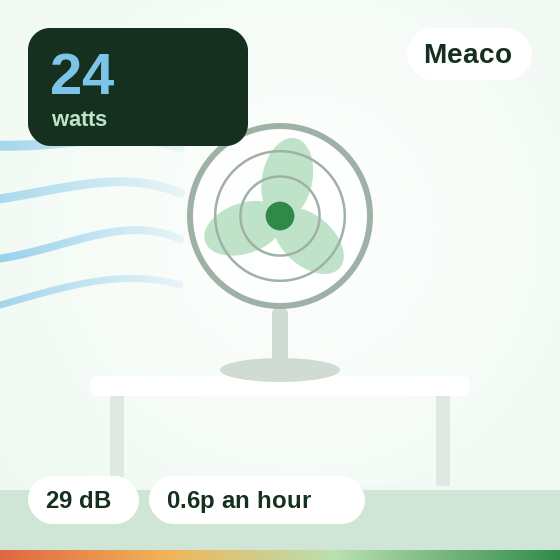
Meaco
MeacoFan 1056 Air Circulator
24 watts · 29 dB · 0.6p an hour
£99.99 at Meaco (maker shop), checked 14 Nov 2026
See it at Meaco (maker shop)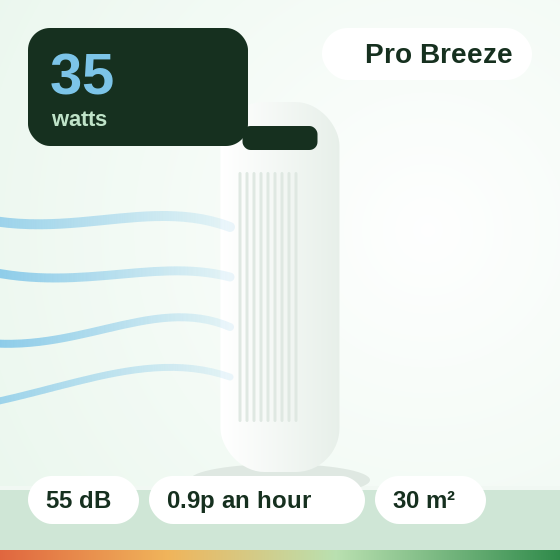
Pro Breeze
30" Oscillating Tower Fan with Touch Panel (PB-F-23)
35 watts · 55 dB · 0.9p an hour · 30 m²
£119.99 at Pro Breeze (maker shop, White), checked 14 Nov 2026
See it at Pro Breeze (maker shop, White)
Figures from the maker or retailer listing. Cost an hour is our own, at the price cap of 26.32p a kWh.