Key takeaways
- A fan costs less to run and adds no moisture. An air cooler can cool the air it blows by a few degrees on a dry day, but it adds moisture. Neither removes heat from the room; an air conditioner does.
- A 24 W fan costs 0.6p an hour at 26.32p per kWh. A 65 W air cooler costs 1.7p, about 2.7 times as much. A 1,000 W portable air conditioner costs 26.3p.
- In humid air an air cooler does little; our worked figures are below.
- The NHS and UKHSA say fans help while the air is below 35C (see below).
The short answer
Fan vs air cooler: a fan moves air over your skin and, on our reading of how a fan works, does not change the air’s temperature or humidity; an air cooler evaporates water into the air, which cools the air it blows and raises its humidity. In dry heat, with a window open, the cooler can feel cooler; in humid heat it adds moisture, which works against sweating. It costs a little more to run than most fans. We have not tested any product; this page compares makers’ and retailers’ figures and our own arithmetic. This page is the fan side of the choice; for air conditioners, see air cooler vs air conditioner and fan vs air conditioner.
How does each work?
- Fan. Moves air over your skin. It does not lower the air temperature of the room (our reading of how a fan works; the NHS and UKHSA advice on fans is below). See cooling fans.
- Air cooler. A fan draws air over a wet pad; water evaporates and takes heat from the air, so the air that leaves is cooler and more humid. PNNL, a US Department of Energy laboratory, says “Unlike standard air conditioning, direct evaporative coolers increase rather than decrease the humidity in the air” [1]. See how air coolers work.
- Portable air conditioner. Removes heat with a compressor and sends it outside through a hose; see portable air conditioners.
What does each cost to run?
Working, once, in plain words. A 24 W fan is 0.024 kW. An hour uses 0.024 kWh, which costs 0.6p at 26.32p per kWh. Eight hours cost 5.1p, and a 350-hour summer (our assumption, about eight hours a day for 44 days) costs £2.21. Every other row is the same sum. The rate is Ofgem’s Great Britain price cap average for 1 October to 31 December 2026 [2]; it carries no VAT (0%) for this period. These figures use the Great Britain price cap. In Northern Ireland, use the unit rate on your own bill.
| Product (rated power) | Type | Per hour | Per 8 hours | Per 350-hour summer |
|---|---|---|---|---|
| MeacoFan 1056 (24 W) [3] | fan | 0.6p | 5.1p | £2.21 |
| Pro Breeze 30 inch tower fan (35 W) [4] | fan | 0.9p | 7.4p | £3.22 |
| Pro Breeze OmniAir 5L (40 W) [5] | air cooler | 1.1p | 8.4p | £3.68 |
| Pro Breeze OmniAir 7L (65 W) [6] | air cooler | 1.7p | 13.7p | £5.99 |
| Symphony DiET 22i (170 W) [7] | air cooler | 4.5p | 35.8p | £15.66 |
| De’Longhi Pinguino PAC EM90 Silent (1,000 W) [8] | portable air conditioner | 26.3p | £2.11 | £92.12 |
A 65 W cooler costs about 2.7 times a 24 W fan (65 / 24 = 2.7) and about one fifteenth of the 1,000 W portable air conditioner (65 / 1,000). The 24 W fan figure is Meaco’s product page as recorded on 14 November 2026; its manual gives 9.5 to 23.5 watts [3]. The OmniAir 5L’s 40 W is Pro Breeze’s own figure as recorded on 14 November 2026 (its page returned HTTP 429 on 25 November 2026). The sums are at rated power, normally top speed; lower speeds use less, and a cooler’s water is extra (about 0.16p an hour for 0.8 litres at CIBSE’s 2018 mains water price [9], our working). Cost is not value: a fan costs least, and only the air conditioner removes heat. Fan running costs are covered on how much a fan costs to run; air conditioner costs on air conditioning running costs.
What does each do to humidity?
On our reading, a fan does not change the humidity of the air. A cooler raises it: CIBSE says “the air leaving the evaporative cooler will have a high relative humidity” [9], and the Energy Technology List says this “can lead to high humidity levels in the cooled air produced” [10]. The Met Office says “In hot and humid conditions, sweat does not evaporate efficiently, making it harder for the body to cool down” [11]. So a cooler that fills a closed room with moisture works against sweating. Makers say to keep a window or door open: Honeywell’s listing says its cooler “will require a flow of air like an open window and/or door in the room to work effectively” [12].
How much cooler: the worked numbers
A fan does not lower the air temperature, so it has no outlet figure. For the cooler, the Met Office says “Wet bulb temperature is the lowest temperature that can be achieved through evaporative cooling” [13]. Our calculation uses Roland Stull’s 2011 wet-bulb formula (as published in the ETHOS.RESKIT code [14]) and PNNL’s 75% to 93% efficiency for thick whole-house pads [1], so real portable units may do worse. The three conditions are ones we chose, not typical UK weather.
| Condition (our chosen inputs) | Wet-bulb | Air cooled by, at best |
|---|---|---|
| A. 30C, 40% humidity (a hot, dry-leaning afternoon) | 20.4C | 7.2C to 8.9C |
| B. 30C, 60% humidity (a hot, humid day) | 24.0C | 4.5C to 5.6C |
| C. 25C, 75% humidity (a muggy summer day or evening) | 21.6C | 2.5C to 3.1C |
On a hot, dry afternoon (30C, 40% humidity) the air leaving a cooler could at best be about 7 to 9C cooler. On a humid day (30C, 60%) at best 4.5 to 5.6C, and in muggy air (25C, 75%) about 2.5 to 3C. That is the air at the outlet, with all water in the air it adds to the room. Full explanation: do evaporative air coolers work in the UK?.
Official advice on fans: fans help while the air is below 35C. The NHS says “Electric fans can help if the temperature is below 35 degrees” [15]; UKHSA says use them “if the air temperature is below 35°C” and not to aim them directly at your body [16]. See how to cool a room with a fan and the UK heatwave guide.
Noise, water, upkeep and price
- Noise. Pro Breeze’s manual for the OmniAir 7L gives 40 to 64 dB; Eco Wizard gives 62 dB for the Symphony DiET 22i [6, 7]. Fan noise differs by model; the sound figures are different measures from different makers and cannot be set against each other without checking what each measures.
- Water and upkeep. A cooler needs a tank filled and emptied, and cleaning. Pro Breeze says the filter “should be cleaned every two weeks” and to empty, clean and dry the appliance when not in use “to prevent mould” [6]. A fan needs a wipe and a vacuum of the vents. See air cooler repair and maintenance.
- Price. The home coolers with a stated power that we found with a price ran from £79.99 (Symphony Duet Desk, Eco Wizard, checked 25 November 2026 [17]) to £199.99 (Igenix IG9750 at Homebase, out of stock on 25 November 2026 [18]). Fan prices vary widely and we give none here. See air cooler prices.
- Sleeping and unattended use. Pro Breeze’s OmniAir 7L manual says “Never leave the appliance unattended while in use” and “This appliance is intended for indoor household use and similar applications” [6]; its 30 inch tower fan manual says “Do not use the appliance while sleeping or place it near a person who is sleeping” and “Never leave the appliance unattended while in use” [4]. We have not read the OmniAir 5L’s manual: check it before leaving that cooler on overnight or unattended. For night-time cooling, see how to keep cool at night.
Which should you choose?
- Dry hot spell, a person near the unit, a window open: a fan or an air cooler. The cooler may feel cooler; the fan costs less and adds no moisture.
- Muggy air or a closed room: a fan, or an air conditioner if you need the room itself cooler. The cooler adds moisture.
- You need heat taken out of the room: an air conditioner; see portable air conditioners.
- Both together? We found no maker’s guidance on pairing them; a cooler still needs an open window or door and still adds moisture.
Frequently asked questions
Is an air cooler better than a fan?
It depends on the air. In dry heat a cooler can blow cooler air than a fan, but it costs more to run and adds moisture, which works against sweating in humid weather [11]. A fan adds no moisture.
Is an air cooler cheaper to run than a fan?
No. A 65 W cooler costs 1.7p an hour against 0.6p for a 24 W fan, at 26.32p per kWh. Both are far cheaper than a 1,000 W portable air conditioner at 26.3p.
Do air coolers cool better than fans?
In dry air, yes, at the outlet. On a hot, dry afternoon (30C, 40% humidity) the air leaving a cooler could at best be about 7 to 9C cooler. On a humid day (30C, 60%) at best 4.5 to 5.6C, and in muggy air (25C, 75%) about 2.5 to 3C. That is the air at the outlet, with all water in the air it adds to the room. Those are our own figures. Neither removes heat from the room.
Which is better in a humid room, a fan or an air cooler?
A fan. A cooler adds moisture, and in saturated air “no further evaporation can occur” [13].
Can I use a fan and an air cooler together?
We found no maker’s guidance on it. The cooler still needs an open window or door and adds moisture whatever else is running.
Is an air cooler worth the extra money over a fan?
Only if your air is dry and you want cooler air at the outlet. The extra running cost is small (about 1.1p an hour more at 65 W against 24 W); the upkeep and moisture are the real trade-offs.
Sources
- PNNL Building America Solution Center: Evaporative cooling systems (checked 25 November 2026)
- Ofgem: Changes to energy price cap between 1 October and 31 December 2026 (checked 25 November 2026)
- Meaco: MeacoFan 1056 manual (the 24 W figure is from Meaco’s product page, which returned HTTP 429 on 25 November 2026 and is cited as recorded on 14 November 2026) (checked 25 November 2026)
- Pro Breeze: 30 inch tower fan (PB-F-23) instruction manual (checked 25 November 2026)
- Pro Breeze: OmniAir 5L air cooler product page (HTTP 429 on 25 November 2026; the 40 W is cited as recorded in our product file) (checked 14 November 2026)
- Pro Breeze: OmniAir 7L (PB-AC06) instruction manual, February 2023 (checked 25 November 2026)
- Eco Wizard: Symphony DiET 22i portable evaporative air cooler (checked 25 November 2026)
- De’Longhi: Pinguino PAC EM90 Silent portable air conditioner (input power 1000 W; out of stock on the page) (checked 25 November 2026)
- CIBSE Journal: Module 135, Direct evaporative cooling for comfort applications (Tim Dwyer, November 2018) (checked 25 November 2026)
- Energy Technology List: ETL and Eurovent Certification collaboration, energy efficient evaporative air coolers (4 October 2024) (checked 25 November 2026)
- Met Office: What is humidity and how does it affect human health? (27 June 2025) (checked 25 November 2026)
- B&Q: Honeywell 10L evaporative air cooler 3 in 1 (checked 25 November 2026)
- Met Office: What are wet bulb temperatures and what they are used for? (7 August 2025) (checked 25 November 2026)
- ETHOS.RESKIT: wet bulb temperature (code of Stull’s 2011 formula) (checked 25 November 2026)
- NHS: Heatwave, how to cope in hot weather (checked 25 November 2026)
- UKHSA: Beat the heat, staying safe in hot weather (checked 25 November 2026)
- Eco Wizard: Symphony Duet Desk evaporative air cooler (checked 25 November 2026)
- Homebase: Igenix white evaporative air cooler 50L (checked 25 November 2026)
Products on this page
Meaco
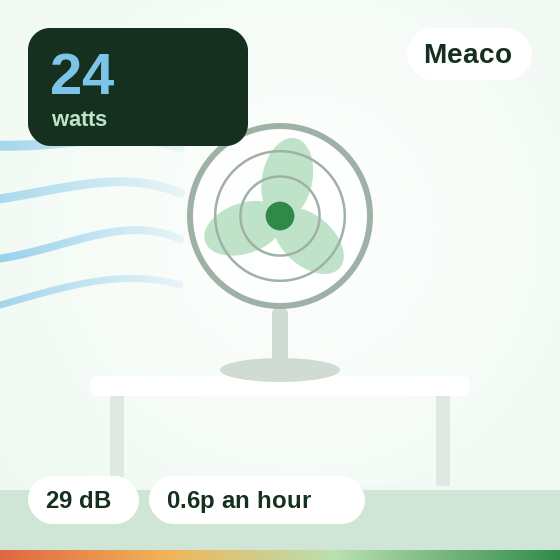
MeacoFan 1056 Air Circulator
24 watts · 29 dB · 0.6p an hour
£99.99 at Meaco (maker shop), checked 14 Nov 2026
See it at Meaco (maker shop)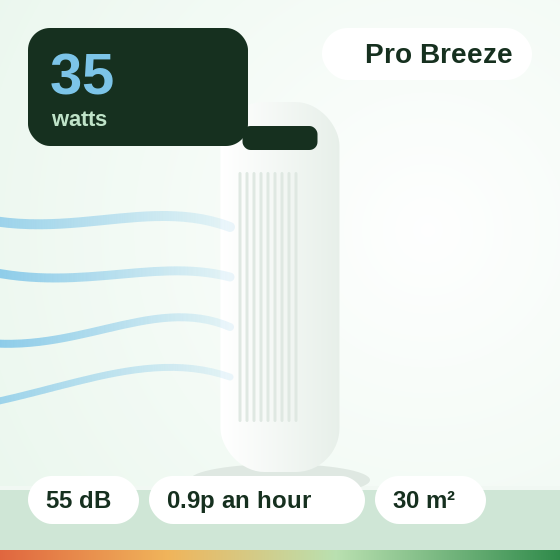
Pro Breeze
30" Oscillating Tower Fan with Touch Panel (PB-F-23)
35 watts · 55 dB · 0.9p an hour · 30 m²
£119.99 at Pro Breeze (maker shop, White), checked 14 Nov 2026
See it at Pro Breeze (maker shop, White)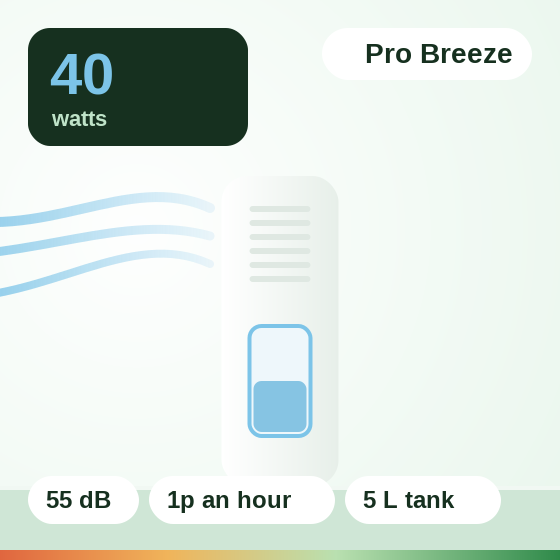
Pro Breeze
OmniAir 5L Evaporative Air Cooler (PB-AC-09)
40 watts · 55 dB · 1p an hour · 5 L tank
£119.99 at Pro Breeze (maker shop), checked 14 Nov 2026
See it at Pro Breeze (maker shop)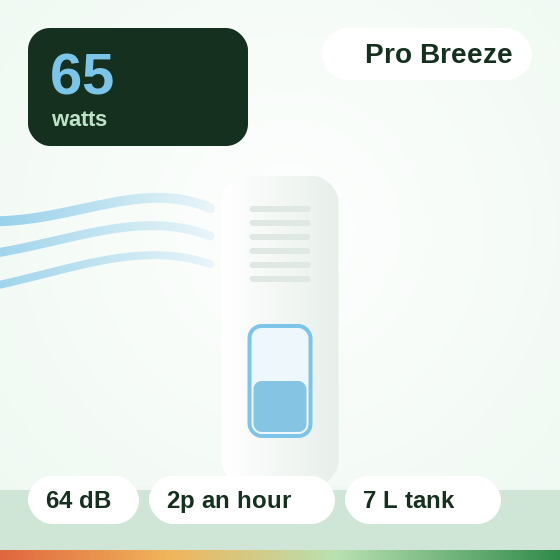
Pro Breeze
OmniAir 7L Evaporative Air Cooler (PB-AC06)
65 watts · 64 dB · 2p an hour · 7 L tank
£149.99 at Pro Breeze (maker shop), checked 14 Nov 2026
See it at Pro Breeze (maker shop)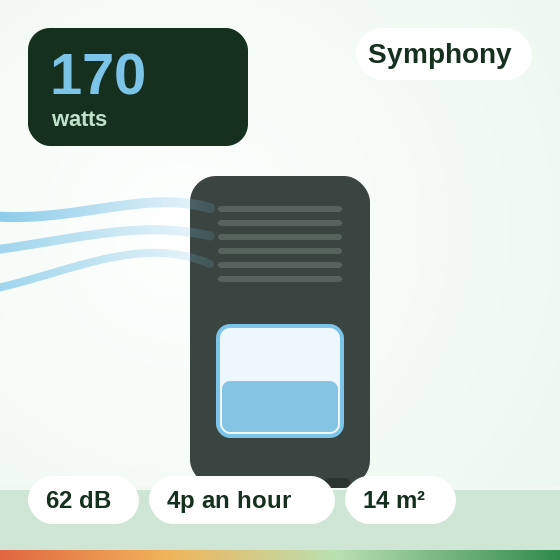
Symphony
DiET 22i Portable Evaporative Air Cooler, 22 litres
170 watts · 62 dB · 4p an hour · 14 m²
£126.98 at Eco Wizard, checked 14 Nov 2026
See it at Eco Wizard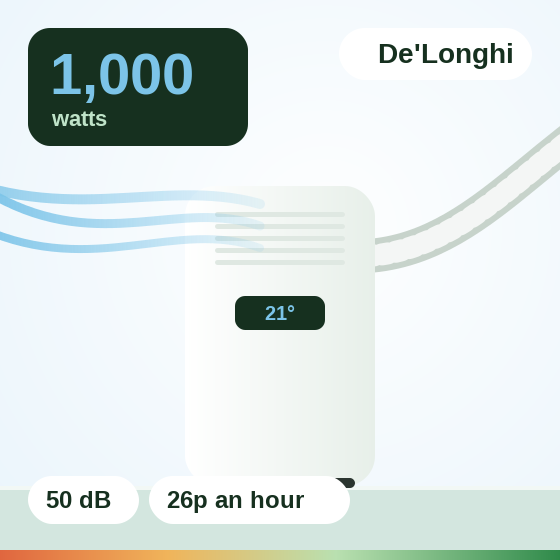
De'Longhi
Pinguino PACEM90 Silent
1,000 watts · 50 dB · 26p an hour
No current UK price found
Figures from the maker or retailer listing. Cost an hour is our own, at the price cap of 26.32p a kWh.