Key takeaways
- Whether to replace an air conditioning unit is not decided by age alone. iHeat says many systems “remain serviceable for well over a decade” and that repeated breakdowns, a climbing repair bill and declining performance are what point to replacement. Our air conditioning repair guide covers the rest of repair and servicing.
- No UK official or UK maker lifespan figure was found. Daikin’s Middle East and Africa site says a unit “usually lasts between 10 and 15 years” (undated, regional).
- iHeat’s guide price for a new single-room system is £2,000 to £3,500+. We found no published repair price we could open on 25 November 2026, so get a written repair quote and compare it with a replacement quote.
- A modern 2.5 kW split uses about £35.53 of cooling electricity a year on its label, so the case to replace one that still cools rests on reliability and repair cost, not on bills.
- Refrigerant in an old system must be recovered by an F-gas qualified person in Great Britain. This is general information, not legal advice.
Should I repair or replace my air conditioner?
Replace it when repairs are repeated, the bill is climbing and performance is falling; repair it when one part has failed on an otherwise sound system. That is iHeat’s reasoning: “Repeated faults can be a sign it is time to replace your air conditioning.” This page covers when to replace an air conditioning unit and why. The price of the new system is on how much it costs to replace an air conditioning unit. It sits within our guide to air conditioning repair, which shows which faults are the owner’s to check first.
Signs it may be time to replace
- Repeated breakdowns. iHeat: “If the same system keeps needing attention, repair costs can quickly add up.”
- An older unit with a rising bill and declining performance. iHeat: “If it is older, the repair bill is climbing and performance is already declining.”
- A unit that struggles to hold temperature or feels expensive to keep going. iHeat says it “may be costing more in the long run than a planned replacement would.”
- A failed compressor on an older system, weighed against the cost test below.
- A leaking system with an old HCFC refrigerant. See the section on old systems.
Before you decide, rule out the simple causes: see air conditioner not cooling. A room that is too large for the unit will not cool however new the unit is; see split air conditioners for sizing.
How long do air conditioners last?
We found no UK official or UK maker figure, so we do not give a UK average. Two regional or installer statements exist:
- Daikin’s Middle East and Africa site says an AC unit “usually lasts between 10 and 15 years”. The page is undated and written for that region.
- iHeat says that “many systems remain serviceable for well over a decade, but age alone does not decide whether replacement is needed” and gives no figure.
How you use and look after the unit matters; see air conditioning maintenance and air conditioning service.
The cost test
BOXT’s guide gave “around £500” for a compressor when it was read on 14 November 2026; the article would not load on 25 November 2026, so treat it as a figure to check. More on compressor replacement cost.
iHeat’s guide prices (updated 22 May 2026, VAT not stated) for a new fitted system are £2,000 to £3,500+ for a single room, £3,500 to £4,500+ for two rooms and £4,500 to £6,000+ for larger multi-room systems.
Daikin’s Middle East and Africa site offers a rule of thumb: it is “generally not worth repairing an AC once it is over 12 to 15 years old”, especially where repair costs reach roughly 30 to 40% of a new system’s price. That is one maker’s regional view, not a UK rule. We found no published price for a regas, leak repair or call-out, so for those, ask for a written itemised quote and compare it with the replacement quote.
Our figure: why bills do not decide it
The Daikin Sensira 2.5 kW has a label figure of 135 kWh a year for cooling. At 26.32p per kWh, Ofgem’s Great Britain average at the price cap for 1 October to 31 December 2026 (no VAT, 0%), that is £35.53 a year. Against a £2,000 replacement, that is 2,000 / 35.53 = 56 years of the whole cooling bill. This is our calculation from the label and says nothing about your unit’s real use; the point is that a unit which still cools properly will not repay a replacement through electricity alone.
Old systems with HCFC gas
Current GOV.UK guidance (published 18 April 2023) says reclaimed or recycled ozone-depleting substances cannot be used to service refrigeration, air conditioning and heat pump equipment in Great Britain, and NetRegs says recovered or reclaimed HCFCs have been banned for topping up or servicing since 1 January 2015. A leaking system of that kind therefore cannot be topped up with them. Neither page names R22. We found no source that says an old system can be converted to another gas, so we make no claim about that. The options to discuss with an F-gas engineer are a leak repair without topping up, or replacement. See air conditioning gas.
What replacement involves
A fitted replacement is installation work, priced on the replacement cost page. Ask whether the quote includes removing the old unit and its pipework, and who recovers the refrigerant: in Great Britain, GOV.UK says you must have qualifications to “recover gases” and “decommission and dispose of old systems”, and the work needs an F-gas qualified technician working for a certified company. Northern Ireland follows the EU F-gas rules. See F-gas rules.
VAT: HMRC’s Notice 708/6 says a zero rate applies to installing certain energy-saving materials until 31 March 2027, then 5% from 1 April 2027, and that permanently fixed air source heat pumps qualify. HMRC’s understanding is that “most air conditioning units are air source heat pumps”, but supply without installation is standard-rated. See VAT on air conditioning.
Repair, replace or something else?
If the old unit only cools, a replacement could also heat. Air-to-air heat pumps are covered at air-to-air heat pumps. Check that a unit suits your room before you buy.
Frequently asked questions
How long does an air conditioner last?
We found no UK figure. Daikin’s Middle East and Africa site says a unit usually lasts between 10 and 15 years (regional, undated), and iHeat says many systems remain serviceable for well over a decade, with age alone not deciding replacement.
When should I replace my air conditioner?
When repairs are repeated, the repair bill is climbing and performance is declining, according to iHeat. Compare a written repair quote with a new system’s price.
Is it worth repairing an old air conditioner?
Daikin’s regional guidance says it is generally not worth repairing a unit over 12 to 15 years old when repairs reach roughly 30 to 40% of a new system’s price. We found no published fault-repair prices, so get a written quote.
Can an old air conditioner with HCFC gas still be used?
We found no source that answers this directly. Current GOV.UK guidance says reclaimed or recycled ozone-depleting substances cannot be used to service this equipment in Great Britain, so a leaking system cannot be topped up with them. Ask an F-gas engineer.
How much does it cost to replace an air conditioner?
iHeat’s guide prices (updated 22 May 2026) are £2,000 to £3,500+ for a single room, £3,500 to £4,500+ for two rooms and £4,500 to £6,000+ for larger systems, VAT not stated.
Is a failed compressor worth fixing?
We found no published compressor price we could open on 25 November 2026. Ask for a written quote that lists recovering and recharging the refrigerant, the part, labour and VAT, and compare it with a replacement quote.
Sources
- iHeat: air conditioning replacement, repair or replace (updated 22 May 2026) (checked 25 November 2026)
- BOXT: air conditioning compressors (updated 24 May 2024); the article would not load on 25 November 2026, so the figure is as read on 14 November 2026 (checked 14 November 2026)
- Daikin Middle East and Africa: how long does an AC unit last? (undated, regional) (checked 25 November 2026)
- GOV.UK: Qualifications required to work on equipment containing F gas (updated 3 March 2026) (checked 25 November 2026)
- GOV.UK: Recovering ozone-depleting substances from equipment (published 18 April 2023) (checked 25 November 2026)
- NetRegs: Stationary refrigeration, air conditioning and heat pumps, ODS controls (checked 25 November 2026)
- HMRC: VAT on energy-saving materials and heating equipment, Notice 708/6 (updated 31 January 2024) (checked 25 November 2026)
- Daikin UK: specifications table FTXF-F with RXF-F (checked 25 November 2026)
- Ofgem: Changes to energy price cap between 1 October and 31 December 2026 (checked 25 November 2026)
Products on this page
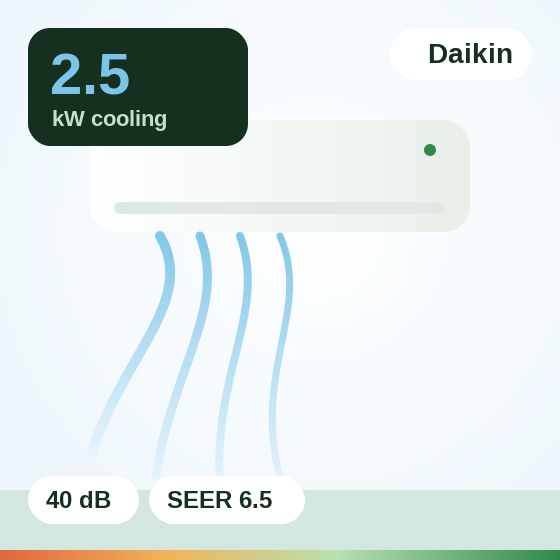
Daikin
Sensira FTXF25F5V1B (indoor) with RXF25F5V1B (outdoor), 2.5 kW
2.5 kW cooling · 40 dB · SEER 6.5
No current UK price found
Figures from the maker or retailer listing. Cost an hour is our own, at the price cap of 26.32p a kWh.