Key takeaways
- A portable air conditioner without hose does not exist as an air conditioner. De’Longhi, asked whether its portables work without the hose, answers “No.”
- Products sold as “hoseless” or “no vent” room coolers are, in our reading, evaporative air coolers, which are not air conditioners under the definition used for UK energy labels.
- A unit “with a self evaporating tank” still has a hose. So does a water cooled home unit.
- The real alternatives are a single hose unit with a good window kit, a portable split (an outdoor part instead of a hose), a fitted split system, or fans.
- Running a Meaco Cirro 12000 without venting still costs 35.5p an hour while about 4.87 kW of heat stays in the room.
You cannot buy a portable air conditioner that cools a room without a hose. Every one has to send heat outside, and the hose is how a normal portable does it. Units sold as hoseless are a different kind of product, and below we say what they are and what to buy instead. The full set-up is in our guide to how to vent a portable air conditioner.
Why every portable air conditioner needs a hose
An air conditioner takes heat out of the room air and has to put it somewhere. On a portable, both the cold and the hot side are in one box, so the hot air leaves through a hose. De’Longhi UK: “No. Our portable air conditioners are designed to work by expelling hot air out of the back of the unit” using the hose supplied. Meaco’s manual for its 12,000 BTU portable says it “needs to be vented to the outside in order to remove hot air”.
How much heat is that? Our own arithmetic, not a maker’s figure: the hose carries away the heat taken from the room plus the electricity the unit uses, because that electricity ends up as heat too. The Meaco Cirro 12000 is rated at 12,000 BTU per hour, which is 12,000 x 0.2930711 = about 3.52 kW of cooling, and it draws 1,350 W. So roughly 3.52 + 1.35 = 4.87 kW goes out of the hose at full output.
Run it with no hose and that heat stays in the room. It still uses 1.35 kW x 26.32p = 35.5p an hour. That is a Great Britain average at the Ofgem price cap for 1 October to 31 December 2026 (26.32p per kWh), without the standing charge; in Northern Ireland, use the unit rate on your own bill.
What “no hose” products actually are
Evaporative air coolers
Products sold as “hoseless”, “ventless” or “no vent” air conditioners are almost always evaporative air coolers (our reading of listings, not a maker’s statement). The regulation that sets UK energy labels defines an air conditioner as “a device capable of cooling or heating, or both, indoor air, using a vapour compression cycle driven by an electric compressor”. An air cooler does not use that cycle, so by that definition it is not an air conditioner (the regulation does not name air coolers; that is our reading of the definition). We cover how they work, and how they compare, in our air cooler guide and air cooler against air conditioner; we make no claims here about how well they cool. For the word itself, see ventless air conditioners.
Self evaporating units
A self evaporating unit sends its collected water out with the exhaust air instead of into a tank you empty. It still has a hose, because the exhaust air is what carries the water out. Meaco’s manual says of its drain bung: “Whilst cooling, do not remove this bung. This is the water reservoir where water sits until it is evaporated out via the duct.” See self evaporating portable air conditioners.
Water cooled units
“Water cooled” does not mean no vent either. The regulation counts home units that use water on the hot coil as air conditioners only if they can also work on air alone. See water cooled air conditioners.
Portable splits
A portable split has no exhaust hose. Midea’s UK PortaSplit page describes an outdoor unit, saying “the heat is dispersed via a heat exchanger without pumping air out”; the indoor unit has wheels, a wall bracket is included, and Midea says it needs “no professional installation”. Its UK page does not describe the connecting line. The Midea PortaSplit was listed from £999.00 at Appliances Direct , checked 14 November 2026.
Ask before you buy. Our product file records the PortaSplit’s refrigerant as R32 (from Midea’s manual, which is too large for us to re-open here), and the law in Great Britain bans new “movable air conditioning equipment (user can move it between rooms)” with a refrigerant of GWP above 150 (GOV.UK). We could not confirm whether the rules treat a portable split as movable equipment or as a split system, and the Appliances Direct listing is inconsistent on whether an F-gas engineer is needed. We do not say it is banned or lawful. This is general information, not legal advice. See portable split air conditioners.
What to do instead
- A single hose portable with a good kit. The simplest route is to use the hose with a kit that suits your window, and seal the gaps. The window kit guide covers every window type.
- A portable split. An outdoor part hangs outside instead of a hose; see above and portable split air conditioners.
- A through-wall or other unit with no outdoor part. See air conditioners without an outdoor unit.
- A fitted split system, if you can have an outdoor unit. Ask an installer; our portable air conditioner guide covers the portable route first.
- Fans and other ways to cool a room, if you cannot vent at all: how to cool a room without AC.
If you have no window, our guide to venting without a window covers doors and walls.
What happens if you run a portable without its hose
The heat stays in the room, so the unit works against itself. De’Longhi’s answer is plain that its units are designed to expel hot air through the hose. Meaco says its window kit steps are “essential” for Cool or Heat mode and “recommended” for Dry mode, and De’Longhi’s New Zealand FAQ says units with a separate dehumidify-only mode still need the hose extended “to allow the moisture to be discharged from the unit”. We found no UK version of that second answer.
Frequently asked questions
Is there a portable air conditioner that does not need a window?
Not one that cools without sending heat outside. A portable can vent through a door kit or a hole in a wall, or you can use a portable split with an outdoor part. See venting without a window.
Can I use a portable air conditioner without the hose?
Not if you want it to cool. De’Longhi answers “No” for its units, and Meaco says its air conditioner “needs to be vented to the outside”. Without the hose the heat stays in the room.
Are hoseless air conditioners just air coolers?
Almost always, in our reading of listings: they are evaporative air coolers, which do not use the vapour compression cycle in the regulation’s definition of an air conditioner. We have not tested any. Our air cooler guide has more.
What is the best alternative to a portable air conditioner with a hose?
It depends on your home. A portable split avoids the exhaust hose but has an outdoor part; a fitted split suits a home where you can have one; a fan or air cooler is a smaller step. We do not rank them here.
Does a portable split need a hose?
It has no exhaust hose. It has an outdoor unit instead. Midea’s UK page says it needs no professional installation; check the F-gas point above before you buy.
Can I run it without the hose in dehumidify mode?
Not as a rule. Meaco recommends its window kit steps for Dry mode, and De’Longhi’s New Zealand FAQ says the hose must still be extended on units with a separate dehumidify-only mode. Check your own manual.
Sources
- Meaco: MeacoCool Pro 12,000 BTU and 12,000CH BTU portable air conditioner, instruction manual (PDF hosted by Air Conditioning Centre) (checked 14 November 2026)
- Meaco: Cirro 12000 BTU Super Quiet Smart Portable Air Conditioner and Heater (checked 14 November 2026)
- De’Longhi UK: Do portable air conditioners work without the hose? (checked 14 November 2026)
- De’Longhi New Zealand: Do I still need to use the hose when my air conditioner is in dehumidifier-only mode? (checked 14 November 2026)
- legislation.gov.uk: Regulation (EU) No 626/2011, Article 2, definitions (checked 14 November 2026)
- Midea UK: PortaSplit (checked 14 November 2026)
- GOV.UK: Bans on F gas in new products and equipment, current and future (checked 14 November 2026)
- Ofgem: Changes to energy price cap between 1 October and 31 December 2026 (checked 14 November 2026)
Products on this page
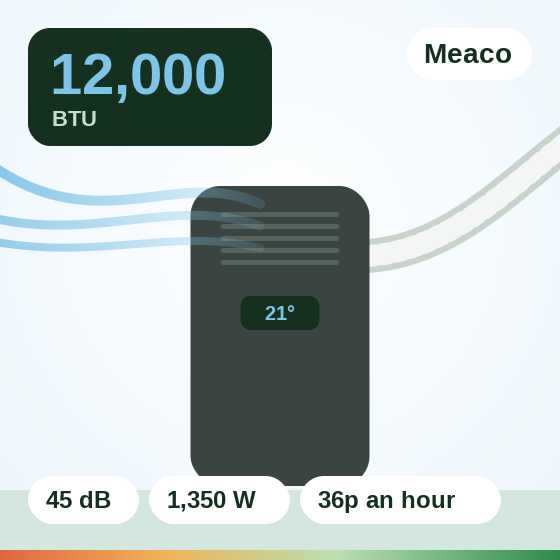
Meaco
Cirro 12000 BTU Super Quiet Smart Portable Air Conditioner & Heater (A-Cirro-12K-CH)
12,000 BTU · 45 dB · 1,350 W · 36p an hour
£539.99 at Meaco (maker shop), checked 13 Nov 2026
See it at Meaco (maker shop)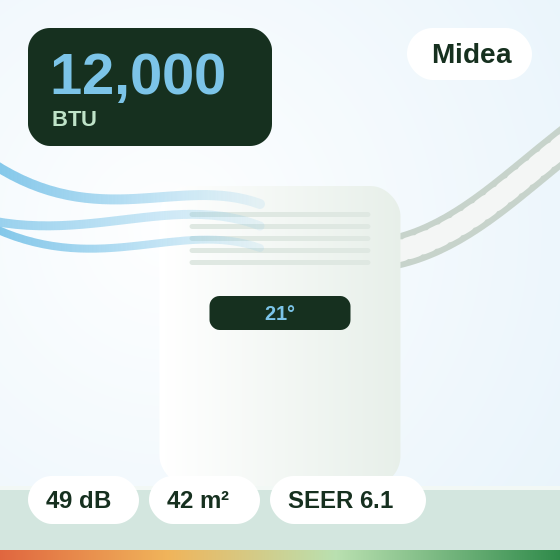
Midea
PortaSplit
12,000 BTU · 49 dB · 42 m² · SEER 6.1
£999.00 at Appliances Direct, checked 14 Nov 2026
See it at Appliances Direct
Figures from the maker or retailer listing. Cost an hour is our own, at the price cap of 26.32p a kWh.