Key takeaways
- An HVAC filter is the part of a heating, ventilation or air conditioning system (see our commercial air conditioning guide) that removes particles from the air. Freudenberg, a filter maker, says ISO 16890 has replaced EN 779; it sorts filters into four groups: ePM1, ePM2.5, ePM10 and ISO coarse.
- A filter must remove at least 50% of the particles in its group to qualify, and efficiency is reported in 5% steps.
- The older EN 779 classes (such as F7) do not convert neatly: a filter maker says “A 1:1 comparison between filter class according to EN 779 and filter class according to ISO 16890 is not possible.” Check the product’s ISO 16890 rating.
- No official source we opened gives a replacement interval. Follow the maker’s instructions and your maintenance contract.
- A US government figure of 5 to 15% lower energy use would be £3.60 to £10.81 a year on one 5 kW cassette at business rates, but it is a US figure for home units.
What kinds of HVAC filter are there?
This page is about commercial buildings. “HVAC” is heating, ventilation and air conditioning; our page on what HVAC means explains the term, and the pillar guide to commercial air conditioning covers the system types. Filters turn up in two places.
- Indoor units of splits and cassettes. These have filters you can reach. Molesey Air’s commercial service lists “filter washing”. For washing at home scale, see how to clean air conditioner filters.
- Air handling units. Designing Buildings (last edited 8 September 2026) describes an air handling unit as “an insulated box” that may include “filter racks or chambers”, a fan, heating and cooling elements, and more. These carry the heavier filtering for a ducted building; see HVAC ductwork.
What is ISO 16890?
The filter maker Freudenberg’s page on the standard says that since 2018 “ISO 16890 has replaced EN 779”, and that it sorts filters into four groups: ISO ePM1, ISO ePM2.5, ISO ePM10 and ISO coarse. We read these points on 25 November 2026:
- “The prerequisite for the respective group is that a filter separates at least 50% of the corresponding particle size range.”
- Efficiency is reported “rounded off in 5-percent increments”.
- The testing uses “a particle size spectrum of 0.3 - 10 micrometers”.
- Its classification table gives ISO coarse as “ePM10 < 50 %”.
So a rating such as “ePM1 70%” (our example, not a product) means the filter’s efficiency on the PM1 particle range was measured and rounded to 70%. The group name says which particle range the filter is rated against; the percentage says how well it does.
What happened to the old EN 779 classes?
Older filters and older maintenance reports use EN 779 classes. Freudenberg’s comparison table lists M5, M6, F7, F8 and F9, and warns that “A 1:1 comparison between filter class according to EN 779 and filter class according to ISO 16890 is not possible.” Any conversion table is a rough guide. When a report says “F7”, ask your contractor for the ISO 16890 rating of the filter now fitted, and order by that.
Which grade goes where?
The standard does not tell you which grade your building needs; the designer does that. One industry view: an article in CIBSE Journal (August 2017) by Peter Dyment, whose author note says he is “a technical manager at Camfi”, recommends “ISO 16890:2016 ePM1-rated filters used to a high efficiency … to clean incoming supply air in city buildings”, and says “For city locations or polluted areas, ePM2.5- and ePM10-rated filters should only be used as pre-filters.” That is one author at one filter company, so treat it as a view. Filters tested to other standards for very fine particles are outside the sources we opened: ask the supplier which test standard applies.
When should you clean or replace a filter?
We found no official interval. What the sources we opened do say:
- HSE says maintained “in line with manufacturers’ instructions”, and that “Air to be recirculated should be adequately filtered to remove particulates”. It also says incoming air that you expect to be heavily contaminated, by traffic or smoke for example, should be filtered.
- The CIBSE article says the standard’s dust-loading test “indicates the life of a filter and development of pressure loss”. Pressure drop across a filter is how contractors judge when a filter is loaded; we found no figure for when to change.
- An installer’s page (Server Room Environments, undated) lists “Clean Filters” in each planned maintenance visit and says most manufacturers recommend servicing twice a year. SFG20, “the industry standard for building maintenance specification”, covers air conditioning, but we read none of its task frequencies.
Our worked figure. The US Department of Energy’s HomeCooling101 (18 June 2014) says “Routinely replace or clean your air filters – it can lower your air conditioner’s energy consumption by 5-15 percent.” The same installer page claims “around 5-15%” for replacement at a service visit. Neither is measured on UK commercial units. A Daikin Round Flow 5 kW cassette’s label figure is 252 kWh a year, and at DESNZ’s April to June 2026 average for small businesses (28.59p per kWh, including the Climate Change Levy and excluding VAT, from its table 3.4.2) that is £72.04. The domestic price cap does not apply to businesses: use the rate on your own bill.
- 5% of £72.04 = £3.60 a year.
- 15% of £72.04 = £10.81 a year.
The saving is small beside the cost of a service. Keep filters clean for airflow, comfort and reliability, as the maker’s manual says.
Filters and the fresh air duty
Regulation 6 of the Workplace (Health, Safety and Welfare) Regulations 1992 (England, Wales and Scotland) requires “a sufficient quantity of fresh or purified air”. HSE, quoting its Approved Code of Practice, says “recirculated air should be adequately filtered to remove impurities” and that “To avoid air becoming unhealthy, purified air should have some fresh air added to it before being recirculated.” A filter cleans air; it does not add fresh air. This is general information, not legal advice.
Who should change air handling unit filters?
Ask your maintenance contractor, and check the contract lists filters. See HVAC maintenance and commercial air conditioning servicing.
How to brief a maintenance contractor about filters
- List every unit with a filter: split and cassette indoor units, and each air handling unit.
- Ask for the ISO 16890 rating and size of each filter fitted, and for the date each was last changed.
- Ask how the contractor decides when to change one (a set interval, a pressure reading, or both).
- Ask whether the price includes new filters or only labour.
- Ask for the filter changes to appear on the service sheet.
Frequently asked questions
What does ePM1 mean?
It is one of the four ISO 16890 groups, for fine particles (PM1). A filter qualifies for it if it separates at least 50% of that particle range, and its efficiency is reported in 5% steps.
What is the ISO 16890 equivalent of an F7 filter?
There is no exact equivalent. Freudenberg says “A 1:1 comparison” between the two systems “is not possible”. Check the product’s own ISO 16890 rating.
How often should HVAC filters be changed?
We found no official interval. HSE says to maintain ventilation systems in line with manufacturers’ instructions, and contractors judge loading by pressure drop. One installer says most makers recommend servicing twice a year.
Can I wash HVAC filters?
Molesey Air’s commercial service includes filter washing for split units. For other filters, follow the filter maker’s instructions: we found no source that covers washing air handling unit filters.
Are HEPA filters used in HVAC?
They can be, but they sit outside the ISO 16890 sources we opened, so we do not describe them here. Ask the supplier for the test standard.
Do better filters use more energy?
A finer filter generally resists the airflow more, which means more fan work, but we found no figure for how much. The CIBSE article mentions Eurovent’s energy rating for filters without giving numbers. Ask for the filter’s pressure drop and energy class.
Sources
- Freudenberg Filtration Technologies: ISO 16890 (checked 25 November 2026)
- CIBSE Journal: Opportunity NOx, testing standards for air filters (August 2017) (checked 25 November 2026)
- Designing Buildings: HVAC (checked 25 November 2026)
- HSE: How to improve ventilation (checked 25 November 2026)
- legislation.gov.uk: Workplace (Health, Safety and Welfare) Regulations 1992, regulation 6 (checked 25 November 2026)
- SFG20: What is SFG20 (checked 25 November 2026)
- Server Room Environments: Air conditioner maintenance contracts (checked 25 November 2026)
- Molesey Air: Air conditioning maintenance, Surrey (checked 25 November 2026)
- US Department of Energy: HomeCooling101 (18 June 2014) (checked 25 November 2026)
- DESNZ: Gas and electricity prices in the non-domestic sector, table 3.4.2 (checked 25 November 2026)
- Daikin UK: FCAG-B / RZAG-B technical details (cassette figure as recorded in our product file, checked 14 November 2026)
Products on this page
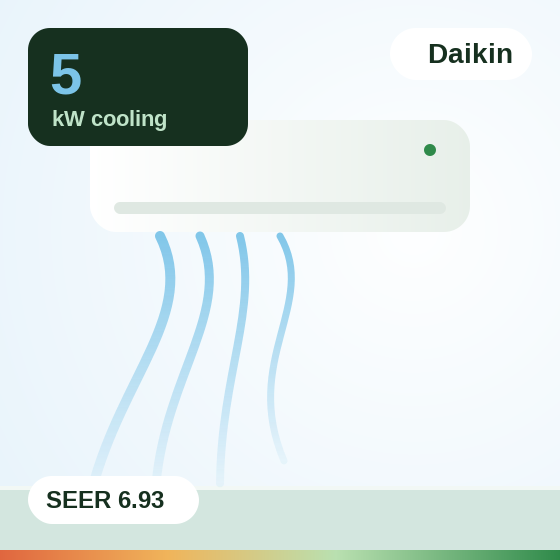
Daikin
Round Flow cassette FCAG60BVEB with Sky Air RZAG50B5V1B outdoor unit
5 kW cooling · SEER 6.93
No current UK price found
Figures from the maker or retailer listing. Cost an hour is our own, at the price cap of 26.32p a kWh.