Key takeaways
- How to clean air conditioner filter: Daikin and Mitsubishi Electric both recommend cleaning a split unit’s air filters every 2 weeks. De’Longhi says to clean a portable’s filter once a week if it is used constantly; Pro Breeze says every two weeks. Our air conditioning repair guide covers the rest of repair and servicing.
- Switch off and turn the breaker off or pull the plug first. Wash or vacuum the filter, in water no hotter than 40°C (Daikin) or 50°C (Mitsubishi), and dry it completely in the shade before refitting.
- Never use gasoline, benzene, thinner, polishing powder, liquid insecticide or a scrubbing brush, and never dry a filter in the sun or near heat.
- Cleaning the filters is the owner’s job. Cleaning the inside of the unit is not: Daikin says you “may NEVER” do it yourself.
- Follow your own maker’s manual. These steps are from named manuals and the makers differ.
Filters are the one part of an air conditioner that every maker we read lets the owner clean. This page covers the filter only; the whole unit is on how to clean an air conditioner, the schedule on air conditioning maintenance, and the bigger picture of what you may and may not do on air conditioning repair and servicing.
How often should you clean the filter?
| Unit | Interval | Whose manual |
|---|---|---|
| Daikin split (FTXF-F) | “every 2 weeks” | Daikin FTXF-F operation manual (60 and 71 sizes) and FTXF-E guide |
| Mitsubishi split (MSZ-LN) | “every 2 weeks” | Mitsubishi MSZ-LN operating instructions (New Zealand edition) |
| De’Longhi portable (PAC AP) | “once a week” if used constantly or systematically | De’Longhi PAC AP manual |
| Pro Breeze portable (PB-AC04) | “every two weeks” | Pro Breeze PB-AC04 manual |
| Meaco Cirro+ portable | “a minimum of every two weeks” | Meaco Cirro+ 14,000 to 16,000 BTU manual |
Mitsubishi explains why: “Dirty filters cause condensation in the air conditioner which will contribute to the growth of fungi such as mold.” Daikin’s E-series guide says a dirty filter “CANNOT deodorise the air”, “CANNOT clean the air”, gives poor cooling and “causes odour”.
Our figure: how many cleans, and what they may save
At every 2 weeks, that is 26 cleans in a year of continuous use, or 13 in a 26-week cooling season (our example, not a maker figure); De’Longhi’s weekly portable interval is 52 in a year of constant use. The US Department of Energy’s HomeCooling101 leaflet (June 2014) says: “Routinely replace or clean your air filters – it can lower your air conditioner’s energy consumption by 5-15 percent.” That is US guidance about air conditioners in general, not a measured UK saving. Applied to the Daikin Sensira 2.5 kW’s label figure of 135 kWh a year, 5% to 15% is £1.78 to £5.33 a year at 26.32p per kWh, Ofgem’s Great Britain average unit rate at the price cap for 1 October to 31 December 2026 (our arithmetic, an illustration: 135 x 26.32p = £35.53, and 5% and 15% of that). Mitsubishi gives no percentage, only that clean filters give “best performance” and “reduce power consumption”.
What you need
- A vacuum cleaner with a brush attachment
- Lukewarm water
- A mild neutral detergent, if the dust does not come off
- A dry, shaded place
How to clean a split air conditioner filter
These steps follow Daikin’s FTXF-F manual. Mitsubishi’s are similar and the differences are noted.
- Stop the unit and turn the breaker off or pull out the supply cord. Daikin: “Otherwise, an electrical shock and injury may result.” Mitsubishi: switch off the power supply or turn off the breaker.
- Hold the front panel by the tabs on both sides and open it. On the Mitsubishi MSZ-LN, you then rotate the stoppers until they click and lower the panel slowly; the panel cannot be removed.
- Push the tab at the centre of each filter and pull it down and out. On the Mitsubishi, pinch the tabs, push the filter slightly up and pull it down towards you.
- Wash the filter with water or vacuum it.
- If it is dirty, soak it in lukewarm water for about 10 to 15 minutes (Daikin). If the dust does not come off, Daikin says to use a neutral detergent diluted in lukewarm water; Mitsubishi says to use kitchen neutral detergent diluted with lukewarm water, and to wipe the detergent off with a damp towel. Do not use “water or air of 40°C or higher” (Daikin) or “water hotter than 50°C” (Mitsubishi).
- Dry it completely in the shade. Mitsubishi: do not expose parts to “direct sunlight, heat, or fire” to dry them.
- Refit all filters in their original positions, making sure they are completely dry. Close the front panel, pressing gently at both sides and the centre until it clicks.
Mitsubishi also asks you not to touch the metal parts, and Daikin says “Do NOT touch the heat exchanger fins. These fins are sharp and could result in cutting injuries.”
The deodorising and air cleaning filters
Only if your Mitsubishi has them. Its air cleaning (deodorising, black) filter is cleaned every 3 months by vacuum, or by soaking the framed filter in lukewarm water of 30 to 40°C for about 15 minutes, rinsing well and drying in the shade. Mitsubishi says the deodorising feature “recovers by cleaning the filter”, and to replace it (part MAC-3010FT-E) “When dirt or smell cannot be removed by cleaning.” The air purifying device is vacuumed every 3 months; Mitsubishi says not to disassemble it or touch parts other than its frame, and not to touch the i-see sensor.
What not to do
- No gasoline, benzene, thinner, polishing powder or liquid insecticide, and no scrubbing brush or hard sponge (Daikin and Mitsubishi).
- No insecticides, flammable sprays, air refreshers or antibacterial agents on the unit (Mitsubishi).
- Do not soak or rinse the horizontal vane (Mitsubishi).
- Do not put a wet filter back, and do not touch the heat exchanger fins.
- Detergent advice differs, so the maker wins. Daikin and Mitsubishi allow a diluted neutral detergent; iHeat’s maintenance guide says only: “Wash only if allowed. Follow the specified water temperature and cleaning-product instructions.”
- We found no line in the Daikin or Mitsubishi manuals about running the unit with the filters removed. Refit them before you restart.
Portable air conditioner filters
- Pro Breeze PB-AC04: unplug, remove the filter mesh from the back, vacuum, rinse under running water in the opposite direction to the airflow, and let it dry completely before refitting. It says a blocked filter “can damage the appliance”, and its PB-AC08 manual says “Do not operate the appliance without the filter.”
- De’Longhi PAC AP: the filter is in the intake grille. Vacuum it; if very dirty, immerse it in warm water and rinse it several times, with water “never hotter than 40°C”, and dry fully before replacing it.
- Meaco Cirro+: clean with a hoover or soapy water no hotter than 40°C, rinse and dry. Meaco says not doing so “could invalidate the air conditioners’ warranty”.
Check the wording of your own manual. See also how to store a portable air conditioner; fans have their own steps on how to clean a tower fan.
When the filter is not enough
If a smell or weak cooling remains after cleaning, see air conditioner smells and air conditioner not cooling. The inside of the unit is an engineer’s job. Daikin: “As an end user, you may NEVER clean inside parts of the unit by yourself; this work must be performed by a qualified service person.” This is the one thing on this page to leave alone.
Frequently asked questions
How often should I clean my air conditioner filter?
Every 2 weeks, say Daikin and Mitsubishi for their split units. De’Longhi says weekly for a portable that is used constantly; Pro Breeze and Meaco say every two weeks.
Can I wash an air conditioner filter with water?
Yes, for the washable filters the manuals describe, in lukewarm water. Mitsubishi does not allow you to wash the unit itself with water or to soak the horizontal vane.
What temperature water should I use on an air conditioner filter?
Not hotter than 40°C for Daikin and De’Longhi, and not hotter than 50°C for Mitsubishi. Mitsubishi’s air cleaning filter soaks at 30 to 40°C.
Can I use detergent to clean an air conditioner filter?
Daikin and Mitsubishi allow a diluted neutral detergent if dust does not come off with water. Follow your own manual.
Can I run my air conditioner without the filter?
Pro Breeze says not to for its portables. We found no line for Daikin or Mitsubishi splits, so refit the filters before restarting.
How do I know if the filter needs replacing?
Washable filters are cleaned, not replaced, in the manuals we read. Mitsubishi says to replace its air cleaning filter if dirt or smell will not clear. A Daikin Madoka wired controller shows a “Time to clean filter” screen.
How do I clean a portable air conditioner filter?
Unplug the unit, take out the filter, vacuum it, rinse it in water no hotter than 40°C (De’Longhi), and let it dry completely before refitting.
Sources
- Daikin: FTXF60F2V1B and FTXF71F2V1B operation manual 3P511999-9S, 2024.09 (PDF) (checked 25 November 2026)
- Daikin: FTXF20 to 42E5V1B user reference guide 4D526466-14K, 2022.09 (PDF) (checked 25 November 2026)
- Mitsubishi Electric: MSZ-LN25VG2 to MSZ-LN60VG3 operating instructions VG79Y699H01, New Zealand edition (PDF) (checked 25 November 2026)
- De’Longhi: PAC AP series instructions for use 5715117836 (PDF) (checked 25 November 2026)
- Pro Breeze: PB-AC04 7000 BTU portable air conditioner instruction manual (PDF) (checked 25 November 2026)
- Pro Breeze: PB-AC08 5000 BTU portable air conditioner instruction manual (PDF) (checked 25 November 2026)
- Meaco: Cirro+ 14,000 to 16,000 BTU portable air conditioner instruction manual (PDF) (checked 25 November 2026)
- Daikin: Madoka wired remote controller BRC1H52W, K, S installation and operation manual 4P596264-1D, 2022.02 (PDF) (checked 25 November 2026)
- US Department of Energy: HomeCooling101 (June 2014, PDF) (checked 25 November 2026)
- iHeat: air conditioning maintenance guide (updated 2 October 2026) (checked 25 November 2026)
- Daikin UK: specifications table FTXF-F with RXF-F, for the 135 kWh annual cooling figure (checked 25 November 2026)
- Ofgem: Changes to energy price cap between 1 October and 31 December 2026 (checked 25 November 2026)
Products on this page
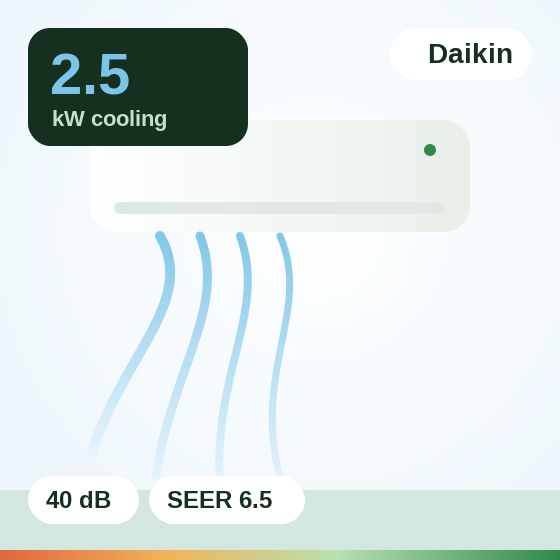
Daikin
Sensira FTXF25F5V1B (indoor) with RXF25F5V1B (outdoor), 2.5 kW
2.5 kW cooling · 40 dB · SEER 6.5
No current UK price found
Figures from the maker or retailer listing. Cost an hour is our own, at the price cap of 26.32p a kWh.