Key takeaways
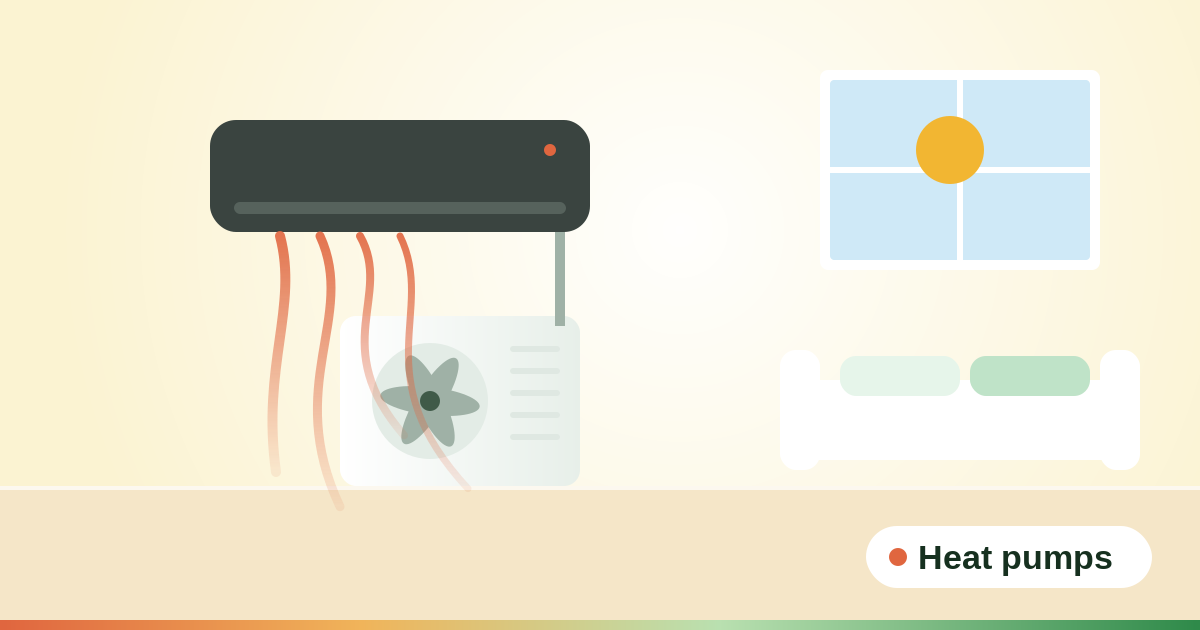
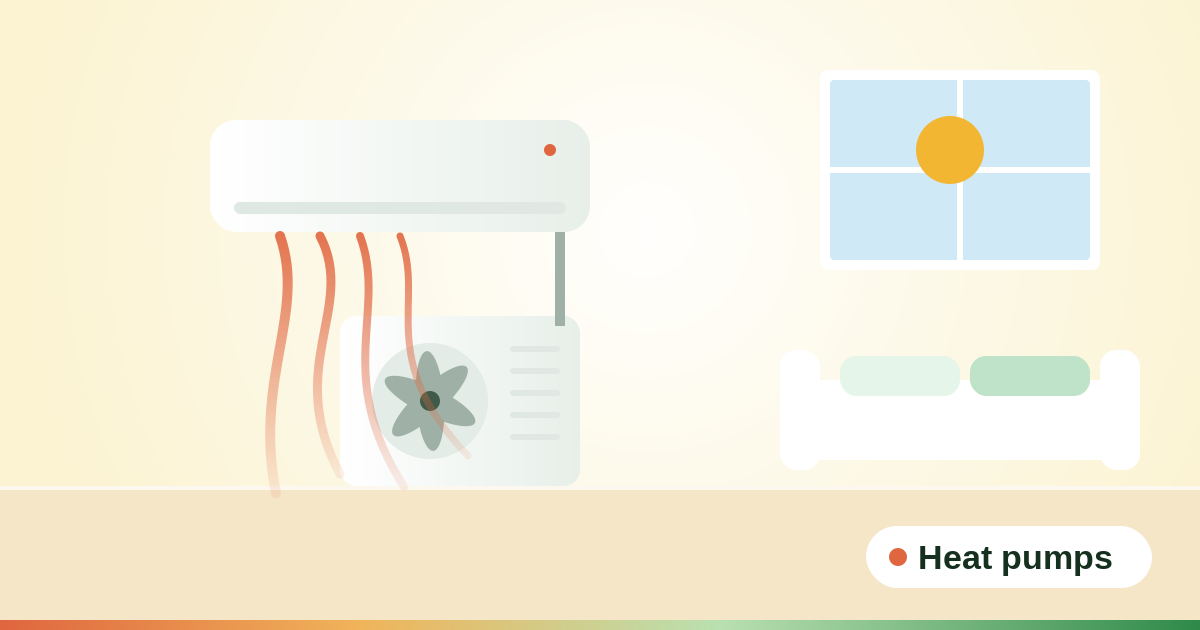
- An air to air heat pump is a split air conditioner run in reverse: the outdoor unit collects heat from the outside air and the indoor unit releases it into the room. The full picture is in our guide to air to air heat pumps.
- It works below freezing because even cold air holds heat that a refrigerant colder than the air can absorb. It becomes less efficient and gives less output as the air gets colder.
- A seasonal efficiency (SCOP) of 5.2 means 5.2 kWh of heat for each kWh of electricity over the test season: 5.1p per kWh of heat at 26.32p.
- It heats room air, not water. MCS says “many air-to-air heat pumps do not provide hot water”.
The short answer
A heat pump does not make heat by burning or by resistance: it moves heat that is already there. A refrigerant circulates between an outdoor and an indoor unit. In winter it absorbs heat outdoors and gives it up indoors, using electricity to drive the compressor that moves it. Because it moves more heat than the electricity it uses, it can deliver several kWh of heat for each kWh it draws.
The refrigerant cycle in heating mode, step by step
Daikin UK lists four steps for the refrigerant cycle: the compressor pumps the refrigerant and turns low-pressure gas into hot high-pressure gas; at the condenser the gas releases its heat and becomes a high-pressure liquid; the expansion valve lowers the pressure so the liquid becomes colder than its surroundings; at the evaporator the cold liquid absorbs heat and evaporates into a low-pressure gas that returns to the compressor. Daikin adds that to understand a heat pump you “simply apply this same four-step process in reverse” (Daikin UK).
In our words, for heating:
- Outdoors, the cold refrigerant passes through the outdoor coil. A fan blows outside air across it. The air is warmer than the refrigerant, so the refrigerant absorbs heat and evaporates.
- The compressor squeezes the gas. That raises its pressure and temperature well above room temperature.
- Indoors, the hot gas passes through the indoor coil. Room air blown across the coil takes the heat, and the gas condenses back to a liquid.
- The expansion valve drops the pressure again, the liquid turns cold, and the loop restarts.
The heat released indoors is the heat taken from outside plus the electrical energy the compressor used. That sum is our working from the conservation of energy, not a sentence from a source. A reversing valve inside the outdoor unit swaps the roles of the two coils, which is how the same machine cools in summer. For the cooling side, see how air conditioning works.
Indoor and outdoor units, and multi split
The outdoor unit holds the compressor and fan (a condensing unit when cooling). The indoor unit holds a coil and a fan and sits on the wall, floor or ceiling. Daikin’s brochure says its systems can be “flexibly designed to work for one room, several rooms, or a whole home” (Daikin UK brochure, October 2025). A multi split connects several indoor units to one outdoor unit. Most units are inverter driven: the compressor speeds up and slows down to match demand rather than switching on and off (inverter explained). The refrigerant is commonly R32 (R32).
Why it works below freezing, and what happens to output
Heat flows from a warmer thing to a colder one. Outdoor air at 0C still holds heat, so a refrigerant cooled below that can absorb it. The colder the air, the bigger the lift the compressor must provide, so efficiency and output both fall.
The energy label sets out how much cold to expect. Regulation 626/2011 uses design temperatures of -10C (average climate), 2C (warmer) and -22C (colder) and tests heating with outdoor air at 7C (Annex VII).
Heating output at 7C against colder air (maker figures)
Makers print a seasonal figure for each climate. For the Bosch Climate 3200i 3.5 kW, the data sheet gives a SCOP of 4.2 in the average climate and 3.4 in the colder one: 19% lower (3.4 against 4.2, our arithmetic). It also gives 2.5 kW of design heating load at -10C, 2.2 kW of heating at -7C, and an operational limit of -10C for the average climate (Worcester Bosch data sheet, checked 14 November 2026). The data sheet’s table is hard to read, so ask the installer to confirm the lowest working temperature from the installation manual. Daikin’s table for the Perfera 2.5 kW gives a nominal 2.80 kW and a SCOP of 5.20, and points to a separate drawing for the operating range (Daikin UK).
For the UK as a whole, DESNZ’s literature review says temperatures below -15C have occurred, mainly in colder regions of Scotland, outside the operating range of the models it reviewed, and that installers must consider backup heat (DESNZ literature review, 2025).
We do not describe defrost cycles: we found no maker document that explains them for these units.
Why it cannot heat your taps and shower
Hot water needs a way to heat a tank or flow of water; an air to air unit only warms room air. MCS says: “It is worth noting that many air-to-air heat pumps do not provide hot water, so you may need an additional system in your home to deliver this” (MCS). DESNZ’s modelling says the systems “did not generally provide hot water”, so hot water came from “a less efficient immersion heated tank” (DESNZ report, 9 July 2026). Nesta’s research makes the same point and adds that provision is “an additional cost” (Nesta). Our guide to air to air heat pumps covers the options.
How efficient is it? COP and SCOP in plain words
- COP is the coefficient of performance at one test point: heat out divided by electricity in. Daikin says “the Coefficient of Performance (COP) of a Daikin heat pump is between 3 and 5” (Daikin UK).
- SCOP is the same ratio over a whole heating season. The label’s average season counts 1,400 hours.
- EER and SEER are the cooling equivalents: EER at one test point, SEER over a season. The label applies 350 hours of cooling a year to split systems.
Our arithmetic at 26.32p per kWh (Great Britain average, price cap for 1 October to 31 December 2026, Ofgem; 0% VAT on electricity in that period): SCOP 5.2 gives 26.32 / 5.2 = 5.1p per kWh of heat. A 90% efficient gas boiler at 7.97p per kWh of gas gives 7.97 / 0.9 = 8.9p. A label figure is a test result: DESNZ modelled air-to-air systems at “around 2.5:1 to around 4:1”, and at 2.5 the same heat costs 10.5p. In Northern Ireland, use the rate on your own bill. See air to air heat pump efficiency and air to air or air to water.
Frequently asked questions
Does an air to air heat pump work in freezing weather?
Yes, with less output and efficiency as it gets colder. Bosch’s 3.5 kW unit has a SCOP of 4.2 in the average climate and 3.4 in the colder one.
Can an air to air heat pump heat water?
Not in most cases. MCS says many do not provide hot water, so you may need another system.
What is the difference between COP and SCOP?
COP is measured at one test condition; SCOP is a seasonal figure covering a whole heating season.
Does it blow cold air in winter?
Nesta’s households reported air movement at higher fan speeds that could be perceived as a draught. Whether the air feels warm depends on the unit and settings; we found no maker document on this.
Is it noisy?
Daikin’s brochure says indoor sound levels start as low as 19dB(A). Nesta reports some users found higher fan speeds intrusive in bedrooms at night.
Sources
- Daikin UK: The refrigerant cycle (checked 15 November 2026)
- Daikin UK: Residential air-to-air heat pumps brochure (UKEPCEN25-1205, October 2025) (checked 15 November 2026)
- Daikin UK: What is a heat pump? (checked 15 November 2026)
- Daikin UK: FTXM-A and RXM-A9 specifications table (checked 15 November 2026)
- Worcester Bosch: Climate 3200i 3.5 kW energy data sheet (2025/04) (checked 14 November 2026)
- legislation.gov.uk: Regulation 626/2011, Annex VII (checked 15 November 2026)
- MCS: Air-to-air heat pumps (checked 25 November 2026)
- DESNZ: Understanding the suitability of reversible air-to-air heat pumps for domestic use in the UK (9 July 2026, PDF) (checked 15 November 2026)
- DESNZ: Air-to-air heat pumps literature review (2025, PDF) (checked 15 November 2026)
- Nesta: Air-to-air heat pumps, a low carbon solution for UK homes (17 February 2026) (checked 15 November 2026)
- Ofgem: Energy price cap unit rates and standing charges (checked 15 November 2026)
Products on this page
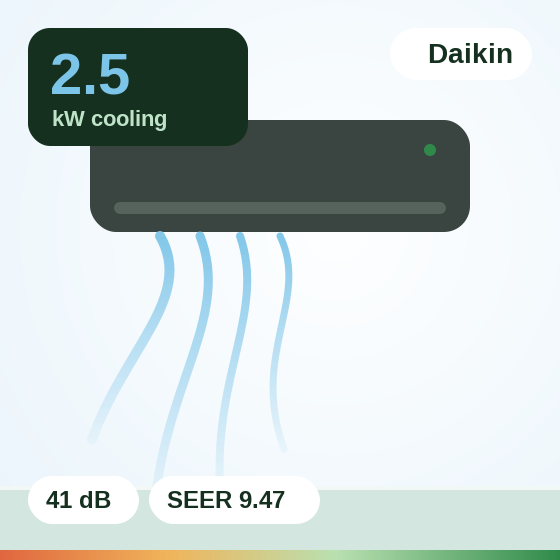
Daikin
Perfera FTXM25A (indoor) with RXM25A5V1B9 (outdoor), 2.5 kW
2.5 kW cooling · 41 dB · SEER 9.47
No current UK price found
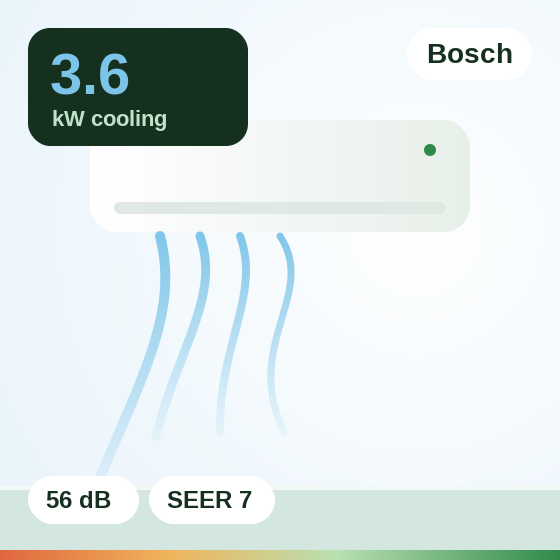
Bosch
Climate 3200i CL3200i-Set 35 WE (7733703596), 3.5 kW
3.6 kW cooling · 56 dB · SEER 7
No current UK price found
Figures from the maker or retailer listing. Cost an hour is our own, at the price cap of 26.32p a kWh.