Key takeaways
- Air to air heat pump efficiency is shown as SCOP: the heat delivered over a heating season divided by the electricity used. On makers’ documents, the units we cover are 5.2 (Daikin Perfera 2.5 kW, Mitsubishi Electric MSZ-LN25VG3) and 4.2 (Bosch Climate 3200i 3.5 kW) in the average climate.
- At 26.32p per kWh that is 5.1p and 6.3p per kWh of heat, against 8.9p from a gas boiler at 0.9 efficiency (October to December 2026 price cap). Break-even is a SCOP of 2.97.
- Efficiency falls as the air outside gets colder. Bosch’s data sheet declares a COP of 5.2 at 7C, 4.2 at 2C and 2.8 at -7C; at that last test point heat costs 9.4p, more than gas.
- A label SCOP is a test figure. Government modelling put air to air systems with electric back-up heaters at around 2.5:1 to around 4:1 for space heating, with higher uncertainty than for other systems: 10.5p to 6.6p per kWh of heat.
Efficiency is the part of an air to air heat pump that decides whether it beats gas on running cost. This page covers heating efficiency and the comparison with gas. Cooling ratings are in our guide to how air conditioning works.
The short answer
The highest label SCOP in our product files is 5.2. The working, once: pence per kWh of heat is the unit rate divided by the efficiency.
- Gas: 7.97p per kWh of gas, divided by 0.9 (the figure DESNZ used for combi condensing boilers) = 8.856p, shown as 8.9p per kWh of heat.
- A SCOP of 5.2: 26.32p / 5.2 = 5.062p, shown as 5.1p.
- A SCOP of 4.2: 26.32p / 4.2 = 6.267p, shown as 6.3p.
These are Great Britain averages at the Ofgem price cap for 1 October to 31 December 2026, by Direct Debit. Electricity carries no VAT (0%) for this period and gas carries 5%. Standing charges are left out. In Northern Ireland, use the unit rate on your own bill. A home’s real figure depends on the house, the weather and the installation, so none of this is a promised saving. Our air to air heat pump running costs page applies the same method to whole years.
COP and SCOP in plain words
The definitions are the energy labelling regulation’s (Regulation (EU) No 626/2011, Annex I).
- COP (coefficient of performance). The declared capacity for heating divided by the rated power input for heating, at standard rating conditions. It is one test point. Mitsubishi Electric’s sheet gives the MSZ-LN25VG3 3.2 kW of nominal heating on 0.600 kW of input, and prints its nominal COP as 5.33.
- SCOP (seasonal coefficient of performance). The overall COP, “representative for the whole designated heating season”, calculated as the reference annual heating demand divided by the annual electricity consumption for heating.
A COP of 5 means 5 kWh of heat for each 1 kWh of electricity. Do not read a COP or SCOP as a percentage saving: none of the documents we opened gives one.
Average, warmer and colder climates on the label
The regulation sets three heating seasons, with design outdoor temperatures of -10C (average), 2C (warmer) and -22C (colder), and counts 1,400 heating hours a year for the average and warmer seasons and 2,100 for the colder (Annex VII, Tables 3 and 4). A label can show one or more.
Daikin’s table for the Perfera 2.5 kW gives the “average” climate figure; Bosch’s data sheet for the Climate 3200i 3.5 kW gives an average-climate SCOP of 4.2 and a colder-climate SCOP of 3.4. Mitsubishi Electric’s sheet lists SCOP and SEER together as 5.2 / 10.5 without naming the climate beside it. We use the average-climate figure whenever a document gives one, and say so. At the colder-climate 3.4, Bosch’s heat costs 26.32p / 3.4 = 7.7p per kWh, against 6.3p at 4.2.
What the best units achieve (maker figures)
| Unit | SCOP | Heating class | Label heating use a year | Heat per kWh |
|---|---|---|---|---|
| Daikin Perfera 2.5 kW | 5.2 (average climate) | A+++ | 647 kWh at a 2.40 kW design load | 5.1p |
| Mitsubishi Electric MSZ-LN25VG3 | 5.2 | A+++ | Not stated on the maker’s sheet | 5.1p |
| Bosch Climate 3200i 3.5 kW | 4.2 (average), 3.4 (colder) | A+ | 833 kWh at a 2.5 kW design load | 6.3p (7.7p colder) |
Sources are in the list below; we have not tested any unit. Daikin’s general FAQ says “Typically, the Coefficient of Performance (COP) of a Daikin heat pump is between 3 and 5”; it is not tied to an air to air model, so we do not use it as a unit figure. For the Perfera, 2.4 kW over 1,400 hours is 3,360 kWh of heat, and 647 kWh of electricity at 26.32p is £170.29. The same heat from gas at 0.9 efficiency needs 3,733 kWh of gas: £297.55 at 7.97p. See Daikin heat pumps, Mitsubishi and Bosch.
Efficiency in cold weather
Bosch’s data sheet declares a COP at several outdoor temperatures, with 20C indoors:
| Outdoor temperature | Declared COP | Heat per kWh at 26.32p |
|---|---|---|
| 12C | 6.6 | 4.0p |
| 7C | 5.2 | 5.1p |
| 2C | 4.2 | 6.3p |
| -7C | 2.8 | 9.4p |
These are single test points, not a season, but they show the direction: at the -7C point the heat costs more than the 8.9p from gas. The sheet gives -10C as its “operational limit temperature heating”, where it declares 2.0 kW and a COP of 2.7. That is a rating-standard value, not a promise of the lowest temperature the unit works at; the installation manual is the place for that. Daikin’s Perfera table does not state an operating range: it says “See separate drawing for operation range”.
What lowers efficiency in cold weather is not set out in the documents we read beyond the figures above. Nesta’s study of 16 households says “During cold weather, outdoor units may enter a defrost cycle”. In DESNZ’s modelling, one home, a 1919-1944 four-bed detached house, was “the only archetype where the RAAHP system was not always able to heat the living room to within the target temperature range during the coldest week”.
Real use: what DESNZ modelling found
DESNZ’s report (9 July 2026) simulated 39 scenarios. It found that for air to air systems with supplementary electric heaters, “the ratio of useful space heating provided to energy use varied from around 2.5:1 to around 4:1”, against between 3:1 and 3.5:1 for air to water heat pumps and around 0.9:1 for combi condensing gas boilers. It adds that the uncertainty for the air to air figures is higher “due to the RAAHP models being constructed from a relatively limited dataset”. Nesta’s report says “real-world data on system efficiency is lacking”.
At these ratios, per kWh of heat at 26.32p:
| Ratio | Heat per kWh |
|---|---|
| 2.5 | 10.5p |
| 3 | 8.8p |
| 3.5 | 7.5p |
| 4 | 6.6p |
Gas is 8.9p. So at the low end of the modelled range an air to air heat pump costs more than gas, and at the high end it costs less. The ratio covers space heating only: DESNZ found hot water was mostly “provided by a less efficient immersion heated tank”, which pulls whole-home cost up. DESNZ’s 2025 literature review adds: “The higher unit cost of electricity compared to gas means that heat pumps do not generally deliver significant running cost savings compared with gas boilers, despite their higher efficiency.”
The SCOP you need to beat gas
Break-even is 26.32p / 8.856p = 2.97. Above a seasonal efficiency of about 3 in your home, heat from an air to air heat pump costs less per kWh than from a 90% efficient gas boiler at these prices. Our air to air heat pump guide also uses the 92% label minimum for new gas boilers in England as gas’s best case, which gives a break-even of 3.04. If you keep gas for hot water or cooking, you still pay its standing charge: 29.68p a day, £108.33 a year.
| Seasonal efficiency | Heat per kWh | Against gas at 8.9p |
|---|---|---|
| 2.5 | 10.5p | Costs more |
| 2.97 | 8.9p | Break-even |
| 4.2 | 6.3p | Costs less |
| 5.2 | 5.1p | Costs less |
What affects efficiency in a real home
We found no source that gives installer settings or setpoints that raise efficiency, so we give none. What the sources do say:
- DESNZ: “if the RAAHP can provide hot water, rather than relying on an immersion heater, then the overall system efficiency is significantly improved”.
- DESNZ: electric radiators and immersion heaters “are, at best, 100% efficient”, so the more heat they supply, the lower the whole-home figure.
- The label figure comes from the unit, but the home sets the result: ask for the unit’s declared figures at low outdoor temperatures (as in Bosch’s sheet) rather than the SCOP alone. That is our suggestion, not a source’s advice.
For other efficient cooling-led units see best energy efficient air conditioners, inverter air conditioners and the best air to air heat pumps.
Frequently asked questions
What is a good SCOP for an air to air heat pump?
On the documents we read, 5.2 in the average climate is the highest (Daikin Perfera 2.5 kW, Mitsubishi Electric MSZ-LN25VG3); 4.2 is the Bosch Climate 3200i 3.5 kW. Above about 3 in real use beats a 90% gas boiler at the October to December 2026 price cap.
What is the difference between COP and SCOP?
COP is heating output divided by electricity input at one set of test conditions. SCOP covers a whole heating season, using the regulation’s reference demand and climate.
Are air to air heat pumps efficient in winter?
Less than in mild weather. Bosch’s data sheet declares a COP of 5.2 at 7C and 2.8 at -7C. DESNZ modelled air to air systems at around 2.5:1 to around 4:1 over a year.
Are they more efficient than air to water?
DESNZ modelled air to water heat pumps at between 3:1 and 3.5:1 and air to air at around 2.5:1 to around 4:1, with higher uncertainty for air to air. Which is cheaper to run depends on the home and on hot water. See air to air vs air to water.
What SCOP beats a gas boiler?
About 3: 2.97 against a 90% efficient boiler at 7.97p per kWh of gas and 26.32p per kWh of electricity (Great Britain, October to December 2026).
Sources
- legislation.gov.uk: Regulation (EU) No 626/2011, Annex I (definitions) (checked 15 November 2026)
- legislation.gov.uk: Regulation (EU) No 626/2011, Annex VII (checked 15 November 2026)
- Daikin UK: FTXM-A and RXM-A9 specifications table (checked 15 November 2026)
- Daikin UK: What is a heat pump? (checked 15 November 2026)
- Mitsubishi Electric UK: MSZ-LN R32 product information sheet (PDF, effective February 2026) (checked 25 November 2026)
- Worcester Bosch: Climate 3200i 3.5 kW energy data sheet (PDF) (checked 15 November 2026)
- DESNZ: Understanding the suitability of reversible air-to-air heat pumps for domestic use in the UK (9 July 2026, PDF) (checked 15 November 2026)
- DESNZ: Air-to-air heat pumps literature review (PDF) (checked 15 November 2026)
- Nesta: Air-to-air heat pumps, a low carbon solution for UK homes (17 February 2026) (checked 15 November 2026)
- Ofgem: Energy price cap unit rates and standing charges (rates as recorded in our energy data, checked 13 November 2026; not re-opened on 15 November 2026)
Products on this page
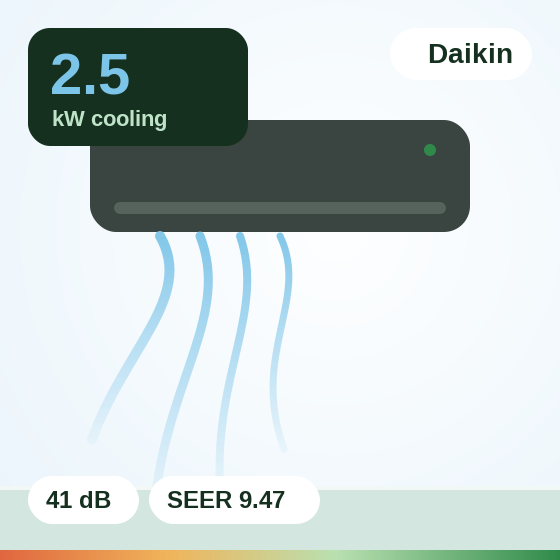
Daikin
Perfera FTXM25A (indoor) with RXM25A5V1B9 (outdoor), 2.5 kW
2.5 kW cooling · 41 dB · SEER 9.47
No current UK price found
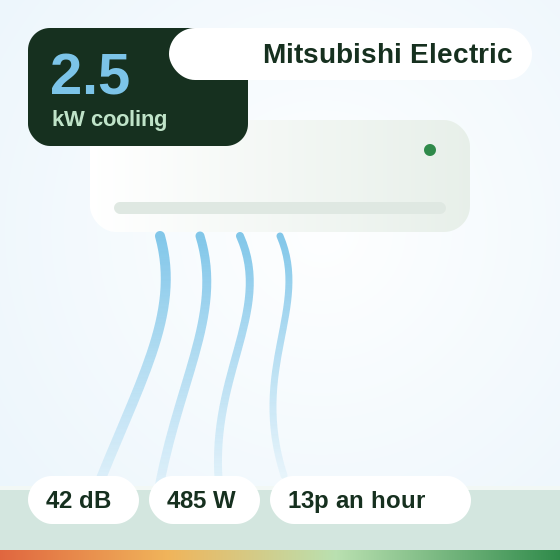
Mitsubishi Electric
MSZ-LN25VG3 (indoor) with MUZ-LN25VG3 (outdoor), 2.5 kW
2.5 kW cooling · 42 dB · 485 W · 13p an hour
No current UK price found
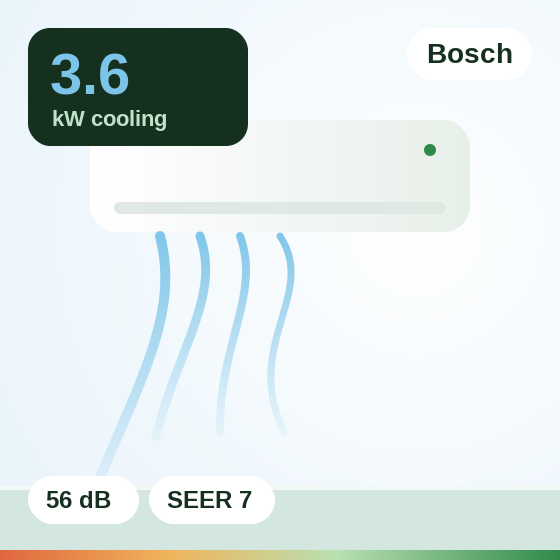
Bosch
Climate 3200i CL3200i-Set 35 WE (7733703596), 3.5 kW
3.6 kW cooling · 56 dB · SEER 7
No current UK price found
Figures from the maker or retailer listing. Cost an hour is our own, at the price cap of 26.32p a kWh.