Key takeaways
- An air to air heat pump installation means a survey, an indoor unit (or several), an outdoor unit, pipework and cable between them, an electrical supply, commissioning and a handover. BOXT says its installs “typically” take 4 to 8 hours; larger systems take longer. Our guide to air to air heat pumps covers the rest.
- The law requires an F-gas qualified technician working for an F-gas certified company to fit a split system. F-gases for installation or servicing may only be sold to and bought by certified businesses (Article 11(4), F gas Regulation as it applies in Great Britain).
- MCS certification is a separate thing: it is what the £2,500 grant needs. When we checked on 25 November 2026, MCS said no installer was yet certified for air-to-air heat pumps, so the grant could not then be claimed.
- A heat pump that heats the whole home needs a room-by-room heat-loss calculation, not a rule of thumb. We do not give instructions for any work on the refrigerant circuit, and electrical work is for a qualified electrician.
This is general information, not legal advice.
Who can fit an air to air heat pump?
F-gas certification (the law)
GOV.UK says you must have qualifications to “install new systems” of air conditioning and heat pump (RACHP) equipment containing F gas, and lists a category 1 certificate “to carry out all activities” and a category 2 certificate to “install, maintain, service and recover refrigerant” on systems under 3 kg of F gas, or under 6 kg if hermetically sealed (GOV.UK, qualifications). The company must be “certified by an approved body” and renew the certification every 3 years (GOV.UK, company certification). A split system that holds an F-gas such as R32 therefore needs an F-gas certified installer; the pipework and refrigerant side of the job is theirs alone. See F-gas regulations and the self-install guide for what a householder can and cannot do.
MCS certification (for the grant) and where it stands
The Boiler Upgrade Scheme has offered £2,500 towards an air-to-air heat pump in England and Wales since 28 April 2026. Ofgem’s guidance says “Installers must be MCS certified” (1.06) (Ofgem guidance V5.2), and Daikin’s installer guide adds that for air-to-air the Technical Supervisor “must hold competence in Refrigeration, Air Conditioning and Heat Pumps (RACHP) at Level 3 (or above)” (Daikin UK). MCS’s consumer page says: “At the moment, no installers are yet certified to install air-to-air heat pumps”, and that once they are, you will be able to use its Find an Installer tool (MCS). When we checked on 25 November 2026, MCS said no installer was yet certified for air-to-air heat pumps, so the grant could not then be claimed. Before you sign a quote that counts on it, ask for the installer’s MCS certificate number for air-to-air heat pumps. See the air to air heat pump grant.
Before installation: heat loss survey and sizing for heating
A survey checks the rooms, walls, windows and where the units, pipes and electrics can go. To heat a home you also need a heat-loss calculation: how much heat each room loses on a cold day. Ofgem’s guidance says the heat pump system must have “sufficient kilowatt thermal capacity to provide 100% of the space heating needs” (3.80). MCS has an online heat load calculator for its installers that “will be able to calculate room-by-room heat load calculations” for sizing; its page does not say whether it covers air-to-air systems (MCS).
As a rough illustration only, Viessmann UK’s radiator rule multiplies a bedroom’s volume in cubic metres by 108 to get BTU per hour (Viessmann UK, 31 May 2022). A bedroom of 4.8 x 4 x 2.4 m is 46.08 m3, and 46.08 x 108 = 4,977 BTU per hour, or 1,459 W (4,977 x 0.2930711). That is a rule for sizing radiators, not air conditioners in heat mode. For comparison, Daikin lists the Perfera 2.5 kW with a nominal heating capacity of 2.80 kW (Daikin UK). A unit with more nominal output than the rule gives is not proof it will heat the room on the coldest day: the installer’s calculation decides.
Installation day, step by step
We describe the job from installers’ and researchers’ own pages and give no instructions for work on the refrigerant circuit.
- Length. BOXT says “It typically takes between 4-8 hours to install home air conditioning, however this can vary depending on the complexity of the job, size of your home, and how many units are being installed” (BOXT). iHeat’s packages page says installation “normally takes 1 to 3 days, depending on the number of units” (checked 14 November 2026).
- Steps. BOXT lists: the engineer assesses locations for pipework and units, fits the internal and external units, routes and seals the pipework, connects and tests everything, sets up the controls and shows you how to use them, takes away rubbish, and registers warranties.
- Disruption. DESNZ’s literature review says there will be “some disruption to occupiers” while indoor units are mounted, pipework is installed, an external unit is mounted and wiring is run (DESNZ literature review, 2025). Nesta’s households generally described installation as “quicker and less disruptive than anticipated” (Nesta).
- Where to site units. Nesta advises that units “should be sited away from bedrooms and neighbouring properties where possible”.
- Electrics. The unit needs an electrical supply. Have it done by a qualified electrician, and ask who certifies it. We confirmed the building regulations rule on new circuits for England only.
- Prices. Published installed prices: Nesta says a single split “could be as low as £2,000-£4,000” and whole-house multi splits “ranged from £5,000 to £15,000” (16 households, not representative). BOXT sells fixed-price installs from £2,299; its page bases that price on a Bosch Climate 3000i 2.6 kW (checked 14 November 2026). Daikin UK says installation “usually ranges between £1,800 and upwards”. Costco’s published prices are for members only and its Daikin Sensira 2.5 kW installed package was £1,849.99 on 14 November 2026; pipe length differs between listings, so check the one you buy. Each includes different things: see air to air heat pump installation cost.
Planning permission and building regulations
In England, an outdoor unit that heats, or heats and cools, can go up without a planning application under permitted development if it meets the size, number and siting limits and is “not solely used for the purpose of cooling” (Class G). The limit for a dwellinghouse is 1.5 cubic metres for the outdoor unit and 0.6 for a block of flats. It must comply with the MCS planning standards: MCS 020 a) calculates whether a noise limit of 37 dB LAeq,5mins at the assessment positions would be met (MCS 020 a)). Wales, Scotland and Northern Ireland have their own rules. See planning permission.
GOV.UK lists “put in a fixed air-conditioning system” among projects that might need building regulations approval in England and says “You do not need to get approval yourself if you use someone registered with a competent person scheme” (GOV.UK). We did not confirm the rules in Wales, Scotland or Northern Ireland. See building regulations. In a leasehold flat, your lease and its plan show which parts of the building are yours and whether you need the freeholder’s consent; a tenant checks the tenancy agreement and asks the landlord.
Hot water arrangements
An air to air heat pump does not heat water. MCS says many “do not provide hot water, so you may need an additional system in your home to deliver this”. Ofgem’s guidance lets a grant-funded system sit alongside non-fossil appliances such as immersion heaters and hot water heat pumps (3.86 and 3.87), provided the combined system meets “the full space heating and hot water demand” (3.90). Agree the plan with your installer before the date: it affects the quote, the electrics and the grant.
Questions to ask an installer
- What is your F-gas company certificate number, and your MCS certificate number for air-to-air heat pumps if the grant matters?
- Can I see the room-by-room heat-loss calculation, and the unit’s output at my area’s design temperature?
- Where will the outdoor unit go, and will you carry out the MCS 020 a) noise calculation?
- What does the price include: electrics, pipe length, making good, a condensate route, removal of old equipment, commissioning and a warranty?
- How will we heat water?
- Who deals with building regulations, and who do I call if something fails?
For general cooling installs, see air conditioning installation, home air conditioning installation cost and domestic air to air heat pumps.
Frequently asked questions
Who can install an air to air heat pump?
An F-gas qualified technician working for an F-gas certified company. For the grant, the installer must also be MCS certified for air-to-air.
Do I need an MCS installer?
Only for the grant. Permitted development in England relies on the MCS 020 a) noise calculation; we found no source saying who must carry it out. When we checked on 25 November 2026, MCS said no installer was yet certified for air-to-air heat pumps, so the grant could not then be claimed.
How long does installation take?
BOXT says home air conditioning installs typically take 4 to 8 hours. iHeat says one to three days, depending on the number of units.
Do I need planning permission?
In England, not if the unit heats or heats and cools and meets the Class G limits. A unit used only for cooling does. Other nations differ.
Can I install it myself?
No, not a split system: fitting one needs F-gas qualifications. F-gases for installation or servicing may only be sold to certified businesses, and we give no instructions for work on the circuit.
What is a heat loss survey?
A calculation of how much heat each room loses on a cold day, used to size the heat pump. MCS describes a room-by-room calculation for its installers.
Sources
- GOV.UK: Qualifications required to work on equipment containing F gas (checked 15 November 2026)
- GOV.UK: Certification for companies working on equipment containing F gas (checked 15 November 2026)
- Ofgem: Boiler Upgrade Scheme, Installer Guidance V5.2 (PDF, 3 November 2026) (checked 25 November 2026)
- Daikin UK: Guide to BUS (checked 15 November 2026)
- MCS: Air-to-air heat pumps (checked 25 November 2026)
- MCS: Heat load calculator (checked 15 November 2026)
- Viessmann UK: How many BTU to heat a room (31 May 2022) (checked 15 November 2026)
- Daikin UK: FTXM-A and RXM-A9 specifications table (checked 15 November 2026)
- BOXT: Air conditioning installation (checked 15 November 2026)
- iHeat: Air conditioning packages (checked 14 November 2026, as recorded in our installation cost data; not re-opened)
- DESNZ: Air-to-air heat pumps literature review (2025, PDF) (checked 15 November 2026)
- Nesta: Air-to-air heat pumps, a low carbon solution for UK homes (17 February 2026) (checked 15 November 2026)
- Daikin UK: Costs of air conditioning installations (checked 15 November 2026)
- Costco: Installed Daikin Sensira single split, domestic (checked 14 November 2026, as recorded in our installation cost data; not re-opened)
- legislation.gov.uk: Class G, General Permitted Development Order 2015 (checked 15 November 2026)
- MCS: MCS 020 a) Issue 1.1 (PDF) (checked 15 November 2026)
- GOV.UK: Building regulations approval, when you need approval (checked 15 November 2026)
- legislation.gov.uk: Regulation (EU) No 517/2014, Article 11 (checked 15 November 2026)
Products on this page
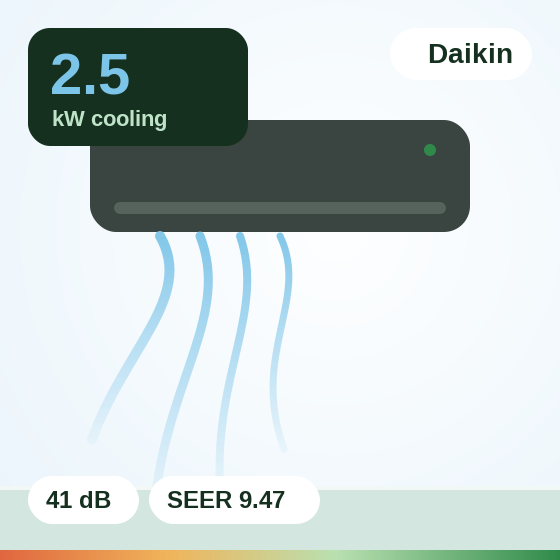
Daikin
Perfera FTXM25A (indoor) with RXM25A5V1B9 (outdoor), 2.5 kW
2.5 kW cooling · 41 dB · SEER 9.47
No current UK price found
Figures from the maker or retailer listing. Cost an hour is our own, at the price cap of 26.32p a kWh.