Key takeaways
- Portable air conditioner not cooling: the causes the portable makers list are mostly the owner’s to check: mode and settings, a kinked or detached exhaust hose, open doors, windows and curtains, heat sources in the room, a dirty filter, a full water tank and a room that is too big. Our air conditioning repair guide covers the rest of repair and servicing.
- A portable can pause by design: a 3 minute compressor delay after a restart (De’Longhi, Pro Breeze and Meaco all describe it) and a defrost pause at low room temperatures.
- Size matters. A 7,000 BTU unit covers 20.5 m2 by our sizing rule, but Pro Breeze states 16 m2 for its PB-AC04: use the lower figure.
- A fault message, a tripped safety device or anything to do with the refrigerant goes to the maker’s service centre. De’Longhi says refrigerant work is for its appointed service centre only.
- Both Meaco and Pro Breeze warn against leaving a portable running unattended.
A portable air conditioner that blows warm air often has a hose, seal, tank, filter or sizing problem. This page uses the manuals of De’Longhi (PAC AP series), Pro Breeze (PB-AC04 and PB-AC08) and Meaco (Cirro+ 14,000 to 16,000 BTU); it is not about split systems, which are on air conditioner not cooling. The wider guide to faults and who may do what is air conditioning repair and servicing.
Stop and switch off. Pro Breeze’s PB-AC08 manual says: “Please contact a professional serviceman without delay in the following situation. Note: when abnormal situations occur, turn off the machine and pull out the plug”. Its PB-AC04 manual says to turn the appliance off and unplug it before handling, cleaning or servicing, and that if the supply cord is damaged it “must be replaced by the manufacturer, its service agent or a similarly qualified person”. De’Longhi says to call its authorised service centre if “the internal safety device has tripped”. Meaco’s table says “Please contact Meaco” for its E0, E1 and E2 codes, as its layout reads. These are named makers’ lists: use your own unit’s manual.
Quick checks
- Plugged in and on. De’Longhi lists “not plugged into the outlet” and “no current”. Pro Breeze’s PB-AC08 table says to reset the circuit breaker on the unit’s cord if there is no display.
- Mode. Meaco’s table says that if the unit is in Super-Quiet or Dry mode you should “change mode if required”. Make sure the unit is in Cool, set below the room temperature.
- Wait 3 minutes. De’Longhi: the unit “does not operate for about three minutes after restarting it”, which “is part of normal operation”. Pro Breeze: after a power loss “the compressor will delay for 3 minutes”. Meaco: “The compressor does not turn on for the first 3 minutes, wait 3 minutes.”
- Remote. Meaco says to replace the batteries and stand closer so the remote is within range.
The exhaust hose and window seal
De’Longhi’s PAC AP manual gives these causes: the unit “works for a short time only” when there are “bends or kinks in the air exhaust hose” (it says to keep the hose “as short and free of curves as possible”), or “something is preventing the air from being discharged”. It also lists “the air exhaust hose is detached from the appliance housing at the back” as a cause of a unit that works but does not cool. Meaco says to avoid “any bends or kinks in the hose” and gives the duct length as 1.8 m. For hoses, seals and window kits, see how to vent a portable air conditioner, portable air conditioner hoses and air conditioner window seals; we do not repeat them here.
Doors, windows, curtains and heat sources
De’Longhi: “windows, doors and/or curtains open” and “heat sources in the room (oven, hairdryer, etc.)” are causes of a unit that works but does not cool; the answer is to close doors, windows and curtains and remove the heat sources. Pro Breeze’s PB-AC08 table lists a unit that “starts frequently” when “Doors and windows are open” or there are “many heat sources” in the room. Meaco says to block the sun’s heat gain with blinds or curtains.
The filter and the water tank
- Filter. De’Longhi lists “filter clogged” as a cause of a unit that does not cool, and says to clean it weekly if used constantly. Pro Breeze says clean it every two weeks and that a blocked filter “can damage the appliance”. Steps are on how to clean air conditioner filters.
- Full tank. De’Longhi’s “HL” message means the internal tray is full: empty it. Meaco’s “Ft (Full Tank)” appears when the tank needs draining. Pro Breeze’s PB-AC04 manual says the unit beeps 20 times, pauses and shows a warning; the PB-AC04 manual’s English text prints “Ft”, while its German, French, Italian and Spanish sections print “E4”. Pro Breeze’s PB-AC08 manual shows “FL” and the “Full Water Tank” symbol and says to turn off, unplug and drain the tank. Check the code against your own manual.
- Defrost pause. At low room temperatures frost can build up. Pro Breeze’s PB-AC04: the power light blinks and the unit switches off for 5 to 10 minutes, then resumes. Meaco says the compressor stops for ten minutes or until the coil reaches 7°C, “This is not a fault”.
Meaco’s troubleshooting table groups “cooling is not effective” with other symptoms, so we cannot match each action to one symptom. Its suggestions include cleaning the filter, keeping 50 cm of space around the unit with the air inlet unblocked, standing it on a level surface, letting it run longer, using it in a smaller room and blocking the sun.
Is the unit big enough for the room?
Our figure: the room-size check
Our sizing rule (Daikin UK’s guide, set out on what size air conditioner do I need?) is 100 W of cooling per square metre of floor at a 2.4 m ceiling, or 41.667 W per cubic metre, plus 15% for a sun-facing room. A 7,000 BTU unit is 7,000 / 341.2141 = 20.5 m2 by that rule. Pro Breeze states 16 m2 for its 7,000 BTU PB-AC04 (the manual gives an applicable area of 8 to 16 m2). That is 4.5 m2, or 22%, less than our table, so use the lower figure.
Example: a 4 x 4 m sun-facing room at 2.4 m is 38.4 m3. 38.4 x 41.667 = 1,600 W; x 1.15 = 1,840 W; x 3.412141 = 6,278 BTU. On paper 7,000 BTU is enough, but the floor is 16 m2, right at Pro Breeze’s limit. If the maker’s figure does not cover your room, go up a size. Use the BTU calculator or read about the 7,000 BTU air conditioner.
A portable’s rated BTU is measured with 35°C dry bulb air on both sides (Regulation 626/2011, Annex VII, Table 2), and for single duct units the condenser “is not supplied with outdoor air, but indoor air”. A single-hose unit blows air out of the room and draws warm air in to replace it, which the rating does not count. No UK document gives a derating factor, so we apply none; expect a single-hose portable to cool less than its rated BTU suggests.
When it needs the service centre
- A message such as PF (probe failure), F1 or F2 on a De’Longhi PAC AP: “consult the nearest authorised service centre”. For a steady “anomaly in the appliance performance” message on some models, De’Longhi says to consult the service centre, and that the alarm is reset by unplugging and re-plugging the unit.
- A tripped safety device on a De’Longhi.
- Refrigerant work. De’Longhi: “Transport, filling, cleaning, recovery and disposal of refrigerant should be performed by a technical service centre appointed by the manufacturer only.” Pro Breeze says people who work on its R290 circuit “must have the appropriate certification”. Check your guarantee before anyone opens the unit; Pro Breeze says repairing electrical or mechanical parts yourself “will void your warranty”. This is general information, not legal advice.
- A unit that has been on its side: De’Longhi says to wait 6 hours (24 recommended) before switching on, “oil needs to return to the compressor”. Meaco says to stand it upright for eight hours before first use and leave it 24 hours before turning it on.
Never leave a portable running unattended unless your manual says it is fine. Meaco: “Do not leave the air conditioner running unattended.” Pro Breeze: “Never leave the appliance unattended while in use.”
When a portable is the wrong tool
If the room is large, hot and sunny, a portable may be the wrong tool. See dual hose portable air conditioners and portable air conditioner window kits.
Frequently asked questions
Why is my portable air conditioner blowing warm air?
The makers list a detached or kinked exhaust hose, open doors, windows or curtains, heat sources in the room, a clogged filter, a full tank and a unit too small for the room. Check them in that order.
Does the hose need to be out of a window for a portable air conditioner to work?
For cooling, the exhaust hose must carry hot air out. De’Longhi lists a detached hose as a cause of no cooling, and Meaco says to attach the duct to the window kit.
Why does my portable air conditioner stop and start?
It may be the 3 minute compressor delay, a defrost pause (Pro Breeze: 5 to 10 minutes) or a full tank. De’Longhi says the delay “is part of normal operation”. A kinked exhaust hose also makes a unit work for a short time only.
How do I know if my portable air conditioner is the right size?
Floor area times height times 41.667 gives the watts needed; add 15% if sun-facing. Compare it with the maker’s room size and use the lower of the two.
Why does my portable air conditioner say the tank is full?
Because the tank or tray is full: De’Longhi’s PAC AP manual gives “HL”, Meaco’s Cirro+ manual “Ft”, Pro Breeze’s PB-AC04 manual “Ft” in its English text and “E4” in its other-language sections, and Pro Breeze’s PB-AC08 manual “FL”. Check the code against your own manual, then switch off, unplug and drain it as the manual says.
Does a portable air conditioner need regassing?
Not by the owner. De’Longhi says refrigerant work is for its appointed service centre only. A unit that has stopped cooling for good is a warranty or service question.
How long does a portable air conditioner take to cool a room?
No maker we read gives a time. Meaco says to let the unit run for longer and that it works best in a well-sealed room.
Sources
- De’Longhi: PAC AP series instructions for use 5715117836 (PDF) (checked 25 November 2026)
- Pro Breeze: PB-AC04 7000 BTU portable air conditioner instruction manual (PDF) (checked 25 November 2026; WebFetch could not read this 17 MB file, so we made one plain download of it from Pro Breeze’s file host and read it with pdftotext)
- Pro Breeze: PB-AC08 5000 BTU portable air conditioner instruction manual (PDF) (checked 25 November 2026)
- Meaco: Cirro+ 14,000 to 16,000 BTU portable air conditioner instruction manual (PDF) (checked 25 November 2026)
- legislation.gov.uk: Commission Delegated Regulation (EU) No 626/2011, Annex VII, as it applies in GB (checked 25 November 2026)
- Daikin UK: how to size an air conditioner (checked 25 November 2026)
Products on this page
Pro Breeze
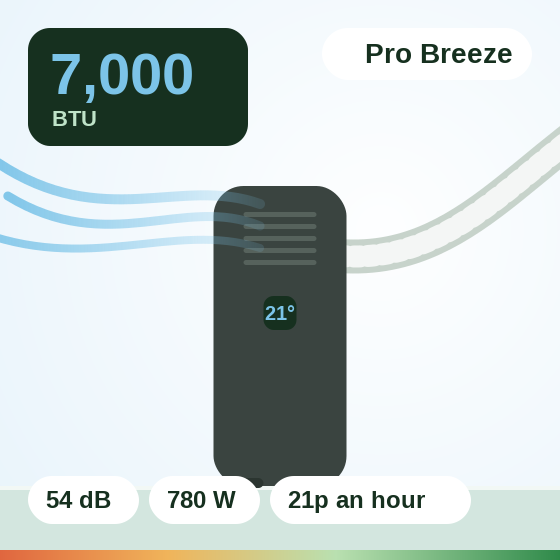
7000 BTU 3-in-1 Portable Air Conditioner with Dehumidification Function (PB-AC-04)
7,000 BTU · 54 dB · 780 W · 21p an hour
£279.99 at Pro Breeze (maker shop), checked 13 Nov 2026
See it at Pro Breeze (maker shop)
De'Longhi
Pinguino GentleJet PAC AP98
£799.99 at De'Longhi UK (maker shop), checked 14 Nov 2026
See it at De'Longhi UK (maker shop)
Figures from the maker or retailer listing. Cost an hour is our own, at the price cap of 26.32p a kWh.