Key takeaways
- Air conditioner not cooling: work through the makers’ own checks in order: power, remote and settings, then filters, blocked inlets and outlets, open doors and windows, Econo mode and furniture under the unit. These are the owner’s checks in Daikin’s and Mitsubishi Electric’s manuals. Our air conditioning repair guide covers the rest of repair and servicing.
- A clean filter will not fix a unit that is too small for the room. A 2.5 kW split covers 25.0 m2 by our sizing rule, or 21.7 m2 in a sun-facing room.
- Mitsubishi says “When the air conditioner does not cool or heat, there is a possibility of refrigerant leakage.” Refrigerant work is for an F-gas engineer in Great Britain, so a top-up is not an owner’s fix.
- We found no published price for a call-out, fault repair or compressor replacement: ask for a written quote.
- For a portable unit, use portable air conditioner not cooling, which covers its hose, window seal and water tank.
An air conditioner that runs but leaves the room warm is a common fault, and most of the causes the makers list are simple. This page covers split systems. For other faults and for who may do what, see air conditioning repair and servicing.
Stop and switch off. Daikin’s operation manual for its FTXF-F room units (the manual names the 60 and 71 sizes) says: “Stop operation and shut OFF the power if anything unusual occurs (burning smells etc.).” It says to turn off the main power if a fuse or breaker “frequently actuates”, to stop the unit if water leaks from it, and, if the operation lamp flashes, to “Notify your installer and report the error code.” Mitsubishi Electric’s MSZ-LN operating instructions say to stop using the unit and consult your dealer “When water leaks or drips from the indoor unit”, “When the operation indicator lamp blinks”, “When the breaker trips frequently”, “When an abnormal sound is heard” and “When any refrigerant leakage is found.” These are two makers’ lists for named model families: use your own unit’s manual.
Quick checks
These come from Daikin’s E-series user reference guide (FTXF20 to 42E5V1B) and Mitsubishi’s MSZ-LN operating instructions (New Zealand edition).
- Power. Daikin says to check there is no power failure, no blown fuse or tripped breaker, and that the remote’s batteries are fine.
- Settings. Mitsubishi asks: is the temperature setting appropriate, and is the fan set high (“High or Super High”)? Daikin says to check the airflow rate, the temperature and the airflow direction.
- Mode. Check the unit is in Cooling. Mitsubishi also asks whether NIGHT MODE is set.
- Wait. After a restart a unit may pause. Mitsubishi says the unit cannot be operated for about 3 minutes when restarted; Daikin says it may resume by itself after about 3 minutes after protecting itself from a voltage fluctuation. Mitsubishi adds that it “may take a certain time to reach the setting temperature or may not reach that depending on the size of the room, the ambient temperature, and the like.”
Airflow checks
- Filters. Daikin: “Check if the air filters are clogged. Clean the air filters.” Steps are on how to clean air conditioner filters. Daikin says dirty filters cause “poor heating/cooling”.
- Blocked inlet or outlet. Check the air inlet or outlet of the indoor and outdoor units “is NOT blocked by obstacles”.
- Furniture. Daikin: “Check if there is any furniture directly under or next to the indoor unit. Move the furniture.”
- Doors and windows. Close them. Mitsubishi lists a window or door open as a cause.
- Econo. Daikin asks whether the unit “operates in Econo operation”, which limits power.
- Other cooling load. Mitsubishi: “When a ventilation fan or a gas cooker is used in a room, the cooling load increases, resulting in an insufficient cooling effect.”
- Dirty indoor fan or heat exchanger. Mitsubishi lists it as a check, but the same manual says “The user should never attempt to wash the inside of the indoor unit.” If it is dirty, ask your dealer.
Is the room too big or too sunny for the unit?
No amount of cleaning helps a unit that is too small. Mitsubishi says: “When the outside temperature is high, the cooling effect may not be sufficient.” Daikin’s FTXF-F manual gives a cooling operation range up to 48°C outdoors, and says “The system’s cooling or heating effect decreases when the outside temperature is too high or too low.”
Our figure: how big a room one unit can cool
Our sizing rule, from Daikin UK’s size guide (“typical UK homes require around 0.1 kW per square metre” at a 2.4 m ceiling), is 100 W of cooling per square metre of floor at 2.4 m, or 41.667 W per cubic metre. Daikin UK says large south- or west-facing windows often need a 10 to 20% increase in capacity; we use 15%.
- A Daikin Sensira 2.5 kW delivers 2,500 W, so 2,500 / 100 = 25.0 m2 at 2.4 m.
- For a sun-facing room, 25.0 / 1.15 = 21.7 m2 (rounded down).
- Check your own room: length x width x height x 41.667 gives the watts needed; add 15% if it is sun-facing. A 5 x 4 m room at 2.4 m is 48 m3 x 41.667 = 2,000 W, or 2,300 W if sun-facing. A 6 x 5 m room is 72 m3, or 3,000 W, more than the Sensira’s 2.8 kW maximum output.
Use the BTU calculator or read what size air conditioner do I need?.
When it may be a fault
Switch off and call your installer if the lamp flashes (Daikin: report the error code), the breaker trips, water leaks, you hear an abnormal sound (Mitsubishi) or anything unusual such as a burning smell occurs (Daikin). Daikin’s E-series guide says its error codes include “refrigerant shortage”, and Mitsubishi says that when the air conditioner does not cool or heat, “there is a possibility of refrigerant leakage”. Daikin says: “The system MUST be repaired by a qualified service person.” In Great Britain, work on the refrigerant circuit needs an F-gas qualified technician from a certified company, and refrigerant for servicing may be sold only to certified businesses (Article 11(4) of the GB F-gas Regulation). Northern Ireland follows the EU rules. A low charge means a leak, not a top-up job: see does home air conditioning need regassing?. This is general information, not legal advice.
What you can safely do, and what needs an engineer
| What you can do | What needs an engineer |
|---|---|
| Check the power, breaker, remote batteries and settings | Anything on the refrigerant circuit: leak search, repair, recovery, recharging |
| Clean the washable filters; clear blocked inlets and outlets | Cleaning inside the unit: Daikin says you may “NEVER clean inside parts of the unit by yourself” |
| Close doors and windows; move furniture; switch off Econo | Opening the casing, electrical checks, replacing parts |
| Switch off and report a flashing lamp or error code | Reading and resetting error codes beyond reporting them |
What an engineer will check
iHeat, an installer, lists what a professional service covers: filters and indoor components, coils and airflow, condensate drainage, outdoor equipment, controls and operation, the refrigerant circuit and a service record. We found no published price for a call-out, a fault repair or a compressor replacement; ask for a written quote saying what is included, such as refrigerant recovery and recharging, parts and labour, and whether VAT is.
Repair or replace?
For the cost of replacing a unit, and when it makes sense, see when to replace an air conditioning unit and compressor replacement cost.
Frequently asked questions
Why is my air conditioner running but not cooling?
Check the settings, the filters, any blocked inlet or outlet, open doors and windows, and Econo mode, as Daikin lists. If the room is larger than the unit’s size covers, none of these will fix it. If the checks fail, ask your installer.
Why is my air conditioner not blowing cold air?
The makers list the same checks: temperature and fan settings, clean filters, unblocked inlets and outlets. Mitsubishi also says high outside temperatures reduce cooling, and that a ventilation fan or gas cooker adds to the load.
Does my air conditioner need regassing if it is not cooling?
Not necessarily. Mitsubishi says poor cooling means there is “a possibility of refrigerant leakage”, and iHeat says a low charge needs investigating “rather than simply adding more refrigerant repeatedly.” Only an F-gas engineer may do it.
How long does an air conditioner take to cool a room?
No maker we read gives a time. Mitsubishi says it depends on the room size and the ambient temperature, and that the room may not reach the set temperature.
Can a dirty filter stop my air conditioner cooling?
It can make cooling poor. Daikin says dirty filters cause “poor heating/cooling”, and Mitsubishi lists unclean filters as a check.
What temperature is too hot for an air conditioner to work?
Daikin’s FTXF-F manual gives a cooling range up to 48°C outdoors, and says a safety device might stop the unit outside it. We did not quote a Mitsubishi range because its table did not read clearly.
Should I turn it off if it is not cooling?
If the lamp flashes, the breaker trips, water leaks or you smell burning, yes: switch off and call. Otherwise, Daikin says to check the items above and, if you cannot fix it, “contact your installer and state the symptoms, the complete model name of the unit” and the installation date.
Sources
- Daikin: FTXF60F2V1B and FTXF71F2V1B operation manual 3P511999-9S, 2024.09 (PDF) (checked 25 November 2026)
- Daikin: FTXF20 to 42E5V1B user reference guide 4D526466-14K, 2022.09 (PDF) (checked 25 November 2026)
- Mitsubishi Electric: MSZ-LN25VG2 to MSZ-LN60VG3 operating instructions VG79Y699H01, New Zealand edition (PDF) (checked 25 November 2026)
- Daikin UK: how to size an air conditioner (checked 25 November 2026)
- Daikin UK: specifications table FTXF-F with RXF-F (2.5 kW, 2.8 kW maximum) (checked 25 November 2026)
- iHeat: air conditioning maintenance guide (updated 2 October 2026) (checked 25 November 2026)
- legislation.gov.uk: Regulation (EU) No 517/2014 as it applies in GB, Article 11 (checked 25 November 2026)
Products on this page
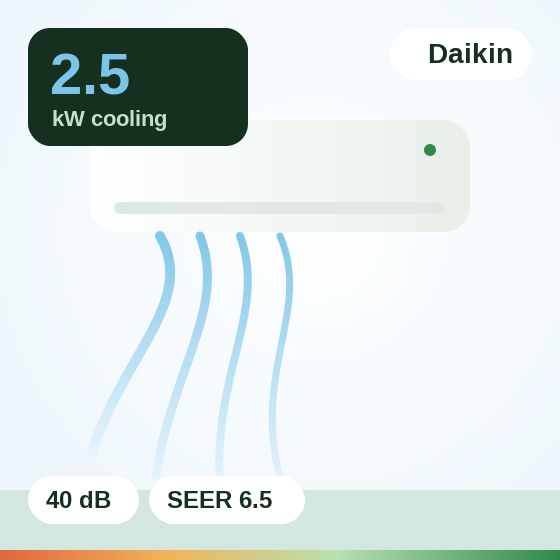
Daikin
Sensira FTXF25F5V1B (indoor) with RXF25F5V1B (outdoor), 2.5 kW
2.5 kW cooling · 40 dB · SEER 6.5
No current UK price found
Figures from the maker or retailer listing. Cost an hour is our own, at the price cap of 26.32p a kWh.