Key takeaways
- A noisy air conditioner is not always faulty: several noises are normal, and the makers list them: water flowing, a blowing sound when refrigerant direction changes, ticking, whistling during defrost, clicking from valves, and a cracking panel. They are in Daikin’s and Mitsubishi Electric’s manuals, named below. Our air conditioning repair guide covers the rest of repair and servicing.
- An abnormal sound is a stop case. Mitsubishi says to stop using the unit and consult your dealer “When an abnormal sound is heard”. The manuals do not describe grinding, banging or loud rattles, so we do not name causes for them.
- Owners can check filters, obstructions near the unit and anything loose, and choose a quiet or night setting if the unit has one. Do not push anything into a grille.
- Maker figures for indoor units run from about 19 to 42 dB(A) across fan speeds; outdoor units in our files 46 to 48 dB(A). Real homes differ from test conditions.
- There is no fixed decibel limit for a home unit once it is installed; neighbour noise is a matter of statutory nuisance.
Is that noise normal? This page sorts the sounds the makers describe from the ones that need an engineer. For other faults, see air conditioning repair and servicing.
Stop and switch off. Daikin’s operation manual for its FTXF-F room units (the manual names the 60 and 71 sizes) says: “Stop operation and shut OFF the power if anything unusual occurs (burning smells etc.).” It says to turn off the main power if a fuse or breaker “frequently actuates”, to stop the unit if water leaks from it, and, if the operation lamp flashes, to “Notify your installer and report the error code.” Mitsubishi Electric’s MSZ-LN operating instructions say to stop using the unit and consult your dealer “When water leaks or drips from the indoor unit”, “When the operation indicator lamp blinks”, “When the breaker trips frequently”, “When an abnormal sound is heard” and “When any refrigerant leakage is found.” These are two makers’ lists for named model families: use your own unit’s manual.
Which noises are normal?
Daikin’s E-series guide (FTXF20 to 42E5V1B) lists these as “NOT system malfunctions”:
- A sound like water flowing: refrigerant flowing in the unit, or water flowing away during cooling or drying.
- A blowing sound: the direction of the refrigerant flow changes, for example from cooling to heating.
- A ticking sound: the unit “slightly expands or contracts with changes in temperature”.
- A whistling sound: refrigerant flowing during defrost.
- A clicking sound, during operation or idle time: refrigerant control valves or electrical parts operating.
- A clapping sound: an extractor hood or exhaust fan sucking air out of a closed room. Daikin says to open the doors or windows, or turn the device off.
- The outdoor fan keeps turning for another 30 seconds after the unit stops, and in very high outdoor temperatures it may turn while the unit is off, “for system protection”.
Mitsubishi’s MSZ-LN manual (New Zealand edition) lists as normal: a cracking sound (the front panel expanding and contracting), a “burbling” sound (outside air drawn up the drain hose when a range hood or ventilation fan runs), mechanical sounds (fan or compressor switching, or the i-see sensor turning), the sound of water flowing (refrigerant or condensed water) and a hissing sound when refrigerant flow changes. It says the unit cannot restart for about 3 minutes, and that heating can stop for up to about 10 minutes for defrost.
Which noises mean a fault?
Mitsubishi lists “an abnormal sound” among the cases where you should stop using the unit and consult your dealer, and its list of stop cases is in the box above. Neither manual we read describes a grinding, banging or loud rattling sound, so we say only that such a sound is not on the makers’ normal lists, and we do not say what causes it. Do not run the unit while you wait for an engineer.
What you can check
With the unit switched off and the power isolated:
- Clean the filters. Daikin says dirty filters cause poor heating and cooling, and odour; see how to clean air conditioner filters.
- Clear anything blocking the air inlet or outlet of the indoor or outdoor unit (Daikin’s checks).
- Move furniture and loose items away from the unit. Daikin says: “Check if there is any furniture directly under or next to the indoor unit.”
- Look for objects or leaves at the outdoor unit’s inlet and outlet, but do not poke into a grille: Daikin warns “Do NOT insert fingers, rods or other objects into the air inlet or outlet. When the fan is rotating at high speed, it will cause injury.”
- Try a quieter setting. Daikin’s FTXF-F manual says that with the airflow rate set to quiet, “the noise from the unit will be reduced”. Mitsubishi’s NIGHT MODE “limits the noise level of the outdoor unit”; it may not change the outdoor noise during protection operation or in some conditions, and using POWERFUL in NIGHT MODE raises it.
How loud are air conditioners?
Makers state sound pressure in dB(A). Their test conditions are not stated in the tables we read, and a real room, wall or fan speed changes what you hear.
| Unit | Indoor, lowest to highest fan speed | Outdoor (cooling) | Source |
|---|---|---|---|
| Daikin Sensira 2.5 kW (FTXF25F5V1B with RXF25F5V1B) | 20 to 40 dB(A) | 46 dB(A) | Daikin UK tables, 25 November 2026 |
| Daikin Perfera 2.5 kW (FTXM25A with RXM25A) | 19 to 41 dB(A) | 46 dB(A) | Daikin UK tables, 25 November 2026 |
| Mitsubishi Electric MSZ-LN25VG3 with MUZ-LN25VG3 | 19 to 42 dB(A) | 46 dB(A) | Mitsubishi Electric UK product information sheet, 25 November 2026 |
| Toshiba Seiya 1.5 kW | 19 to 37 dB(A) | 48 dB(A) | Toshiba price list, as in our product file, 14 November 2026 |
| Pro Breeze PB-AC04 portable | 54 dBA (one figure) | in the room | Pro Breeze manual, 25 November 2026 |
The Sensira’s range is 20 dB between its quietest and loudest setting. Decibels are not a simple scale, so compare figures only when they are given on the same basis, as sound pressure in dB(A) here.
When the noise bothers a neighbour
GOV.UK says a statutory nuisance must “unreasonably and substantially interfere with the use or enjoyment of a home or other premises” or “injure health or be likely to injure health”. There is no fixed decibel limit for home air conditioning once it is installed. See air conditioning noise regulations in the UK for the rules, and inverter air conditioners for why speed changes the sound.
Portable units
A portable’s compressor and fan are in the room, so the maker’s dB figure is the one to use; see quiet portable air conditioners. Check that it stands level: Pro Breeze’s PB-AC08 manual lists “Loud noise coming from the unit” with the cause “The machine is not put on flat ground”. Empty the tank and clean the filter. De’Longhi’s PAC AP manual says that a unit that has been on its side must wait 6 hours (24 recommended) before switching on: without it the unit “may function for only a short time, and then the compressor will break down from lack of oil.”
Frequently asked questions
Why is my air conditioner making a clicking noise?
Daikin says a clicking sound during operation or idle time is generated when refrigerant control valves or electrical parts operate, and is not a malfunction.
Is it normal for an air conditioner to make a gurgling or water sound?
Yes, according to both makers. Daikin says it is refrigerant flowing or water flowing away during cooling or drying; Mitsubishi says it is refrigerant or condensed water flowing.
Why is my air conditioner making a rattling or banging noise?
The manuals we read do not describe it. Mitsubishi says to stop using the unit and consult your dealer when an abnormal sound is heard.
How loud is a split air conditioner?
Makers give indoor sound pressure of about 19 to 42 dB(A) across fan speeds for the units in the table, and 46 to 48 dB(A) outdoors, with test conditions not stated.
Why is my outdoor air conditioner unit so loud?
The outdoor fan runs for 30 seconds after stopping (Daikin), and Mitsubishi says that in cooling, when the outside temperature is low, the outdoor fan operates intermittently. Outdoor noise that is abnormal, or blocked airflow, is a case for your installer.
Can neighbours complain about my air conditioner noise?
Yes: noise that unreasonably and substantially interferes with the use of a home can be a statutory nuisance, and councils must investigate complaints.
How can I make my air conditioner quieter?
Use the quiet airflow setting or night mode, if your unit has it, and keep the filters and airflow clear.
Sources
- Daikin: FTXF60F2V1B and FTXF71F2V1B operation manual 3P511999-9S, 2024.09 (PDF) (checked 25 November 2026)
- Daikin: FTXF20 to 42E5V1B user reference guide 4D526466-14K, 2022.09 (PDF) (checked 25 November 2026)
- Mitsubishi Electric: MSZ-LN25VG2 to MSZ-LN60VG3 operating instructions VG79Y699H01, New Zealand edition (PDF) (checked 25 November 2026)
- De’Longhi: PAC AP series instructions for use 5715117836 (PDF) (checked 25 November 2026)
- Pro Breeze: PB-AC04 7000 BTU portable air conditioner instruction manual (PDF) (checked 25 November 2026)
- Pro Breeze: PB-AC08 5000 BTU portable air conditioner instruction manual (PDF) (checked 25 November 2026)
- Daikin UK: specifications table FTXF-F (indoor) and RXF-F (outdoor) (checked 25 November 2026)
- Daikin UK: specifications table FTXM-A (indoor) and RXM-A9 (outdoor) (checked 25 November 2026)
- Mitsubishi Electric UK: MSZ-LN R32 product information sheet, effective February 2026 (PDF) (checked 25 November 2026)
- Toshiba Seiya 19 to 37 dB(A) indoor and 48 dB(A) outdoor: taken from our product file (Toshiba retail price list, effective 1 October 2026), checked 14 November 2026; we could not re-open the address on 25 November 2026 (it returned 404).
- GOV.UK: Statutory nuisances, how councils deal with complaints (published 7 April 2015) (checked 25 November 2026)
Products on this page
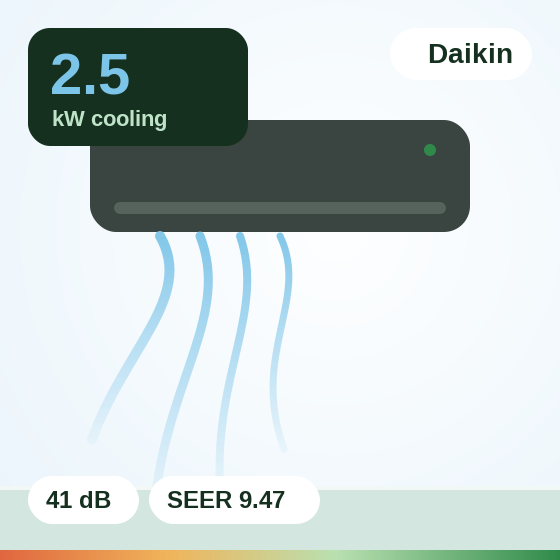
Daikin
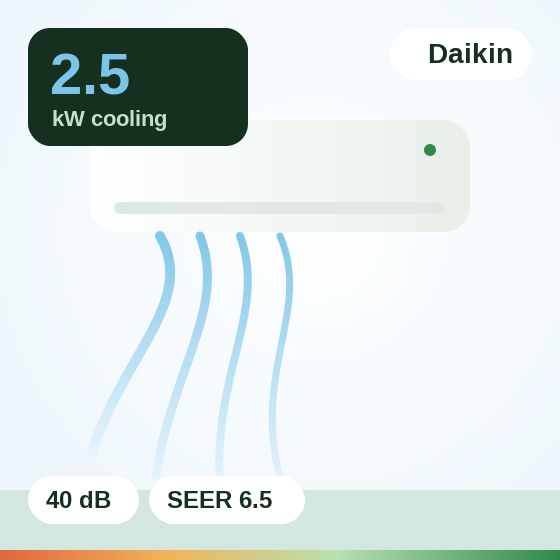
Sensira FTXF25F5V1B (indoor) with RXF25F5V1B (outdoor), 2.5 kW
2.5 kW cooling · 40 dB · SEER 6.5
No current UK price found
Daikin
Perfera FTXM25A (indoor) with RXM25A5V1B9 (outdoor), 2.5 kW
2.5 kW cooling · 41 dB · SEER 9.47
No current UK price found
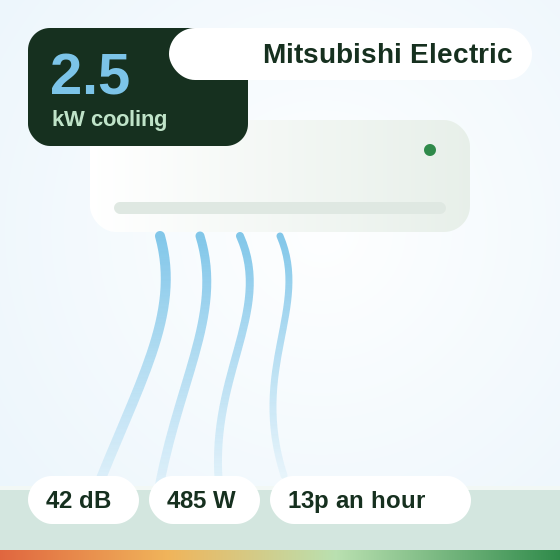
Mitsubishi Electric
MSZ-LN25VG3 (indoor) with MUZ-LN25VG3 (outdoor), 2.5 kW
2.5 kW cooling · 42 dB · 485 W · 13p an hour
No current UK price found
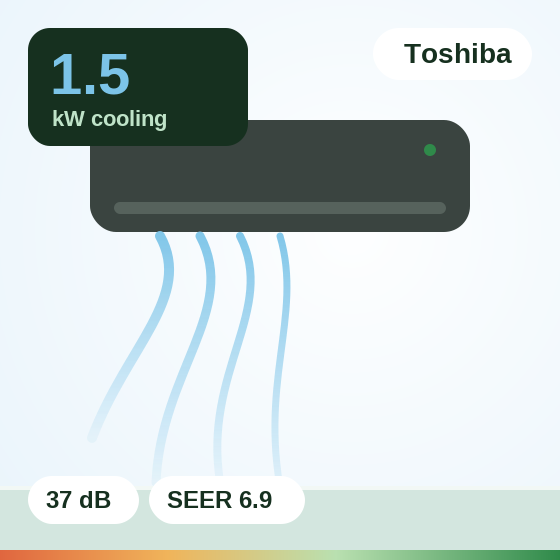
Toshiba
Seiya RAS-B05S4KVG-E (indoor) with RAS-05E2AVG-E (outdoor), 1.5 kW
1.5 kW cooling · 37 dB · SEER 6.9
No current UK price found
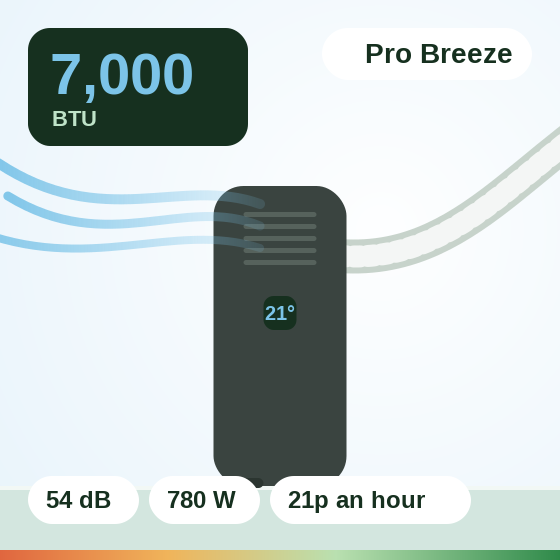
Pro Breeze
7000 BTU 3-in-1 Portable Air Conditioner with Dehumidification Function (PB-AC-04)
7,000 BTU · 54 dB · 780 W · 21p an hour
£279.99 at Pro Breeze (maker shop), checked 13 Nov 2026
See it at Pro Breeze (maker shop)
Figures from the maker or retailer listing. Cost an hour is our own, at the price cap of 26.32p a kWh.