Key takeaways
- The day before a heatwave: check that fans, fridges and freezers work, check how your medicines should be stored, and find the coolest room in the house (UKHSA).
- By day, shut the heat out: keep windows, curtains and blinds shut on the sunny side, turn the heating off, and switch off lights and equipment you are not using.
- In the evening and at night, let the heat out: open windows when the air outside feels cooler than inside, if it is safe to.
- Check on anyone at higher risk and the rooms where they live and sleep. Heatstroke is a medical emergency: call 999.
- A 50 W pedestal fan for 16 hours costs about 21.1p; a 1,005 W portable air conditioner for 8 hours about £2.12.
This is how to keep your house cool in a heatwave: a plan for the day before, the daytime and the night, from the UK Health Security Agency (UKHSA), the NHS and the Met Office. For what counts as a heatwave and who is most at risk, see our UK heatwave guide; for why some homes overheat and the lasting fixes, see how to keep your house cool. Most of the NHS and UKHSA guidance linked here is written for England; in Wales, Scotland and Northern Ireland, use your own nation’s NHS service.
When to get help
Heatstroke is a medical emergency (NHS).
Call 999 if you or someone else have signs of heatstroke, including (NHS):
- “still being unwell after 30 minutes of resting in a cool place, being cooled and drinking fluids”
- “a very high temperature”
- “hot skin that’s not sweating and might look red”
- “a fast heartbeat”
- “fast breathing or shortness of breath”
- “confusion and lack of coordination”
- “a seizure or fit”
- “loss of consciousness”
“Do not drive yourself to A&E.” (NHS)
UKHSA: “If you think someone has heatstroke you should dial 999 and then try to cool them down.”
Call 111 (NHS) if “you or someone else have symptoms of heat exhaustion that you’re struggling to treat or you need advice about”.
For a baby or child under 5, the NHS says call NHS 111 if “you’re worried about any of your child’s symptoms or do not know what to do”, and lists the signs that need 999 on its page Is your baby or toddler seriously ill?
While you wait, the NHS says to move the person to a cool place, take off clothing they do not need, give them plenty of water to drink, and cool their skin by spraying or sponging it with cool water and fanning them.
The day before: prepare
UKHSA says “We often get some warning when a period of hot weather is coming”. Use that time:
- Check your kit. “Check that fridges, freezers, and fans are working properly, for example by checking that your food is remaining cold or frozen” (UKHSA).
- Check your medicines. “Check medicines can be stored according to the instructions on the packaging.” UKHSA adds that “Some medications need to be stored below 25°C or in the fridge”.
- Find the coolest room with a thermometer: that is where people sleep and where anyone at risk spends the hottest hours.
- Know who to check on. UKHSA asks you to “Check in with anyone you think might be at risk and see if they need help.”
For the forecast and any alerts in force, see our heat-health alerts page.
During the day: shut out the heat
- Shut the sunny side. Keep windows, curtains and blinds shut on the sunny side by day; open windows when the air outside feels cooler than inside, usually in the evening and at night, if it is safe to. The NHS says “Close windows, curtains and blinds during the day”. The Met Office says “Counter intuitively, closing doors and windows in the heat of the day can keep it cooler inside.”
- Heating off. “Check that your heating is turned off” (UKHSA).
- Fewer heat sources. “To reduce heat generated in the home, turn off lights and electrical equipment that are not in use and consider cooking at cooler times of the day” (UKHSA).
- Fans where people are. Fans help while the air is below 35C (NHS, UKHSA). Do not aim one directly at your body. A fan cools people, not the room.
Evening and night: let it out
Once the air outside is cooler than the air inside, open up. The NHS says to open windows, curtains and blinds “at night when the temperature outside has gone down”. UKHSA says “Open windows (when it is safe to do so) when the air feels cooler outside, for example at night, and try to get air flowing through the home.” The Met Office adds: “At night, keep your sleeping area well ventilated. Night cooling is important as it allows the body to recuperate.”
Close up again the next morning, once it is hotter outside than in. Our page on windows open or closed in a heatwave sets out the timing.
Room by room
- Bedrooms. Sleep in the coolest room you have. UKHSA says “Move to a cooler part of the house, especially for sleeping if possible.” See how to keep a bedroom cool.
- Top floor and loft rooms. UKHSA lists “flats on the top floor because heat rises” among homes more likely to overheat; if a lower room measures cooler, sleep there.
- Conservatory. See how to keep a conservatory cool.
- Kitchen. Cooking adds heat; UKHSA suggests cooking “at cooler times of the day”.
People at risk in the house
The NHS says “Check the temperature of rooms, especially where people at higher risk live and sleep”. It names older people, especially those aged 65 and over; babies and children aged 5 and under; people who are pregnant or have serious long-term conditions; and people who live alone. There is no official maximum room temperature for adults, so we do not give one. For babies, the NHS says a room “between 16C and 20C” is most comfortable for sleep: see keeping a newborn cool in hot weather. For the full before and during checklist, see heatwave advice.
When the house is too hot to stay in
If every room is too hot, go somewhere cooler for a while. UKHSA says “It may be cooler outside in the shade or in a public building (such as places of worship, local libraries, or supermarkets)”, and to consider a visit “if you are able to safely travel there without putting yourself at more risk from the heat.”
Running costs if you add a fan or air conditioner
A fan cools people; only an air conditioner lowers the room’s air temperature. A portable air conditioner needs its hose vented out of a window: see portable air conditioners and cooling fans.
| Appliance | Rated power | Hours | Cost |
|---|---|---|---|
| Igenix DF1655 16 in pedestal fan | 50 W | 16 hours (a long day and evening) | 21.1p |
| Meaco MeacoCool MC Series Pro 9000 portable air conditioner (9,000 BTU) | 1,005 W | 8 hours | £2.12 |
How we worked it out. Igenix’s own page gives no wattage and listings differ: B&Q lists the DF1655 at 50 W and Dunelm at 40 W. We use the higher 50 W, so the cost is not understated: 0.05 kW x 16 hours = 0.8 kWh, which at 26.32p per kWh is 21.1p. The Meaco MC Series Pro 9000 is rated at 1,005 W: 1.005 kW x 8 hours = 8.04 kWh, or £2.12, about ten times the fan’s cost. The eight hours are a measure of cost, not advice to leave it running: we have not read this unit’s manual, so check it before running the unit overnight or unattended.
The unit rate is Ofgem’s price cap average for electricity in Great Britain, by Direct Debit, 1 October to 31 December 2026, with no VAT (0%) for that period and the standing charge left out. These figures use the Great Britain price cap. In Northern Ireland, use the unit rate on your own bill. Rated power is the maker’s figure at full output, so treat these as upper estimates. The Igenix is listed from £32.99 at Igenix and £32.99 at B&Q , checked 14 November 2026; the Meaco from £399.99 at Meaco , checked 13 November 2026 (out of stock that day).
Frequently asked questions
Should I close all windows in a heatwave?
By day, yes on the sunny side, while it is hotter outside than in. Open them when the air outside feels cooler, usually in the evening and at night, if it is safe to. The NHS says “Close windows, curtains and blinds during the day and open them at night when the temperature outside has gone down.”
Which room is coolest in a house?
It varies, so measure it with a thermometer. UKHSA says top-floor flats overheat “because heat rises”, and large unshaded east, west or south-facing windows add heat, so a shaded, lower room is often cooler.
Should I turn the fridge down in a heatwave?
The official guidance does not give a fridge setting. UKHSA says to “Check that fridges, freezers, and fans are working properly, for example by checking that your food is remaining cold or frozen.” Follow your fridge maker’s instructions for anything more.
Is it worth going to a public building to cool down?
It can be. UKHSA says “It may be cooler outside in the shade or in a public building (such as places of worship, local libraries, or supermarkets)”, and to go only if you can travel there safely without putting yourself at more risk from the heat.
How do I know if my home is too hot for an older relative?
There is no official room temperature limit for adults. The NHS says to check the temperature of rooms “especially where people at higher risk live and sleep”, and to check on people at higher risk. Call 999 for signs of heatstroke.
Sources
- UKHSA: Beat the heat, keep cool at home checklist (updated 21 July 2026, England) (checked 15 November 2026)
- NHS: Heatwave, how to cope in hot weather (reviewed 12 June 2026) (checked 15 November 2026)
- UKHSA: Beat the heat, staying safe in hot weather (updated 21 July 2026, England) (checked 15 November 2026)
- Met Office: Tips for keeping cool in hot weather (checked 15 November 2026)
- Met Office: Hot weather and its impacts (checked 15 November 2026)
- NHS: Heat exhaustion and heatstroke (reviewed 28 May 2026) (checked 15 November 2026)
- NHS: Is your baby or toddler seriously ill? (reviewed 6 August 2026) (checked 15 November 2026)
- NHS: Safety in the sun, babies and children (reviewed 27 September 2024) (checked 15 November 2026)
- Ofgem: Changes to energy price cap between 1 October and 31 December 2026 (checked 14 November 2026)
- B&Q: Igenix DF1655 16 inch pedestal fan, 50 W (checked 14 November 2026)
- Igenix: DF1655 16 inch pedestal fan (checked 14 November 2026)
- Meaco: MeacoCool MC Series Pro 9000 portable air conditioner (checked 13 November 2026)
- Dunelm: Igenix 16 inch pedestal fan listing (40 W) (checked 15 November 2026)
Products on this page
Igenix
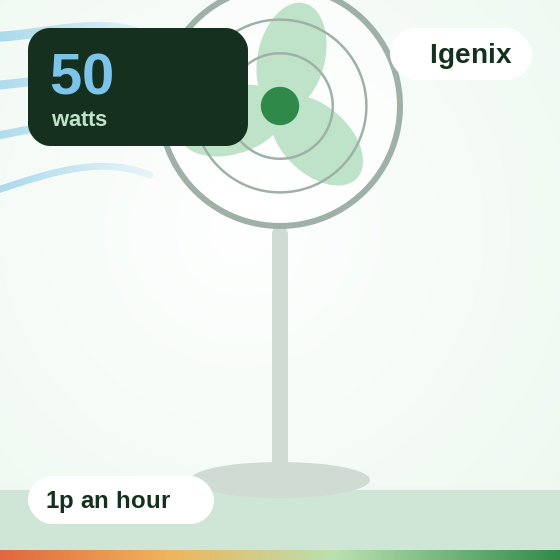
DF1655 16 Inch Pedestal Fan, 3 Speeds, White
50 watts · 1p an hour
£32.99 at Igenix (maker shop), checked 14 Nov 2026
See it at Igenix (maker shop)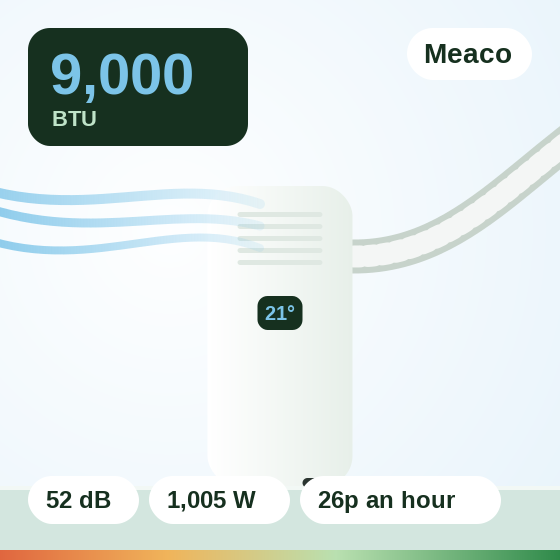
Meaco
MeacoCool MC Series Pro 9000 CH BTU Portable Air Conditioner & Heater (MC9000CHRPRO)
9,000 BTU · 52 dB · 1,005 W · 26p an hour
£399.99 at Meaco (maker shop), checked 13 Nov 2026
See it at Meaco (maker shop)
Figures from the maker or retailer listing. Cost an hour is our own, at the price cap of 26.32p a kWh.