Key takeaways
- No. A dehumidifier does not cool a room. De’Longhi says a working dehumidifier “releases slightly warmer air than the room temperature” and is “not an air conditioner”.
- Desiccant dehumidifiers give out more warmth: Meaco says they “produce warmer air”.
- Drier air can make a muggy room feel less sticky, but the air temperature does not drop.
- To cool yourself, use a fan: fans help while the air is below 35C, and should not be aimed directly at your body (NHS, UKHSA). To cool the room itself, you need an air conditioner.
- An hour of a 151 W dehumidifier costs about 4.0p, and none of that electricity cools the room.
Does a dehumidifier cool a room? No. It takes water out of the air, and the air it blows back out is slightly warmer than the air it took in. For everything else about hot weather, see our UK heatwave guide. This page answers that one question, shows what an hour of running one costs beside a fan and an air conditioner, and points you to what does cool a room. For when a dehumidifier is still worth running in muggy weather, and compressor against desiccant models in summer, see does a dehumidifier help with heat?
Does a dehumidifier cool a room?
The makers say no, in plain words. De’Longhi’s UK help page answers the question “My dehumidifier emits hot air. Is that normal?” like this:
- “Yes, it’s normal that, when the dehumidifier is working, it releases slightly warmer air than the room temperature.”
- “The dehumidifier is not an air conditioner and does not produce cold air.” (De’Longhi’s page runs the last two words together.)
So the honest answer is the opposite of cooling: a dehumidifier running in a closed room adds a little warmth to it.
Why a dehumidifier makes the air slightly warmer
There are two kinds of dehumidifier, and the makers describe both as giving out warmth.
- Compressor dehumidifiers are the common type. De’Longhi’s answer above covers them: the air comes out “slightly warmer” than the room. No maker we read gives a figure for how much warmer, so we do not give one.
- Desiccant dehumidifiers use more energy, and Meaco says “they release this as warmth into the room”. Its help centre says desiccant models “produce warmer air”, which it presents as useful when drying clothes indoors. In a hot room, that warmth is the last thing you want.
The electricity a dehumidifier uses ends up in the room as heat. That is why the hour’s cost below is money spent on drier air, not on cooling.
Can a dehumidifier make a hot room feel better?
It can make a muggy room feel less sticky. Meaco lists summer use “when muggy, humid air makes rooms feel sticky” among the reasons to run one, and recommends “setting a target humidity level of 55% RH”. Meaco also says “Indoor humidity is most comfortable and healthy between about 40% and 60%” (that range is Meaco’s, not an NHS or UKHSA figure).
Two things follow:
- If the room is already dry, a dehumidifier has little to do, and you get the warmth without the benefit.
- Even in humid air, the thermometer will not drop. Feeling less clammy is not the same as being cooler, and it does nothing for anyone at risk of heat illness.
The NHS and UKHSA heat advice does not mention dehumidifiers at all. Their advice for keeping a home cool is to shade windows, open them when it is cooler outside, switch off heat sources and use a fan while the air is below 35C.
Dehumidifier or air conditioner in a heatwave?
They are different machines with different jobs.
- A portable air conditioner takes heat out of the room and sends it outside through its hose, which must be vented out of a window. It also removes some moisture as it cools. See portable air conditioners.
- An air conditioner’s dry mode concentrates on taking moisture out rather than cooling hard. Our page on dry mode explains it.
- A dehumidifier only takes moisture out, and gives the room back slightly warmer air.
If the room is too hot, an air conditioner is the one that cools it. If the room is damp in winter, a dehumidifier is the right tool.
What cools a room instead
Start with the free steps from UKHSA’s keep cool at home checklist: “If possible, shade or cover windows”, open windows “when the air feels cooler outside”, “Check that your heating is turned off”, and “turn off lights and electrical equipment that are not in use”. Our step-by-step guide to how to cool down a room covers each one, and how to cool a room without AC covers homes with no air conditioning.
Then, if you need a machine:
- A fan cools people, not the room, by moving air over your skin. Fans help while the air is below 35C. The NHS says “Electric fans can help if the temperature is below 35 degrees”; UKHSA says use them “if the air temperature is below 35°C” and not to aim them directly at your body. See cooling fans.
- A portable air conditioner is the only appliance on this page that lowers the room’s air temperature.
What an hour costs
| Appliance | Rated power (maker) | Per hour | Does it cool the room? |
|---|---|---|---|
| Meaco MeacoDry Arete One 10L (compressor dehumidifier) | 151 W | 4.0p | No: the air comes out slightly warmer |
| Meaco MeacoFan 1056 air circulator (fan) | 24 W | 0.6p | No: it cools people by moving air |
| Meaco MeacoCool MC Series Pro 9000 (portable air conditioner, 9,000 BTU) | 1,005 W | 26.5p | Yes |
How we worked it out. Meaco’s UK product page rates the Arete One 10L at 151 W, the figure we use. An hour uses 0.151 kWh, and at 26.32p per kWh that is 4.0p. The fan is rated at 24 W: 0.6p an hour. The air conditioner is rated at 1,005 W: 26.5p an hour. So an hour of the dehumidifier costs more than six hours of the fan, and it is the fan that makes you feel cooler.
The unit rate is Ofgem’s price cap average for electricity, 26.32p per kWh, for customers in Great Britain paying by Direct Debit, 1 October to 31 December 2026. We leave out the standing charge. These figures use the Great Britain price cap. In Northern Ireland, use the unit rate on your own bill. Rated power is an upper estimate: a compressor dehumidifier with a humidistat stops its compressor once the room reaches its target humidity, and a fan on a low speed uses less.
Prices, for reference: the Arete One 10L was from £159.99 at Meaco , the MeacoFan 1056 from £99.99 at Meaco (both checked 14 November 2026), and the MC Series Pro 9000 from £399.99 at Meaco (checked 13 November 2026, out of stock that day). We have not read the MC Series Pro 9000’s manual: check it before running the unit overnight or unattended. Eight-hour costs and more models are in the table on how to cool down a room.
Frequently asked questions
Does a dehumidifier make a room hotter?
Slightly, yes. De’Longhi says a working dehumidifier “releases slightly warmer air than the room temperature”, and Meaco says desiccant models “produce warmer air”. No maker we read gives a figure for how much warmer a compressor model makes a room.
Is it worth running a dehumidifier in summer?
Only for damp, not for heat. Meaco lists summer use when “muggy, humid air makes rooms feel sticky”, but it will not lower the temperature. If the aim is to feel cooler, a fan below 35C costs far less to run. Our guide to whether a dehumidifier helps with heat covers when summer use makes sense.
Is a dehumidifier the same as an air conditioner on dry mode?
No. An air conditioner moves heat out of the room through its hose or outdoor unit, and dry mode tilts it towards removing moisture. A dehumidifier keeps the heat in the room and gives back slightly warmer air. De’Longhi says plainly that a dehumidifier “is not an air conditioner”.
What humidity should a room be in summer?
Meaco recommends a target of 55% RH and says indoor humidity is most comfortable between about 40% and 60%. That is a maker’s figure: the NHS and UKHSA heat guidance gives no humidity target.
What is better in a heatwave, a fan or a dehumidifier?
A fan, while the air is below 35C. A fan cools you by moving air over your skin, for about 0.6p an hour for a 24 W model at 26.32p per kWh. A dehumidifier does not cool you or the room, and a 151 W model costs about 4.0p an hour. Do not aim a fan directly at your body (UKHSA).
Sources
- De’Longhi UK: My dehumidifier emits hot air. Is that normal? (checked 14 November 2026)
- Meaco: Dehumidifier help centre (checked 14 November 2026)
- NHS: Heatwave, how to cope in hot weather (reviewed 12 June 2026) (checked 15 November 2026)
- UKHSA: Beat the heat, staying safe in hot weather (updated 21 July 2026, England) (checked 15 November 2026)
- UKHSA: Beat the heat, keep cool at home checklist (updated 21 July 2026, England) (checked 15 November 2026)
- Ofgem: Changes to energy price cap between 1 October and 31 December 2026 (checked 14 November 2026)
- Meaco: MeacoDry Arete One 10L, specification (checked 14 November 2026)
- Meaco: MeacoFan 1056 air circulator (checked 14 November 2026)
- Meaco: MeacoCool MC Series Pro 9000 portable air conditioner (checked 13 November 2026)
Products on this page
Meaco
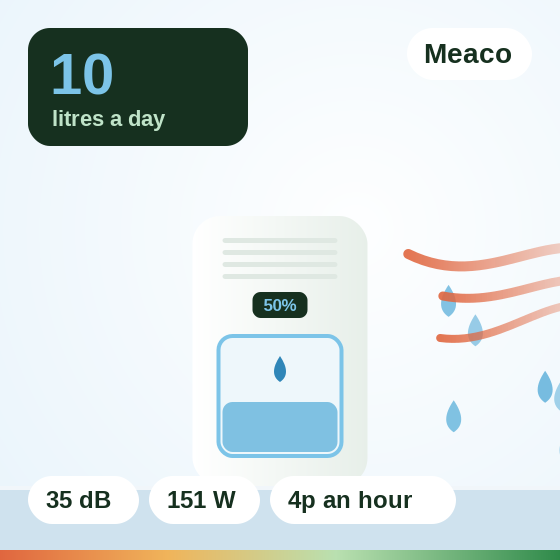
MeacoDry Arete One 10L Dehumidifier / Air Purifier
10 litres a day · 35 dB · 151 W · 4p an hour
£159.99 at Meaco (maker shop), checked 14 Nov 2026
See it at Meaco (maker shop)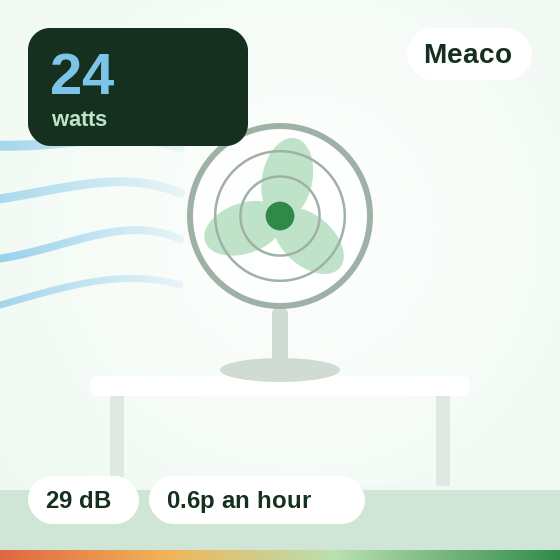
Meaco
MeacoFan 1056 Air Circulator
24 watts · 29 dB · 0.6p an hour
£99.99 at Meaco (maker shop), checked 14 Nov 2026
See it at Meaco (maker shop)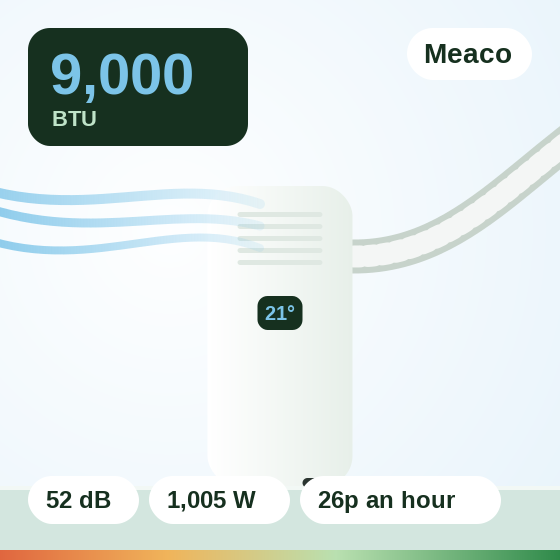
Meaco
MeacoCool MC Series Pro 9000 CH BTU Portable Air Conditioner & Heater (MC9000CHRPRO)
9,000 BTU · 52 dB · 1,005 W · 26p an hour
£399.99 at Meaco (maker shop), checked 13 Nov 2026
See it at Meaco (maker shop)
Figures from the maker or retailer listing. Cost an hour is our own, at the price cap of 26.32p a kWh.