Key takeaways
- How to cool down a room fast, in order: shut curtains and blinds on the sunny side, switch off heat sources and the heating, then get air moving with a fan.
- Fans help while the air is below 35C, and should not be aimed directly at your body (NHS, UKHSA).
- Cool yourself while the room catches up: cool water on your skin, a cool shower and cold drinks. UKHSA says you should start to feel better within 30 minutes.
- If it is cooler outside than in, open the windows, if it is safe to.
- Only an air conditioner lowers the room’s temperature itself. A 563 W portable costs about 14.8p an hour to run.
This is how to cool down a room fast: the quickest actions first, from the UK Health Security Agency (UKHSA), the NHS and the Met Office. For the full step-by-step method, see how to cool down a room; for who is most at risk from heat, see our UK heatwave guide. Most of the NHS and UKHSA guidance linked here is written for England; in Wales, Scotland and Northern Ireland, use your own nation’s NHS service.
If someone in the room is unwell, do not wait for the room to cool: go straight to the help box at the end of this page.
What you need
Curtains or blinds, a fan if you have one, and cool water.
In the first five minutes
- Shut out the sun. UKHSA says “close blinds and curtains on windows that are exposed to direct sunlight during the day”. The Met Office says “Close curtains in rooms that face the sun to keep indoor spaces cooler.”
- Close the windows if it is hotter outside. It feels wrong, but the Met Office says “Counter intuitively, closing doors and windows in the heat of the day can keep it cooler inside.”
- Switch off heat sources. UKHSA says “turn off lights and electrical equipment that are not in use”.
- Check the heating is off. “Check that your heating is turned off” (UKHSA).
Get air moving
Fans help while the air is below 35C. The NHS says “Electric fans can help if the temperature is below 35 degrees”; UKHSA says use them “if the air temperature is below 35°C” and not to aim them directly at your body, “as this can lead to dehydration”.
A fan works at once on the people in its path, but it does not lower the temperature of the room. Our guide to how to cool down a room with a fan covers where to put it. A 24 W fan such as the Meaco MeacoFan 1056 costs about 0.6p an hour to run.
Cool yourself while the room catches up
The quickest relief is for your body, not the room. From the NHS and UKHSA:
- “Have a cool shower or put cool water on your skin or clothes” (NHS).
- “apply cool water by spray or sponge to exposed skin” (UKHSA).
- “Have cold food and regular cold drinks” and “avoid alcohol, caffeine and hot drinks” (NHS).
UKHSA says “You should start to cool down and feel better within 30 minutes.” If you or someone else does not, see the help box at the end of this page.
If it is cooler outside: open up
As soon as the air outside is cooler than inside, often in the evening, open the windows. UKHSA says “Open windows (when it is safe to do so) when the air feels cooler outside, for example at night, and try to get air flowing through the home.” Our page on windows open or closed in a heatwave explains the timing.
The fastest fix: a portable air conditioner
A portable air conditioner is the only option here that takes heat out of the room. It sends the heat outside through a hose vented out of a window, so it needs a window nearby: see how to vent a portable air conditioner. Neither makers nor official sources give a time for how fast a portable cools a room, so we do not give one: it depends on the unit’s size, the room and how much sun it is taking in.
Size it for the room. Our rule follows Daikin UK, which says “typical UK homes require around 0.1 kW per square metre” at a standard 2.4 m ceiling. A typical 4 x 3.5 m bedroom with a 2.4 m ceiling is 33.6 cubic metres: 33.6 x 41.67 W = 1,400 W, or 4,777 BTU per hour, so the smallest common size, 5,000 BTU. A single-hose portable cools less than its rating suggests, so check the maker’s room size too. Pro Breeze gives 12 square metres for its 5000 BTU unit, smaller than this 14 square metre room, so go up a size: Pro Breeze gives 16 square metres for its 7000 BTU unit. Our BTU calculator does the sum for your room, and small air conditioners compares compact units.
| Appliance | Rated power (maker) | Maker’s room size | Per hour | Price, as listed |
|---|---|---|---|---|
| Pro Breeze 5000 BTU 3 in 1 portable air conditioner | 563 W | 12 m2 | 14.8p | from £224.99 at Pro Breeze , checked 13 November 2026 (shown as pre-order that day, shipping “Early March 2027”; check stock) |
| Pro Breeze 7000 BTU 3 in 1 portable air conditioner | 780 W | 16 m2 | 20.5p | from £279.99 at Pro Breeze , checked 13 November 2026 (sold out that day) |
How we worked it out. The Pro Breeze 5000 BTU unit’s manual gives a rated power input of 563 W: 0.563 kW x 26.32p per kWh = 14.8p an hour. The 7000 BTU unit’s 780 W (the figure recorded from its manual in our product file, 14 November 2026) gives 20.5p. The unit rate is Ofgem’s price cap average for electricity in Great Britain, by Direct Debit, 1 October to 31 December 2026, with no VAT (0%) for that period and the standing charge left out. These figures use the Great Britain price cap. In Northern Ireland, use the unit rate on your own bill. Rated power is the maker’s figure at full output, so treat these as upper estimates. For a fan and an air cooler beside these, see the cost table in how to cool down a room.
What the manuals say. Pro Breeze’s manual for its 5000 BTU unit says it “is intended for indoor household use” and “Never leave the appliance unattended while in use.” We could not read the 7000 BTU unit’s manual: the file is too large for our tools. Check it before you buy, and before running the unit overnight or unattended. More in portable air conditioners.
If someone is unwell, do not wait for the room
Heatstroke is a medical emergency (NHS).
Call 999 if you or someone else have signs of heatstroke, including (NHS):
- “still being unwell after 30 minutes of resting in a cool place, being cooled and drinking fluids”
- “a very high temperature”
- “hot skin that’s not sweating and might look red”
- “a fast heartbeat”
- “fast breathing or shortness of breath”
- “confusion and lack of coordination”
- “a seizure or fit”
- “loss of consciousness”
“Do not drive yourself to A&E.” (NHS)
UKHSA: “If you think someone has heatstroke you should dial 999 and then try to cool them down.”
Call 111 (NHS) if “you or someone else have symptoms of heat exhaustion that you’re struggling to treat or you need advice about”.
While you wait, the NHS says to move the person to a cool place, take off clothing they do not need, give them plenty of water to drink, and cool their skin by spraying or sponging it with cool water and fanning them.
Frequently asked questions
How can I cool my room down in 5 minutes?
Without an air conditioner you cannot drop the room’s temperature much in five minutes, but you can stop it getting hotter: shut curtains on the sunny side, switch off heat sources, and turn on a fan (below 35C, not aimed at your body). Then cool yourself with cool water.
How long does a portable air conditioner take to cool a room?
Makers do not state it, and no official source gives a figure. It depends on the unit’s size against the room, how much sun the room is taking in and how warm it is to start with. Size the unit for the room with our BTU calculator.
Is it quicker to open or close windows?
It depends on which side is cooler. Keep windows shut while it is hotter outside, and open them when the air outside feels cooler than inside, usually in the evening and at night, if it is safe to (NHS, UKHSA, Met Office).
Does a cold shower cool you down quickly?
The NHS says to “Have a cool shower or put cool water on your skin or clothes”. It says cool, not cold. UKHSA says you should start to cool down and feel better within 30 minutes.
Sources
- UKHSA: Beat the heat, staying safe in hot weather (updated 21 July 2026, England) (checked 15 November 2026)
- UKHSA: Beat the heat, keep cool at home checklist (updated 21 July 2026, England) (checked 15 November 2026)
- NHS: Heatwave, how to cope in hot weather (reviewed 12 June 2026) (checked 15 November 2026)
- NHS: Heat exhaustion and heatstroke (reviewed 28 May 2026) (checked 15 November 2026)
- Met Office: Tips for keeping cool in hot weather (checked 14 November 2026)
- Ofgem: Changes to energy price cap between 1 October and 31 December 2026 (checked 14 November 2026)
- Daikin UK: Air conditioner size guide (checked 14 November 2026)
- Pro Breeze: 5000 BTU smart portable air conditioner (checked 13 November 2026)
- Pro Breeze: PB-AC08 instruction manual (December 2022), specifications and safety instructions (checked 15 November 2026)
- Pro Breeze: 7000 BTU 3 in 1 portable air conditioner (checked 13 November 2026)
- Pro Breeze: PB-AC04 instruction manual (January 2023), specifications, as recorded in our product file (not opened by us) (checked 14 November 2026)
- Meaco: MeacoFan 1056 air circulator (checked 14 November 2026)
Products on this page
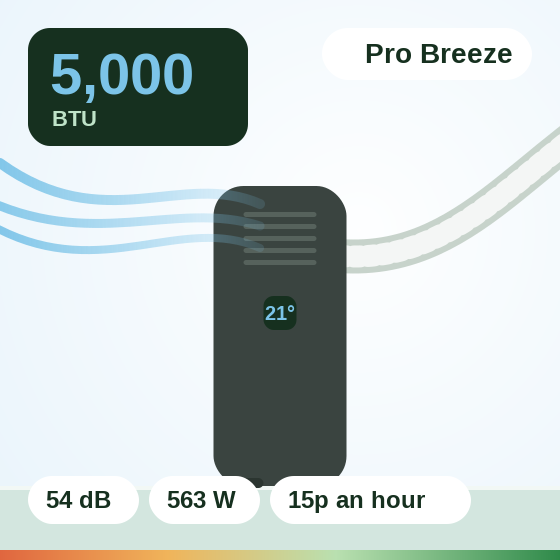
Pro Breeze
5000 BTU 3-in-1 Portable Air Conditioner with Dehumidification Function, Smart Wifi App (PB-AC-08)
5,000 BTU · 54 dB · 563 W · 15p an hour
£224.99 at Pro Breeze (maker shop), checked 13 Nov 2026
See it at Pro Breeze (maker shop)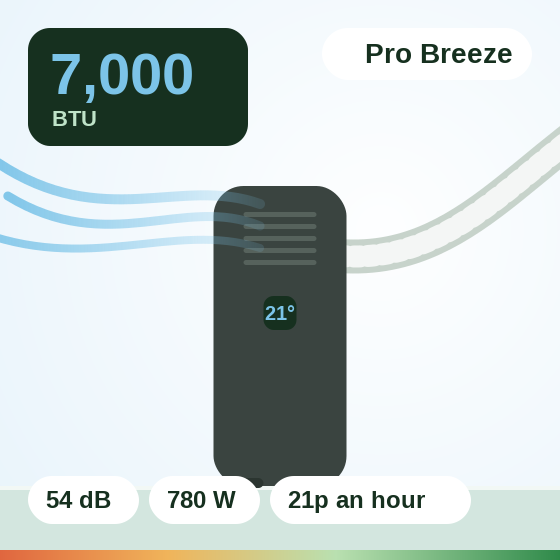
Pro Breeze
7000 BTU 3-in-1 Portable Air Conditioner with Dehumidification Function (PB-AC-04)
7,000 BTU · 54 dB · 780 W · 21p an hour
£279.99 at Pro Breeze (maker shop), checked 13 Nov 2026
See it at Pro Breeze (maker shop)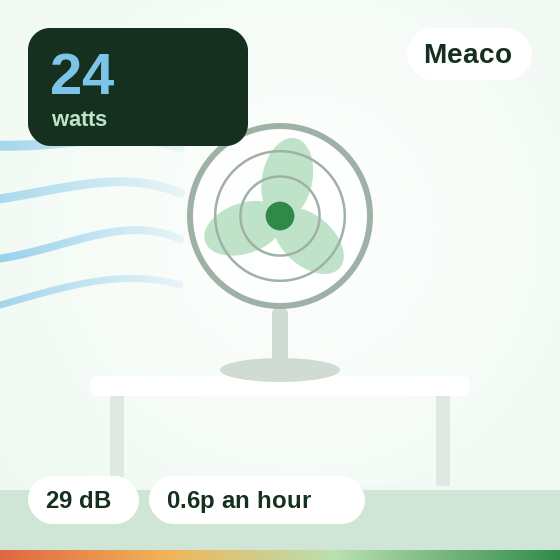
Meaco
MeacoFan 1056 Air Circulator
24 watts · 29 dB · 0.6p an hour
£99.99 at Meaco (maker shop), checked 14 Nov 2026
See it at Meaco (maker shop)
Figures from the maker or retailer listing. Cost an hour is our own, at the price cap of 26.32p a kWh.