Key takeaways
- How to keep conservatory cool: shade the glass before the sun reaches it, keep windows and vents shut while it is hotter outside, and open up when the air outside is cooler, if it is safe to.
- Close the door between the conservatory and the house during the hottest part of the day, in line with the Met Office’s advice on closing doors and windows in the heat of the day.
- Shading on the outside of the glass, such as shutters, roller blinds or awnings, is “very effective” (UKHSA).
- Our sizing rule gives 7,000 BTU for a 4 by 3.5 m conservatory with a 2.5 m average height. A 780 W, 7,000 BTU portable costs 20.5p an hour to run.
A conservatory is mostly glass, and in a heatwave it can get hotter than the rest of the house. For who is most at risk in the heat and when to call 999, see our UK heatwave guide. This page sets out how to keep a conservatory cool, step by step, and what it takes if you want to cool it with an air conditioner. No NHS or UKHSA guidance deals with conservatories by name, so we apply their general advice on shading and ventilation and say where we are doing so. Most of the NHS and UKHSA guidance linked here is written for England; in Wales, Scotland and Northern Ireland, use your own nation’s NHS service.
Why conservatories get so hot
UKHSA lists the homes most likely to overheat. One of them describes most conservatories: homes with “large east, west or south-facing windows which do not have shade from the sun”. A conservatory has glass on several sides and often on the roof as well, so the sun can reach it for much of the day.
Shade the glass
UKHSA’s checklist says “If possible, shade or cover windows”, suggests internal blinds or curtains, and says external shutters, roller blinds or awnings “are also very effective”. The Met Office says “Close curtains in rooms that face the sun to keep indoor spaces cooler.” In a conservatory, that means closing roof and side blinds on the sunny glass before the sun reaches it, and using any outside shading you have. The guidance does not compare types of blind or mention window film or roof replacement, so we do not either.
Ventilate at the right time
The same rule as for any room: keep windows, curtains and blinds shut on the sunny side by day; open windows when the air outside feels cooler than inside, usually in the evening and at night, if it is safe to. The NHS says “Close windows, curtains and blinds during the day and open them at night when the temperature outside has gone down.” If your conservatory has roof vents, the same timing applies. Our windows open or closed in a heatwave page goes through it.
Keep the heat out of the house
Close the door between the conservatory and the house while the conservatory is hot. The Met Office says “Counter intuitively, closing doors and windows in the heat of the day can keep it cooler inside.” It does not mention conservatories, but shutting off a room that is hotter than the rest of the house is consistent with that advice. Open the door again in the evening once the conservatory has cooled. For the rest of the house, see how to keep your house cool.
Plants
UKHSA’s checklist says growing plants outside can shade windows, especially south-facing ones, and that plants inside may help cool the air. If you keep plants in the conservatory, they will need more water in the heat: see watering plants in a heatwave.
Fans and air coolers in a conservatory
A fan moves air over you; it does not lower the temperature of the conservatory. Fans help while the air is below 35C. The NHS says “Electric fans can help if the temperature is below 35 degrees”; UKHSA says use them “if the air temperature is below 35°C” and not to aim them directly at your body, which it says “can lead to dehydration”. Check the temperature with a thermometer before relying on one.
An air cooler blows air over wet pads and adds moisture to the room; how much it helps depends on how humid the air already is. See air coolers.
Air conditioning for a conservatory: sizing and cost
An air conditioner is the only appliance that lowers the room’s air temperature. Our sizing rule starts from Daikin UK’s guide of about 0.1 kW of cooling per square metre at a standard 2.4 m ceiling, scaled by the room’s volume (100 W / 2.4 m = 41.6667 W per cubic metre), and adds 30% for a conservatory. The 30% is the top of the 25 to 30% that Electric Point, a retailer, says to add “at least” for conservatories and garden rooms; no maker or official figure was found. We do not add extra for sun on top, because the conservatory figure already allows for the glass.
Worked example. A conservatory 4 m by 3.5 m with an average height of 2.5 m:
- Volume: 4 x 3.5 x 2.5 = 35 cubic metres.
- Base cooling: 35 x 41.6667 W = 1,458 W.
- Add 30% for a conservatory: 1,458 x 1.3 = 1,896 W (1.90 kW).
- Convert to BTU per hour: 1,896 x 3.412 = 6,469, or about 6,500 BTU per hour.
- Round up to the next size sold (5,000, 7,000, 8,000 BTU and so on): 7,000 BTU.
This is a rule of thumb, not a survey. A glass roof in full sun can need more, so ask an installer to work out the heat load. Our BTU calculator does the sums for your own conservatory.
Running cost. The Pro Breeze 7000 BTU 3-in-1 portable air conditioner (PB-AC-04) is rated at 780 W, the figure our product file records from its maker’s manual (14 November 2026). An hour uses 0.78 kWh: 20.5p at 26.32p per kWh, or £1.64 for eight hours of daytime use. Over our standard summer of 350 hours (an assumption: real use depends on the weather and your home), it would cost £71.85. It was listed from £279.99 at Pro Breeze , checked 13 November 2026, when it was sold out. Pro Breeze gives it a room size of 16 square metres.
The unit rate is Ofgem’s price cap average for electricity in Great Britain, by Direct Debit, 1 October to 31 December 2026, with the standing charge left out. These figures use the Great Britain price cap. In Northern Ireland, use the unit rate on your own bill. Rated power is the maker’s figure at full output, so treat these as upper estimates.
A portable needs its hose vented out of a window; see portable air conditioners. We could not read the 7000 BTU unit’s own manual: the file is too large for our tools, so we have not seen its safety instructions. Check them before you buy, and before leaving the unit running unattended. Pro Breeze’s manual for its smaller 5000 BTU portable says it is “intended for indoor household use” and “Never leave the appliance unattended while in use”.
A fixed system. For a conservatory used all year, compare units in best air conditioners for a conservatory. In England, GOV.UK lists putting in “a fixed air-conditioning system” among projects that might need building regulations approval, though “You do not need to get approval yourself if you use someone registered with a competent person scheme.” For England, the Planning Portal says that if a system “only offers a cooling function”, the permitted development rights for heat pumps do not apply “and an application for planning permission will be required”. If you rent, check your tenancy agreement and ask your landlord before fitting anything. This is general information, not legal advice.
Frequently asked questions
How can I stop my conservatory getting so hot?
Shade the glass before the sun reaches it, ideally from outside. Keep windows and vents shut while it is hotter outside, open them when it is cooler, if it is safe to, and close the door to the house in the heat of the day.
Do conservatory roof blinds keep the heat out?
The official guidance does not deal with conservatory roofs. Its general advice is to shade or cover windows that get the sun; roof blinds do that for the glass overhead. It calls outside shading very effective.
What size air conditioner do I need for a conservatory?
By our rule, a 4 by 3.5 m conservatory with a 2.5 m average height needs about 6,500 BTU per hour, so a 7,000 BTU unit. A glass roof in full sun can need more. Use our BTU calculator and ask an installer for a heat load survey before a fixed system.
Is a fan enough for a conservatory?
Sometimes, while the air is below 35C. A fan cools you, not the room, so it helps only while you sit in its path. In a glass room in full sun, check the temperature; the NHS and UKHSA say fans help while the air is below 35C, and their advice stops there.
Can I use a conservatory as a bedroom in summer?
UKHSA’s advice is to “Move to a cooler part of the house, especially for sleeping if possible”, and the NHS says “Check the temperature of rooms, especially where people at higher risk live and sleep”. If the conservatory is cooler than your bedroom at night, it may suit; if it is warmer, sleep elsewhere. See how to keep a bedroom cool.
Sources
- UKHSA: Beat the heat, keep cool at home checklist (updated 21 July 2026, England) (checked 15 November 2026)
- UKHSA: Beat the heat, staying safe in hot weather (updated 21 July 2026, England) (checked 15 November 2026)
- Met Office: Tips for keeping cool in hot weather (checked 14 November 2026)
- NHS: Heatwave, how to cope in hot weather (reviewed 12 June 2026) (checked 15 November 2026)
- Ofgem: Changes to energy price cap between 1 October and 31 December 2026 (checked 14 November 2026)
- Daikin UK: Air conditioner size guide (checked 14 November 2026)
- Electric Point: Portable air conditioning units, UK buying guide (checked 14 November 2026)
- Pro Breeze: 7000 BTU 3-in-1 portable air conditioner (checked 13 November 2026)
- Pro Breeze: PB-AC04 (7000 BTU) instruction manual, rated input 780 W as recorded in our product file (not opened by us) (checked 14 November 2026)
- Pro Breeze: PB-AC08 (5000 BTU) instruction manual (checked 15 November 2026)
- GOV.UK: Building regulations approval, when you need approval (checked 14 November 2026)
- Planning Portal: Do I need planning permission to add air conditioning to my home? (checked 14 November 2026)
Products on this page
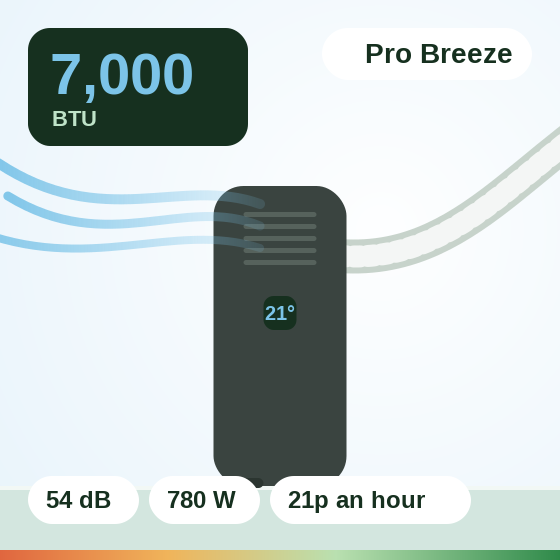
Pro Breeze
7000 BTU 3-in-1 Portable Air Conditioner with Dehumidification Function (PB-AC-04)
7,000 BTU · 54 dB · 780 W · 21p an hour
£279.99 at Pro Breeze (maker shop), checked 13 Nov 2026
See it at Pro Breeze (maker shop)
Figures from the maker or retailer listing. Cost an hour is our own, at the price cap of 26.32p a kWh.