Key takeaways
- How to keep your house cool comes down to three things: keep the sun off the windows, time when you open them, and cut the heat made inside.
- Top-floor flats, homes with windows on one side only, homes with large unshaded east, west or south windows and some highly insulated homes overheat most easily (UKHSA).
- Shading outside the glass works best: UKHSA says external shutters, roller blinds or awnings “are also very effective”.
- A fan cools people, not the house. Only an air conditioner lowers a room’s temperature, one room at a time: about £92.58 a summer for a 1,005 W portable against £2.21 for a 24 W fan (350 hours, our assumption).
This guide explains how to keep your house cool in any hot spell: why some homes get so hot, and the lasting changes that help, from the UK Health Security Agency (UKHSA), the NHS and the Met Office. For the hour-by-hour plan during a heatwave itself, see how to keep your house cool in a heatwave; for who is most at risk from heat, see our UK heatwave guide. Most of the NHS and UKHSA guidance linked here is written for England; in Wales, Scotland and Northern Ireland, use your own nation’s NHS service.
Why some homes get so hot
UKHSA’s checklist names the homes more likely to overheat:
- “flats on the top floor because heat rises”;
- “homes with opening windows on just one side of the property, as this means there is less ventilation through the home”;
- “homes with little shading from the sun either externally, for example no shutters or shades, or internally, for example no curtains or blinds”;
- “large east, west or south-facing windows which do not have shade from the sun”;
- homes in “a densely built-up urban area with little green space nearby”, which “may experience even hotter temperatures”;
- “some highly insulated or energy-efficient homes may trap heat inside”;
- “homes with low efficiency appliances that release excess heat, such as poorly insulated hot water systems”;
- “homes with restricted opening of windows, for example if there is a safety catch installed”.
On insulation, UKHSA is clear that it is not the problem in itself: “Making homes energy efficient has lots of health and other benefits but care needs to be taken to avoid overheating in the summer.”
Shade first: inside and outside
- Outside the glass. “Consider installing internal blinds or curtains, or external shutters, roller blinds or awnings are also very effective” (UKHSA).
- Inside the glass. Close curtains and blinds on the windows the sun reaches. UKHSA says “close blinds and curtains on windows that are exposed to direct sunlight during the day”; the Met Office says “Close curtains in rooms that face the sun to keep indoor spaces cooler.”
- Plants. UKHSA says “Growing plants outside can provide shade, which may be particularly helpful in front of south-facing windows, while plants inside may help cool the air.”
The official guidance names curtains, blinds, shutters and awnings, not particular types or materials, so we make no claims for blackout, thermal or reflective products.
Airflow: when to open up and when to shut
Keep windows, curtains and blinds shut on the sunny side by day; open windows when the air outside feels cooler than inside, usually in the evening and at night, if it is safe to.
- NHS: “Close windows, curtains and blinds during the day and open them at night when the temperature outside has gone down.”
- UKHSA: “Open windows (when it is safe to do so) when the air feels cooler outside, for example at night, and try to get air flowing through the home.”
- Met Office: “Counter intuitively, closing doors and windows in the heat of the day can keep it cooler inside.”
Our page on windows open or closed in a heatwave covers the timing in detail.
Less heat from inside
Everything that uses electricity ends up as heat in the house. UKHSA says:
- “Check that your heating is turned off.”
- “To reduce heat generated in the home, turn off lights and electrical equipment that are not in use and consider cooking at cooler times of the day.”
Ventilation systems: summer mode
If the house has a ventilation system, UKHSA says to “check this is switched on and operating in ‘summer mode’ if it has one.”
Fans, air coolers and air conditioners for the whole house
No portable appliance cools a whole house. Think one room at a time: the room where people spend the day, and the room where they sleep.
- A fan moves air over your skin; it does not lower the room’s temperature. Fans help while the air is below 35C. The NHS says “Electric fans can help if the temperature is below 35 degrees”; UKHSA says use them “if the air temperature is below 35°C” and not to aim them directly at your body. See cooling fans.
- A portable air conditioner takes heat out of one room and needs its hose vented out of a window. See portable air conditioners.
- A fixed split system cools rooms from an outdoor unit and is fitted by an engineer. See home air conditioning.
Sizing the main room. Our rule follows Daikin UK, which says “typical UK homes require around 0.1 kW per square metre” at a standard 2.4 m ceiling, with 10 to 20% more for large south- or west-facing windows and “around 0.18 kW per person if there are more than two people”. For a 5 x 4 m living room with a 2.4 m ceiling, sun-facing, used by four people: 48 cubic metres x 41.67 W = 2,000 W; plus 15% for sun (our figure, inside Daikin’s range) = 2,300 W; plus 2 x 180 W for the extra people = 2,660 W, or 9,076 BTU per hour, so a 10,000 BTU unit. A single-hose portable will cool less than its rating suggests, so check the maker’s stated room size too. Our BTU calculator works it out for your rooms.
Running cost for a summer.
| Appliance | Rated power (maker) | Per hour | Per 350-hour summer (our assumption) | Price, as listed |
|---|---|---|---|---|
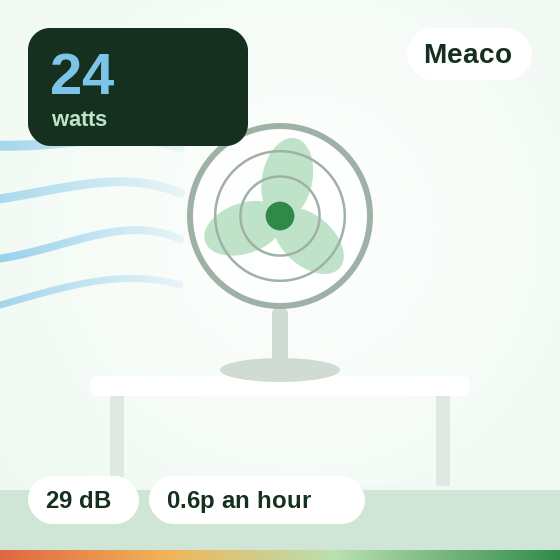
| Meaco MeacoFan 1056 air circulator (fan) | 24 W | 0.6p | £2.21 | from £99.99 at Meaco , checked 14 November 2026 |
| Meaco MeacoCool MC Series Pro 9000 (portable air conditioner, 9,000 BTU) | 1,005 W | 26.5p | £92.58 | from £399.99 at Meaco , checked 13 November 2026 (out of stock that day) |
How we worked it out. The Meaco 1056 is rated at 24 W: 0.024 kW x 350 hours = 8.4 kWh, which at 26.32p per kWh is £2.21. The MC Series Pro 9000 is rated at 1,005 W: 1.005 kW x 350 hours = 351.75 kWh, or £92.58. The 350-hour summer is our own assumption (roughly eight hours a day for 44 days); real use depends on the weather and your home. Note that the 9,000 BTU Meaco is smaller than the 10,000 BTU our rule gives for the living room above; Meaco states a room size of 16 to 26 square metres for it. We have not read Meaco’s manual for this model: check it before running the unit overnight or unattended. For the cost of eight hours and other models, see the table in how to cool down a room.
The unit rate is Ofgem’s price cap average for electricity in Great Britain, by Direct Debit, 1 October to 31 December 2026, with no VAT (0%) for that period and the standing charge left out. These figures use the Great Britain price cap. In Northern Ireland, use the unit rate on your own bill. Rated power is the maker’s figure at full output, so treat these as upper estimates. More in air conditioning running costs.
If you are insulating or refurbishing
UKHSA says “If insulating or refurbishing your home, ask installers for advice about reducing overheating.” For the room-by-room view, see how to keep a room cool in summer.
If a hot home is affecting someone’s health, heatstroke is a medical emergency: call 999. The signs, and when to call 111, are in our UK heatwave guide. If you rent, the NHS says your council’s environmental health office “can inspect a rented home for hazards to health, including excess heat”.
Frequently asked questions
Why is my house so hot?
Often because of where and how it is built. UKHSA says top-floor flats, homes with opening windows on one side only, homes with large unshaded east, west or south-facing windows, homes in built-up areas, and some highly insulated homes are more likely to overheat. Heat from lights, appliances and cooking adds to it.
Do external blinds keep a house cooler?
UKHSA’s checklist says external shutters, roller blinds or awnings “are also very effective”. They shade the glass from outside, so the sun’s heat does not get into the room in the first place.
Does loft insulation keep a house cool in summer?
UKHSA does not say. It says “some highly insulated or energy-efficient homes may trap heat inside”, that energy efficiency “has lots of health and other benefits”, and that if you are insulating, you should “ask installers for advice about reducing overheating.”
Should I leave the loft hatch open in hot weather?
The NHS and UKHSA guidance does not cover loft hatches, so we make no recommendation. The official advice is to shade windows, open them when it is cooler outside, and sleep in the coolest part of the house.
Can I cool a whole house with portable air conditioners?
Not easily. Each portable cools one room, needs its own window for the hose and adds to the bill (about 26.5p an hour for a 1,005 W unit). For several rooms, ask an engineer about a fixed system: see home air conditioning.
Sources
- UKHSA: Beat the heat, keep cool at home checklist (updated 21 July 2026, England) (checked 15 November 2026)
- NHS: Heatwave, how to cope in hot weather (reviewed 12 June 2026) (checked 15 November 2026)
- UKHSA: Beat the heat, staying safe in hot weather (updated 21 July 2026, England) (checked 15 November 2026)
- Met Office: Tips for keeping cool in hot weather (checked 14 November 2026)
- Ofgem: Changes to energy price cap between 1 October and 31 December 2026 (checked 14 November 2026)
- Daikin UK: Air conditioner size guide (checked 14 November 2026)
- Meaco: MeacoFan 1056 air circulator (checked 14 November 2026)
- Meaco: MeacoCool MC Series Pro 9000 portable air conditioner (checked 13 November 2026)
- NHS: Heat exhaustion and heatstroke (reviewed 28 May 2026) (checked 15 November 2026)
Products on this page
Meaco
MeacoFan 1056 Air Circulator
24 watts · 29 dB · 0.6p an hour
£99.99 at Meaco (maker shop), checked 14 Nov 2026
See it at Meaco (maker shop)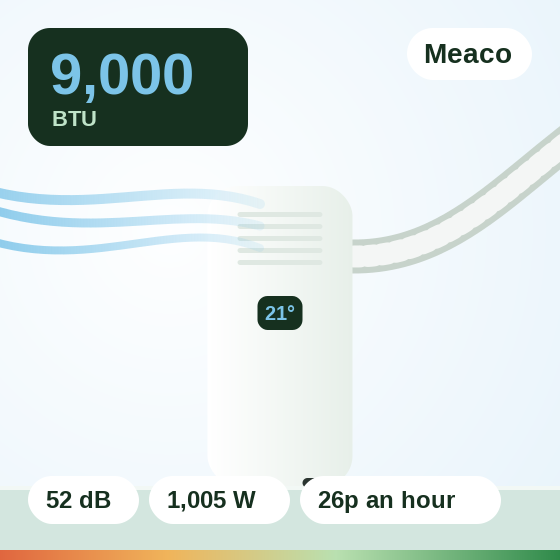
Meaco
MeacoCool MC Series Pro 9000 CH BTU Portable Air Conditioner & Heater (MC9000CHRPRO)
9,000 BTU · 52 dB · 1,005 W · 26p an hour
£399.99 at Meaco (maker shop), checked 13 Nov 2026
See it at Meaco (maker shop)
Figures from the maker or retailer listing. Cost an hour is our own, at the price cap of 26.32p a kWh.