Key takeaways
- How to cool down a room with a fan: keep the sun out first, place the fan so air moves past you without being aimed straight at your body, and use it to bring in cooler air once it is cooler outside.
- A fan cools people, not the room. It moves air over your skin; it does not lower the air temperature.
- Fans help while the air is below 35C, and should not be aimed directly at your body (NHS, UKHSA).
- Running a fan costs pennies: 4.2p for eight hours with a 20 W tower fan, 10.5p with a 50 W pedestal fan. Check your fan’s manual before leaving it on overnight.
This guide is for anyone who already has a fan and wants to get the most from it in hot weather: how to cool down a room with a fan, where to put it, when to use the cooler air outside, and when a fan is the wrong tool. The safety advice comes from the NHS and the UK Health Security Agency (UKHSA). If you are choosing a fan, see best fans to cool a room; for the wider picture, see our UK heatwave guide. Most of the NHS and UKHSA guidance linked here is written for England; in Wales, Scotland and Northern Ireland, use your own nation’s NHS service.
What a fan can and cannot do
A fan moves air. When that air passes over your skin it carries heat away from you, so you feel cooler. It does not take heat out of the room, and the fan’s motor adds a little heat of its own. So:
- A fan helps the person in its stream, not an empty room. Turn it off when you leave.
- It cannot bring down a room that is hotter than you want; only an air conditioner does that.
- Fans help while the air is below 35C. The NHS says “Electric fans can help if the temperature is below 35 degrees”; UKHSA says use them “if the air temperature is below 35°C” and not to aim them directly at your body. UKHSA’s guidance for schools adds that above 35C oscillating fans “may be counterproductive”. The 35C is the air temperature, not a room target.
Step 1: shut out the heat first
A fan cannot undo the sun’s heat, so keep windows, curtains and blinds shut on the sunny side by day, and switch off heat sources first. Our step-by-step guide to how to cool down a room covers those steps; this page covers the fan.
Step 2: place the fan
UKHSA’s advice on placement is one line: “do not aim the fan directly at your body as this can lead to dehydration”.
In practice:
- Near you, not in your face. Put the fan where its air passes across you or across the bed, rather than blowing straight at you from close range.
- Use oscillation. If the fan turns from side to side, let it. The air moves across a wider area and is not aimed at you all the time.
- Height. A pedestal fan at bed or sofa height reaches you over furniture; a tower or desk fan suits a bedside table or desk.
- Babies and children. The NHS says “Do not aim the fan directly at your child as this could make them dehydrated.” The Lullaby Trust says “You could also use a fan to cool the room, but don’t aim it directly towards the baby.” A fan moves air; it does not lower the room’s temperature.
Step 3: use cooler outside air in the evening and at night
Once the air outside is cooler than inside, open the windows (when it is safe to) and let the fan help move that air through the room. UKHSA says to open windows “when the air feels cooler outside than inside” and to “try to get air flowing through your home”. The Met Office says “At night, keep your sleeping area well ventilated.”
Some people put a fan in or near an open window, facing into the room, to draw cooler evening air in. That is a common practice, not something the NHS or UKHSA advise, and it only makes sense when the air outside really is cooler than inside. A room thermometer tells you when that is.
Step 4: ceiling fans and their direction in summer
A ceiling fan moves air over the whole room. Many run in two directions: Fantasia, for example, gives its Zeta six speeds forward and six in reverse, and describes a winter setting that recirculates warm air trapped at ceiling level. Which way to run a ceiling fan in summer is covered in our ceiling fan direction guide; check your own fan’s manual for which setting is which. Fitting a ceiling fan is a wiring job: Fantasia says to consult a qualified electrician if you are in any doubt. See ceiling fans.
Ice in front of a fan: does it work?
A bowl of ice or frozen bottles in front of a fan is a popular tip, but it is not in the NHS or UKHSA guidance. Our page on ice in front of a fan looks at the physics. What the NHS does say is to cool your own skin: “have a cool shower or put cool water on your skin or clothes”.
When not to rely on a fan
- When the air is 35C or above. The NHS and UKHSA limit their fan advice to air below 35C.
- When someone is at higher risk. For people aged 65 and over, babies and children aged 5 and under, and people with long-term conditions, a fan alone may not be enough. The NHS says “Check the temperature of rooms, especially where people at higher risk live and sleep”.
- When someone is unwell. “Heatstroke is a medical emergency” (NHS): call 999 if someone is still unwell after 30 minutes of resting somewhere cool, being cooled and drinking fluids, or is confused, has a seizure or loses consciousness. Call 111 if you are struggling to treat heat exhaustion or need advice. The full list of signs is in our UK heatwave guide.
If a room stays too hot with a fan running, see fan vs air conditioner.
What it costs to run
| Fan | Type | Rated power | Per hour | Per 8 hours (a measure of cost) | The maker’s manual | Price, as listed |
|---|---|---|---|---|---|---|
| Meaco Sefte 19 in tower fan | small tower | 20 W (Meaco) | 0.5p | 4.2p | We read it: no warning about use while sleeping; it says “Be sure the unit is inaccessible to children when not attended.” | from £69.99 at Meaco , checked 14 November 2026 |
| Igenix DF1655 16 in pedestal fan | pedestal | 50 W (B&Q listing) | 1.3p | 10.5p | We have not read one. Check it before leaving the fan on overnight or unattended. | from £32.99 at Igenix , checked 14 November 2026 |
| Fantasia Zeta ceiling fan (light off) | ceiling | 32 W (Fantasia, motor) | 0.8p | 6.7p | We have not read one. Check it before leaving the fan on overnight. | from £299 at Fantasia , checked 14 November 2026, plus fitting |
How we worked it out. The Sefte 19 is rated at 20 W, so an hour uses 0.02 kWh: 0.5p at 26.32p per kWh, or 4.2p for eight hours. The Igenix is listed at 50 W by B&Q (its maker’s page gives no wattage; Dunelm lists 40 W, and we use the higher figure): 1.3p an hour, 10.5p for eight hours. The Zeta’s motor is rated at 32 W: 0.8p an hour, 6.7p for eight hours, with the 18 W light switched off.
The unit rate is Ofgem’s price cap average for electricity in Great Britain, by Direct Debit, 1 October to 31 December 2026, with the standing charge left out. These figures use the Great Britain price cap. In Northern Ireland, use the unit rate on your own bill. Rated power is at top speed, so these are upper estimates: Meaco gives 2 W for the Sefte 19 at its lowest setting. More in how much a fan costs to run and on our cooling fans page.
Frequently asked questions
Where should I put a fan to cool a room?
Where its air passes across you, not aimed straight at your body. UKHSA says aiming a fan directly at your body “can lead to dehydration”. Use oscillation if the fan has it, and set the height so the air reaches you over furniture.
Should a fan face in or out of a window?
The NHS and UKHSA do not say. A common practice is to face a fan into the room from an open window to draw air in, but only when the air outside is cooler than inside. The official advice is to open windows when it is cooler outside and get air flowing through your home.
Do fans work above 35C?
The NHS and UKHSA say to use fans when the air is below 35C. The NHS says “Electric fans can help if the temperature is below 35 degrees.” Above that, cool your skin with water, move somewhere cooler and watch for signs of heat illness.
Which way should a ceiling fan spin in summer?
It depends on the fan, so check its manual. Our ceiling fan direction guide explains the summer and winter settings.
Is it bad to have a fan pointing at you all night?
UKHSA says not to aim a fan directly at your body because it “can lead to dehydration”. Point it across the room or the bed instead, use oscillation and a timer, and never aim one at a baby or child (NHS). Read your fan’s manual before leaving it on overnight.
Sources
- NHS: Heatwave, how to cope in hot weather (reviewed 12 June 2026) (checked 15 November 2026)
- UKHSA: Beat the heat, staying safe in hot weather (updated 21 July 2026, England) (checked 15 November 2026)
- UKHSA: Beat the heat, keep cool at home checklist (updated 21 July 2026, England) (checked 14 November 2026)
- Met Office: Hot weather and its impacts (checked 14 November 2026)
- NHS: Safety in the sun, babies and children (reviewed 27 September 2024) (checked 14 November 2026)
- Lullaby Trust: Baby room temperature (updated 30 April 2026) (checked 15 November 2026)
- NHS: Heat exhaustion and heatstroke (reviewed 28 May 2026) (checked 15 November 2026)
- Ofgem: Changes to energy price cap between 1 October and 31 December 2026 (checked 14 November 2026)
- Meaco: Sefte 19 in tower fan, specification (checked 14 November 2026)
- Meaco: Sefte 19 in tower fan manual (EN01 v1.1), technical data (checked 15 November 2026)
- B&Q: Igenix DF1655 pedestal fan listing (50 W) (checked 14 November 2026)
- Igenix: DF1655 16 inch pedestal fan (checked 14 November 2026)
- Fantasia Ceiling Fans: Zeta DC ceiling fan (checked 14 November 2026)
- Dunelm: Igenix 16 in pedestal fan listing (40 W) (checked 15 November 2026)
- UKHSA: Looking after children and those in early years settings before and during hot weather (updated 8 July 2026, England) (checked 15 November 2026)
Products on this page
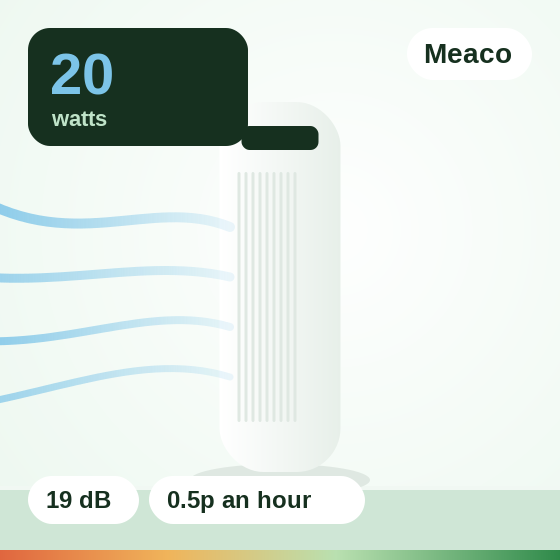
Meaco
Sefte 19" Tower Fan
20 watts · 19 dB · 0.5p an hour
£69.99 at Meaco (maker shop), checked 14 Nov 2026
See it at Meaco (maker shop)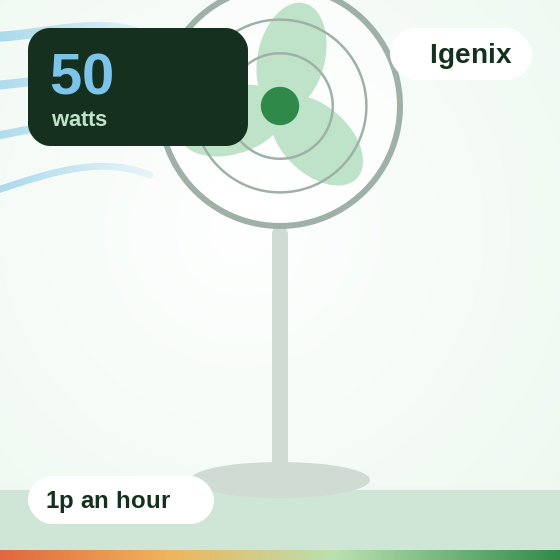
Igenix
DF1655 16 Inch Pedestal Fan, 3 Speeds, White
50 watts · 1p an hour
£32.99 at Igenix (maker shop), checked 14 Nov 2026
See it at Igenix (maker shop)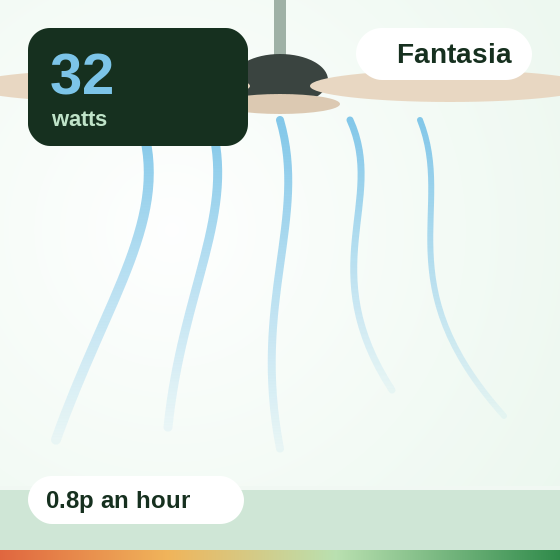
Fantasia
Zeta DC ceiling fan with LED light and remote
32 watts · 0.8p an hour
£299.00 at Fantasia Ceiling Fans (maker shop), checked 14 Nov 2026
See it at Fantasia Ceiling Fans (maker shop)
Figures from the maker or retailer listing. Cost an hour is our own, at the price cap of 26.32p a kWh.