Key takeaways
- How do portable air conditioners work? A portable air conditioner uses a sealed refrigerant cycle driven by an electric compressor to move heat out of the room air. The hose carries that heat, plus the unit’s own electricity, outside: see how to vent a portable air conditioner.
- Most are single hose: they take room air, heat it and blow it out of the window, so other air leaks in to replace it. Dual hose units take the cooling air from outside through a second duct.
- For a Meaco Cirro 12000, our arithmetic puts about 4.87 kW of heat out of the hose at full output (3.52 kW cooling plus 1.35 kW of electricity).
- The water the unit collects leaves with the exhaust air or into a tank or drain hose, depending on the mode.
- Single duct units are rated with indoor air feeding the hot coil, so their rated BTU flatters real cooling. We give no percentage because no UK document does.
The short answer
A portable air conditioner works like any air conditioner: a compressor drives a refrigerant round a sealed loop, a cold coil takes heat from the room air, and a hot coil gets rid of it. On a portable both coils are in one box, so the hot air leaves through a hose, which is why you must vent a portable air conditioner to the outside.
Inside the box: compressor, two coils and two fans
UK energy labels use a legal definition: an air conditioner is “a device capable of cooling or heating, or both, indoor air, using a vapour compression cycle driven by an electric compressor” (Regulation (EU) No 626/2011, as it applies in Great Britain). In plain words, the parts are:
- A compressor, driven by electricity, that squeezes the refrigerant gas and makes it hot.
- A hot coil (the condenser), where that hot refrigerant gives up its heat to a stream of air.
- A cold coil (the evaporator), where the refrigerant, now cold, takes heat from the room air blown across it.
- Two fans: one moves room air across the cold coil and back into the room, the other moves air across the hot coil and out.
We describe only the cycle the definition names. Our condensing unit glossary entry and refrigerant guide cover the parts in more depth.
Where the heat goes
The heat does not vanish: it moves from the room to the hot coil, and the electricity driving the compressor also ends up as heat. So the stream of air over the hot coil carries both. For the Meaco Cirro 12000 (12,000 BTU per hour of cooling, 1,350 W of electricity), our arithmetic:
- 12,000 BTU per hour x 0.2930711 = about 3.52 kW of cooling.
- Add the 1.35 kW of electricity: 3.52 + 1.35 = about 4.87 kW of heat to get rid of.
No maker states this figure; it is our own sum and the word “about” matters. It is why a hose left in the room makes things worse. Meaco’s manual says the air conditioner “needs to be vented to the outside in order to remove hot air”, and De’Longhi UK answers “No” when asked whether its portables work without the hose, saying they are designed to work by expelling hot air out of the back using the hose supplied.
Single hose and dual hose
The regulation defines both:
- Single duct: “the condensor or evaporator intake air is introduced from the space containing the unit and discharged outside this space”. The unit takes room air over the hot coil and blows it outside, so the room loses air and other air leaks in to replace it, from outdoors and from other rooms.
- Double duct (dual hose): the intake air “is introduced from the outdoor environment to the unit by a duct and rejected to the outdoor environment by a second duct”.
The test conditions matter. The regulation rates single duct units with indoor air, not outdoor air, supplied to the hot coil (Annex VII, Table 2, note a). So a single duct unit’s rated BTU does not count the warm air drawn in to replace what the hose blows out. A single hose portable will cool less than its rated BTU suggests. No UK or EU document gives a figure for the gap, so we do not give one: compare the maker’s room size with ours from the BTU calculator, and if the maker’s figure does not cover your room, go up a size.
Dual hose units avoid drawing room air for the hot coil. When we checked in November 2026 we found no dual hose portable confirmed by its maker on sale in the UK; see dual hose portable air conditioners. Hose length, diameter and extension rules are in our hose guide.
Where the water goes
Cooling room air also takes moisture out of it, which collects as water. A portable deals with it in different ways, depending on the unit and the mode. On Meaco’s manual for its 12,000 BTU portable:
- In Cool mode, the drain bung is a reservoir: “Whilst cooling, do not remove this bung. This is the water reservoir where water sits until it is evaporated out via the duct.” The drainage hose need not be attached continuously, but the tank must be drained when “Ft (Full Tank)” appears on the display.
- In Dry mode the drainage hose must stay attached to the central drain port, and in Heat mode to the lower one.
Units that send the water out with the exhaust air are called self evaporating: see self evaporating portable air conditioners. Whatever the design, the exhaust hose is still needed.
What the numbers mean
- BTU is an amount of energy. Air conditioners are rated in BTU per hour (a rate), even when a listing says only “BTU”. A “12,000 BTU” portable removes up to 12,000 BTU of heat an hour, about 3.52 kW. Our BTU guide explains more.
- Power in is a different figure: the Cirro 12000 draws 1,350 W.
- EER (energy efficiency ratio) is cooling output divided by electricity in. Our arithmetic: 3.52 / 1.35 = 2.6. Meaco’s EU energy fiche for the Cirro 12000 gives EER 2.7 for 3.5 kW of cooling and 1.3 kWh per hour, which is the maker’s figure. The difference is rounding.
Running cost
At 1,350 W, the Cirro 12000 costs 1.35 kW x 26.32p = 35.5p an hour. An eight-hour night is £2.84. Over our standard summer of 350 hours (an assumption; the energy label does not apply 350 hours to single-hose portables) it uses 472.5 kWh, or £124.36. Meaco’s own page gives the same 35.5p an hour at 26.32p per kWh. These are Great Britain averages at the Ofgem price cap for 1 October to 31 December 2026; the standing charge is left out, and in Northern Ireland you should use the unit rate on your own bill. Real use is likely to be lower once the room is cool. For other units see air conditioning running costs.
Portable against other types
- Window air conditioner: one box fitted in the window itself.
- Split system: an indoor unit and an outdoor unit joined by refrigerant pipes, installed by a professional.
- Portable split: wheeled indoor unit and an outdoor part, no exhaust hose.
- Portable heat pump air conditioner: a portable that also heats.
- Air cooler: not an air conditioner; see air cooler against air conditioner. If you want a portable without a hose, read portables without a hose.
For the full choice, see our portable air conditioner guide.
Frequently asked questions
Do portable air conditioners actually work?
Yes, they cool the air using the same refrigerant cycle as other air conditioners. A single hose portable cools less than its rated BTU suggests, because warm air leaks in to replace what the hose blows out, so size it with that in mind.
Why does a portable air conditioner need a hose?
Because the heat it takes from the room, plus its own electricity, has to go somewhere. For a Meaco Cirro 12000 we estimate about 4.87 kW at full output. The hose takes it outside.
Do portable air conditioners use a lot of electricity?
A Cirro 12000 draws 1,350 W, which is 35.5p an hour at 26.32p per kWh. Smaller units draw less; check the rated input of the model you are considering.
Where does the water go?
Into a reservoir that the unit empties out through the exhaust duct, or into a tank or drain hose. On Meaco’s unit the tank needs draining when “Ft (Full Tank)” shows, and the drainage hose must stay attached in Dry and Heat modes.
Is a portable air conditioner as good as a split system?
They work on the same principle, but a split puts its hot coil outside, so it does not blow room air out. See split air conditioners. We have not tested either, and we do not rank them here.
Do portable air conditioners bring in fresh air?
Not by design. A single hose unit blows room air outside, so air leaks into the room from outdoors and from other rooms to replace it. A dual hose unit takes its cooling air from outside through a second duct and returns it there.
Sources
- Meaco: MeacoCool Pro 12,000 BTU and 12,000CH BTU portable air conditioner, instruction manual (PDF hosted by Air Conditioning Centre) (checked 14 November 2026)
- Meaco: Cirro 12000 BTU Super Quiet Smart Portable Air Conditioner and Heater (checked 14 November 2026)
- EPREL: product fiche 2756020, Meaco Cirro 12000 (Regulation 626/2011) (checked 14 November 2026)
- De’Longhi UK: Do portable air conditioners work without the hose? (checked 14 November 2026)
- legislation.gov.uk: Regulation (EU) No 626/2011, Article 2, definitions (checked 14 November 2026)
- legislation.gov.uk: Regulation (EU) No 626/2011, Annex VII, standard rating conditions (checked 14 November 2026)
- Ofgem: Changes to energy price cap between 1 October and 31 December 2026 (checked 14 November 2026)
Products on this page
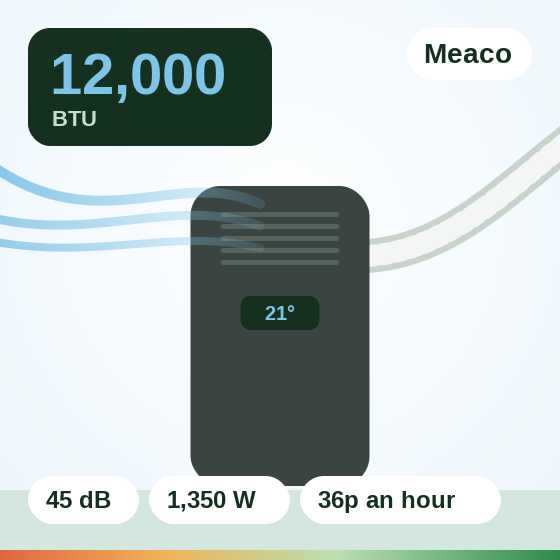
Meaco
Cirro 12000 BTU Super Quiet Smart Portable Air Conditioner & Heater (A-Cirro-12K-CH)
12,000 BTU · 45 dB · 1,350 W · 36p an hour
£539.99 at Meaco (maker shop), checked 13 Nov 2026
See it at Meaco (maker shop)
Figures from the maker or retailer listing. Cost an hour is our own, at the price cap of 26.32p a kWh.