Key takeaways
- A self evaporating portable air conditioner sends the water it collects out with the exhaust air, through the hose, instead of leaving it all in a tank for you to empty.
- That works best in Cool mode. Meaco’s manual says the tank may still fill in high humidity or after a long run, and the unit shows “Ft” (Full Tank) when it must be drained.
- In Dry mode and Heat mode, Meaco says the drain hose must stay attached.
- Self evaporating does not mean hoseless. The water leaves through the exhaust duct, so the hose is still needed.
A self evaporating portable air conditioner is one that disposes of the water it removes from the air by evaporating it out through the exhaust, rather than only collecting it in a tank. It still needs its hose, and you may still have to drain it. This page is a glossary entry; for fitting the hose, see our guide to how to vent a portable air conditioner. We have not tested any unit; everything here comes from Meaco’s manual and De’Longhi’s product sheet, and other makers may differ.
What self evaporating means
When an air conditioner cools air it also pulls water out of it. Makers handle that water in different ways. In Meaco’s manual for its 12,000 BTU portable, the water sits in a reservoir and leaves by the exhaust. Of the drain bung, the manual says: “Whilst cooling, do not remove this bung. This is the water reservoir where water sits until it is evaporated out via the duct.”
De’Longhi’s product sheet for its Pinguino PAC EX130 ECO RealFeel lists an “Exclusive condensate recirculation system”. The sheet does not explain the mechanism in the text we could read, so we make no claim about how it works beyond the name.
Other labels for the same idea are “auto evaporation” and “self evaporative”. Whether a given unit uses the idea, and how far, depends on the model: check its manual.
When you still need to drain it
Self evaporating is not the same as never draining. Meaco’s manual describes three cases:
- Cool mode. The drain hose “does not need to be attached continuously. However, in high humidity conditions or after a long period of use, the water tank will need to be drained”. “Ft (Full Tank)” appears on the display to say when.
- Dry mode. The drainage hose “needs to be attached continuously to the central drainage port”.
- Heat mode. The drainage hose “needs to be attached continuously to the lower drainage port”.
Why Dry mode needs a drain: Meaco’s specification lists moisture removal of 1.6 litres an hour. Over an 8-hour night that is up to 12.8 litres (1.6 x 8; our arithmetic from the maker’s figure), a lot of water. The manual does not say how much the duct can evaporate; it simply has you drain continuously in Dry mode, at full output. The unit’s running cost is 35.5p an hour (1.35 kW x 26.32p; a Great Britain average at the Ofgem price cap for 1 October to 31 December 2026, standing charge excluded; use your own unit rate in Northern Ireland).
The manual’s steps for draining the tank:
- Unplug the air conditioner.
- Raise it slightly so the water can drain from the tank by gravity.
- Remove the plug from the drainage port, taking care not to lose the drainage bung.
- Attach the drainage hose securely to the port.
- Put the end of the hose over a drain or bucket so the water flows freely.
- Do not submerge the end of the hose in the water, as this creates an air lock.
- When drained, remove the hose and put the plug back.
If the unit is leaking rather than showing “Ft”, see air conditioner leaking water.
Does a self evaporating unit need a hose?
Yes. The water leaves with the exhaust air, so the duct is the route. Separately, every portable air conditioner has to send heat outside through the hose: Meaco’s manual says it “needs to be vented to the outside in order to remove hot air”, and De’Longhi UK answers “No” when asked whether its portables work without the hose. For the hose itself, see our hose guide; for how the whole unit works, see how portable air conditioners work.
Draining before storage or moving
Meaco’s storing instructions begin: “Remove the plug from the socket, detach the duct and drain the air conditioner using the drainage hose provided”. Its troubleshooting table says, for a unit that leaks water: “Drain water from the air conditioner before moving it”. Full storage steps are in our guide to storing a portable air conditioner. For other makers we did not find a figure for how much water stays behind, so check yours.
Frequently asked questions
What does self evaporating mean on an air conditioner?
It means the unit sends the water it removes from the air out through the exhaust duct, where it evaporates, instead of relying only on a tank you empty. Meaco’s manual describes its reservoir water as sitting “until it is evaporated out via the duct”.
Do self evaporating air conditioners need emptying?
Sometimes. Meaco says that in Cool mode the tank may need draining in high humidity or after a long period of use, and the unit shows “Ft” when it does. In Dry and Heat modes the drain hose must stay attached.
Does a self evaporating air conditioner need a hose?
Yes. The hose carries the water out as well as the heat, and a portable air conditioner cannot cool a room without sending its heat outside. See ventless air conditioners for why none can work without a hose.
Why is my self evaporating air conditioner full of water?
Most likely the weather is humid or the unit has run for a long time. Meaco’s manual says the tank will need draining in those conditions. In Dry or Heat mode, check the drain hose is attached to the right port and straight: the manual says kinks can trap water.
Do I need the drain hose in dehumidify mode?
On the Meaco unit, yes: the manual says it must be attached continuously to the central drainage port in Dry mode. De’Longhi’s New Zealand FAQ also says units with a dehumidify-only mode still need the hose extended; check your own manual, as makers differ.
Sources
- Meaco: MeacoCool Pro 12,000 BTU and 12,000CH BTU portable air conditioner, instruction manual (PDF hosted by Air Conditioning Centre) (checked 14 November 2026)
- Meaco: Cirro 12000 BTU Super Quiet Smart Portable Air Conditioner and Heater (page could not be re-opened on 14 November 2026; 1,350 W as recorded 13 November 2026)
- De’Longhi: Pinguino PAC EX130 ECO RealFeel product sheet (PDF hosted by Appliances Direct) (checked 14 November 2026)
- De’Longhi UK: Do portable air conditioners work without the hose? (checked 14 November 2026)
- De’Longhi New Zealand: Do I still need to use the hose when my air conditioner is in dehumidifier-only mode? (checked 14 November 2026)
- Ofgem: Changes to energy price cap between 1 October and 31 December 2026 (checked 13 November 2026, via our energy data file)
Products on this page
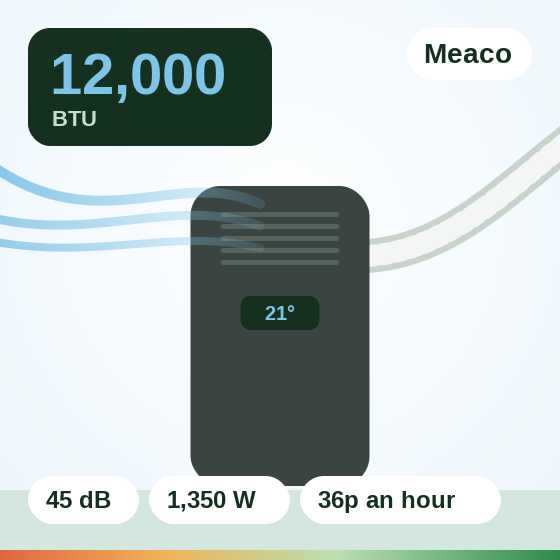
Meaco
Cirro 12000 BTU Super Quiet Smart Portable Air Conditioner & Heater (A-Cirro-12K-CH)
12,000 BTU · 45 dB · 1,350 W · 36p an hour
£539.99 at Meaco (maker shop), checked 13 Nov 2026
See it at Meaco (maker shop)
Figures from the maker or retailer listing. Cost an hour is our own, at the price cap of 26.32p a kWh.