
Key takeaways
- A plug-in portable is the usual air conditioning for flats: it is not development, so it needs no planning permission, but renters should check the tenancy agreement and leaseholders the lease.
- A fitted split changes the outside of the building: the lease and its plan show which parts are yours and whether you need the freeholder’s consent, and it may need planning permission too; you can need both.
- In England, permitted development covers one outdoor unit per block of flats, up to 0.6 cubic metres, and only if it heats as well as cools; a block with a shop in it does not qualify. Ask the council and the freeholder.
- A top-floor flat needs about 20% more cooling by our rule: a 4.5 x 4 m living room needs about 6,142 BTU (buy 7,000), or 7,370 BTU (buy 8,000) on the top floor.
With air conditioning for flats, what you are allowed to fit matters as much as which model to buy; for bedrooms in any home, see air conditioners for a bedroom. This page sets out the permissions first, then the options from least to most permission needed, then our picks with running costs. Every figure comes from makers’ and retailers’ documents listed at the end; we have not tested any unit. For the law on leases in depth, see air conditioning in a leasehold flat.
What can you fit in a flat?
From least to most permission needed:
| Option | What changes outside | Permission likely needed | Notes |
|---|---|---|---|
| Plug-in portable | A hose through an open window | Usually none; tenants check the tenancy agreement, leaseholders the lease | The usual flat option |
| Portable split (Midea PortaSplit) | An outdoor half hangs outside a window or on a balcony | Not confirmed: ask the freeholder or landlord | See the labelled box below |
| Through-the-wall monoblock (Argo Apollo) | Two holes in an outside wall, with grilles | Treat as an alteration needing consent (our reading) | No outdoor unit |
| Fitted split | Outdoor unit on the wall or balcony, pipes through the wall | Freeholder’s consent if the lease requires it; planning permission unless permitted development applies | Quietest and cheapest to run |
Whether a through-the-wall unit counts as an alteration under your lease is our reading, not a rule we found stated; read the lease and ask. Our guides to wall-mounted units without an outdoor unit and window air conditioners cover those types.
Do you need permission?
If you own a leasehold flat. Read the lease before fitting air conditioning. GOV.UK says your lease sets out the conditions you have agreed to, for example “if you need permission to make alterations”; the lease and its plan show which parts of the building are yours and whether you need the landlord’s (freeholder’s) consent. In England and Wales, where a lease needs consent for improvements, the Landlord and Tenant Act 1927 says that consent “is not to be unreasonably withheld”, though the landlord can ask for a reasonable sum for damage or loss of value and legal costs. Our reading is that a lease which bans alterations outright is not softened by that rule; confirm with a solicitor.
Planning permission. Planning permission and the landlord’s consent are separate: you can need both.
- England. An outdoor unit that heats, or heats and cools, can usually go up under permitted development if it meets the limits; a unit used only for cooling is not covered and needs planning permission. For flats the right covers a block of flats, with one unit per block and an outdoor unit of no more than 0.6 cubic metres, and “A block of flats must consist wholly of flats”, so a block with a shop or other business does not qualify. How one flat owner’s unit counts against “one per block” is not set out, so ask the council and the freeholder.
- Scotland. The right covers a building containing flats, or a flat within it, with one air source heat pump per building, used only for domestic heating or hot water.
- Wales and Northern Ireland. The rights we found are for houses only; flat owners should ask the council.
- Listed buildings. Fitting air conditioning to a listed building, or in its grounds, is outside permitted development in every nation, and any alteration that affects the building’s character needs listed building consent.
If you rent. No law we found requires a landlord in England or Wales to provide air conditioning. A tenant who wants to fit it checks the tenancy agreement and asks the landlord; GOV.UK says “You should only carry out repairs if the tenancy agreement says you can.” Whether you need permission for a plug-in portable depends on your tenancy agreement; we found no general rule. In England, Awaab’s Law has applied to social landlords since 27 October 2025, and the regulations that extend Awaab’s Law to excess heat in social housing in England (S.I. 2026/1195) were made on 13 November 2026, with 30 November 2026 as the date they come into force. For private renting, the government opened a consultation on extending it; when we checked on 25 November 2026 it was still open, closing on 18 December 2026. See landlords and air conditioning and heatwaves in rented homes.
Noise. There is no fixed decibel limit for home air conditioning once it is installed, but if an outdoor unit’s noise unreasonably and substantially interferes with a neighbour’s use of their home, the council can treat it as a statutory nuisance and serve an abatement notice. See air conditioning noise rules.
The engineer. A split that contains F-gas must be fitted by an F-gas qualified technician working for a certified company. See F-gas rules.
This is general information, not legal advice. See air conditioning planning permission and listed buildings.
What size air conditioner does a flat need?
We use one rule across the site, from Daikin UK’s guidance of around 0.1 kW of cooling per square metre at a 2.4 m ceiling. These rooms are our worked examples.
| Room | Volume | Cooling needed | Buy |
|---|---|---|---|
| Flat living room, 4.5 x 4 m, 2.4 m ceiling | 43.2 m3 | 1,800 W, 6,142 BTU | 7,000 BTU |
| Same room in a top-floor flat (+20%) | 43.2 m3 | 2,160 W, 7,370 BTU | 8,000 BTU |
The working: 43.2 x 100 / 2.4 = 1,800 W; x 3.412 = 6,142 BTU. On the top floor, under the roof, we add 20% (the top of the 10 to 20% that Electric Point, a retailer, gives for top-floor rooms): 2,160 W, 7,370 BTU. For bedrooms, see the bedroom guide or small AC units for a bedroom; the BTU calculator does other rooms.
Venting a portable in a flat
Tilt-and-turn, top-hung and restricted-opening windows make a window kit harder; a Juliet balcony door can take a door seal. Hoses are short (1.8 m on the Meacos). See how to vent a portable air conditioner, window kits for outward-opening windows and venting without a window.
Our picks at a glance
Running costs are at 26.32p per kWh, the Great Britain price cap for 1 October to 31 December 2026. Portables and the Argo are costed from rated input power at full output over our standard summer of 350 hours (an assumption, not a forecast); the PortaSplit from its energy label figure, which assumes 350 hours of cooling a year; the Mitsubishi from a formula estimate over the same hours. The methods differ, so the figures are not like for like.
| Unit | Type | Permission likely needed | Size | Per hour | Per summer or year | Quietest stated | Price, checked |
|---|---|---|---|---|---|---|---|
| MeacoCool MC Pro 9000 | Portable | Usually none | 9,000 BTU | 26.5p | £92.58 | 52 dB (type not stated) | From £399.99 at Meaco, 13 November 2026 (out of stock) |
| Meaco Cirro 12000 | Portable | Usually none | 12,000 BTU | 35.5p | £124.36 | 45 dB, Super Quiet mode | From £539.99 at Meaco, 13 November 2026 (in stock) |
| Pro Breeze 7000 | Portable | Usually none | 7,000 BTU | 20.5p | £71.85 | 54 dBA (one figure) | From £279.99 at Pro Breeze, 13 November 2026 (sold out) |
| Argo Apollo | Through-the-wall | Consent (our reading); ask the council | 8,000 BTU | 23.7p | £82.91 | 29 dB(A) fan only; 46 to 48 dB(A) cooling (listing) | Listed at £869.00 at Appliances Direct, 13 November 2026 |
| Mitsubishi Electric MSZ-LN25VG3 | Fitted split | Consent and planning rules | 2.5 kW | about 6.3p average | £21.93 (formula estimate) | 19 dB(A) indoor sound pressure | Installed only |
These figures use the Great Britain price cap. In Northern Ireland, use the unit rate on your own bill. See air conditioning running costs.
How we chose
Permission needed first, then fit to our flat examples, computed running cost, the maker’s lowest noise figure and its type, and a dated UK price. Specifications come from makers’ documents, or the retailer’s listing where we say so. No scores and no testing.
No-permission picks (portables)
MeacoCool MC Pro 9000: most flat living rooms and bedrooms
Who it suits: a flat living room or bedroom up to 26.3 m2 by our rule (Meaco gives 16 to 26 m2), including our top-floor example. Key specs: 9,000 BTU from 1,005 W; heats too (8,100 BTU); class A; R290; 52 dB lowest (type not stated); 24.3 kg; 1.8 m hose; two-year warranty. Running cost: 1.005 kW x 26.32p = 26.5p an hour, £2.12 a night, £92.58 a summer. Watch for: at 24.3 kg it is heavy to carry up stairs. We have not read this model’s manual; Meaco’s manual for its Cirro+ units says “Do not leave the air conditioner running unattended”, so check your own unit’s manual before running it overnight or unattended. Where to buy: from £399.99 at Meaco , checked 13 November 2026, when it was out of stock. More on the MC Series Pro 9000 page and the Meaco range.
Meaco Cirro 12000: top-floor flats and larger rooms
Who it suits: a hot top-floor flat or an open-plan room; Meaco gives 20 to 30 m2. Key specs: 12,000 BTU (3.5 kW) from 1,350 W; heats (10,000 BTU); EER 2.7, class A; R290; 45 dB in Super Quiet mode, sound power 51 dB on its energy fiche; 28.9 kg; 1.8 m hose; two window kits; two-year warranty. Running cost: 1.35 kW x 26.32p = 35.5p an hour, £2.84 a night, £124.36 a summer. Watch for: at 28.9 kg it is the heaviest here. Where to buy: from £539.99 at Meaco , checked 13 November 2026, when it was listed in stock. More on the Cirro 12000 page.
Pro Breeze 7000: budget, for a bedroom
Who it suits: a flat bedroom on a budget; Pro Breeze gives 8 to 16 m2, which is smaller than our 18 m2 living room, so choose a larger unit for that. Key specs: 7,000 BTU (2.05 kW) from 780 W; EER 2.6, class A; R290; 19.5 kg; 54 dBA, one figure; sleep mode and a 1 to 24 hour timer. Warranty term: Not stated by the maker. Running cost: 0.78 kW x 26.32p = 20.5p an hour, £1.64 a night, £71.85 a summer. Watch for: its manual asks for a room larger than 7 m2 and 50 cm of clearance on all sides, and says never to leave it unattended while in use. Where to buy: from £279.99 at Pro Breeze , checked 13 November 2026, when it was sold out. More on the Pro Breeze 7000 BTU page.
Portable split: ask before you buy
Portable split: ask before you buy
The Midea PortaSplit is an indoor unit on wheels joined by a sealed refrigerant line to a small outdoor half. The seller’s listing includes a “Window / balcony mounting bracket (for outdoor unit)”, so there is no hose through the room and the compressor is outside. Midea says it is 12,000 BTU (3.5 kW), SEER 6.1, A++, and 39 dB(A) in Silent Mode; the listing gives sound pressure as 39 to 49 dB. Its label figure is 201 kWh a year, which at 26.32p per kWh is £52.90 a year. It was listed from £999.00 at Appliances Direct , checked 14 November 2026.
Why it is in a box and not in our picks: new movable room air conditioners, which the law defines as hermetically sealed units the user can move between rooms, cannot use an HFC with a GWP of 150 or more (since 1 January 2020). The PortaSplit uses R32 (GWP 675), and we could not confirm whether the GB F-gas rules treat it as a movable unit or as a split system. The listing also contradicts itself: it says the unit “does not require installation by an F Gas certified engineer”, and elsewhere that R32 “requires installation by an F-Gas certified engineer”. Whether a lease or the planning rules cover an outdoor half hanging from a flat’s window or balcony is also not confirmed. Ask the seller, and the freeholder or landlord, before you buy. More on the PortaSplit page and our portable split guide.
With consent: through-the-wall and fitted splits
Argo Apollo: no outdoor unit
Who it suits: a flat where an outdoor unit would not be allowed but the freeholder will consent to two small wall holes; 8,000 BTU covers our top-floor example. Key specs, according to the retailer’s listing: 8,000 BTU (2.35 kW) from 900 W; heats (2.36 kW); EER 2.61, class A; R32; 29 dB(A) in fan-only mode, 46 to 48 dB(A) at rated cooling; 36.2 kg; 615 x 965 x 200 mm; one-year warranty. It mounts on the inside of an outside wall with two ducts through it. Room size: not stated in the official datasheets, the listing says. Running cost: 0.9 kW x 26.32p = 23.7p an hour, £1.90 a night, £82.91 a summer at full power. Watch for: the listing lists the unit as pre-gassed, while its general text says R32 units need an F-gas certified engineer; confirm who fits it before ordering. Where to buy: listed at £869.00 at Appliances Direct , checked 13 November 2026. Check what the price includes before ordering.
Mitsubishi Electric MSZ-LN25VG3: quietest and cheapest to run
Who it suits: a leaseholder with the freeholder’s consent, for a living room or bedroom up to 25 m2 (2.5 kW x 10), which covers our top-floor example. Key specs: 2.5 kW cooling (1.0 to 3.5 kW), 3.2 kW heating; SEER 10.5, A+++; indoor sound pressure in cooling 19, 23, 29, 36 and 42 dB(A) across its fan speeds; outdoor unit 46 dB(A) in cooling; R32. Warranty: Not stated by the maker. Running cost: a formula estimate, not the label figure: 2.5 kW x 350 hours / SEER 10.5 = 83.3 kWh a year, which at 26.32p per kWh is £21.93 a year, about 50.1p a night on average, assuming the design load equals the rated capacity. It heats and cools, which matters for permitted development in England. Where to buy: through an installer. Published installed prices for a single split in one room run from about £1,500 to £4,000 (OVO £1,500 to £2,500; Fuse Energy £1,500 to £4,000); a survey sets the price for your flat. See installation costs and the Mitsubishi Electric range.
For the whole home, see home air conditioning and the best home air conditioners; for portables in general, portable air conditioners.
Frequently asked questions
Can I have air conditioning in a flat?
Yes. A plug-in portable needs no planning permission and is the usual choice; check your lease or tenancy agreement. For a fitted split, the lease shows whether you need the freeholder’s consent; it may need planning permission too, and must be fitted by an F-gas qualified engineer.
Do I need my freeholder’s permission for air conditioning?
Your lease tells you: GOV.UK says it sets out “if you need permission to make alterations”, and the lease and its plan show which parts of the building are yours. In England and Wales, where the lease allows improvements with consent, the landlord cannot unreasonably refuse it. For a portable, check the lease.
Do I need planning permission for air conditioning in a flat?
In England, permitted development covers one outdoor unit per block of flats, up to 0.6 cubic metres, only if it heats as well as cools and only in a block made up wholly of flats; otherwise you need planning permission. Scotland allows one unit per building for heating or hot water; the Welsh and Northern Ireland rights we found are for houses. Ask the council. This is general information, not legal advice.
Can I use a portable air conditioner in a rented flat?
Usually, but check the tenancy agreement; we found no general rule. Before fitting a split, check the tenancy agreement and ask the landlord.
What is the best air conditioner for a top-floor flat?
A top-floor 4.5 x 4 m living room needs about 7,370 BTU by our rule, so 8,000 BTU. The MeacoCool MC Pro 9000 covers it as a portable; the Meaco Cirro 12000 gives more headroom; with consent, the Mitsubishi Electric MSZ-LN25VG3 split is the quietest and cheapest to run.
Can I put an air conditioning unit on my balcony?
Check the lease and its plan first: they show whether the balcony and wall are yours and whether you need the freeholder’s consent. The planning rules above apply too. Whether a lease or the planning rules cover the PortaSplit’s outdoor half on a balcony bracket is not confirmed.
Can my freeholder refuse air conditioning?
If the lease bans alterations outright, yes. If it allows improvements with consent, in England and Wales the Landlord and Tenant Act 1927 says consent “is not to be unreasonably withheld”, though the freeholder can ask for reasonable costs. Get advice on your own lease.
Sources
- Ofgem: Changes to energy price cap between 1 October and 31 December 2026 (checked 14 November 2026)
- legislation.gov.uk: Regulation (EU) No 626/2011, Annex VII, 350 hours a year in cooling mode (checked 14 November 2026)
- Daikin UK: Air conditioner size guide (checked 14 November 2026)
- Electric Point: Portable air conditioning units, UK buying guide (checked 14 November 2026)
- GOV.UK: Leasehold property, leaseholder rights and responsibilities (checked 14 November 2026)
- legislation.gov.uk: Landlord and Tenant Act 1927, section 19 (checked 14 November 2026)
- Planning Portal: Air source heat pumps, planning permission (England) (checked 14 November 2026)
- Scottish Government: Circular 1/2024, householder permitted development rights, Class 6H (checked 14 November 2026)
- Welsh Government: Planning permission, heat pumps (checked 14 November 2026)
- legislation.gov.uk: Planning (General Permitted Development) (Amendment) Order (Northern Ireland) 2023, Schedule (checked 14 November 2026)
- legislation.gov.uk: Planning (Listed Buildings and Conservation Areas) Act 1990, section 7 (checked 14 November 2026)
- GOV.UK: Private renting, repairs (checked 14 November 2026)
- legislation.gov.uk: Hazards in Social Housing (Prescribed Requirements) (England) Regulations 2025 (checked 14 November 2026)
- GOV.UK: Awaab’s Law phase 2, guidance for social landlords (checked 25 November 2026)
- legislation.gov.uk: Hazards in Social Housing (Prescribed Requirements) (England) (Amendment) Regulations 2026 (S.I. 2026/1195), as made (checked 25 November 2026)
- GOV.UK: Extending Awaab’s Law to private rented tenancies and to licences (consultation) (checked 25 November 2026)
- GOV.UK: Statutory nuisances, how councils deal with complaints (checked 14 November 2026)
- GOV.UK: Qualifications to work with F gas (checked 14 November 2026)
- legislation.gov.uk: Regulation (EU) No 517/2014, Annex III (checked 14 November 2026)
- GOV.UK: Bans on F gas in new products and equipment (checked 14 November 2026)
- OVO: Air conditioning installation cost (checked 14 November 2026)
- Fuse Energy: Air conditioning installation costs (checked 14 November 2026)
- Meaco: MeacoCool MC Series Pro 9000 CH (checked 13 November 2026)
- Meaco: Cirro 12000 BTU Super Quiet Smart (checked 14 November 2026)
- EPREL product fiche 2756020, Meaco Cirro 12000 (checked 14 November 2026)
- Pro Breeze: 7000 BTU 3-in-1 Portable Air Conditioner (checked 13 November 2026)
- Pro Breeze: PB-AC04 instruction manual (UK and EU) (checked 14 November 2026)
- Appliances Direct: Midea PortaSplit 12000 BTU (checked 14 November 2026)
- Midea UK: PortaSplit (checked 14 November 2026)
- EPREL product fiche 1917520, Midea PortaSplit (checked 14 November 2026)
- Appliances Direct: Argo Apollo 8000 BTU (price checked 13 November 2026; listing re-read 14 November 2026)
- Mitsubishi Electric UK: MSZ-LN R32 product information sheet (checked 14 November 2026)
- Meaco: Cirro+ 14,000 and 16,000 BTU (and CH) instruction manual (checked 15 November 2026)
Other products mentioned
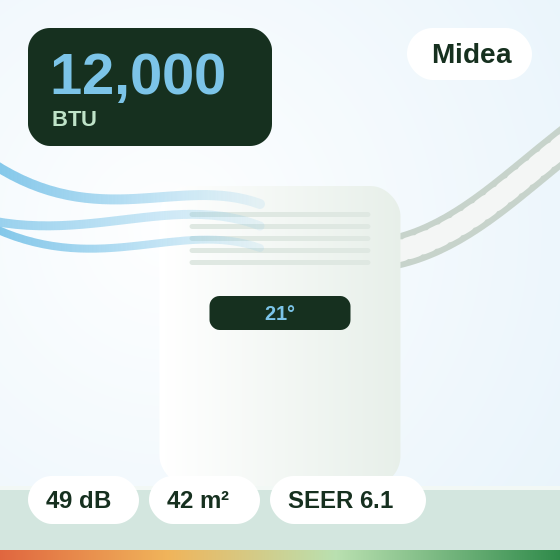
Midea
PortaSplit
12,000 BTU · 49 dB · 42 m² · SEER 6.1
£999.00 at Appliances Direct, checked 14 Nov 2026
See it at Appliances Direct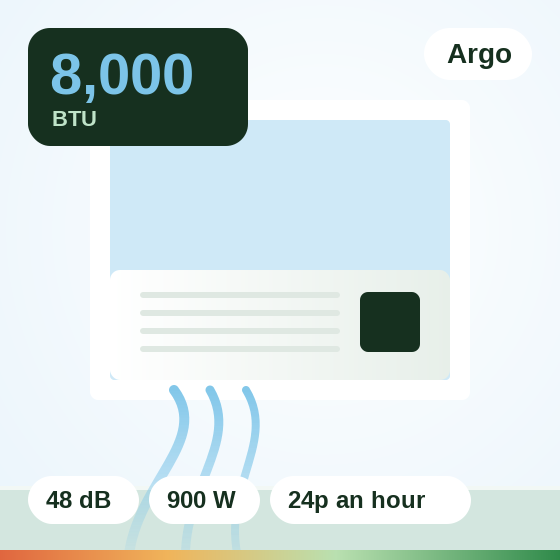
Argo
Apollo 8000 BTU Mounted Inverter All-In-One Smart Air Conditioner with Heat Pump (APOLLO-12HP)
8,000 BTU · 48 dB · 900 W · 24p an hour
£869.00 at Appliances Direct, checked 13 Nov 2026
See it at Appliances Direct
Figures from the maker or retailer listing. Cost an hour is our own, at the price cap of 26.32p a kWh.