
Key takeaways
- A wall mounted air conditioner with no outdoor unit is a monoblock: everything sits in one indoor box on the wall, and air moves in and out through ducts in the outside wall.
- On the units we cover, it runs noisier in the room and costs more to run than a split. The Argo Apollo draws 900 W at full power, which is £82.91 over 350 hours, against £24.21 a year for a Daikin Perfera 2.5 kW on its label. The two methods differ, so the gap is a guide.
- The Apollo’s listing says its R32 refrigerant needs installation by an F-Gas certified engineer. A split has to be fitted by an F-gas qualified engineer too, per GOV.UK.
- Flats, leasehold homes and listed buildings need extra checks before any hole goes through the wall.
If you want a fixed unit but no box outside, a through-the-wall monoblock is the answer, with trade-offs. This guide explains how it works, what fitting involves and who should choose one. For the usual alternative, see split air conditioners.
How they work
A split has a compressor in an outdoor unit. A monoblock keeps the compressor, both coils and the fans in one box. Air from outside is drawn through one wall duct to cool the hot coil and leaves through a second, while room air cools over the other coil. Appliances Direct’s listing for the Argo Apollo says it needs “only wall ducts for intake and exhaust”, and gives its size as 615 x 965 x 200 mm (H x W x D). Our list of the best air conditioners without an outdoor unit compares the units on sale; the wall mounted air conditioner hub shows how this sits beside the other kinds. For units sold as ventless, see our ventless air conditioner guide.
What fitting involves
The unit hangs on a wall, and two holes go through the outside wall for the ducts. The Apollo’s listing says it includes an installation template. It does not give the hole sizes, so check the maker’s manual before you drill.
The Apollo’s listing gives R32, and says: “R32 requires installation by an F-Gas certified engineer.” GOV.UK says you must have F-gas qualifications to install new systems, service them, check for leaks and recover the gas. The listing also gives a second refrigerant, R290, in the text beside its R32 specification, and we could not confirm which is right. Our F-gas regulations guide explains the rules. The Apollo is listed at £869.00 at Appliances Direct , checked 14 November 2026; check what the price includes before you order.
Running cost against a split
How we work it out. For the Apollo we multiply its rated input of 900 W by 26.32p per kWh, Ofgem’s average unit rate for 1 October to 31 December 2026. For the split we use the energy label’s yearly cooling use, 350 hours at full design load.
The working, once: 900 W is 0.9 kW. 0.9 kW x 26.32p = 23.7p an hour. Over an eight-hour night that is £1.90. Over the same 350 hours (for the Apollo, our assumption, not a label figure), 0.9 x 350 = 315 kWh, which is £82.91.
The Daikin Perfera 2.5 kW uses 92 kWh a year on its label, which is £24.21. The gap is £58.70 a year at this cap, but the methods differ: the Apollo figure is rated input at full power, an upper estimate, and the Perfera figure is a seasonal label figure. These figures use the Great Britain price cap. In Northern Ireland, use the unit rate on your own bill. They leave out the standing charge. See air conditioning running costs.
Noise
The Argo Apollo’s listing gives 29 dB(A) as the lowest sound pressure, in fan-only mode, and 46 to 48 dB(A) at rated operation, with a sound power of 56 dB(A). Because the compressor is in the room, you hear it. A Daikin Perfera 2.5 kW indoor unit is rated at 19 to 41 dB(A), with its compressor outdoors. See noise regulations.
Permissions
The planning right for air conditioning in England, Class G, covers air source heat pump outdoor units, and says the unit must not be used solely for cooling. We found no GOV.UK statement on through-the-wall units with wall ducts, so check with your council. See air conditioning planning permission.
- Flats and leasehold: GOV.UK says your lease sets out “if you need permission to make alterations”. The lease and its plan show which parts of the building are yours and whether you need the freeholder’s consent, so check them first. See air conditioning in a leasehold flat.
- Listed buildings: Class G excludes listed buildings and their grounds. See air conditioning in a listed building.
Who should choose one
- Someone with no outside space or no place for an outdoor unit, such as a flat with an external wall but no balcony or yard.
- A property where a visible outdoor box is not allowed or not wanted.
- Someone who wants fixed cooling in one room and accepts higher running costs and more noise in the room.
Otherwise a split or a portable suits most rooms better; see best air conditioners for flats and the window air conditioner page. Call an F-gas qualified engineer before you buy.
Frequently asked questions
Is there a wall mounted air conditioner without an outdoor unit?
Yes. The Argo Apollo 8,000 BTU is an example: a monoblock that hangs on the wall and uses two wall ducts instead of an outdoor unit. It is listed at £869.00 at Appliances Direct, checked 14 November 2026; check what the price includes before you order.
How big are the holes for a through-the-wall air conditioner?
The Apollo’s listing does not say. It includes an installation template; check the manual for the hole sizes.
Does a wall air conditioner with no outdoor unit need an F-gas engineer?
The Apollo’s listing says its R32 “requires installation by an F-Gas certified engineer”. GOV.UK says you must have F-gas qualifications to install new systems and check for leaks.
Are they as good as a split system?
Not on the units we cover. The Apollo is noisier in the room (46 to 48 dB(A) against 19 to 41 dB(A) for a Perfera indoor unit) and costs more to run, by a method that differs from a label.
Do I need planning permission?
We found no GOV.UK statement on units with wall ducts, so ask your council. Class G for outdoor heat pump units excludes cooling-only units and listed buildings. Leaseholders should also check the lease.
Do they heat as well?
The Apollo’s listing gives a heating output of 2.36 kW and a heating input of 0.76 kW, against 2.35 kW of cooling.
Sources
- GOV.UK: Qualifications to work with F gas (checked 14 November 2026)
- legislation.gov.uk: General Permitted Development Order 2015, Schedule 2, Part 14 (checked 14 November 2026)
- Ofgem: Changes to the energy price cap, 1 October to 31 December 2026 (checked 14 November 2026)
- Appliances Direct: Argo Apollo APOLLO-12HP (checked 14 November 2026)
- Daikin UK: Perfera FTXM-A / RXM-A9 specifications (checked 14 November 2026)
- Daikin UK: FTXM-A indoor unit specifications (checked 14 November 2026)
- GOV.UK: Leaseholder rights and responsibilities (checked 14 November 2026)
Products on this page
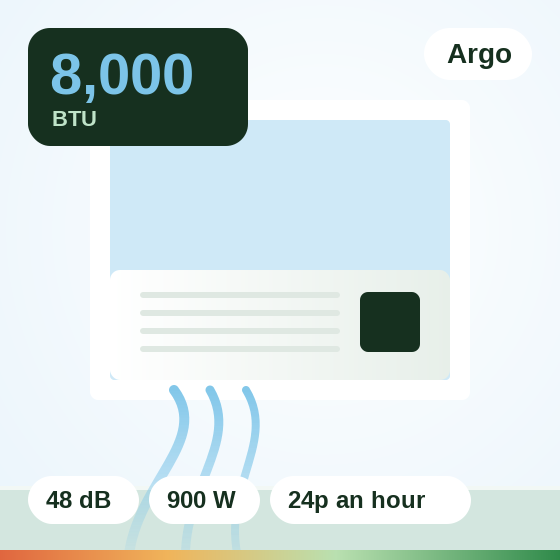
Argo
Apollo 8000 BTU Mounted Inverter All-In-One Smart Air Conditioner with Heat Pump (APOLLO-12HP)
8,000 BTU · 48 dB · 900 W · 24p an hour
£869.00 at Appliances Direct, checked 13 Nov 2026
See it at Appliances Direct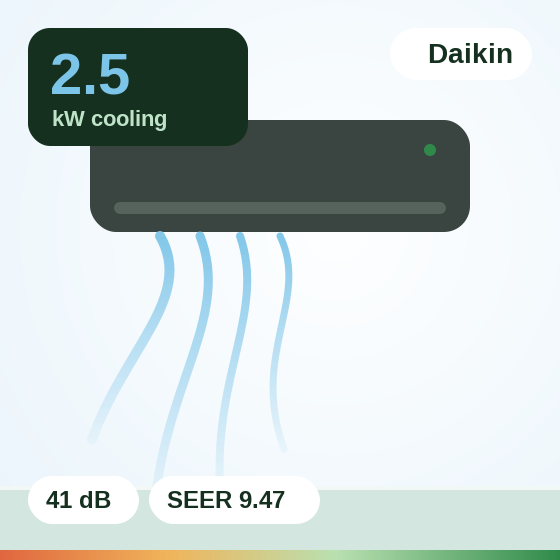
Daikin
Perfera FTXM25A (indoor) with RXM25A5V1B9 (outdoor), 2.5 kW
2.5 kW cooling · 41 dB · SEER 9.47
No current UK price found
Figures from the maker or retailer listing. Cost an hour is our own, at the price cap of 26.32p a kWh.