
Key takeaways
- A tent air conditioner can work, but a tent is a poor place for one: thin fabric lets heat straight back in, the hot air must leave through a hose, and the power comes from a limited hook-up.
- Because a tent loses cool air through its walls, no room-sizing rule applies, so we give no BTU figure for a tent.
- Most Camping and Caravanning Club sites give 10 or 16 amp hook-ups, and the Club says tents need a proprietary hook-up unit made for tents.
- The one real air conditioner here that can run on a battery is the EcoFlow WAVE 3; the EcoWizard listing gives 2 to 8 hours on its add-on battery and states no conditions for that range.
- Most cheap “camping air conditioners” are evaporative air coolers: no hose, a water tank and no BTU figure.
Most campers looking for a tent air conditioner will be better served by shade, airflow and a fan; for cooling a room at home, see air conditioners for a bedroom. If you still want a real air conditioner under canvas, this page explains what it needs (a hose route, ground space and power), what it draws from a hook-up, and the one unit we would consider. Every figure comes from makers’ and retailers’ documents listed at the end; we have not tested any unit.
Can you air condition a tent?
Yes, but with three catches.
- The fabric. An air conditioner removes heat from the air inside. Tent fabric holds very little heat back, so warm air and sun on the walls keep replacing what the unit removes. Our sizing rule (100 W of cooling per square metre at a 2.4 m ceiling, from Daikin UK’s guidance for homes) assumes walls and a roof that insulate; a tent does not, and no maker or camping club gives a tent formula. That is why this page gives no BTU figure.
- The hose. A portable air conditioner pushes its heat out through an exhaust hose. In a tent that means a port, a flap or a zipped gap the hose can pass through. No maker or club we read explains how to route a hose through a tent; our reading is that any gap left around it lets warm air back in. See how to vent a portable air conditioner.
- The power. A real air conditioner draws hundreds of watts. On a pitch that means an electric hook-up; off grid it means a large battery.
A “ventless” unit with no hose cannot remove heat from the space; our guide to ventless air conditioners explains why, and portable air conditioners without a hose covers the options people ask about.
Power: hook-up or battery?
Hook-up. The Camping and Caravanning Club says “Hook-ups on Club Sites have maximum ratings of 10A or 16A”; most can provide 16 A, some only 10 A, and other campsites may provide “as little as 5A”. It works out 10 A as 2,300 W and 16 A as 3.68 kW. For tents it says “it is essential to use a proprietary electric hook-up device, manufactured specifically for tent hook-ups”, and that the cable will likely be the lower grade 1.5 mm2 and only 15 m long, so plan where you pitch. The Caravan and Motorhome Club’s rule of thumb is that 1 kW of load needs 5 A at 230 V.
Battery. We quote a battery runtime only as a source states it, with the source named. Neither club’s page mentions air conditioners.
What the WAVE 3 uses of a tent hook-up
No current is stated for the WAVE 3, so we work it out from the two power figures the EcoWizard listing states: “Rated Cooling Power (AC/DC): 690W / 640W” and an AC input of “820W Max” (at 100 to 240 V). At 230 V, 690 W / 230 = 3.0 A, and the 820 W maximum / 230 = about 3.6 A. These are our sums, not a current the maker states; for a hook-up, plan on the maximum.
| Unit | Current when cooling | Left on 10 A | Left on 16 A |
|---|---|---|---|
| EcoFlow WAVE 3 | about 3.0 A at 690 W; up to about 3.6 A at the 820 W maximum (our sums) | about 6.4 A at the maximum | about 12.4 A at the maximum |
A 2 kW domestic fan heater draws 8.7 A in the Camping and Caravanning Club’s table, and the Club warns that domestic kettles “can draw 10A or more on their own”. On a 10 A hook-up, neither fits alongside the WAVE 3.
Our picks
| Unit | Type | Cooling | Power | Current (hook-up) | Battery option | Weight | Price, checked |
|---|---|---|---|---|---|---|---|
| EcoFlow WAVE 3 | Portable air conditioner, mains or battery | 6,100 BTU (1.8 kW) | 690 W mains, 640 W DC | about 3.0 A rated, up to about 3.6 A (our sums) | Optional add-on battery, 2 to 8 hours (EcoWizard listing, no conditions stated) | 15.6 kg | From £799.00 at EcoWizard, 14 November 2026 (out of stock); £1,299.00 with battery at EcoFlow UK, 14 November 2026 |
How we chose: a real refrigerant air conditioner (not an air cooler), a published power figure we can check against a hook-up, the lowest weight and draw in our product files, and a UK price with a date. No testing and no scores. Units such as the Zero Breeze Mark 3, sold for camping, are not listed because we could not read a UK listing or a maker’s specification for them.
EcoFlow WAVE 3: the pick for a tent
Who it suits: campers with an electric hook-up, or with the budget for the add-on battery, who want a real air conditioner they can carry. Key specs: 6,100 BTU (1.8 kW) cooling and 6,800 BTU heating; 690 W on mains and 640 W on DC; EER 2.6; R290; 15.6 kg; 519 x 297 x 336 mm; noise 44 to 58 dB, type not stated; two-year warranty. The EcoWizard listing’s specification gives “Runtime (with Add-On Battery): 2-8 hours” and states no power setting or temperature for that range. Room size and energy class: Not stated by the maker. Running cost: at home, 0.69 kW x 26.32p = 18.2p an hour, or £1.45 for an 8-hour night. Watch for: the EcoWizard listing is inconsistent on hoses: its FAQ says inlet and exhaust ducts, its box list only an exhaust duct. Work out the hose route through your tent before you go. Where to buy: from £799.00 at EcoWizard , checked 14 November 2026, when it was out of stock. EcoFlow UK listed it at £799.00 alone and £1,299.00 with the battery on 14 November 2026 at EcoFlow UK . More on the EcoFlow WAVE 3 page and the EcoFlow range.
Why not a cheaper home portable?
A home portable such as the Pro Breeze 5000 draws less (563 W, a “Rated Input Current” of 2.5 A in its manual), but its manual says “This appliance is intended for indoor household use and similar applications. Do not use outdoors” and “Never leave the appliance unattended while in use”, and that it must be installed, operated and stored in a room with a floor area larger than 4 m2. A tent or awning is not covered by those words, so it is not a pick here. See the Pro Breeze range for its home units.
Camping “air conditioners” that are air coolers
Many small units sold as camping or tent air conditioners are evaporative coolers: a fan blows air over a wet pad or through water. You can tell from the listing:
- there is no exhaust hose;
- there is a water tank or an ice compartment;
- there is no BTU or kW cooling figure, only a fan speed or airflow.
An air cooler adds moisture to the air rather than taking heat out of the space, so it works best in dry heat and does less in humid weather. Our pages on air coolers, air cooler against air conditioner, evaporative coolers against air conditioners and solar air coolers explain the difference. Desk-sized mini air conditioners are mostly coolers too.
Other ways to keep a tent cool
Pitch in shade where you can, open vents and doors on opposite sides for a through draught, and keep the tent’s porch or awning closed against the sun. A battery or hook-up fan moves air across you for a fraction of an air conditioner’s power: see cooling fans. For heat and health advice in hot weather, see our UK heatwave guide.
Running costs
Pitch electricity is sometimes in the pitch fee and sometimes metered at the site’s own rate, which we have not checked, so we give no tent running cost in pounds. If you also use the unit at home, the figures above are at the Great Britain price cap of 26.32p per kWh (1 October to 31 December 2026), at full power, without the standing charge: the WAVE 3 costs 18.2p an hour and £1.45 a night. These figures use the Great Britain price cap. In Northern Ireland, use the unit rate on your own bill. See air conditioning running costs and, for off-grid camping, solar-powered air conditioners.
Frequently asked questions
Can you put an air conditioner in a tent?
You can, if it has a hose route out of the tent, ground space and power. A tent’s fabric lets heat back in quickly, so it will not cool like a room, and most campers do better with shade and a fan.
Will an air conditioner work on a camping hook-up?
A small one will. By our sums from its listed power figures, the EcoFlow WAVE 3 draws about 3.0 A at its rated 690 W and up to about 3.6 A at its 820 W maximum, well inside a 10 A or 16 A Club hook-up. Use a proprietary tent hook-up unit, as the Camping and Caravanning Club advises, and do not run a kettle or 2 kW heater at the same time on 10 A.
Is there a battery-powered air conditioner for camping?
The EcoFlow WAVE 3 runs on mains or an optional add-on battery; it was listed at £1,299.00 with the battery at EcoFlow UK on 14 November 2026. Most other battery “camping air conditioners” are air coolers.
Do camping air coolers work?
They blow cooler air at you in dry heat, but they add moisture rather than removing heat from the space, so they do less in humid weather. If a listing has a water tank and no hose or BTU figure, it is an air cooler.
How do you vent an air conditioner in a tent?
Through a port, flap or zipped gap in the tent. No maker or club we read gives instructions for a tent; our reading is that any gap left around the hose lets warm air back in. Follow the unit’s own manual on hose length and routing.
How long will a battery air conditioner run?
For the EcoFlow WAVE 3, the EcoWizard listing gives “Runtime (with Add-On Battery): 2-8 hours” and states no power setting or temperature for that range, so we cannot say which end you would get.
Sources
- Ofgem: Changes to energy price cap between 1 October and 31 December 2026 (checked 14 November 2026)
- Daikin UK: Air conditioner size guide (checked 14 November 2026)
- Camping and Caravanning Club: Electricity for campers and caravanners (checked 14 November 2026)
- Caravan and Motorhome Club: How caravan electrics work on site (checked 14 November 2026)
- EcoWizard: EcoFlow WAVE 3 (checked 14 November 2026)
- EcoFlow UK: WAVE 3 portable air conditioner (checked 14 November 2026)
- Pro Breeze: PB-AC08 instruction manual (UK) (checked 14 November 2026)
Other products mentioned
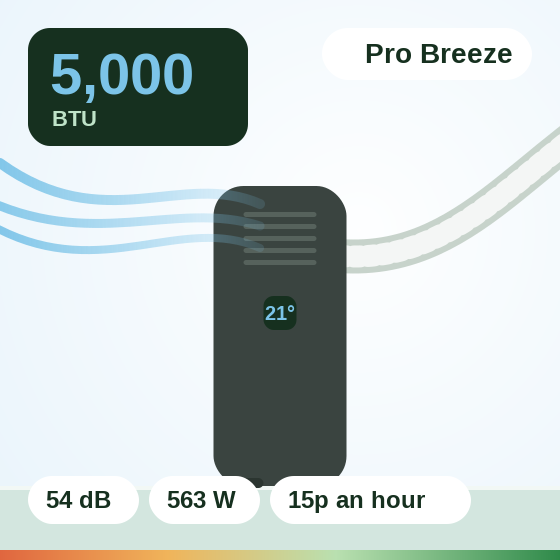
Pro Breeze
5000 BTU 3-in-1 Portable Air Conditioner with Dehumidification Function, Smart Wifi App (PB-AC-08)
5,000 BTU · 54 dB · 563 W · 15p an hour
£224.99 at Pro Breeze (maker shop), checked 13 Nov 2026
See it at Pro Breeze (maker shop)
Figures from the maker or retailer listing. Cost an hour is our own, at the price cap of 26.32p a kWh.