Key takeaways
- In a UK heatwave rental homes have no special cooling rules: no law we found requires a landlord in England or Wales to provide air conditioning. For staying safe in the heat, see our UK heatwave guide.
- Excess heat is one of the 21 hazards councils assess under England’s Housing Health and Safety Rating System, and the NHS says the council’s environmental health office can inspect a rented home for it.
- Awaab’s Law has applied to social housing in England since 27 October 2025. The regulations that extend it to excess heat (S.I. 2026/1195) were made on 13 November 2026, with 30 November 2026 as the date they come into force. It does not cover private renting.
- Before fitting anything, check your tenancy agreement and ask your landlord. A fan, shading and well-timed windows change nothing about the property.
- A 50 W pedestal fan costs about 1.3p an hour to run; a 780 W portable air conditioner about 20.5p.
This is general information, not legal advice. It covers England unless we say otherwise; the rules in Wales, Scotland and Northern Ireland differ, and we have not checked them for this page.
If you rent and your home is too hot, this page sets out what your landlord must and need not do, when to involve the council, and what you can do without changing the property.
Does a landlord have to keep a rented home cool?
Not as such. No law we found requires a landlord in England or Wales to provide air conditioning or to keep a home below any temperature.
What the law does require is about heating. Section 11 of the Landlord and Tenant Act 1985, which applies in England and Wales, makes the landlord of a short lease keep “in repair and proper working order the installations in the dwelling-house for space heating and heating water”. GOV.UK says “Your landlord is always responsible for repairs to” a list that includes “heating and hot water”.
So if your heating is stuck on in hot weather, that is a repair for your landlord. Report it in writing.
Excess heat as a housing hazard
In England, councils assess hazards in homes under the Housing Health and Safety Rating System (HHSRS). GOV.UK’s tenant guide says “the HHSRS comprises 21 types of hazards”, and excess heat is one of them: “A lack of ventilation can cause a property to become overheated, airless and stifling.” The NHS says you “can also get help from the environmental health office at your local council” and that “They can inspect a rented home for hazards to health, including excess heat.” The government’s HHSRS guide for landlords says “Local councils can inspect any property being used for residential purposes to determine whether action should be taken”.
The tenant guide gives no temperature at which a home counts as too hot, and no law we found makes a landlord fit air conditioning to deal with excess heat.
Awaab’s Law
- Social housing. “Awaab’s Law came into force in the social rented sector on 27 October 2025” (GOV.UK). It makes social landlords deal with certain hazards within fixed times. GOV.UK’s guidance for social landlords says “From 30 November 2026, Awaab’s Law will be extended to” a list of hazards “where they present a significant risk of harm”, including “excess heat”. The regulations that extend Awaab’s Law to excess heat in social housing in England (S.I. 2026/1195) were made on 13 November 2026, with 30 November 2026 as the date they come into force. Under that guidance, landlords must “Investigate any potential significant hazards within 10 working days of becoming aware of them”, with emergency hazards dealt with within 24 hours.
- Private renting. Awaab’s Law does not cover private tenancies. In October 2026 the government opened a consultation on extending it to private rented homes in England; when we checked on 25 November 2026 it was still open, closing at 11.59pm on 18 December 2026. Check GOV.UK for whether that has been brought in.
When to contact the council
Talk to your landlord first, in writing, and keep a copy. If nothing happens, or if the heat is affecting someone’s health, contact the environmental health department at your local council (GOV.UK gives the same advice when repairs are not done).
It helps to have a record:
- Room temperatures, with dates and times, especially where people sleep. The NHS asks everyone to “Check the temperature of rooms, especially where people at higher risk live and sleep”.
- Who lives there and who is at higher risk (a baby, someone aged 65 or over, someone with a long-term condition).
- Any health effects, and any GP or NHS 111 contact.
- What you have asked the landlord to do, and when.
Can a tenant use a fan or portable air conditioner?
A plug-in fan changes nothing about the property, so it is the safest choice.
A portable air conditioner is less clear. It needs its exhaust hose vented out of a window, usually through a window kit (see portable air conditioner window kits). Whether you need your landlord’s permission for one depends on your tenancy agreement; we found no general rule either way. For anything that changes the property, such as cutting a hole for a hose or fitting a split system, check your tenancy agreement and ask your landlord first. GOV.UK says tenants “should only carry out repairs if the tenancy agreement says you can”. If you own a flat on a lease, the lease decides: GOV.UK says it will tell you “if you need permission to make alterations”. See air conditioning in a leasehold flat and landlords, tenants and air conditioning.
What the tenant’s options cost to run
| Option | Rated power (maker or listing) | Per hour | Per 8 hours (a measure of cost) | Price, as listed |
|---|---|---|---|---|
| Igenix DF1655 16 in pedestal fan | 50 W | 1.3p | 10.5p | from £32.99 at Igenix , checked 14 November 2026 |
| Pro Breeze 7000 BTU 3 in 1 portable air conditioner | 780 W | 20.5p | £1.64 | from £279.99 at Pro Breeze , checked 13 November 2026 (sold out that day) |
How we worked it out. Igenix’s own page gives no wattage and listings differ: B&Q lists the fan at 50 W and Dunelm at 40 W. We use the higher 50 W, so the cost is not understated: an hour uses 0.05 kWh, 1.3p at 26.32p per kWh, or 10.5p for eight hours. The portable air conditioner’s manual gives 780 W in cooling: 20.5p an hour, £1.64 for eight hours. That is a measure of cost, not advice to leave it running: we have not read this unit’s safety instructions, so check its manual before running it overnight or unattended. The unit rate is Ofgem’s price cap average for electricity in Great Britain, by Direct Debit, 1 October to 31 December 2026, with the standing charge left out. These figures use the Great Britain price cap. In Northern Ireland, use the unit rate on your own bill. Rated power is at full output, so treat these as upper estimates. More options: air conditioning for flats and portable air conditioners.
Keeping a rented home cool without alterations
None of these changes the property. They come from UKHSA’s keep cool at home checklist and the NHS:
- Shade and time the windows. “If possible, shade or cover windows.” Keep windows, curtains and blinds shut on the sunny side by day; open windows when the air outside feels cooler than inside, usually in the evening and at night, if it is safe to.
- Cut heat inside. “Check that your heating is turned off”, and “turn off lights and electrical equipment that are not in use”.
- Use a fan properly. Fans help while the air is below 35C (NHS, UKHSA). Do not aim one directly at your body.
- Sleep in the coolest room. “Move to a cooler part of the house, especially for sleeping if possible.”
UKHSA says top-floor flats, homes with windows that open on one side only, and homes with large unshaded east, west or south-facing windows are more likely to overheat. Our guides to keeping your house cool and cooling a room without AC go further.
If someone in the home is at risk
The NHS says people most at risk in hot weather include older people, especially those aged 65 and over, babies and children aged 5 and under, people who are pregnant or have serious long-term conditions, and people who live alone.
When to get help (NHS)
“Heatstroke is a medical emergency.” Call 999 if you or someone else have signs of heatstroke, including “still being unwell after 30 minutes of resting in a cool place, being cooled and drinking fluids”, “a very high temperature”, “hot skin that’s not sweating and might look red”, “a fast heartbeat”, “fast breathing or shortness of breath”, “confusion and lack of coordination”, “a seizure or fit” or “loss of consciousness”. “Do not drive yourself to A&E.”
Call 111 if “you or someone else have symptoms of heat exhaustion that you’re struggling to treat or you need advice about”.
Most of the NHS and UKHSA guidance linked here is written for England; in Wales, Scotland and Northern Ireland, use your own nation’s NHS service.
Frequently asked questions
Is my landlord responsible if my house is too hot?
Not for the temperature as such. No law we found makes a landlord keep a home cool or fit air conditioning, but in England excess heat is one of the 21 hazards a council assesses under the HHSRS. This is general information, not legal advice.
Can I ask my landlord for air conditioning?
Yes, you can ask, but no law we found makes them agree. If you want to fit a unit yourself, check your tenancy agreement and ask your landlord before you start, because fitting one changes the property. See landlords, tenants and air conditioning.
Can I use a portable air conditioner in a rented flat?
Check your tenancy agreement first: whether you need permission depends on it, and we found no general rule either way. If the hose would mean cutting or drilling anything, ask your landlord before you do, and keep their answer in writing.
Who do I contact if my rented home is dangerously hot?
Tell your landlord in writing first. If that does not help, contact the environmental health office at your local council, which the NHS says can inspect a rented home for hazards to health, including excess heat. If anyone shows signs of heatstroke, call 999.
Does Awaab’s Law cover heat?
For social housing in England, from 30 November 2026, where it presents a significant risk of harm (GOV.UK guidance). The regulations that extend Awaab’s Law to excess heat in social housing in England (S.I. 2026/1195) were made on 13 November 2026, with 30 November 2026 as the date they come into force. It does not cover private renting; the government opened a consultation in October 2026 on extending it to private rented homes in England, which on 25 November 2026 was still open, closing on 18 December 2026.
Sources
- legislation.gov.uk: Landlord and Tenant Act 1985, section 11 (checked 14 November 2026)
- GOV.UK: Private renting, repairs (checked 15 November 2026)
- GOV.UK (MHCLG): Landlord and agent guide to the Housing Health and Safety Rating System (updated 16 September 2026) (checked 14 November 2026)
- GOV.UK (MHCLG): Awaab’s Law phase 2, guidance for social landlords (updated 31 July 2026) (checked 25 November 2026)
- GOV.UK (MHCLG): Extending Awaab’s Law to private rented tenancies and to licences, consultation (9 October to 18 December 2026) (checked 25 November 2026)
- GOV.UK: Leasehold property, leaseholder rights and responsibilities (checked 14 November 2026)
- NHS: Heatwave, how to cope in hot weather (reviewed 12 June 2026) (checked 15 November 2026)
- NHS: Heat exhaustion and heatstroke (reviewed 28 May 2026) (checked 15 November 2026)
- UKHSA: Beat the heat, keep cool at home checklist (updated 21 July 2026, England) (checked 15 November 2026)
- UKHSA: Beat the heat, staying safe in hot weather (updated 21 July 2026, England) (checked 15 November 2026)
- Ofgem: Changes to energy price cap between 1 October and 31 December 2026 (checked 14 November 2026)
- B&Q: Igenix DF1655 pedestal fan listing (50 W) (checked 14 November 2026)
- Igenix: DF1655 16 inch pedestal fan (checked 14 November 2026)
- Pro Breeze: 7000 BTU 3 in 1 portable air conditioner (checked 13 November 2026)
- Pro Breeze: PB-AC04 instruction manual (January 2023), specifications (checked 14 November 2026)
- GOV.UK (MHCLG): Tenant guide to the Housing Health and Safety Rating System (updated 16 September 2026, England) (checked 15 November 2026)
- legislation.gov.uk: Hazards in Social Housing (Prescribed Requirements) (England) (Amendment) Regulations 2026 (S.I. 2026/1195), as made (checked 25 November 2026)
- Dunelm: Igenix 16 inch pedestal fan listing (40 W) (checked 15 November 2026)
Products on this page
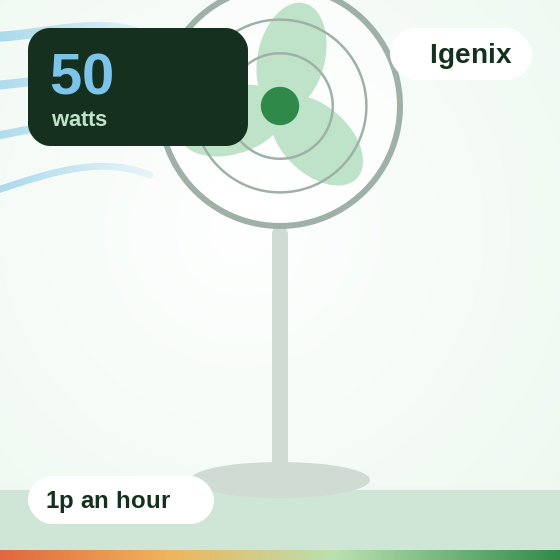
Igenix
DF1655 16 Inch Pedestal Fan, 3 Speeds, White
50 watts · 1p an hour
£32.99 at Igenix (maker shop), checked 14 Nov 2026
See it at Igenix (maker shop)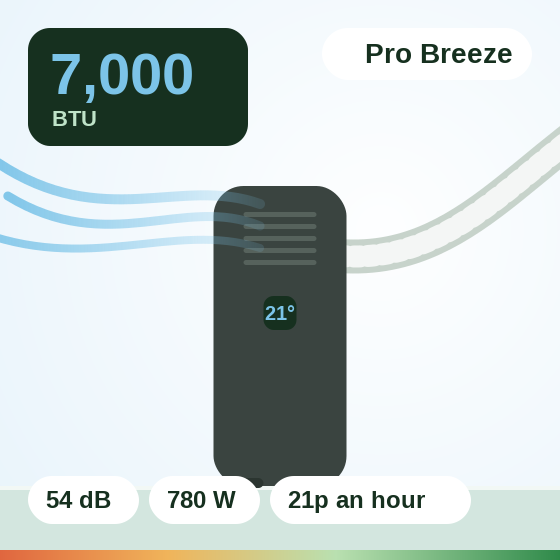
Pro Breeze
7000 BTU 3-in-1 Portable Air Conditioner with Dehumidification Function (PB-AC-04)
7,000 BTU · 54 dB · 780 W · 21p an hour
£279.99 at Pro Breeze (maker shop), checked 13 Nov 2026
See it at Pro Breeze (maker shop)
Figures from the maker or retailer listing. Cost an hour is our own, at the price cap of 26.32p a kWh.