
Key takeaways
- You can self install air conditioning of the portable kind: it plugs in and vents through a window, with no refrigerant work.
- For a split system containing F-gas such as R32, work on the refrigerant circuit is for an F-gas qualified engineer. Checkmark’s terms let you mount the units; its engineer connects the refrigerant pipes, leak tests, evacuates and commissions it.
- A shop selling you a split that contains F-gas and is not hermetically sealed must first take, in writing, the details of the qualified technician who will fit it, and check them.
- Checkmark charges £349 for a typical visit to connect, test, commission and certify a split you have mounted yourself (checked 14 November 2026).
- The DIY route only saves money if the unit, the electrician and the £349 visit together cost less than a fully fitted price, such as Molesey Air’s £1,529.
Can you install air conditioning yourself?
Self install air conditioning is possible for some types and partly possible for others; for how a normal fitted job works, see our air conditioning installation guide. The answer by type:
- Portable units: yes. You set them up yourself; the qualification rules are for work on the refrigerant circuit, and a portable has no refrigerant to connect. See how to vent a portable air conditioner.
- Split systems with R32 or another F-gas: partly. Some firms, such as Checkmark, let you do the preparation and mounting on their terms; an F-gas qualified engineer must do the refrigerant work.
- R290 (propane) “easy fit” splits: sellers say no F-gas engineer is needed; see the law section below.
This page is the step-by-step route. For which DIY kits are on sale and how they differ, see DIY air conditioning units.
What the law says
In short:
- Who may work on the system. GOV.UK says you must have F-gas qualifications to “install new systems”, “service and maintain systems”, “check for leaks”, “recover gases” and “decommission and dispose of old systems”. “It is against the law to work with F gas if you do not have the correct qualifications,” and “you could receive a civil penalty for breaking the law.”
- Who may sell to you. Before selling equipment containing F-gas that is not hermetically sealed, a seller must “ask your end user for the details of the qualified technician who will install the equipment”, get them in writing and check they are valid. Hermetically sealed equipment (welded or brazed shut, with a tested leak rate under 3 grams a year) is exempt.
- Enforcement. In Buy It Direct Ltd v Environment Agency (decided 5 September 2023) the First-tier Tribunal upheld a civil penalty on a retailer that sold air conditioning units without evidence that a certified company would install them, reducing it from £42,000 to £37,500.
Only an F-gas certified company can install a split system that contains F-gas such as R32, and a householder cannot legally buy refrigerant: Article 11(4) of the GB F-gas Regulation lets F-gas for installing or servicing be sold only to certified businesses.
R290 kits. Sellers say no F-gas engineer is needed. The F-gas rules cover fluorinated gases only, and propane (R290) is not one, but we found no GOV.UK or HSE guidance on who may fit a propane system. Follow the maker’s instructions; in England any new electrical circuit is notifiable building work. We are not saying that fitting one yourself is legal or safe. More in R290 air conditioners and our F-gas rules guide.
How one DIY-assisted split service works, step by step
This section describes what one supplier offers; it is not legal advice. The F-gas rules require the refrigerant circuit work on a system containing F-gas, including installing it, to be done by an F-gas qualified engineer working for a certified company. Checkmark, which commissions splits that owners have mounted, puts the line here: “You do the preparation and physical mounting of the equipment but must not touch the refrigerant or F-gas connections.” On its terms, the job runs like this.
- Choose and size the unit. Work out the cooling you need with what size air conditioner do I need?. Check the unit’s pre-charge allowance against your pipe run: Checkmark may charge extra if the pipe length falls outside it.
- Line up the engineer before you buy. A shop selling an F-gas split must have your technician’s details first, so book the commissioning visit early.
- Mount the indoor and outdoor units. Checkmark’s terms leave “the preparation and physical mounting of the equipment” to you; follow the maker’s manual.
- Condensate pipework and positioning. Checkmark’s list of your jobs names “condensate pipework, and positioning”. Leave every refrigerant connection to the engineer.
- Electrical supply. Have a qualified electrician fit it; Checkmark’s list includes electrics, but we do not treat that as a householder’s job. In England, electrical safety in homes is covered by Part P of the Building Regulations (Approved Document P). GOV.UK lists putting in a fixed air conditioning system among the jobs that might need building regulations approval, and under regulation 12(6A) of the Building Regulations 2010 a new circuit needs a building notice or full plans application. Using an electrician registered with a competent person scheme means you do not have to apply yourself. See air conditioning building regulations.
- Engineer visit. The engineer flares and connects the pipework, pressure tests it with oxygen-free nitrogen, evacuates the system with a vacuum pump, releases the refrigerant and records temperatures and pressures in a commissioning log. Checkmark says this “takes between half and a full day”.
- Warranty and servicing. Register the warranty and book a yearly service. See air conditioning service cost.
Never cut, open or connect refrigerant pipework yourself.
What you need
For mounting, you need the tools and fixings the maker’s installation manual lists for the wall plate and the brackets, plus safe access to where the outdoor unit will go. Read the manual before you buy: it also sets the pipe lengths and clearances the engineer will check.
You do not need refrigeration tools. Checkmark says its service saves you buying or hiring pipe flaring tools, oxygen-free nitrogen and pressure test equipment, vacuum pumps, gauges, refrigerant, scales and hoses.
What it costs
Checkmark: £349 for a typical visit to connect, test, commission and certify a DIY install (checked 14 November 2026). Extra charges may apply for a unit of 5 kW or more, more than one indoor unit, a job outside the M25 or more than 20 miles from Bromley, Kent, pipes outside the pre-charge allowance, lengthening or brazing, condensate pumps, or commercial premises. The page does not mention VAT.
Electrical work: not priced by any source we read.
Our figure. The DIY route saves money only when:
price of the unit + electrician + £349 commissioning < a fully fitted price
Two fitted reference points, both checked 14 November 2026:
- Molesey Air, Surrey: a 2.5 kW Fujitsu split fitted for £1,529 at 0% VAT, including the mains electrical supply and commissioning (single storey back-to-back, subject to site inspection). To beat it, the unit and your electrician together must cost less than £1,180 (£1,529 minus £349).
- Costco (prices for members only), installed Daikin Sensira 2.5 kW: £1,849.99, which excludes the electrical supply. To beat it, the unit alone must cost less than £1,500.99 (£1,849.99 minus £349); you need an electrician either way. Every size listing showed out of stock that day.
Bigger units cost more to commission. The electriQ iQool 24,000 BTU, a pre-gassed split with a 5 m pipe kit, is 7.02 kW, above Checkmark’s 5 kW threshold for extra charges. It was listed at £769.98 at Appliances Direct, checked 14 November 2026; the listing does not say whether that price includes installation, so check what it includes before you buy. We do not use it in the sum. The listing says “the unit must be installed by a F-Gas qualified AC engineer”. For fitted prices, see split air conditioner installation cost and the air conditioning installation cost guide.
Risks
- Warranty. The electriQ iQool listing says its 2-year warranty “is subject to commissioning by qualified F-Gas engineers”. Read the maker’s terms before you buy.
- Electrical safety. Have a qualified electrician do the electrical work. A new circuit in England is notifiable building work; using an electrician registered with a competent person scheme means you do not have to apply yourself.
- Permissions. Planning, and in a flat any freeholder’s consent the lease requires, apply whoever does the work (BOXT’s FAQ, for example, says you need permission “from the freeholder of the building or land”; see air conditioning in a leasehold flat). Checkmark leaves local planning, including any noise assessment, to you. See air conditioning planning permission.
Frequently asked questions
Can I legally install my own air conditioning?
A portable, yes. For a split containing F-gas, work on the refrigerant circuit, including the connection, leak test and commissioning, must be done by an F-gas qualified engineer; Checkmark’s terms let you mount the units, and a qualified electrician should fit the electrical supply. GOV.UK says working with F-gas without qualifications is against the law.
Do I need an F-gas engineer for a pre-gassed unit?
Yes, if it contains R32 or another F-gas. The electriQ iQool listing says it “must be installed by a F-Gas qualified AC engineer”. Sellers of R290 kits say no F-gas engineer is needed; we found no official guidance either way.
How much does an engineer charge to commission a DIY install?
Checkmark charges £349 for a typical visit to connect, test, commission and certify a single split, with extra charges for 5 kW or more, more than one indoor unit, or distance.
Will a DIY install void the warranty?
It can. The electriQ iQool warranty is subject to commissioning by qualified F-gas engineers. Check the maker’s terms before buying.
Do I need an electrician for air conditioning?
Usually. A fixed unit needs a power supply, and in England a new circuit is notifiable building work. Costco’s packages need a 16 amp supply fitted by a qualified electrician before installation.
Can I move an air conditioning unit myself?
A portable, yes. Moving a split means recovering the refrigerant and reconnecting the pipes, which need F-gas qualifications.
Sources
- GOV.UK: qualifications required to work on equipment containing F gas (updated 3 March 2026) (checked 14 November 2026)
- GOV.UK: selling F gas or equipment (updated 17 January 2024) (checked 14 November 2026)
- Find Case Law: Buy It Direct Ltd v Environment Agency [2023] UKFTT 808 (GRC) (checked 14 November 2026)
- Checkmark: what we do (checked 14 November 2026)
- Checkmark: DIY with Checkmark (checked 14 November 2026)
- Appliances Direct: electriQ iQool24 (checked 14 November 2026)
- Molesey Air: prices (checked 14 November 2026)
- Costco: installed Daikin Sensira 2.5 kW, domestic (checked 14 November 2026)
- GOV.UK: when you need building regulations approval (checked 14 November 2026)
- legislation.gov.uk: Building Regulations 2010, regulation 12 (England) (checked 14 November 2026)
- legislation.gov.uk: Regulation (EU) No 517/2014 as it applies in Great Britain, Article 11 (checked 14 November 2026)
- BOXT: air conditioning FAQs (checked 14 November 2026)
- GOV.UK: electrical safety, Approved Document P (England) (checked 14 November 2026)
Products on this page
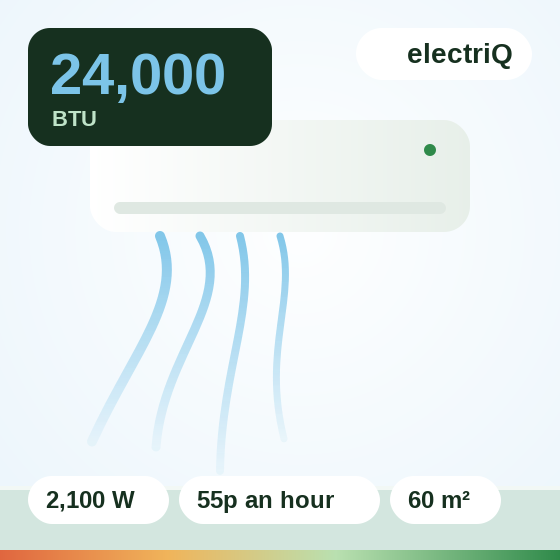
electriQ
iQool 24000 BTU WiFi Smart A++ Wall Mounted Split Air Conditioner with Heat Pump (iQool24)
24,000 BTU · 2,100 W · 55p an hour · 60 m²
£769.98 at Appliances Direct, checked 13 Nov 2026
See it at Appliances Direct
Figures from the maker or retailer listing. Cost an hour is our own, at the price cap of 26.32p a kWh.