Key takeaways
- This air conditioning running cost calculator will turn a unit’s watts (or a split’s label kWh), your unit rate and your hours into pounds per hour, per 8-hour night and per summer, with the sum written out. Until it is built, the worked examples below show the same sums.
- It will start with Ofgem’s Great Britain average of 26.32p per kWh for 1 October to 31 December 2026, and 350 hours for the summer. Change either to your own.
- Rule of thumb at that rate: every 1,000 W running for an hour costs 26.3p. A 2,000 W unit costs 52.6p an hour, £4.21 for 8 hours and £184.24 for 700 kWh.
- Rated watts are a full-power figure, so for an inverter unit the result is an upper estimate. The standing charge is left out.
Air conditioning running cost calculator
The calculator will work out what an air conditioner costs to run; the specification below is for the build, and the tool itself is built later. It is part of our air conditioning running costs guide, which has the same method and the tables for common types. It is designed to work in your browser, so nothing you type is meant to leave the page.
name: air-conditioning-running-cost-calculator
inputs:
  - unit: pick a product from the list (built from data/products files that have powerW or annualCoolingKwh), or type rated input power in watts
  - unitRatePence: default priceCap.pence from data/energy.json (26.32), shown with the cap period 1 October to 31 December 2026 beside it; the reader can type their own
  - hours: default hoursPerSummer 350 (about 8 hours a day for 44 days); the reader can type hours a day and number of days, or hours for the summer directly
outputs:
  - cost per hour, per 8-hour night and per summer, in pence below £1 and pounds above
  - kWh used over the summer
  - the sum written out under each figure, for example "0.7 kW x 26.32p = 18.4p an hour"
rules:
  - watts path: kW = watts / 1000; per hour = kW x rate; per night = per hour x 8; per summer = kW x hours x rate / 100
  - label path (split unit with annualCoolingKwh): per year = label kWh x rate / 100; per hour = label kWh / 350 x rate, and the page says "from the label"
  - formula-estimate path (split unit with SEER but no label kWh): kWh = cooling kW x 350 / SEER; the result is labelled "formula estimate"
  - rounding: pence to 1 decimal place, pounds to 2, kWh to 1; never round the rate before multiplying
  - show beside the result: "Great Britain average at the Ofgem price cap, 1 October to 31 December 2026. In Northern Ireland, use the unit rate on your own bill." and "The standing charge is not included."
  - when a product's rated power is used, show: "Rated power is a full-power figure. An inverter unit draws less once the room is cool."
no-javascript fallback: the worked examples table below
Without JavaScript, the table of worked examples below shows the same sums for the three models.
How the calculator works
It will use the same method as every cost on this site, in plain words:
- Watts to kilowatts. Take the unit’s rated input power in watts and divide by 1,000. Use input power (the electricity it draws), not the cooling capacity in BTU or kW, which is the heat it moves.
- Kilowatts to pence an hour. Multiply by your unit rate in pence per kWh. At 26.32p, 1 kW costs 26.32p for an hour.
- Night. Multiply the hourly cost by 8.
- Summer. Multiply the kW by the hours (350 by default) to get kWh, then by the unit rate, then divide by 100 for pounds.
- Split units with an energy label. If the label gives the yearly cooling kWh, the tool will multiply that by your rate for the year, and divide by 350 hours for the hourly figure. If the maker gives only the SEER, it will use cooling capacity in kW times 350 hours divided by the SEER, and call the result a formula estimate.
The tool will round pence to one decimal place, pounds to two and kWh to one. It will never round the unit rate before multiplying.
Why 350 hours? It is the number of cooling hours a year the legal energy label uses for split air conditioners: Regulation (EU) No 626/2011 as it applies in Great Britain, Annex VII, Table 4, lists 350 h/annum in cooling mode (legislation.gov.uk). The label does not use it for single-duct portables, so for a portable our standard summer of 350 hours is our own assumption. Either way it is roughly 8 hours a day for 44 days, not a forecast, and real use depends on the weather and your home. Change it to your own.
Why 26.32p? It is Ofgem’s average electricity unit rate under the energy price cap for customers in England, Scotland and Wales on a standard variable tariff paying by Direct Debit, for 1 October to 31 December 2026 (Ofgem). Ofgem says the rate does not include VAT. Separately, HMRC’s temporary zero rate of VAT on household electricity in Great Britain runs to 30 June 2027 (HMRC); Ofgem’s pages, written before Budget 2026 extended it, say 31 March 2027. Ofgem sets a new cap every three months, so the default will change.
Worked examples
All at 26.32p per kWh, the Ofgem price cap for 1 October to 31 December 2026, Great Britain average, 350 hours a summer and an 8-hour night.
| Model | Input | Per hour | Per 8-hour night | Per 350-hour summer | The sum |
|---|---|---|---|---|---|
| De’Longhi Pinguino PACEM90K.1 Silent (portable, A) | 1,000 W | 26.3p | £2.11 | 350 kWh, £92.12 | 1 kW x 26.32p = 26.3p; x 8 = £2.11; 350 kWh x 26.32p = £92.12 |
| De’Longhi Pinguino PACEX100 Silent (portable, A++) | 700 W | 18.4p | £1.47 | 245 kWh, £64.48 | 0.7 kW x 26.32p = 18.4p; x 8 = £1.47; 245 kWh x 26.32p = £64.48 |
| Mitsubishi Electric MSZ-LN25VG3 (split, A+++) | 2.5 kW cooling, SEER 10.5 | about 6.3p (average) | about 50.1p (average) | 83.3 kWh, £21.93 (formula estimate) | 2.5 kW x 350 h / 10.5 = 83.3 kWh; x 26.32p = £21.93; 83.3 / 350 = 0.24 kWh an hour = 6.3p |
| A unit you type in | 2,000 W | 52.6p | £4.21 | 700 kWh, £184.24 | 2 kW x 26.32p = 52.64p; x 8 = 421.12p; 700 kWh x 26.32p = £184.24 |
Model figures come from the makers’ UK pages: De’Longhi UK for the two portables and the Mitsubishi Electric UK product information sheet (February 2026) for the split, whose sheet gives no yearly kWh, hence the formula estimate. At its full rated input of 485 W the split would cost 12.8p an hour, which is the figure for flat-out running, not an average. Maker prices: from £529.99 (PACEM90K.1 Silent) and £759.99 (PACEX100 Silent) at De’Longhi UK, checked 14 November 2026, both out of stock.
For a printed label example: Daikin’s specification table gives 92 kWh a year for the Perfera FTXM25A with RXM25A, which at 26.32p is £24.21 a year (Daikin UK).
Where to find your numbers
- Watts. The rating plate on the unit, the manual or the maker’s specification sheet. Look for “rated input power” or “power consumption” in W or kW. Do not use the BTU or cooling kW figure. If the maker does not state it, write “Not stated by the maker” and do not guess.
- Yearly kWh for a split. The energy label, or the maker’s specification table. Labels for portables show kWh per hour instead.
- Your unit rate. Your bill or supplier account, in pence per kWh. Use the rate for the tariff you are on. If you are on a fixed tariff, Economy 7 or another time-of-use tariff, use the rate you pay at the time you run the unit. Ofgem publishes no average off-peak rate, so we quote none.
- Northern Ireland. The Ofgem cap covers England, Scotland and Wales only. In Northern Ireland the Utility Regulator regulates Power NI’s tariff and VAT on electricity stays at 5%, so use the rate on your own bill.
- Hours. Your own use. For a rough number, multiply hours a night by the nights you expect to use it.
Why your real cost may be lower
- Inverter units. Rated power is what the unit draws at full output at the test conditions: for split systems and other units with an outdoor part 35C outside and 27C indoors, and for single-duct portables 35C air on both sides (Regulation 626/2011, Annex VII, Table 2). An inverter slows down once the room is cool and draws less, so a wattage-based figure is an upper estimate for it.
- Cooler days. A unit working against a smaller gap between inside and outside runs less of the time. We give no per-degree saving, because we have not found a primary source for one. See the best temperature for air conditioning.
- Fewer hours than 350. Change the hours and the cost scales in proportion.
For fans and dehumidifiers, the same method works: see how much a fan costs to run and how much a dehumidifier costs to run. To pick a unit big enough for the room first, use our BTU calculator. Our best energy efficient air conditioners are chosen on running cost, and is air conditioning expensive to run? answers the yes or no.
Frequently asked questions
How do I work out what my air conditioner costs to run?
Divide its rated input power in watts by 1,000, then multiply by your unit rate in pence per kWh to get pence an hour. A 1,000 W unit at 26.32p costs 26.3p an hour. Multiply by the hours you run it.
Where do I find my air conditioner’s wattage?
On the rating plate, in the manual or on the maker’s specification sheet, as rated input power in W or kW. Use input power, not cooling capacity in BTU. If a maker does not state input power, the tool will not be able to give a reliable figure.
What unit rate should I use?
Your own, from your bill. The default of 26.32p is Ofgem’s Great Britain average for 1 October to 31 December 2026 for a standard variable tariff paid by Direct Debit. It changes every three months and differs by region, payment method and meter.
Why is the calculator’s figure higher than my bill?
Usually because the unit does not run at full power for every hour. Rated watts are a full-power figure, and an inverter unit draws less once the room is cool. You may also have used fewer hours than the 350 default, or have a cheaper tariff.
Does the calculator include the standing charge?
No, it will leave it out. The standing charge (54.83p a day at the October to December 2026 cap) is paid whether or not the air conditioner runs, so it is not part of the running cost.
Does it work in Northern Ireland?
It will, if you type your own unit rate from your Power NI or other supplier bill. The 26.32p default is a Great Britain figure, and electricity VAT in Northern Ireland is 5%.
Sources
- Ofgem: Changes to energy price cap between 1 October and 31 December 2026 (checked 14 November 2026)
- HMRC: VAT on fuel and power (VAT Notice 701/19), updated 28 October 2026 (checked 14 November 2026)
- legislation.gov.uk: Regulation (EU) No 626/2011, Annex VII, measurements and calculations (checked 14 November 2026)
- De’Longhi UK: Pinguino PACEM90K.1SILENT (checked 14 November 2026)
- De’Longhi UK: Pinguino PACEX100SILENT EX:2 (checked 14 November 2026)
- Mitsubishi Electric UK: MSZ-LN R32 product information sheet, February 2026 (PDF) (checked 14 November 2026)
- Daikin UK: FTXM-A and RXM-A9 specifications table (checked 14 November 2026)
Products on this page
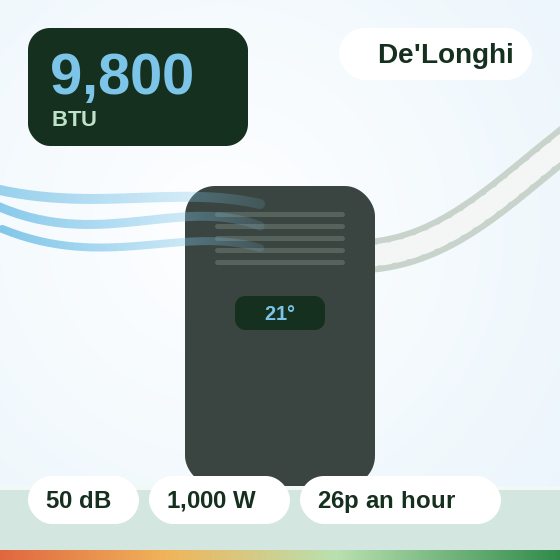
De'Longhi
Pinguino EM Series PACEM90K.1SILENT
9,800 BTU · 50 dB · 1,000 W · 26p an hour
£529.99 at De'Longhi UK (maker shop), checked 14 Nov 2026
See it at De'Longhi UK (maker shop)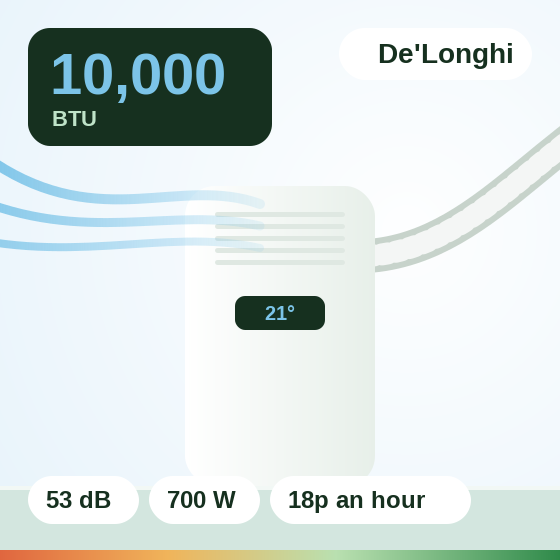
De'Longhi
Pinguino 100 Silent PACEX100SILENT EX:2
10,000 BTU · 53 dB · 700 W · 18p an hour
£759.99 at De'Longhi UK (maker shop), checked 14 Nov 2026
See it at De'Longhi UK (maker shop)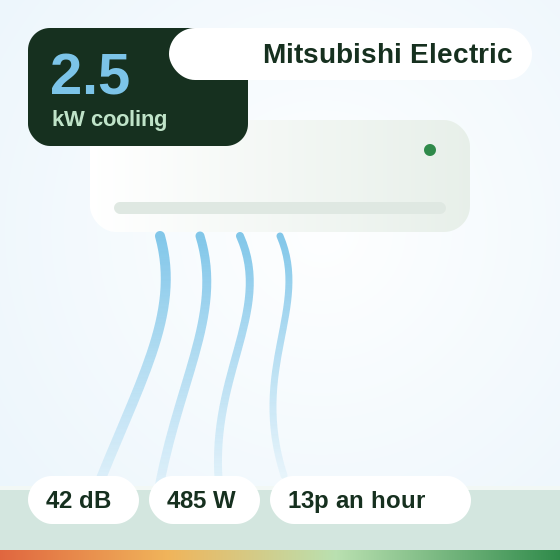
Mitsubishi Electric
MSZ-LN25VG3 (indoor) with MUZ-LN25VG3 (outdoor), 2.5 kW
2.5 kW cooling · 42 dB · 485 W · 13p an hour
No current UK price found
Figures from the maker or retailer listing. Cost an hour is our own, at the price cap of 26.32p a kWh.